

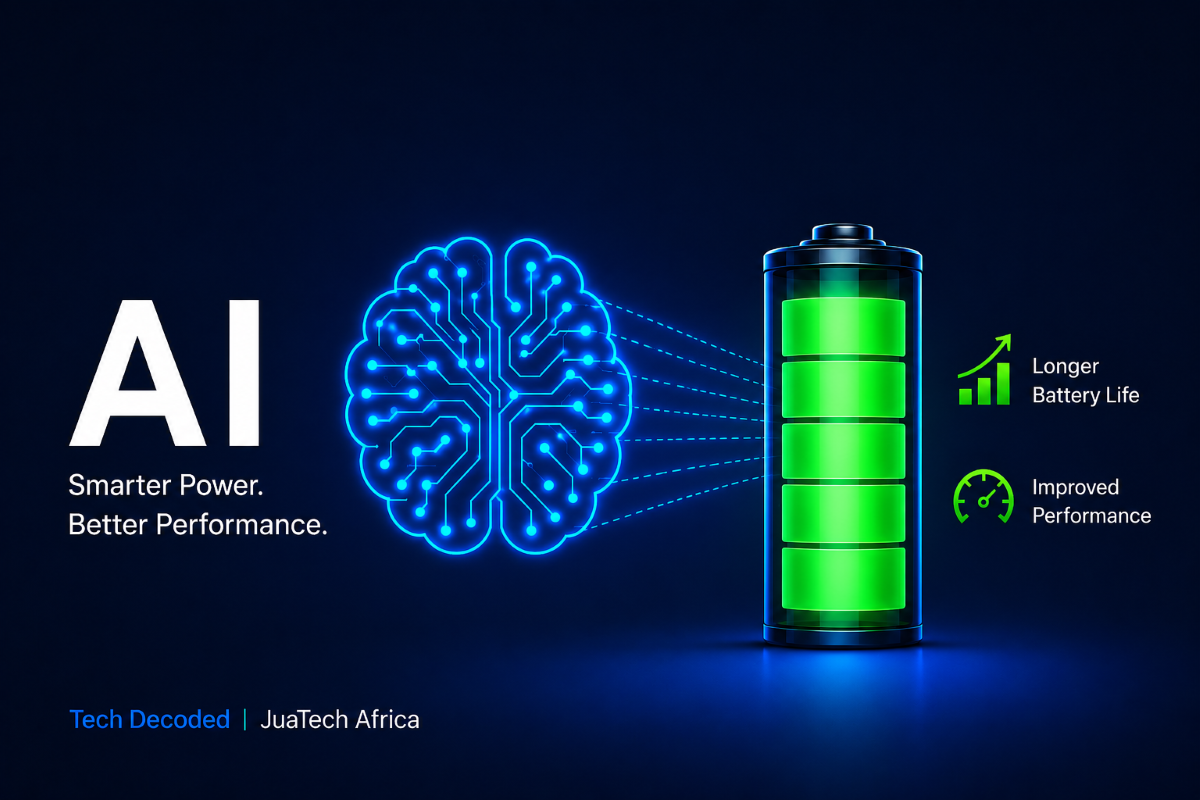
Artificial intelligence has become one of the most important technologies enabling modern smartphone efficiency. While AI is commonly associated with cameras, voice assistants, and translation, its most critical and constant role is invisible. AI continuously optimizes the operation of the processor, memory, network, and power systems to maximize performance while minimizing battery consumption.
Without AI-driven optimization, modern smartphones would experience significantly shorter battery life, slower performance, higher heat generation, and faster battery degradation.

AI enables smartphones to adapt to user behavior dynamically, intelligently allocate processing resources, prevent unnecessary power consumption, and maintain stable performance across different workloads.
This is why newer smartphones often deliver longer battery life and faster performance, even when battery capacity remains similar to previous generations.
Understanding how AI improves battery life and performance explains how modern smartphones achieve efficiency, responsiveness, and long-term reliability.
Quick Definition: AI-Driven Power and Performance Optimization
AI power optimization refers to machine learning algorithms running continuously on the smartphone that intelligently manage processor usage, background activity, memory allocation, network communication, and charging behavior to maximize efficiency and performance.
These algorithms run primarily on the Neural Processing Unit, or NPU, which is designed to perform machine learning tasks efficiently with minimal power consumption.
AI continuously learns from usage patterns and dynamically adjusts system behavior in real time.
This improves both battery life and performance stability.
The Core Engineering Challenge: Performance vs Power Consumption
Smartphones must balance two competing requirements:
- High performance
- Low power consumption
Higher performance requires increased processor activity, which consumes more energy.
Higher energy consumption reduces battery life and generates heat.
Every smartphone task consumes energy, including:
- Opening apps
- Running games
- Processing camera images
- Using mobile data
- Running background services
Without intelligent optimization, battery life would decrease significantly.
AI solves this problem through dynamic resource management.
The Hardware Foundation: Where AI Runs Inside Your Smartphone
Specialized processors within modern smartphone chipsets enable AI optimization.
The key processors include:
| Processor | Role in AI optimization |
| NPU | Executes AI models efficiently |
| CPU | Handles general system coordination |
| GPU | Assists with parallel processing tasks |
| ISP | Uses AI for camera and image processing |
| Modem | Optimizes network efficiency |
The NPU is specifically designed for power-efficient machine learning. It can perform billions of AI calculations per second while consuming minimal power. This enables continuous optimization without draining the battery.
How AI Learns Your Smartphone Usage Patterns
AI continuously observes and learns how you use your smartphone. This includes:
- Which apps do you use most frequently
- Which apps do you rarely use
- When you typically use your phone
- When your phone is idle
- How long have you used specific apps
AI builds a usage profile based on behavior patterns. This allows the system to predict future usage. AI uses this predictive capability to optimize power allocation
AI Limits Background Activity to Reduce Battery Drain
One of the largest sources of battery drain is background processes. Apps may continue running even when not actively used. These processes consume:
- CPU cycles
- RAM
- Network bandwidth
- Battery power
AI identifies rarely used apps and restricts their background activity. This prevents unnecessary energy consumption.
Frequently used apps remain fully optimized for performance. Rarely used apps are restricted. This improves overall efficiency.
AI Optimizes CPU Core Usage for Maximum Efficiency
Modern smartphone CPUs use a heterogeneous core architecture. This includes:
| Core type | Purpose | Power consumption |
| Efficiency cores | Background and light tasks | Lowest |
| Performance cores | Moderate workloads | Medium |
| Prime core | Heavy workloads | Highest |
AI intelligently assigns tasks to appropriate cores.
- Light tasks use efficiency cores.
- Heavy tasks use performance cores.
- Demanding workloads use the prime core.
This ensures power is used efficiently. It prevents unnecessary energy consumption.
AI Dynamically Adjusts CPU Frequency and Voltage
AI continuously monitors workload intensity and dynamically adjusts CPU frequency and voltage to match performance demand. CPU power consumption increases exponentially as clock speeds and voltage rise, so running the processor at maximum speed when it is not necessary wastes energy and generates excess heat. To prevent this, AI ensures the processor operates at the lowest power level required to complete the current task efficiently. This process, known as dynamic voltage and frequency scaling, allows the smartphone to deliver the required performance while minimizing energy consumption. By managing this process in real time, AI improves battery efficiency, reduces heat generation, and maintains stable performance without unnecessary power usage.
AI Optimizes GPU Usage for Gaming and Graphics
AI continuously monitors GPU workload in real time and dynamically adjusts its performance based on actual graphical demand. The GPU is one of the most power-intensive components, especially during gaming, video playback, and graphics rendering. Running the GPU at maximum power when full performance is not required wastes energy and generates unnecessary heat. AI prevents this by scaling GPU frequency and power usage to match the current workload precisely. This ensures the GPU delivers smooth graphics and stable frame rates while minimizing power consumption. As a result, AI improves battery life, enhances thermal efficiency, and maintains consistent performance without unnecessary energy use.
AI Improves Memory and RAM Efficiency
RAM consumes power continuously while active.
Poor RAM management increases energy consumption and reduces performance.
AI optimizes memory allocation by:
- Prioritizing active apps
- Closing unnecessary background apps
- Preventing memory overload
This improves multitasking efficiency. It reduces the processor workload.
This improves both performance and battery life.
AI Optimizes Network Power Consumption
Wireless communication is one of the most power-intensive operations on smartphones.
The cellular modem consumes significant power when transmitting data.
AI reduces network power consumption by:
- Limiting background data usage
- Optimizing synchronization timing
- Reducing unnecessary network activity
This improves battery efficiency.
AI Enables Adaptive Battery Technology
Adaptive Battery is a system powered by AI. It analyzes usage patterns and adjusts power allocation accordingly.
Apps are categorized into usage tiers:
- Active apps
- Frequently used apps
- Rarely used apps
Rarely used apps receive limited system resources. This improves efficiency.
Battery life improves over time as AI learns usage patterns.
AI Improves Charging Efficiency and Battery Lifespan
Lithium-ion batteries degrade faster when exposed to high heat, sustained high voltage, and aggressive charging patterns. Charging a battery rapidly to 100 percent and keeping it at full charge for extended periods accelerates chemical wear and reduces long-term capacity. To address this, modern smartphones use AI-driven adaptive charging, which intelligently controls charging speed and timing based on your usage habits.
AI learns when you typically charge your phone and when you are likely to unplug it. Instead of charging to 100 percent immediately, the system may pause charging at around 80 percent and complete the remaining charge closer to the time you normally start using the device. This reduces the time the battery remains under high-voltage stress, which is one of the primary causes of long-term degradation.
By slowing charging when full capacity is not immediately needed and completing it at the optimal time, AI minimizes heat generation, reduces chemical stress inside the battery, and preserves battery health. This intelligent charging management extends overall battery lifespan, maintains higher battery capacity over time, and ensures consistent performance throughout the device’s usable life.
AI Reduces Heat Generation and Improves Thermal Efficiency
Heat is one of the most damaging factors affecting smartphone performance, efficiency, and long-term battery health. Excessive heat reduces processor efficiency, accelerates battery degradation, and forces the system to lower performance to prevent hardware damage. This performance reduction is known as thermal throttling, and it directly affects gaming, multitasking, and sustained workloads.
AI helps prevent this by continuously monitoring processor workload, temperature levels, and system activity in real time. It intelligently distributes tasks across efficiency cores and performance cores, adjusts processor frequency, and limits unnecessary background activity to reduce power consumption. Since heat is directly related to power usage, reducing unnecessary workload lowers heat generation at the source.
By maintaining optimal operating temperatures, AI improves thermal efficiency, allowing the processor and GPU to sustain higher performance for longer periods without throttling. This results in smoother gameplay, more stable performance, improved energy efficiency, and a longer battery life, especially during demanding tasks.
AI Improves App Launch Speed and Overall System Responsiveness
AI continuously learns your usage patterns and predicts which apps you are most likely to open based on time of day, location, and historical behavior. Using this predictive intelligence, the system preloads frequently used apps and their essential data into RAM before you even open them. Because the app is already partially prepared in memory, the processor does not need to load everything from storage at launch.
This significantly reduces app launch time, making the device feel faster and more responsive. Instead of waiting for the system to locate, load, and initialize the app, it opens almost instantly. AI also prioritizes system resources for active and predicted tasks, ensuring smooth multitasking and minimizing delays. This intelligent resource management improves overall responsiveness, reduces perceived lag, and delivers a faster, more fluid user experience across the entire system.
AI Improves Long-Term Battery Health and Extends Device Lifespan
Battery degradation is an unavoidable chemical process, but operating conditions heavily influence its speed. The three most damaging factors are excessive heat, prolonged exposure to high voltage levels, and inefficient or aggressive charging patterns. These conditions accelerate internal chemical wear, permanently reducing the battery’s ability to hold a charge and deliver stable power.
AI helps protect battery health by actively managing these stress factors. It monitors temperature, charging behavior, and power consumption patterns in real time, then adjusts processor activity, charging speed, and background processes to reduce unnecessary heat and electrical stress. AI-driven adaptive charging prevents the battery from remaining at peak voltage for extended periods, while intelligent workload distribution reduces thermal buildup during heavy use.
By minimizing heat exposure, controlling charging stress, and optimizing overall power efficiency, AI significantly slows battery degradation. This preserves battery capacity for longer, maintains consistent performance, and improves overall device reliability. As a result, smartphones retain usable battery life longer and deliver a more stable experience throughout their lifespan.
Why New Smartphones Have Better Battery Life Even with Similar Battery Size
Battery capacity, measured in milliampere-hours (mAh), determines how much energy a battery can store, but it does not determine how efficiently that energy is used. Two smartphones with the same battery capacity can deliver very different battery life depending on how efficiently their hardware and software manage power consumption.
Modern smartphones achieve longer battery life primarily through AI-driven efficiency improvements. AI continuously monitors how the processor, GPU, display, and background apps use power, then dynamically adjusts system behavior to minimize unnecessary energy consumption. It intelligently assigns tasks to low-power efficiency cores when possible, restricts unused apps from running in the background, and optimizes network and memory usage. This ensures that energy is used only where and when it is needed.
As a result, newer smartphones can deliver significantly longer battery life without increasing battery size. These efficiency gains are driven largely by AI optimization working alongside more advanced chipsets and power management systems. Instead of relying solely on larger batteries, modern devices use intelligent power management to extend battery life, improve thermal efficiency, and deliver consistent performance throughout the day.
Real-World Example: AI Optimization in Modern Smartphone Chipsets
Modern smartphone chipsets integrate powerful NPUs. These processors continuously monitor system activity. They optimize performance and power consumption in real time.
This enables:
- Longer battery life
- Faster performance
- Improved thermal efficiency
AI is now essential to smartphone efficiency.
Final Verdict: How AI Improves Battery Life and Performance
Artificial intelligence is now a core system technology that enables modern smartphone efficiency at every level of operation. It extends battery life by intelligently managing processor activity, limiting unnecessary background processes, optimizing memory usage, and reducing inefficient network and hardware behavior. At the same time, AI improves performance by dynamically allocating system resources, predicting user needs, and ensuring the CPU, GPU, and memory operate at optimal efficiency for each task.
This intelligent, real-time optimization allows smartphones to deliver fast, responsive performance while minimizing energy consumption, heat generation, and long-term battery wear. As smartphone hardware becomes more powerful and complex, AI has become essential for maintaining efficiency, stability, and reliability. Without AI-driven power and performance management, modern smartphones would not be able to deliver the battery life, responsiveness, and sustained performance that users now expect.
SEO Metadata
Focus keyphrase: how AI improves battery life and performance