

In the early days of AI on smartphones, AI features largely operated as tools users had to activate manually. You circled an object to search for it. You tapped a button to translate a conversation. You opened a separate app to generate text or edit photos. Artificial intelligence behaved like a feature that waited quietly until the user requested help.
By 2026, that model will have fundamentally changed.

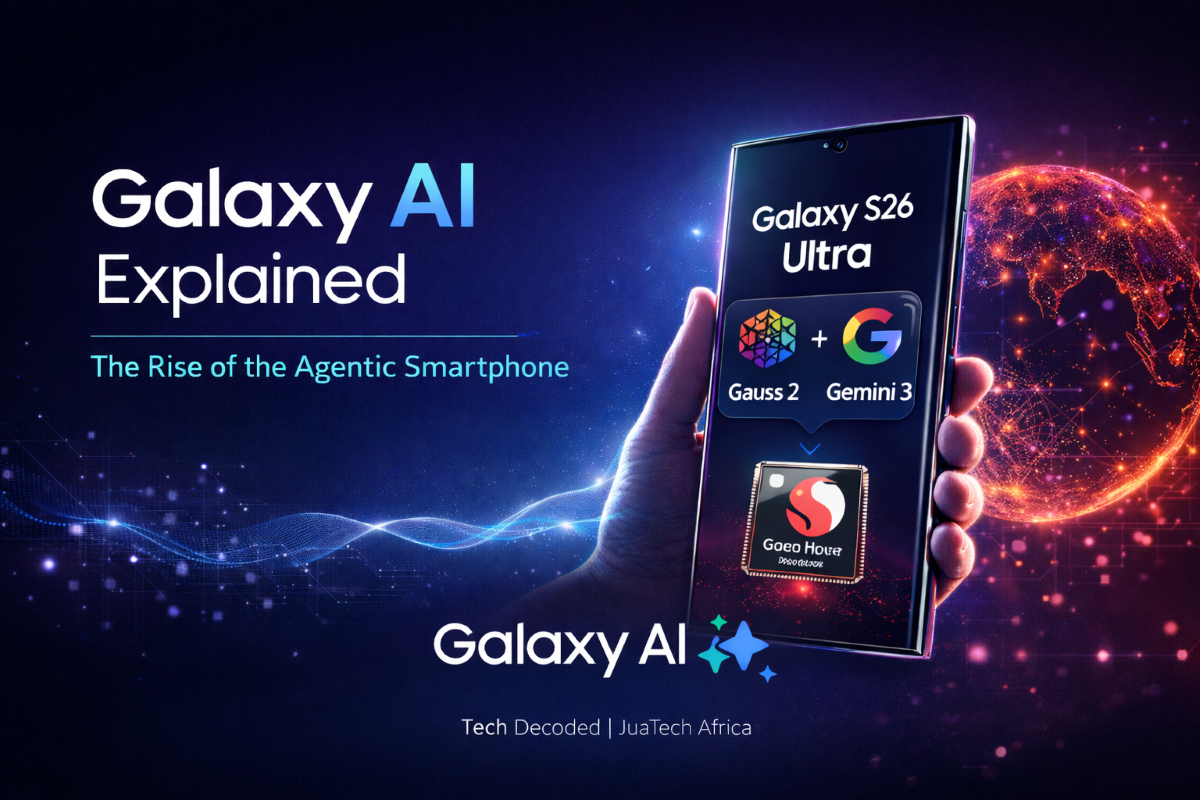
With the arrival of the Galaxy S26 series, Samsung has pushed mobile AI into a new phase that industry analysts now describe as the Agentic Smartphone Era. Instead of waiting for commands, Galaxy AI is increasingly designed to anticipate user needs, analyze context, and offer assistance before the user explicitly asks for it.
This shift transforms the smartphone from a passive tool into an intelligent digital companion capable of interpreting context, anticipating intent, and automating complex workflows.
At the center of this transformation is Galaxy AI, Samsung’s multi-layer artificial intelligence framework that combines on-device machine learning with powerful cloud-based AI models.
For readers of JuaTech Africa, the significance of Galaxy AI goes far beyond flashy software features. The true story is the massive shift happening inside smartphone hardware. Delivering real-time AI capabilities requires specialized processors, faster memory architectures, and advanced thermal management systems.
Without these hardware innovations, the concept of an “always-on AI agent” would quickly drain the device’s battery and cause it to overheat.
Samsung’s 2026 flagship smartphones, therefore, represent more than incremental upgrades. They illustrate the beginning of a new generation of AI-native mobile devices.
Explore AI & Emerging Technology, Master Guide.
Tech Decoded Summary: Galaxy AI Architecture
| Component | Role | Why It Matters |
| Samsung Gauss 2 | Local AI model running on device | Enables private and offline AI capabilities |
| Gemini 3 Integration | Cloud-based reasoning model | Handles complex AI tasks |
| Snapdragon 8 Elite Gen 5 | AI-optimized mobile processor | Delivers high-performance on-device AI |
| Agentic Interface | Proactive AI interactions | Predicts user needs |
| On-Screen Awareness | Real-time contextual analysis | Enables smart suggestions |
The Hybrid AI Core: Samsung Gauss 2 and Google Gemini
One of Galaxy AI’s defining characteristics is its multi-model architecture. Instead of relying entirely on a single AI system, Samsung has built a hybrid ecosystem that combines its proprietary models with Google’s large-scale AI infrastructure.
This dual approach allows Samsung devices to balance privacy, performance, and computational scale.
At the center of the local AI system is Samsung Gauss 2, the company’s next-generation multimodal artificial intelligence model. Gauss 2 is designed to run directly on the device, enabling the smartphone to perform many AI tasks without sending data to external servers.
The model is deployed in three configurations based on the device’s performance.
| Model Variant | Function |
| Gauss Compact | Lightweight on-device tasks |
| Gauss Balanced | Mixed AI workloads |
| Gauss Supreme | High-performance AI processing |
The Compact version is optimized for efficiency and runs continuously in the background to power everyday features such as real-time translation, voice recognition, and contextual notifications.
For more complex tasks that require deeper reasoning or access to external information, Galaxy AI relies on Google’s Gemini 3 platform.
Gemini operates in the cloud and provides powerful reasoning capabilities that exceed what a smartphone can handle locally. Tasks such as multi-step automation, advanced content generation, or complex search queries are seamlessly routed to Gemini’s infrastructure.
This hybrid architecture allows Galaxy AI to deliver both privacy-focused on-device intelligence and powerful cloud-based reasoning when needed.
Hardware Foundation: The Snapdragon 8 Elite Gen 5
Delivering agentic AI capabilities requires more than powerful software models. It demands a new generation of smartphone processors designed specifically for artificial intelligence workloads.
The Snapdragon 8 Elite Gen 5 for Galaxy, introduced with the Galaxy S26 series, represents one of the most advanced AI processors ever integrated into a mobile device.
The chipset features a significantly upgraded Neural Processing Unit (NPU) that delivers approximately 39% higher AI performance compared to the previous generation.
This improvement enables the phone to perform tasks such as:
- real-time language translation
- contextual content recognition
- background AI automation
- live object detection
without significantly impacting battery life.
AI Processing Architecture
| Processing Unit | Function |
| CPU | General system tasks |
| GPU | Graphics and image processing |
| NPU | AI inference and machine learning |
| ISP | Camera and visual intelligence |
The NPU is particularly important for features that rely on continuous context analysis.
One example is Now Nudge, a system that analyzes the content displayed on the screen and surfaces relevant suggestions in real time.
If a user receives a message about a planned trip, the device might immediately suggest flight details stored in the calendar or relevant photos from the gallery.
Thermal Engineering and the AI Heat Problem
Running advanced AI models on a smartphone creates significant thermal challenges.
AI inference workloads can generate intense bursts of computational activity, which in turn produces heat. If this heat is not properly managed, the device may throttle its performance to avoid overheating.
Samsung addressed this issue in the Galaxy S26 series by redesigning the vapor chamber cooling system.
The updated thermal architecture uses a larger vapor chamber combined with an improved thermal interface material that distributes heat more evenly across the device’s internal structure.
This design allows the smartphone to sustain AI workloads for longer periods without performance degradation.
The Agentic User Experience
The most visible change introduced by Galaxy AI is the transition from reactive features to proactive intelligence.
Traditional smartphone AI features typically require user input before performing any action. Galaxy AI is designed to observe context and automatically provide suggestions.
Two of the most prominent examples of this new interface paradigm are Now Nudge and Now Brief.
Now Nudge operates as a contextual suggestion engine. It monitors the user’s current activity and surfaces relevant information or shortcuts when appropriate.
For example, if a user is discussing travel plans in a messaging app, the system may suggest calendar entries, booking confirmations, or relevant photos.
Now Brief functions as a personalized intelligence dashboard that summarizes key information from multiple sources throughout the day. It can present weather updates, schedule reminders, and important notifications in a unified interface.
Key Galaxy AI Features
| Feature | Description |
| Now Nudge | Context-aware suggestions |
| Now Brief | Daily AI summary dashboard |
| Circle to Search | Visual search capability |
| Live Translation | Real-time language interpretation |
| Generative Edit | AI-powered photo editing |
These features illustrate Samsung’s broader vision for mobile AI. The smartphone becomes a personal intelligence hub that continuously interprets context and proactively assists the user.
Privacy Innovation: AI-Powered Privacy Display
Another notable innovation introduced in the Galaxy S26 series is Privacy Display, a feature that combines hardware sensors with AI algorithms to protect sensitive information.
The system uses the phone’s front-facing camera and AI detection algorithms to determine whether someone other than the user is looking at the screen.
If the AI detects a second set of eyes viewing the display from the side, the phone automatically narrows the screen’s viewing angle to prevent visual snooping.
This feature is particularly useful for professionals who frequently work with confidential information in public environments such as airports, cafes, or offices.
The Evolution of Bixby
Samsung’s long-standing digital assistant, Bixby, has also undergone a significant transformation as part of the Galaxy AI ecosystem.
Earlier versions of Bixby focused primarily on voice commands and device control. The new iteration functions more like a conversational AI agent, capable of understanding complex natural-language instructions.
Users can issue multi-step commands such as adjusting system settings while launching applications or managing device automation routines.
For example, a user might say:
“Bixby, reduce the screen brightness, turn on privacy mode, and open my notes app.”
The assistant can interpret the intent behind the command and execute the sequence without requiring multiple separate interactions.
Hardware Realities: The Memory Requirement
Running advanced AI models locally requires significant system memory.
Because the Gauss 2 Compact model resides in system RAM, Galaxy AI devices must continuously allocate memory to support background AI processes.
This creates what analysts often refer to as the AI memory tax.
The smartphone must maintain sufficient memory capacity to support both user applications and AI models simultaneously.
RAM Requirements for AI Smartphones
| RAM Configuration | AI Performance |
| 8 GB | Limited multitasking |
| 12 GB | Standard AI performance |
| 16 GB | Optimal agentic AI experience |
For power users who frequently run multiple applications simultaneously, the 16 GB configuration available in the Galaxy S26 Ultra becomes particularly valuable.
The Future of Mobile Intelligence
The transition toward agentic smartphones represents a fundamental shift in the role of mobile devices.
Instead of functioning purely as communication tools, smartphones are becoming personal intelligence systems capable of interpreting context, automating tasks, and assisting users proactively.
As AI models continue to improve and mobile hardware becomes more specialized for machine learning workloads, the distinction between cloud intelligence and device intelligence will continue to blur.
The smartphone may become the primary interface through which individuals interact with artificial intelligence in their daily lives.
JuaTech Africa Verdict: The Aggregator Advantage
Galaxy AI distinguishes itself from competing mobile AI platforms through its flexible ecosystem approach.
Instead of locking users into a single assistant or AI provider, Samsung allows multiple AI services to coexist on the device.
Users can choose between Bixby, Gemini, and even third-party AI assistants such as Perplexity, depending on their preferred workflow.
This flexibility gives Galaxy AI what can be described as the aggregator advantage.
The platform is not tied to a single intelligence provider. Instead, it acts as a bridge connecting multiple AI systems into a unified mobile experience.
For users who value flexibility and advanced AI capabilities, this multi-model ecosystem may prove to be one of the most compelling advantages of Samsung’s flagship devices.
Frequently Asked Questions About Galaxy AI
- What is Galaxy AI?
Galaxy AI is Samsung’s integrated artificial intelligence platform that combines on-device AI models with cloud-based AI services to deliver intelligent features across the Galaxy ecosystem.
- Which phones support Galaxy AI?
Galaxy AI is currently supported on Samsung’s flagship devices, including the Galaxy S25 and Galaxy S26 series, as well as select premium Galaxy tablets.
- What makes Galaxy AI different from other smartphone AI systems?
Galaxy AI uses a hybrid architecture combining Samsung’s Gauss models with Google’s Gemini AI, enabling both private on-device processing and powerful cloud-based intelligence.
- Does Galaxy AI require internet connectivity?
Many Galaxy AI features run directly on the device and do not require internet access. However, advanced tasks that require large-scale AI reasoning may rely on cloud connectivity.
- Is Galaxy AI safe for private data?
Samsung provides a setting called “Process Data Only on Device” that allows users to restrict certain AI tasks to local processing.
- What is an agentic smartphone?
An agentic smartphone is a device that uses artificial intelligence to proactively assist users by predicting needs and automating tasks without explicit commands.
- Does Galaxy AI impact battery life?
AI workloads consume additional power, but modern chipsets such as the Snapdragon 8 Elite Gen 5 include specialized AI processors that improve efficiency.
- Can Galaxy AI replace traditional apps?
Galaxy AI is designed to enhance apps rather than replace them. It integrates AI features into existing workflows to speed up tasks and make them more intuitive.
- What role does Gemini play in Galaxy AI?
Gemini provides powerful cloud-based AI capabilities that complement Samsung’s on-device Gauss AI models.
- Is Galaxy AI the future of smartphones?
Many analysts believe that the integration of proactive AI assistants will define the next generation of mobile computing.
Subscribe to our Newsletter and JuaTech Africa WhatsApp Official Platform for timely updates of our articles and insights in the Mobile Tech Industry.