

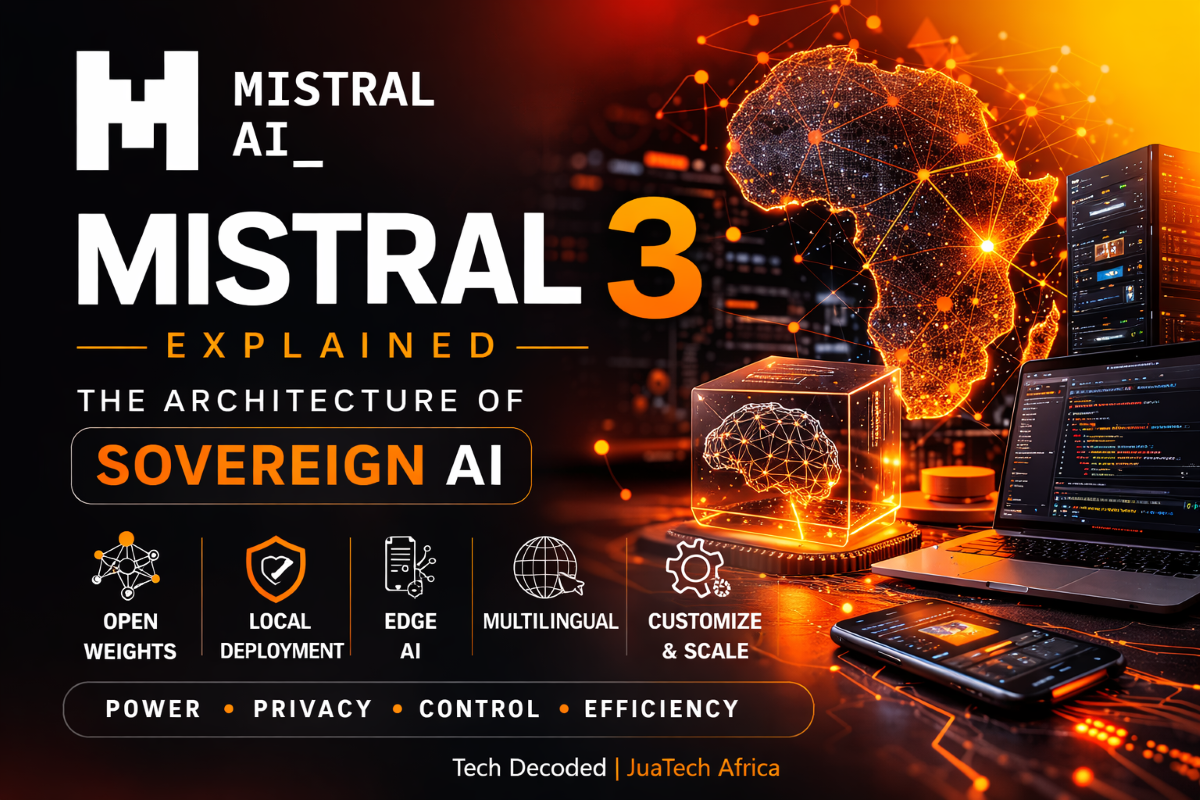
A deep dive into how Mistral AI’s open-weight models, edge-optimized architecture, and multilingual intelligence are redefining sovereign artificial intelligence for developers, enterprises, and emerging digital economies.
The global race for artificial intelligence leadership is usually framed as a contest between two dominant technology ecosystems. On one side stands Silicon Valley with companies such as OpenAI, Google, and Anthropic pushing the boundaries of large-scale AI models. On the other side, China continues to develop powerful systems backed by large national technology firms and extensive state investment.

In the middle of this increasingly polarized landscape, a third philosophy has begun to gain serious traction. This approach prioritizes independence, transparency, and local control over computational intelligence. At the center of this alternative vision stands Mistral AI, a European company that has rapidly emerged as one of the most influential players in open artificial intelligence.
Mistral’s design philosophy is built around a simple but powerful principle. Artificial intelligence should not require organizations to surrender control over their infrastructure or their data. Instead of forcing developers and institutions to rely entirely on centralized cloud platforms controlled by large technology corporations, Mistral builds models that can be deployed locally, inspected openly, and customized freely.
For the African technology ecosystem, this distinction is extremely important. Across the continent, sectors such as financial technology, digital government services, healthcare innovation, and agricultural technology are undergoing rapid digital transformation. These sectors increasingly depend on data-driven intelligence systems to automate operations, analyze data, and support decision-making.
However, many organizations face a critical constraint when adopting artificial intelligence solutions. Sensitive information often cannot be transmitted to external servers located in foreign jurisdictions. Regulatory frameworks, privacy concerns, and cybersecurity risks require institutions to maintain strict control over their data environments.
Mistral’s architecture addresses this challenge directly. Its models are designed to be portable, open-source, and deployable within local infrastructure, enabling organizations to build powerful AI systems without sacrificing sovereignty.
For developers and organizations across Africa, this represents something far more significant than another AI model release. It represents the emergence of Sovereign AI, a model of artificial intelligence where institutions retain full control over their intelligence infrastructure while still benefiting from frontier-level capabilities.
Explore JuaTech Africa’s Tech Decoded – AI & Emerging Technologies Master Guide.
Tech Decoded Quick Summary
| Core Feature | Technical Meaning | Practical Impact |
| Open-Weight Models | Model parameters can be downloaded and deployed locally | Full control over infrastructure and data |
| Sliding Window Attention | Efficient architecture for long-context processing | Lower computing cost |
| Ministral Models | Small language models for mobile and edge devices | Enables offline AI |
| Multilingual Training | Built for multilingual environments | Strong performance in non-English languages |
| Quantization Support | Models can be compressed to run on smaller hardware | Accessible AI deployment |
Open-Weight AI: Beyond the Black Box
A defining feature of the Mistral ecosystem is its commitment to open-weight artificial intelligence models.
Most modern AI systems operate as closed platforms. Developers interact with them through APIs, sending prompts to remote servers and receiving generated responses in return. While this model simplifies deployment, it also introduces several limitations. Developers cannot inspect how the model works internally, customize it deeply, or guarantee that sensitive data remains within their infrastructure.
Open-weight models fundamentally change this dynamic.
When an AI model is released with open weights, developers gain access to the parameters that define how the neural network processes information. This allows organizations to run the model on their own servers, fine-tune its behavior, and integrate it directly into their internal systems.
The implications of this approach are particularly significant for sectors that handle sensitive information.
A financial institution in Nairobi could deploy Mistral Large 3 inside its internal infrastructure and fine-tune the model using datasets related to Kenyan financial regulations and compliance frameworks. Because the model runs locally, customer transaction data never leaves the organization’s secure environment.
Similarly, a healthcare research institution could train a model using anonymized medical datasets while complying with privacy laws.
This level of control allows organizations to treat artificial intelligence as internal infrastructure rather than an outsourced service.
Mistral vs Closed AI Platforms
| Capability | Mistral AI | Typical Closed AI Platforms |
| Model Transparency | Open weights | Hidden architecture |
| Data Control | Fully local deployment | Data processed remotely |
| Customization | Deep fine-tuning possible | Limited |
| Infrastructure Ownership | Organization controls deployment | Provider controls the environment |
| Long-Term Cost | Infrastructure investment | Ongoing API fees |
This difference is the foundation of Mistral’s value proposition. Instead of renting intelligence from global providers, organizations can own and operate their AI systems independently.
Architectural Efficiency: Sliding Window Attention and GQA
High-performance language models typically require enormous computational resources. Transformer architectures must process large volumes of text simultaneously, which can lead to high memory requirements and high operating costs.
Mistral addresses this challenge through architectural innovations designed to improve efficiency without sacrificing performance.
One of the most important innovations is Sliding Window Attention. Instead of processing an entire sequence of text simultaneously, the model analyzes overlapping segments of information. Each segment provides sufficient context for accurate reasoning while significantly reducing the computational burden.
This approach allows Mistral models to handle long documents efficiently without requiring massive GPU clusters.
Another key optimization is Grouped Query Attention (GQA). Traditional transformer models use multiple independent query heads to process contextual relationships within text. GQA allows several query heads to share computational components, reducing memory usage while maintaining reasoning performance.
These optimizations enable Mistral models to compete with much larger systems while operating on comparatively modest hardware.
For developers and organizations operating outside large data center environments, this efficiency can dramatically reduce the cost of deploying AI solutions.
The Ministral Era: Artificial Intelligence at the Edge
One of the most transformative developments in the Mistral ecosystem arrived with the introduction of the Ministral model family.
Ministral models represent a new generation of small language models optimized for edge computing environments. Instead of running exclusively on large cloud servers, these models are designed to operate on smartphones, tablets, IoT devices, and embedded systems.
Two prominent models in this family include Ministral 3B and Ministral 8B.
These models demonstrate that powerful AI capabilities no longer require massive centralized infrastructure.
When deployed on modern devices equipped with neural processing units, Ministral models can perform tasks such as document summarization, scheduling assistance, natural language interaction, and offline knowledge retrieval.
Because these systems operate locally, they offer several critical advantages. They do not require constant internet connectivity, provide extremely low-latency responses, and ensure that sensitive user data remains on the device.
Edge AI Applications in Emerging Markets
| Sector | Potential Application |
| Agriculture | AI-powered crop monitoring systems |
| Healthcare | Portable diagnostic analysis tools |
| Industrial Systems | Real-time equipment monitoring |
| Education | Offline tutoring and learning assistants |
In regions with inconsistent internet connectivity, edge-based AI offers a transformative opportunity.
Multilingual Intelligence for the Global South
Many artificial intelligence systems have historically been trained primarily on English-language datasets. While these systems can process other languages through translation layers, their performance often declines when handling multilingual inputs.
Mistral models were designed with multilingual training as a core objective. Their datasets include a broad representation of languages beyond English, including several commonly used across Africa.
In addition to multilingual training, Mistral employs a tokenizer optimized for non-English languages.
Tokenization determines how text is broken into smaller units that the model can process. When tokenization is inefficient, languages with longer words or more complex grammar require more tokens to represent the same content.
Because tokenization directly affects computational cost, inefficient tokenization can significantly increase the cost of AI applications in multilingual environments.
Mistral’s tokenizer reduces this inefficiency, allowing languages such as Swahili and French to be processed using fewer tokens.
This translates directly into lower computational costs and improved performance for multilingual applications.
Developer Portability and Quantization
Another important strength of the Mistral ecosystem lies in its portability. The models are designed to integrate easily with open-source AI deployment frameworks such as vLLM and Ollama.
These tools allow developers to run models locally without relying on external cloud infrastructure.
A particularly important technique used in this process is quantization.
Quantization compresses a neural network by reducing the precision of its parameters. By reducing numerical precision, developers can dramatically reduce the memory required to run the model.
Quantization and Hardware Requirements
| Precision | Typical Hardware Requirement | Use Case |
| 16-bit | High-end GPU clusters | Model training |
| 8-bit | Mid-range GPUs | Production inference |
| 4-bit | Consumer laptops | Local development |
Through quantization, developers can run powerful language models on hardware that would otherwise be unable to support large AI systems.
Customization Through LoRA Fine-Tuning
Another powerful capability supported by Mistral models is LoRA fine-tuning. LoRA, which stands for Low-Rank Adaptation, allows developers to fine-tune an existing language model using relatively small datasets. Instead of retraining the entire model from scratch, developers can attach a lightweight layer that adapts the model’s knowledge to a specific domain.
This approach dramatically reduces the cost and complexity of creating specialized AI systems. For example, a developer could train a model to understand Kenyan tax law, regional agricultural best practices, or specific healthcare protocols.
The result is a customized AI system capable of providing expert-level responses in a specific domain without the massive resources typically required for training large language models.
JuaTech Africa Verdict: The Sovereign AI Strategy
Mistral 3 represents a fundamentally different vision for artificial intelligence. Instead of concentrating power within centralized cloud providers, it distributes intelligence across organizations that wish to operate their own AI infrastructure.
For governments and financial institutions, this architecture offers a pathway to adopting artificial intelligence while maintaining strict data sovereignty.
It provides a foundation for building innovative AI applications that function even in environments with limited connectivity for developers and start-ups.
For emerging digital economies such as those across Africa, Mistral’s approach may ultimately prove to be one of the most important developments in the evolution of artificial intelligence.
By enabling organizations to deploy and control their own AI systems, Mistral transforms artificial intelligence from a rented service into a strategic capability that institutions can truly own.
Frequently Asked Questions About Mistral AI
- What is Mistral AI?
Mistral AI is a European artificial intelligence company that develops high-performance open-weight language models designed for local deployment and customization.
- What makes Mistral different from ChatGPT?
Unlike ChatGPT, which is primarily accessed through cloud APIs, Mistral models can be downloaded and deployed locally.
- What does open-weight AI mean?
Open-weight AI means developers can access the model’s parameters and run it on their own infrastructure.
- Can Mistral run on local computers?
Yes. Through quantization and optimization techniques, many Mistral models can run on laptops or local servers.
- What are Ministral models?
Ministral models are small language models optimized for mobile devices and edge computing environments.
- Why is Mistral important for Africa?
Mistral enables organizations to build AI systems locally without sending sensitive data to foreign cloud providers.
- Does Mistral support multiple languages?
Yes. Mistral models are trained to support multilingual input and are optimized for languages beyond English.
- What is LoRA fine-tuning?
LoRA is a technique that allows developers to adapt a large language model using small domain-specific datasets.
- What industries benefit most from Mistral?
Industries such as fintech, healthcare, agriculture, education, and government services can benefit significantly.
- Is Mistral the future of open AI?
Mistral represents one of the strongest movements toward decentralized artificial intelligence infrastructure.