

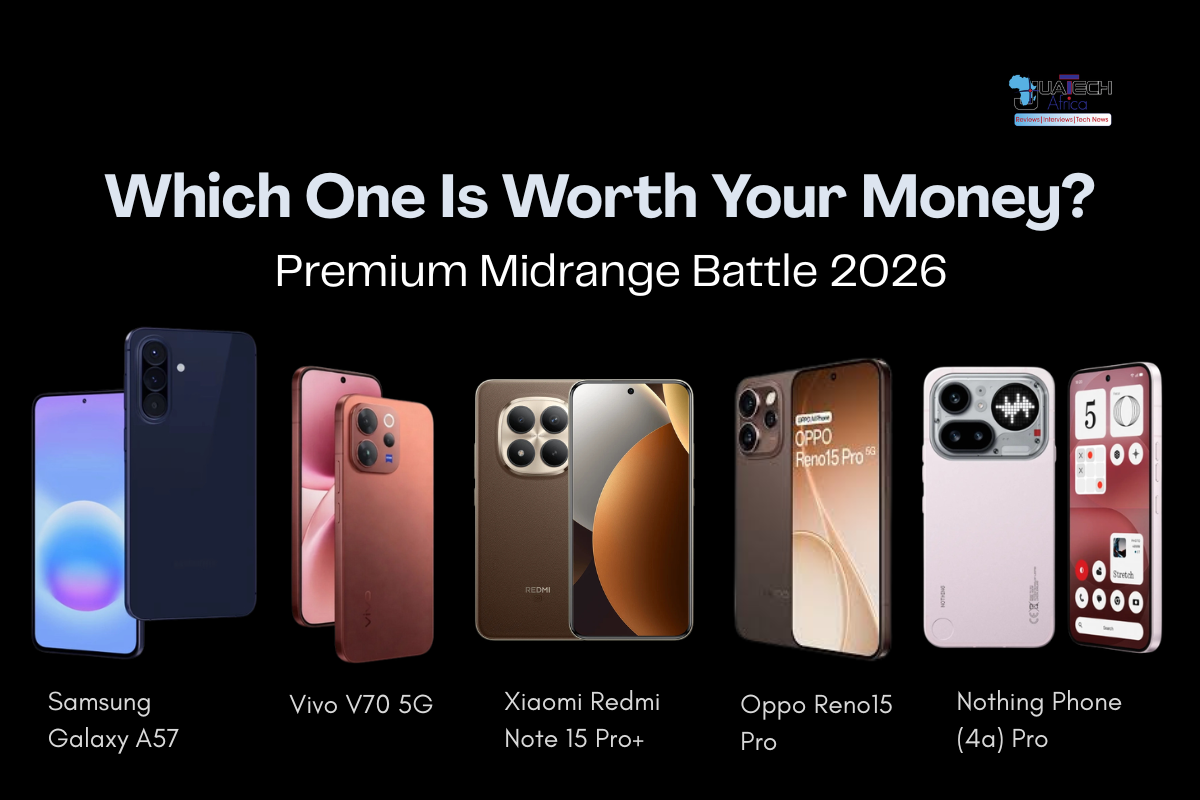
The premium midrange smartphone is no longer a compromise. It is where the smartest buying decisions are made and where the most expensive mistakes happen. In 2026, this segment will become the true battleground of the industry, with brands packing flagship-level features into devices that cost significantly less while competing aggressively for your attention, your money, and your long-term satisfaction. Companies like Samsung, Xiaomi, OPPO, Vivo, and Nothing are no longer differentiating on specifications alone. They are competing on how their devices perform after months of use, how their cameras interpret real people and real environments, and how their software holds up over time. For buyers in Kenya, this is not a casual purchase. A smartphone sits at the center of work, communication, and income generation, and choosing wrong has real consequences.
This guide moves beyond spec sheets and marketing claims to examine what these devices actually deliver and which one aligns with how you live, work, and spend. For a broader view of this segment, including additional devices and market context, you can explore our full premium midrange smartphone comparison in Kenya here.

Scope and Methodology: How We Evaluated the Best Premium Midrange Smartphones in Kenya (2026)
This analysis focuses on premium midrange smartphones available in Kenya in 2026, typically priced between KES 60,000 and 90,000. The devices considered represent the latest offerings within their respective lineups, including Samsung’s Galaxy A-series and FE models, Oppo’s Reno series, Vivo’s V-series, Xiaomi’s Redmi Note Pro+ range, and the Nothing Phone (4a) Pro. The goal is not to compare isolated specifications, but to evaluate how these devices perform in the contexts that matter most to users in this market.
The assessment is grounded in real-world usage rather than lab metrics alone. This includes day-to-day performance, thermal consistency, battery behavior over time, camera output in practical conditions, and software experience across extended use. Particular attention is given to factors that influence ownership in Kenya, such as pricing realities, availability, after-sales support, and long-term value, including resale.
Where specifications are referenced, they are interpreted through actual use rather than presented in isolation. The objective is clear. To move beyond marketing claims and provide grounded, defensible guidance that helps you choose the right premium midrange smartphone with confidence.
What Defines a Premium Midrange Smartphone in 2026?
The premium midrange segment in 2026 is no longer defined by what it lacks, but by how well it delivers where it matters. At a glance, most devices in this category look similar. High-refresh-rate AMOLED displays, capable chipsets, fast charging, and multi-camera systems have become standard. The real difference is not in the presence of features, but in the quality of their execution over time.
In practical terms, a premium midrange smartphone today should offer a smooth, consistent user experience across daily tasks, reliable performance under sustained use, and camera output that holds up even in challenging lighting conditions. It should charge quickly, but more importantly, maintain battery health over months of use. It should feel responsive not just on day one, but well into its lifecycle.
What separates devices in this category is not raw capability, but refinement. Software optimization, thermal management, camera tuning, and update support now carry more weight than headline specifications. This is where brands begin to diverge in meaningful ways.
For buyers, the implication is clear. The right choice is no longer about the most powerful device on paper, but the one that delivers the most dependable and complete experience over time.
Quick Comparison Snapshot: Where Each Phone Stands
Before diving deeper, it helps to step back and see how these devices position themselves at a glance. On paper, they may appear evenly matched, but each one leans strongly into a specific strength that shapes the overall experience.
| Phone | Core Strength | Key Trade-Off | Best For |
| Samsung Galaxy (A-series vs FE tier) | Software reliability, long-term support | Charging speed and pricing spread | Stability and longevity |
| Xiaomi Redmi Note 15 Pro+ | Raw performance, ultra-fast charging | Software consistency | Power users and gamers |
| Oppo Reno15 Pro | Premium design, portrait tuning | Price-to-performance balance | Style-conscious users |
| Vivo V70 | Camera accuracy, portrait, and video | Update consistency | Content creators |
| Nothing Phone (4a) Pro | Clean UI, distinct design | Peak performance limits | Minimalist users |
Samsung stands out in this comparison by covering two layers within the premium midrange segment. The Galaxy A-series targets value-driven users, while the FE line pushes closer to flagship territory with stronger performance and broader feature support. This distinction is important, as it explains why Samsung appeals to a wider range of users within the same price bracket.
This snapshot is not about declaring a winner. It is about clarity. Each device is built with a different priority in mind, and understanding that priority is the first step toward making the right choice.
Meet the Contenders: Positioning, Verified Specifications, and What Actually Matters
Samsung Galaxy A57 vs Galaxy S25 FE
Samsung’s strategy is clearly split across two tiers within the premium midrange. The Galaxy A57 sits in the upper midrange with a 6.7-inch AMOLED display at 120Hz, powered by the Exynos 1680 chipset and backed by a 5000mAh battery with 45W charging. This combination emphasizes efficiency, thermal stability, and consistent everyday performance.
The Galaxy S25 FE operates at a higher level. It features a 6.7-inch Dynamic AMOLED display, powered by the Exynos 2400-class chipset, paired with a 4900mAh battery and 45W charging. It also adds premium capabilities such as wireless charging, stronger camera processing, and extended software support under One UI.
The distinction is practical. The A57 is built for dependable balance. The S25 FE is built for users who want flagship-grade performance and features at a price within the same broader band.
Xiaomi Redmi Note 15 Pro+
The Redmi Note 15 Pro+ is one of the most aggressive devices in this segment. It features a large 6.83-inch AMOLED display, powered by the Snapdragon 7s Gen 4 chipset, paired with a 6500mAh battery and 100W fast charging.
This is hardware built for endurance and speed. The large battery, combined with ultra-fast charging, delivers long battery life and minimal downtime. The chipset provides strong sustained performance for gaming and heavy multitasking.
However, under HyperOS, the experience can feel feature-heavy, and long-term optimization may not match its hardware strength. The value is clear—maximum hardware capability at a competitive price.
Oppo Reno15 Pro
The Oppo Reno15 Pro is built around refinement and camera performance. It features a 6.78-inch AMOLED display at 120Hz, powered by the MediaTek Dimensity 8450 chipset, paired with a large 6500mAh battery and 80W fast charging.
This combination delivers strong everyday performance and excellent endurance. The large battery gives it a clear advantage in sustained usage, while the charging speed ensures quick recovery.
Its camera system, led by a 200MP sensor with additional telephoto and ultra-wide lenses, is tuned for portrait and lifestyle photography. Under ColorOS, the experience is polished and visually cohesive.
Oppo’s focus is clear. It delivers a premium feel backed by strong imaging and battery performance.
Vivo V70
The Vivo V70 is built with a clear priority on imaging and endurance. It features a 6.59-inch AMOLED display, a large 6500mAh-class battery, and fast charging support.
Its strength lies in camera tuning. Vivo continues to focus on portrait photography, delivering accurate skin tones, strong depth processing, and reliable low-light performance. Video stabilization and color consistency further strengthen its position for content creators.
Performance is balanced rather than aggressive, ensuring smooth daily use without pushing extreme benchmarks. Under OriginOS, the experience continues to improve, though long-term update consistency remains a consideration.
This device is designed around visual output and endurance.
Nothing Phone (4a) Pro
The Nothing Phone (4a) Pro approaches the segment in a different way. It features a 6.7-inch OLED display at 120Hz, powered by a Snapdragon 7 Gen 4 (4 nm) chipset, paired with a 5080mAh battery and 45W fast charging.
Performance is stable and efficient, designed for smooth everyday usage rather than peak output. The real strength lies in Nothing OS, which delivers a clean, near-stock Android experience with minimal bloat and strong fluidity.
Its transparent design and glyph interface reinforce its identity as a device focused on simplicity and user experience rather than hardware excess.
Performance and Consistency: Power Is Easy, Sustained Experience Is Not
Performance in the premium midrange segment is no longer defined solely by peak speed. It is defined by how well a device maintains that performance over time in real-world use.
On raw capability, the Redmi Note 15 Pro+ leads with its Snapdragon 7s Gen 4 platform. It delivers strong CPU and GPU performance, making it well-suited for gaming, heavy multitasking, and high-refresh-rate use on its 6.83-inch AMOLED display. Paired with a 6500mAh battery and 100W charging, it is built for users who push their devices hard and expect quick recovery.
Samsung takes a more balanced and thermally controlled approach. The Galaxy S25 FE, powered by the Exynos 2400e chipset, delivers higher-tier processing with improved sustained performance under load. The Galaxy A57, powered by the Exynos 1680, is tuned for efficiency, delivering stable day-to-day performance, lower heat buildup, and a more predictable battery life.
The Oppo Reno15 Pro, powered by the Dimensity 8450, delivers strong mid- to high-tier performance with good efficiency. Combined with its 6500mAh battery and 80W charging, it handles extended daily use well, though it is not tuned for sustained peak performance.
The Vivo V70 focuses on balanced performance. Its configuration prioritizes smooth operation across everyday tasks rather than aggressive output, ensuring consistency without significant thermal strain.
The Nothing Phone (4a) Pro takes a software-first approach. Its Snapdragon 7 Gen 4 (4 nm) platform, combined with a clean and lightweight interface, delivers fluid performance in daily use while minimizing background load and heat buildup.
The distinction is clear. Peak performance is easy to achieve. Sustained performance, thermal control, and long-term consistency are what define a better device.
Camera Performance: Hardware Matters, Processing Decides Everything
Camera quality in the premium midrange segment is no longer defined solely by megapixels. It is defined by how well hardware, image processing, and tuning work together to produce consistent, usable results across different conditions.
The Oppo Reno15 Pro stands out on paper with a 200MP primary sensor, backed by an ultra-wide and a telephoto lens. That resolution allows for high detail and flexible cropping, but its real strength lies in portrait tuning. It delivers bright, socially optimized images with strong subject separation and pleasing skin tones, making it particularly effective for lifestyle photography.
Camera set up:
Main Camera:
- 200 MP (wide)
- 50 MP (telephoto) 3.5x optical zoom
- 50 MP (ultrawide), AF
- Video: 4K@30/60fps, 1080p@30/60/120/240/480fps, gyro-EIS, HDR, OIS
Front lens:
- 50 MP (ultrawide), AF
- Video: 4K@30/60fps, 1080p@30/60fps, gyro-EIS, HDR
The Vivo V70 takes a more refined approach. Its camera system (50MP is tuned for accuracy, especially in portrait and low-light scenarios. Rather than pushing resolution, it focuses on controlled processing, delivering natural skin tones, balanced exposure, and reliable depth rendering across varied lighting conditions.
Camera set up:
Main Camera
- 50 MP (wide)
- 50 MP (periscope telephoto), 3x optical zoom
- 8 MP (ultrawide)
- Video: 4K@30/60fps, 1080p@30/60fps, gyro-EIS, OIS, HDR, LUT
Selfie lens
- 50 MP (wide)
- Features: Zeiss optics, HDR
- Video: 4K@30fps, 1080p@30/60fps
Samsung’s Galaxy S25 FE combines a proven multi-camera system with strong image processing.
Main Camera Triple setup:
- 50 MP (wide)
- 8 MP (telephoto) 3x optical zoom
- 12 MP (ultrawide)
- Video: 8K@24/30fps, 4K@30/60/120fps
Front Camera:
- 12 MP (wide)
- Video: 4K@4K@30/60fps
Its main sensor operates in the 50MP class, but the real advantage comes from consistent color science and video stability under One UI.
The Galaxy A57 follows a similar philosophy, offering dependable results without aggressive processing.
Main Camera:
- 50 MP (wide)
- 12 MP (ultrawide)
- 5 MP (macro)
- Video: 4K@30fps, 1080p@30/60fps, HDR, gyro-EIS
Selfie camera:
- 12 MP (wide)
- Video: 4K@30fps, 1080p@30/60fps, 10-bit HDR
The Xiaomi Redmi Note 15 Pro+ pairs high-resolution sensors with computational photography. It performs well in well-lit conditions and captures sharp images, but results can vary depending on scene optimization and processing balance.
Main Camera set up:
- 200 MP (wide)
- 8 MP (ultrawide)
- Video: 4K@30fps, 1080p@30/60/120fps, gyro-EIS, OIS
Selfie camera:
- 32 MP (wide)
- Video:1080p@30/60fps
The Nothing Phone (4a) Pro delivers a clean and natural imaging style. It avoids heavy processing, producing images that feel closer to real-life scenes, though it does not aim to dominate in any single category.
Camera Set-up
Selfie lens:
- 32 MP (wide)
- Video: 1080p@30fps
Main Camera:
- 50 MP (wide)
- 50 MP (periscope telephoto) 3.5x optical zoom
- 8 MP (ultrawide)
- Video: 4K@30fps, 1080p@30/60/120fps, gyro-EIS, OIS, Dolby Vision HDR, Ultra XDR
The key takeaway is clear. The best camera is not the one with the highest specifications, but the one that consistently delivers results you can rely on.
Battery and Charging: Speed, Capacity, and the Technology Behind It
Battery life and charging performance in the premium midrange segment are no longer just about how big the battery is or how fast it charges. They are about how intelligently power is delivered, controlled, and preserved over time in real-world use.
The Xiaomi Redmi Note 15 Pro+ combines a 6500mAh battery with 100W wired charging, supported by Xiaomi’s proprietary charging architecture. This includes a dual-cell battery design and advanced charge pumps that allow high-wattage power to flow efficiently while managing heat. The result is extremely fast top-ups and minimal downtime, making it ideal for heavy users and gamers.
The Oppo Reno15 Pro takes a similarly advanced approach. Its 6500mAh battery and 80W charging are backed by Oppo’s battery health engine, which regulates voltage, reduces heat stress, and maintains long-term battery capacity. This balance between speed and durability makes it more sustainable over the long term.
The Vivo V70 introduces BlueVolt technology, combining a 6500mAh battery with 90W wired charging, reverse wired charging, and bypass charging. Bypass charging is particularly valuable during gaming or extended use, as it powers the device directly while reducing heat buildup and battery wear.
Samsung’s Galaxy A57 (5000mAh) and Galaxy S25 FE (4900mAh) prioritize controlled charging at 45W, focusing on thermal stability, battery longevity, and consistent performance over time rather than peak charging speeds.
The Nothing Phone (4a) Pro, with a 5080 mAh battery and 50W charging, leans on software efficiency to minimize background drain and maintain steady performance.
The distinction is clear. Fast charging defines convenience in the moment, but battery life, thermal control, and charging intelligence determine how well a device serves you over months and years of real use.
Software and Longevity: Verified Support and Long-Term Value
Software longevity determines how long a smartphone remains secure, stable, and relevant beyond its initial performance. In this segment, updated commitment is no longer a bonus. It is a core differentiator.
Samsung leads with a clear, structured policy. The Galaxy A57 runs Android 16 with One UI 8.5 and is backed by up to 6 major Android upgrades and 6 years of security updates. This level of support makes the product usable well beyond typical ownership cycles and reinforces long-term value. The Galaxy S25 FE extends this by 1 year to 7 major Android upgrades and 7 years of security updates.
Xiaomi’s Note 15 Pro+ runs Android 15 with HyperOS 2 and offers up to 4 major Android upgrades, supported by extended security updates. The platform is feature-rich and tightly integrated with hardware, though long-term consistency depends on optimization and update delivery.
Oppo closes the gap with the Reno15 Pro. Running Android 16 with ColorOS 16, it delivers 5 major OS updates and 6 years of security patches, placing it firmly in the same long-term support tier as Samsung.
Vivo’s V70 runs Android 16 with OriginOS 6 and offers up to 4 major Android upgrades. The shift to OriginOS signals a move toward a cleaner, more responsive experience with improved lifecycle support.
The Nothing Phone (4a) Pro runs Android 16 with Nothing OS 4.1 and offers up to 3 major Android upgrades and around 4 years of security updates, with a focus on consistency and efficiency.
Software Update Policy (2026)
| Device | OS / UI | Android Upgrades | Security Updates |
| Samsung Galaxy A57 | One UI 8.5 (Android 16) | Up to 6 | Up to 6 years |
| Samsung Galaxy S25 FE | One UI 8 (Android 16) | Up to 7 | Up to 7 years |
| Xiaomi Note 15 Pro+ | HyperOS 2 (Android 15) | Up to 4 | ~4–5 years |
| Oppo Reno15 Pro | ColorOS 16 (Android 16) | 5 years | 6 years |
| Vivo V70 | OriginOS 6 (Android 16) | Up to 4 | ~4 years |
| Nothing Phone (4a) Pro | Nothing OS 4.1 (Android 16) | Up to 3 | ~4 years |
Software support defines ownership. The longer the support window and the more consistent the optimization, the longer a device remains secure, smooth, and valuable.
What This Means for Buyers in Kenya: Practical Realities That Shape Value
In Kenya, smartphone value is determined less by specifications and more by real-world ownership realities.
Network infrastructure is still evolving. While 5G is expanding in cities like Nairobi, coverage remains inconsistent nationwide. As a result, overall network performance, modem efficiency, and battery optimization matter more than simply having 5G support.
After-sales support is critical. The availability of service centers, spare parts, and repair turnaround time directly affects the ownership experience. Samsung maintains a strong advantage here with an established service network and reliable parts availability. This also strengthens its resale value, which remains one of the highest in the market.
Xiaomi offers strong upfront value, delivering high-spec products at competitive prices. However, resale value and service consistency can vary by device and distribution channel.
Oppo and Vivo position themselves around design, camera, and lifestyle appeal. They perform well for users focused on photography and aesthetics, though long-term value depends on support and update consistency.
The Nothing Phone (4a) Pro appeals to a more informed segment of buyers who prioritize clean software and unique design over mainstream brand strength.
The conclusion is practical. In Kenya, the best smartphone is not just the one with the best specifications. It is the one you can maintain easily, rely on daily, and resell with confidence when it is time to upgrade.
JuaTech Africa Merit Index: A Clear, Defensible View of Real-World Value
The JuaTech Africa Merit Index translates specifications and features into what actually matters in daily use. It evaluates five pillars that define ownership in this segment: sustained performance, camera reliability, battery life and charging behavior, software support, and overall value within the Kenyan market.
This is not a lab score. This is a structured interpretation of how each device performs over time, based on verified specifications, software commitments, and practical usage patterns from the sections above.
JuaTech Africa Merit Index (2026)
| Brand | Performance | Camera | Battery Life & Charging | Software & Longevity | Value (Kenya Context) |
| Samsung (A57 / S25 FE) | High | High | High | Very High | High |
| Xiaomi (Note 15 Pro+) | Very High | Medium | Very High | Medium | Very High |
| Oppo (Reno15 Pro) | High | High | Very High | Very High | High |
| Vivo (V70) | High | Very High | Very High | High | High |
| Nothing (Phone 4a Pro) | High | High | High | High | High |
Samsung leads on software longevity and overall balance, driven by its six-year update commitment and consistent optimization. Xiaomi delivers the strongest raw performance and charging speeds, making it the most aggressive value proposition upfront. Oppo closes the gap with flagship-level software support and strong battery performance, positioning it as a more complete long-term option. Vivo stands out in camera performance and endurance, while continuing to improve its software direction. Nothing focuses on clean, efficient software that delivers consistency rather than peak hardware dominance.
The conclusion is direct. No single device leads across all categories. The right choice depends on which pillar matters most to your usage, but this index makes those trade-offs clear and measurable.
Which Phone Should You Buy? A Decision Framework That Matches Real Use
In this segment, the difference is no longer about capability. It is about alignment. Each of these devices performs well, but they are built for different users and ownership priorities.
- Choose Samsung, particularly the Galaxy A57 or Galaxy S25 FE, if your priority is reliability, long-term software support, and a stable everyday experience. With extended update commitments and a strong service ecosystem in Kenya, Samsung remains the safest choice for consistency and resale value.
- Choose the Xiaomi Redmi Note 15 Pro+ if performance and charging speed matter most. Its Snapdragon 7s Gen 4 platform and 100W fast charging deliver responsiveness and minimal downtime, making it ideal for power users and heavy multitaskers.
- Choose the Vivo V70 if camera performance is your priority. Its strength in portrait accuracy, skin tone reproduction, and low-light consistency makes it well-suited for content creation.
- Choose the Oppo Reno15 Pro if design, display quality, and battery endurance matter most. It delivers a refined experience backed by a 6500mAh battery and fast charging.
- Choose the Nothing Phone (4a) Pro if you value simplicity and clean software. It offers a distraction-free experience with consistent performance.
Choose based on how you use your phone, how long you plan to keep it, and the value you expect over time.
The Hidden Trade-Offs: What You Gain, What You Give Up
Every phone in this segment is strong. None is complete. The difference is not in what they offer, but in what they compromise to get there.
Xiaomi pushes performance and charging to the limit. The Redmi Note 15 Pro+ delivers speed, responsiveness, and 100W fast charging, but this comes at the cost of a heavier software experience under HyperOS. Over time, this can lead to inconsistent optimization and reduced overall smoothness.
Samsung takes the opposite approach. The Galaxy A57 and S25 FE prioritize stability, long-term software support, and ecosystem integration under One UI. The trade-off is clear. Charging speeds are slower, and hardware upgrades are more measured rather than aggressive.
Oppo and Vivo focus on camera performance, design, and battery endurance. The Reno15 Pro and V70 deliver strong portrait output and large 6500mAh batteries, but their long-term software consistency and update depth do not yet match Samsung’s level across all markets.
The Nothing Phone (4a) Pro strips things back. It offers a clean, consistent experience, but does not lead in raw performance, camera specialization, or charging speed.
The decision is not about avoiding compromise. It is about choosing the right one. What you gain from each device is directly tied to what you are willing to give up.
Final Verdict
There is no universal winner in this segment because the competition has matured beyond simple comparisons. Every device here is capable, refined, and designed with a clear priority in mind. The difference is no longer about which phone is objectively better. It is about which one aligns with how you use your device every day.
If you value long-term reliability, software support, and resale confidence, Samsung remains the most dependable choice. If your priority is performance and charging speed, Xiaomi delivers the strongest immediate value. Suppose camera quality and visual output matter most, Vivo and Oppo offer compelling, specialized experiences. If you prefer simplicity and a clean, distraction-free interface, Nothing stands apart.
The decision should not be driven solely by specifications. Usage, expectations, and ownership horizon should guide it. The best smartphone is not the one that does the most. It is the one that fits seamlessly into your life and continues to deliver value long after the initial purchase.
From Reader to Insider: Make Smarter Tech Decisions with JuaTech Africa
If this guide helped you cut through the noise and make sense of the premium midrange smartphone market, then you are exactly the kind of person JuaTech Africa is built for.
We do not just review devices. We break down technology in a way that reflects real use, real markets, and real decisions across Africa. From smartphones and ecosystems to industry trends and buying strategies, our focus is simple: to help you succeed. Help you make informed choices that deliver value over time.
Technology is evolving fast, and the cost of getting it wrong is higher than ever. The right insight saves you money, improves your experience, and positions you ahead.
Stay connected with JuaTech Africa for deeper analysis, practical guides, and market intelligence designed for African users. Follow JuaTech Africa. Explore more. Share this with someone about to make a decision.
JuaTech Africa — Making Sense of Technology in Africa.