

There is a moment before any serious purchase when the excitement begins to settle and something more reflective takes over. It is not driven by specifications or brand perception, but by a quieter and often uncomfortable question that most buyers tend to ignore: do I actually need this device, or am I simply buying what is considered the best?
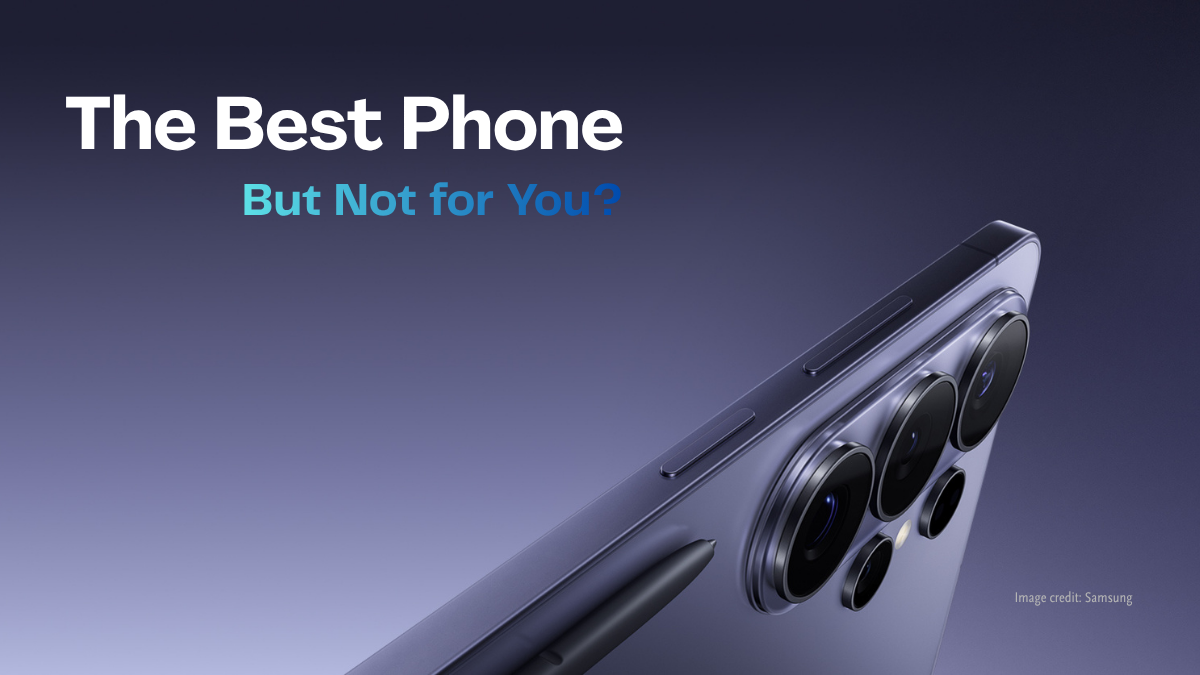
The Samsung Galaxy S26 Ultra is built to answer that question with confidence. It presents itself as the definitive flagship, combining a 6.9-inch Dynamic AMOLED 2X display with QHD+ resolution and a 120Hz adaptive refresh rate, peak brightness of around 2600 nits, a 200MP primary camera system, and the Snapdragon 8 Elite Gen 5 chipset. On paper and in real-world use, it delivers one of the most complete smartphone experiences available today.

That is precisely why this conversation matters. In a mature smartphone market, the question is no longer whether a phone is good. The real question is whether it is right for how you actually use it.
The Ultra Is Not Overhyped. It Is Over-Optimized
Samsung has earned its reputation. From the Samsung Galaxy S23 Ultra to the S26 Ultra, the company has refined its formula with discipline and consistency.
The display remains industry-leading, combining resolution, brightness, and adaptive refresh for excellent visibility in all conditions. The processor delivers sustained performance with improved thermal efficiency, supported by a redesigned vapor chamber that enhances heat dissipation.
The camera system continues to anchor the experience. The 200MP wide sensor, paired with a 50MP ultrawide, a 50MP periscope telephoto with 5x optical zoom, and a 10MP 3x telephoto lens, delivers versatility across focal lengths.
Software support remains one of Samsung’s strongest advantages. With up to seven years of updates and a deeply integrated One UI experience, the device is designed to remain relevant over time.
None of this is in dispute. The issue is not capability. The issue is converting that capability into real value.
The Numbers Tell a More Interesting Story
On paper, the Galaxy S26 Ultra looks like a leap forward. In reality, many of its core specifications reveal continuity rather than transformation.
The battery remains at 5000 mAh, a figure that has not changed significantly across multiple generations. Real-world testing shows improved efficiency, with endurance of around 16 hours in controlled use cases, but it still trails competitors like the iPhone 17 Pro Max in similar tests.
Charging has improved, but not enough to redefine expectations. The S26 Ultra now supports up to 60W wired charging, up from 45W in previous generations. In practical terms, this allows about 70-75% charge in roughly 30 minutes and a full charge in just over an hour.
That sounds fast until it is placed in context.
Competitors like the Xiaomi 17 Pro Max push well beyond 100W charging, enabling near full charges in under 30 minutes. The difference is not theoretical. It changes behavior. A 10-minute charge can meaningfully extend usage, unlike Samsung’s approach.
This is where the gap becomes visible. Samsung is improving, but it is not leading.
Mid-Article Reality Check: How Do You Use Your Phone
Pause for a moment and consider your actual usage patterns, not what your phone is capable of, but what you consistently rely on every single day. For most users, smartphone interaction revolves around a familiar set of activities: messaging on platforms like WhatsApp, scrolling through social media, browsing the web, streaming video content, and taking occasional photos. These are not demanding tasks. They do not require a 200MP camera sensor, a complex multi-lens system, or a high-performance chipset engineered for sustained, intensive workloads.
This is where the disconnect begins to take shape. The Galaxy S26 Ultra is built to deliver professional-grade capability across photography, video, multitasking, and AI-assisted workflows. However, the average user rarely operates at that level. The more advanced features, while impressive on paper and in demonstrations, tend to be used sparingly after the initial excitement fades. Over time, they become part of a broader set of capabilities that exist but are not fully integrated into everyday use.
What emerges from this is not a flaw in the device, but a structural mismatch between capability and application. The phone is designed for a level of use that most people do not consistently reach. As a result, a significant portion of what makes the Galaxy S26 Ultra exceptional remains underutilized. This is where value begins to erode, not because the device lacks it, but because that value is not fully realized in practical, day-to-day scenarios.
Samsung’s Strategic Shift Is Clear
Samsung is no longer chasing hardware extremes the way it once did, and this is no accident. Over the past few generations, the company has gradually repositioned its flagship strategy toward software-led experiences, deeper ecosystem integration, and practical AI use cases. This shift is not just theoretical. It is clearly reflected in the Galaxy S26 Ultra, where the emphasis is less on headline-grabbing specifications and more on how the device fits into everyday usage.
Features such as Privacy Display, which intelligently limits viewing angles to enhance on-screen security, and broader AI integration across tasks like summarization, translation, and contextual assistance point to a deliberate focus on usability. These are not features designed to impress in isolation. They are meant to quietly improve how the device functions in real-world scenarios, often in subtle yet meaningful ways over time.
However, this strategic pivot comes with trade-offs that are becoming increasingly difficult to ignore. Hardware innovation, while still present, has slowed in terms of visible breakthroughs. Charging speeds remain conservative compared to competitors pushing far more aggressive solutions. Camera improvements, though consistent, tend to be incremental rather than transformative, relying heavily on software refinements rather than new hardware directions. Even the design language reflects continuity rather than bold experimentation.
What emerges is a clear pattern. Samsung is no longer trying to surprise the market with radical shifts. Instead, it is focused on stabilizing and optimizing a formula that already works. While this approach ensures reliability and consistency, it also raises an important question in a rapidly evolving premium segment: Is refinement alone enough to maintain leadership?
Competitors Are Forcing a Different Conversation
A single, universal standard of excellence no longer defines the premium smartphone segment. It is increasingly shaped by distinct product philosophies, where each manufacturer chooses to lead in a specific domain rather than balance everything equally. This shift is important because it changes how value is perceived. Buyers are no longer just comparing specifications. They are comparing what each device is optimized to do best in real-world use.
Imaging Leadership: Vivo’s Aggressive Camera Innovation
Take imaging, for instance. Devices like the Vivo X300 Ultra are pushing the boundaries of mobile photography in ways that go beyond incremental upgrades. With large sensor sizes, advanced portrait optics, and co-engineered imaging systems, Vivo is not simply improving camera quality; it is advancing the entire imaging experience. It is redefining how smartphones handle depth, light, and subject separation in real-world scenarios.
The result is not just sharper images, but a distinct photographic character that appeals to users who prioritize visual storytelling. Portrait rendering, background separation, and low-light consistency are being treated as core experiences rather than secondary features. In comparison, Samsung’s 200MP system remains highly versatile and reliable, but it leans toward consistency and predictability rather than bold experimentation.
AI as a Core Experience: Google’s Pixel Approach
On the intelligence front, the Pixel 10 Pro XL continues to set the pace by integrating AI deeply into the user experience. Features such as real-time transcription, contextual suggestions, and advanced on-device processing are not presented as isolated tools. They are embedded into everyday interactions, influencing how users search, communicate, and complete tasks.
This creates a sense of fluidity where the device feels less like a tool and more like an assistant. The value here is not in raw performance, but in how seamlessly intelligence becomes part of daily use. Samsung has made meaningful progress in AI, particularly with Galaxy AI, but its implementation often feels layered on rather than fundamentally reshaping the experience.
Efficiency and Ecosystem: Apple’s Quiet Advantage
Efficiency and ecosystem cohesion remain areas where Apple maintains a strong position. The iPhone 17 Pro Max demonstrates how tight hardware and software integration can translate into real-world advantages that are immediately noticeable.
Despite operating within similar battery capacities, Apple consistently delivers longer endurance through aggressive optimization. This is not simply about battery size. It is about how effectively the system manages power across applications, background processes, and user behavior over time. The result is a device that feels dependable in ways that go beyond raw specifications.
Charging and Power: Xiaomi’s Real-World Convenience Play
Charging and power delivery represent another area where competitors are actively redefining expectations. Devices such as the Xiaomi 17 Pro Max push well beyond 100W of wired charging, enabling near-full charges in under 30 minutes.
This is not a laboratory advantage. It has direct implications for daily use. Users are no longer tied to overnight charging routines. A short charging window before leaving the house or during a break can meaningfully extend usage throughout the day. In contrast, Samsung’s approach remains conservative, prioritizing battery longevity but limiting the flexibility that faster charging enables.
The Bigger Shift: From Balance to Specialization
Each of these approaches addresses a specific user need with clarity and intent. Vivo focuses on imaging excellence. Google prioritizes intelligence and contextual assistance. Apple refines efficiency and ecosystem integration. Xiaomi emphasizes speed and convenience through aggressive hardware choices. These are not overlapping strategies. They are deliberate differentiators.
Samsung, by comparison, delivers a balanced experience across all these areas. The Galaxy S26 Ultra performs well in imaging, AI, battery life, and overall usability. However, it does not decisively lead in any single category. This balance has long been Samsung’s strength, but in a market where competitors are defining themselves through clear advantages, it also becomes a limitation.
The conversation has shifted. It is no longer about which phone does everything well. It is about which phone does what matters to you exceptionally well.
The Experience Gap Is Narrowing
One of the most important realities in today’s smartphone market is that flagship devices are converging. The differences that once defined generational upgrades are becoming less pronounced, not because innovation has stopped, but because the baseline has become exceptionally high. Most modern flagships are already fast, capable, and reliable enough to handle everyday tasks without strain.
The difference between the Samsung Galaxy S23 Ultra and the Samsung Galaxy S26 Ultra is noticeable, but for most users, it is not transformative in daily use. Applications open slightly faster, animations feel more refined, and AI-driven features introduce moments of convenience. However, the core experience remains largely the same. Messaging, browsing, streaming, and casual photography feel familiar because they were already well-handled in previous generations.
This is where the gap shifts from capability to perception. Improvements in processing power, camera tuning, and software intelligence are real, but they rarely redefine how the device is used on a day-to-day basis. A faster chip does not change how often you send messages. A higher-resolution sensor does not fundamentally alter how you capture everyday moments. Even AI features, while useful, tend to enhance existing behaviors rather than replace them.
What emerges is a subtle but important disconnect. Users are encouraged to upgrade because progress is presented as significant and necessary. Marketing highlights performance gains, camera improvements, and new features as reasons to move forward. In practice, however, the lived experience often remains familiar, with incremental rather than transformative changes.
This creates a perception gap where the idea of improvement outweighs its real-world impact. For many users, the question is no longer whether the new device is better, but whether it is meaningfully different enough to justify the upgrade.
The Core Problem: Overqualification
The Samsung Galaxy S26 Ultra represents the peak of what a modern smartphone can offer. From its 200MP camera system and multi-lens versatility to its high-performance chipset and advanced AI capabilities, it is engineered to handle almost any scenario a user can throw at it. In terms of raw capability, there are very few devices that can match its breadth and consistency.
The issue, however, is not what the device can do. It is the extent to which that capability is actually used in practice. Most users do not operate at the level the Ultra is designed for. Their daily interactions are predictable and relatively undemanding, centered around communication, content consumption, and occasional photography. These are tasks that do not require the full extent of the Ultra’s hardware or software capabilities to be executed well.
When a device offers significantly more capability than a user can meaningfully utilize, the additional power does not translate into a better experience. Instead, it becomes dormant potential. The extra processing headroom, the advanced camera modes, and the productivity features exist, but they do not consistently influence how the device is used from one day to the next. Over time, the perceived value of these features diminishes because they are not actively contributing to the user’s experience.
This is where the concept of overqualification becomes relevant. The Galaxy S26 Ultra is not lacking in value. In fact, it offers more value than most devices in absolute terms. The challenge is that much of that value remains untapped for the average user. The device is built for a level of engagement that many people do not reach.
As a result, recommending the Ultra becomes more complex. It is not a question of whether it is good, but whether it is necessary. For a significant portion of buyers, the device delivers more than is required to achieve the same practical outcome. That surplus does not enhance the experience. It simply increases the cost of achieving it.
Who Should Buy the Galaxy S26 Ultra
A strong argument is not complete until it defines its exceptions clearly. The Galaxy S26 Ultra is not a device without an audience. On the contrary, it is exceptionally well-suited for a specific category of users whose needs align closely with what the device is built to deliver.
For content creators, the value proposition is immediate and practical. The 200MP primary sensor, supported by multiple telephoto lenses and advanced video capabilities, offers a level of flexibility beyond casual photography. Whether it is capturing high-resolution stills for editing, shooting stabilized video, or working across different focal lengths, the camera system offers tools that can be consistently utilized, not just occasionally explored.
For professionals who operate in mobile-first environments, the Ultra’s capabilities extend beyond performance into workflow. Multitasking features, large display real estate, and the integration of the S Pen create opportunities for note-taking, document handling, and on-the-go productivity that are difficult to replicate on smaller or less capable devices. In these scenarios, the device is not simply powerful. It becomes a functional part of how work gets done.
There is also a segment of users who are deeply embedded in Samsung’s ecosystem. For them, the value of the Galaxy S26 Ultra is amplified by device continuity, long-term software support, and a level of familiarity that reduces friction in daily use. The promise of extended updates and ecosystem integration is not theoretical. It is something they benefit from over time.
In all these cases, the device’s capabilities are not excessive. They are actively utilized. The features that define the Ultra are not sitting idle. They are part of the user’s routine and directly contribute to productivity, creativity, or efficiency.
The distinction, then, is not about whether the Galaxy S26 Ultra is a good device. It is about whether its strengths are relevant to the person using it. For users who can consistently translate its capabilities into real-world value, the Ultra is not overqualified. It is precisely aligned.
For everyone else, the decision requires a more careful evaluation. Not because the device falls short, but because it may offer far more than is needed to achieve the same everyday outcomes.
Verdict: The Cost of Playing It Safe
Samsung has not fallen behind. It has deliberately and calculatedly decided where it wants to compete. From the Galaxy S23 Ultra to the Galaxy S26 Ultra, the company has shifted away from aggressive, headline-driven innovation toward a model defined by refinement, stability, and ecosystem strength. The result is a device that performs exceptionally well across almost every category, delivering a level of consistency and reliability that few competitors can match.
However, in a premium market once again shaped by bold, focused innovation, that strategic restraint comes with trade-offs. While competitors are pushing forward in clearly defined areas such as ultra-fast charging, AI-first experiences, and experimental camera systems, Samsung’s approach prioritizes balance over leadership in any single domain. This ensures dependability, but it also reduces the sense of progression that once defined the Ultra line.
For the user, this creates a more nuanced decision than ever before. The Galaxy S26 Ultra does not fail in any meaningful way. It delivers exactly what it promises. The question is whether what it promises is aligned with what most people actually need. When a device offers significantly more capability than a user can consistently utilize, the additional power does not translate into a better experience. It simply increases the cost of achieving the same outcome.
This is where the central argument becomes clear. The Galaxy S26 Ultra is not overpriced in the traditional sense. It delivers substantial value for what it is. But for a large portion of its audience, it is overqualified. Its strengths, while undeniable, extend beyond what is required to improve everyday usage meaningfully.
The best phone on the market isn’t always the right one to buy. The right phone is the one that aligns with how you live, how you work, and what you consistently expect from it. In 2026, that distinction matters more than ever.
Our Closing Perspective
At JuaTech Africa, the goal is not to echo consensus, but to examine it with clarity, context, and a willingness to ask harder questions. The Samsung Galaxy S26 Ultra is, by every measurable standard, an exceptional device. That much is clear. What is less obvious, and far more important, is whether that level of capability aligns with how most people actually use their smartphones.
This is where better decisions are made, not in the comparison of specifications, but in the understanding of personal usage. Before committing to a device of this level, it is worth stepping back and taking an honest look at your current habits. Which features do you rely on daily? Which ones did you explore once and never return to? Where does your phone genuinely add value, and where does it simply exist as untapped potential?
These are not technical questions. They are practical ones. And they matter more now than ever.
Because the smartest technology decision is no longer defined by what a device can do at its peak, but by how consistently it delivers value in your everyday life. Power, on its own, is no longer the differentiator. Alignment is.
In a market filled with exceptional devices, the real advantage belongs to the user who understands their needs well enough to choose accordingly.
That is the difference between buying the best phone and choosing the right one.