

Artificial intelligence has entered a phase where raw capability alone is no longer enough. In 2026, the defining question surrounding advanced AI systems is not simply how powerful they are, but how reliable their reasoning can be under real-world pressure.
In this evolving landscape, different models have begun to specialize. Some prioritize creativity, others ecosystem integration, and others still focus on speed and accessibility.

If ChatGPT has emerged as the Creative Specialist and Google’s Gemini has positioned itself as the Ecosystem Giant, then Anthropic’s Claude 4.6 has established a very different reputation: the Precision Architect of modern AI.
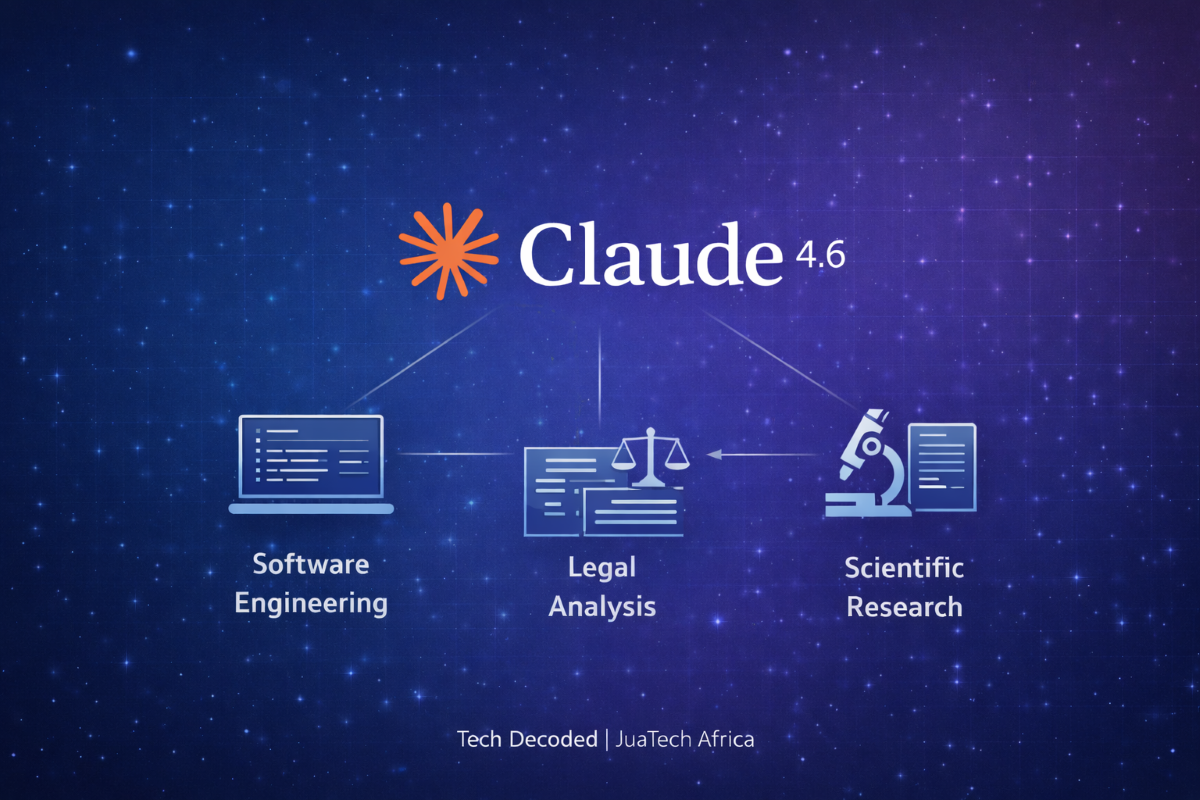
Claude’s development philosophy places less emphasis on flashy capabilities and more emphasis on structured reasoning, transparency, and ethical alignment. As a result, it has become the preferred AI model for high-stakes professional work, such as:
- legal document analysis
- complex software engineering
- scientific research
- regulatory compliance reviews
- enterprise knowledge management
For the JuaTech Africa professional audience, Claude 4.6 represents an important shift in how AI is used. Instead of merely chatting with a conversational assistant, users increasingly collaborate with an analytical reasoning partner capable of evaluating large volumes of information with structured logic.
At the center of this capability lies Anthropic’s foundational design principle: Constitutional AI, a training approach intended to ensure that Claude’s reasoning remains grounded in consistent ethical rules while minimizing hallucinations and unreliable outputs.
Explore in-depth on ChatGPT Explained | Gemini Explained | Meta AI Explained | Perplexity Explained | Get Full Access on all Tech Decoded’s AI & Emerging Technology Explainers.
Tech Decoded Summary
| Feature | Why It Matters |
| Adaptive Thinking Engine | Dynamically adjusts reasoning depth depending on task complexity |
| 1-Million Token Context | Enables analysis of massive documents or codebases |
| Constitutional AI | An ethical training framework designed to reduce hallucinations |
| MCP Protocol | Secure integration with enterprise data sources |
| Extended Output | Generates up to 128K tokens in a single response |
The Rise of Reliability-Centered AI
Over the past few years, one of the most persistent criticisms of generative AI has been its tendency to hallucinate information or fabricate confident but incorrect answers.
This is particularly problematic in professional contexts.
A hallucinated response might be amusing in a casual chat environment, but in fields such as law, finance, medicine, or cybersecurity, inaccurate outputs can lead to serious consequences.
Anthropic’s response to this challenge has been to focus Claude’s development around reasoning transparency and cautious response generation.
Rather than producing the fastest answer, Claude is designed to evaluate when deeper analysis is required before delivering a conclusion.
This principle is most clearly demonstrated in Claude 4.6’s most important technical innovation.
The Adaptive Thinking Architecture
One of the defining capabilities introduced in Claude 4.6 is its Adaptive Thinking engine.
Earlier generations of AI systems generally followed one of two modes of operation:
- Instant response generation, which prioritized speed but sometimes sacrificed accuracy.
- Chain-of-Thought reasoning, which produced more reliable results but required slower, step-by-step reasoning processes.
Claude 4.6 introduces a hybrid approach.
Instead of forcing every prompt through a fixed reasoning path, the model automatically assesses the task’s complexity and adjusts its reasoning effort accordingly.
Dynamic Resource Allocation
When a user asks a simple question such as: “Explain the difference between RAM and storage.”
Claude responds instantly using a lightweight reasoning process.
However, when a prompt demands deeper analytical work, such as “Audit this 5,000-line smart contract for potential security vulnerabilities.”
Claude activates Extended Thinking mode, which enables the model to allocate significantly more computational resources to reasoning.
This process allows Claude to:
- analyze large code structures
- trace logical dependencies
- evaluate potential edge cases
without compromising response accuracy.
The “Thinking Trace” Interface
Another key feature introduced in Claude 4.6 is transparent reasoning visualization. Users can expand the Thinking section in the interface to view a simplified representation of the model’s reasoning process before it produces a final answer.
This feature is especially valuable for:
- developers reviewing debugging suggestions
- researchers verifying analytical conclusions
- legal professionals reviewing reasoning chains
For readers and subscribers of JuaTech Africa, this transparency adds an important layer of trust and verifiability, allowing professionals to understand why the AI reached a particular conclusion.
Effort Controls for Professional Users
Claude 4.6 also introduces manual reasoning controls.
Users can specify Effort Levels ranging from Low to Max depending on the complexity of their project.
| Effort Level | Best Use Case |
| Low | Quick questions and summaries |
| Medium | General research and writing |
| High | Code analysis and technical documentation |
| Max | Scientific reasoning and complex audits |
This flexibility allows organizations to balance speed, computational cost, and analytical depth as needed.
The 1-Million Token Context Window
Another breakthrough introduced in Claude 4.6 is its 1-million-token context window, currently available in beta for the Opus and Sonnet model tiers.
To understand the significance of this capability, consider the approximate scale of a token.
A token represents a small unit of text. Roughly speaking:
- 1 token ≈ ¾ of a word.
This means a 1-million-token context window can contain approximately 750,000 words of text.
This is equivalent to:
- an entire legal archive
- dozens of academic research papers
- a multi-year software project codebase
—all processed in a single conversation.
Real-World Use Cases for Long Context
The ability to process extremely large contexts unlocks entirely new workflows.
Legal and Compliance Analysis
Law firms can upload hundreds of pages of legal documentation and ask Claude to:
- summarize key clauses
- identify regulatory conflicts
- highlight risk factors
Software Engineering
Developers can provide entire code repositories and request:
- architecture analysis
- dependency mapping
- security vulnerability detection
Scientific Research
Researchers can analyze large bodies of literature and generate:
- structured literature reviews
- cross-paper synthesis
- hypothesis comparisons
Context Compaction: Managing Massive Conversations
Handling a million tokens requires significant computational resources. To address this challenge, Anthropic introduced a feature called Context Compaction.
This system automatically summarizes earlier sections of a conversation while preserving essential context. Instead of discarding earlier information entirely, Claude compresses it into a more efficient representation.
This enables long-running AI tasks to maintain practical “infinite memory” without excessive resource consumption.
Expanded Output Capacity
Claude 4.6 also significantly increases output limits. The model can now generate up to 128,000 tokens per response.
This enables Claude to produce extremely large outputs, such as:
- full technical documentation
- detailed research summaries
- multi-module software implementations
For developers across Africa building AI-assisted workflows, this dramatically reduces the need to break tasks into smaller segments.
Constitutional AI: The Ethical Foundation
What truly differentiates Claude from competing models is its Constitutional AI framework. Most AI systems are trained using large volumes of human feedback. While effective, this approach can introduce biases depending on the perspectives of human reviewers.
Anthropic instead developed a system in which a structured constitutional framework guides AI behavior.
This framework is inspired by:
- the UN Declaration of Human Rights
- international safety standards
- ethical guidelines for AI deployment
During training, the model evaluates its own responses against this constitutional rule set.
If a response violates these guidelines, the model is trained to revise its reasoning until it aligns with the constitutional principles.
Why Constitutional AI Matters
The result is a model that tends to be:
- more cautious
- more transparent
- less likely to fabricate answers
In benchmark testing across several AI evaluation frameworks in 2026, Claude 4.6 demonstrated one of the lowest hallucination rates among major models. One particularly notable behavior is Claude’s willingness to acknowledge uncertainty.
Instead of inventing a plausible-sounding explanation, Claude may respond with statements such as: “I cannot identify an error in this logic based on the provided information.”
For professionals performing critical analysis, this honesty is often more valuable than speculative answers.
MCP: The Model Context Protocol
In late 2025, Anthropic introduced the Model Context Protocol (MCP). By 2026, MCP will have matured into a widely adopted open standard that enables Claude to integrate with external data sources securely.
Secure Local Data Integration
Using MCP, Claude can connect to enterprise tools such as:
- Google Drive
- Slack
- GitHub
- internal document repositories
Unlike traditional API integrations, MCP creates a standardized interface for AI systems to access contextual data while respecting strict security controls.
This enables Claude to function as an internal knowledge assistant capable of analyzing company-specific information.
Enterprise Advantages
- For organizations across Africa, MCP offers several advantages.
- Technology startups can use Claude to analyze their internal code repositories.
- Legal firms can integrate Claude with document management systems.
- Financial institutions can deploy Claude as a compliance review assistant that understands internal policies and regulatory frameworks.
In each case, the AI operates as a domain-specific consultant rather than a generic chatbot.
JuaTech Africa Verdict: When to Choose Claude 4.6
Claude 4.6 has established itself as the reliability leader among modern AI systems. While some models excel in creativity or multimodal capabilities, Claude’s strength lies in structured reasoning and analytical precision.
For Developers and Engineers
Claude is particularly powerful for debugging and root-cause analysis. Where other models might propose speculative fixes, Claude carefully analyzes code structure before proposing solutions. This makes it an excellent tool for diagnosing complex issues across large multi-file projects.
For Legal and Financial Analysis
Claude’s massive context window and conservative reasoning style make it ideal for reviewing large sets of documentation. Professionals working with contracts, compliance frameworks, or financial disclosures can use Claude to identify patterns and potential risks across extensive datasets.
Hardware Considerations
To take full advantage of Claude’s advanced capabilities on mobile devices, JuaTech Africa recommends hardware that includes:
- LPDDR5x RAM (12GB or more)
- high-performance CPUs
- modern browsers capable of handling large rendering tasks
Long-context sessions involving hundreds of thousands of tokens can require significant memory resources for smooth scrolling and visualization.
The Bigger Picture
Claude 4.6 represents an important milestone in the evolution of artificial intelligence.
The industry is gradually moving beyond the early phase of generative AI experimentation toward a new era where trust, reliability, and reasoning quality become the defining metrics of AI capability.
In that environment, Claude’s emphasis on ethical alignment and structured analysis may prove to be one of the most important architectural choices in the future of AI.
For professionals, developers, and researchers across Africa, the emergence of models like Claude signals a future in which artificial intelligence functions less as a novelty and more as a dependable analytical partner, capable of supporting complex intellectual work.
Frequently Asked Questions on Claude 4.6
- What is Claude 4.6, and how is it different from other AI models?
Claude 4.6 is an advanced large language model developed by Anthropic, designed primarily for high-precision reasoning, complex analysis, and enterprise-grade AI applications. Unlike many generative AI systems that prioritize speed or creativity, Claude is engineered to emphasize logical consistency, safety, and transparent reasoning.
What distinguishes Claude from other AI models is its architecture based on Constitutional AI, a training methodology that aligns the model’s behavior with a set of ethical and safety guidelines. Instead of relying solely on human feedback during training, Claude evaluates its responses against these guiding principles, enabling it to produce more cautious, reliable answers.
In practice, this makes Claude particularly effective for professional use cases where accuracy matters more than stylistic creativity, such as legal document review, scientific research analysis, financial modeling, and advanced software debugging.
For organizations and professionals across Africa, this means Claude can function less as a casual assistant and more as a dependable analytical collaborator capable of handling complex intellectual tasks.
- How does Claude’s Adaptive Thinking system work?
Claude 4.6 introduces an architectural innovation, Adaptive Thinking, that dynamically adjusts the model’s reasoning depth based on the task’s complexity.
When a user asks a straightforward question, Claude generates a rapid response using a lightweight inference process. However, when the model encounters a complex analytical task—such as reviewing a large codebase or analyzing a legal framework—it automatically activates Extended Thinking mode.
In Extended Thinking mode, Claude allocates additional computational resources to:
- break down the problem into logical components
- analyze relationships between variables or documents
- evaluate potential edge cases or inconsistencies
The system also provides a transparent reasoning trace, allowing users to inspect how the model arrived at its conclusion.
This adaptive architecture allows Claude to balance speed, computational efficiency, and analytical depth, making it particularly valuable for professionals who require both quick insights and deep reasoning.
- What is the significance of Claude’s 1-million token context window?
One of the most groundbreaking capabilities introduced in Claude 4.6 is its 1-million-token context window, which enables the model to process extraordinarily large volumes of information within a single interaction.
A token represents a small unit of text—roughly three-quarters of a word. With a 1-million token context capacity, Claude can analyze approximately 750,000 words of content at once.
This capability transforms how AI can be used in professional workflows.
For example:
- Lawyers can upload extensive legal case files and contracts for analysis.
- Developers can provide entire software repositories for debugging or architecture review.
- Researchers can analyze dozens of academic papers simultaneously to identify patterns or emerging trends.
Rather than breaking information into smaller segments, users can now conduct holistic analysis across large bodies of knowledge, dramatically improving productivity and insight generation.
- How reliable is Claude compared to other AI models?
Claude is widely regarded as one of the most reliable AI models available for analytical work, particularly when compared to systems that prioritize creative output.
Anthropic has invested heavily in reducing hallucinations—instances where an AI model produces confident but incorrect information. Through the Constitutional AI framework and advanced reasoning safeguards, Claude is trained to prioritize accuracy and honesty over speculation.
One notable behavior of Claude is its willingness to acknowledge uncertainty. When insufficient information is available, the model may respond by stating that it cannot confidently determine an answer rather than generating a potentially misleading response.
For professionals working in fields such as law, finance, cybersecurity, or scientific research, this conservative approach significantly reduces the risk associated with AI-assisted decision-making.
- What is Constitutional AI, and why is it important?
Constitutional AI is the core training methodology behind Claude models. Instead of relying solely on human annotators to determine appropriate responses, Anthropic trains Claude using a set of guiding principles inspired by international ethical frameworks such as the UN Declaration of Human Rights and global AI safety standards.
During training, Claude evaluates its own responses against this “constitution.” If a response violates one of the rules—for example, by promoting harm, misinformation, or unethical behavior—the model revises its reasoning until it aligns with the constitutional guidelines.
This approach produces an AI system that is designed to be:
- transparent
- ethical
- resistant to manipulation
- aligned with human safety values
For organizations integrating AI into sensitive environments, Constitutional AI represents an important step toward building trustworthy artificial intelligence systems.
- What types of tasks is Claude best suited for?
Claude excels at tasks that require deep reasoning, large context analysis, and structured thinking. Some of the most effective use cases include:
- Software development: Claude can analyze complex codebases, identify logical errors, and explain software architecture in detail.
- Legal and compliance analysis: The model can review large volumes of contracts, policies, and regulatory frameworks to identify inconsistencies or risks.
- Scientific research synthesis: Researchers can use Claude to analyze multiple academic studies and generate structured literature reviews.
- Enterprise knowledge management: Claude can act as an internal knowledge assistant by synthesizing company documentation and answering context-aware questions.
Because of its reasoning-focused design, Claude is often considered one of the best AI tools for serious professional and analytical workloads.
- What is the Model Context Protocol (MCP)?
The Model Context Protocol, commonly referred to as MCP, is an open standard developed by Anthropic that enables Claude to interact securely with external data sources.
Through MCP integrations, Claude can connect to platforms such as:
- Google Drive
- GitHub repositories
- Slack workspaces
- internal enterprise databases
This allows Claude to analyze information directly within a company’s digital ecosystem while maintaining strict security boundaries. Instead of functioning as a generic AI chatbot, Claude becomes a context-aware assistant that understands organizational knowledge and workflows.
For African startups, research institutions, and technology companies, MCP opens the door to building AI-powered internal knowledge systems that enhance productivity and decision-making.
- How does Claude compare with ChatGPT and Gemini?
Claude, ChatGPT, and Gemini represent three different design philosophies in the AI ecosystem.
- ChatGPT is widely recognized for its creative versatility and broad application across writing, coding, and conversational tasks.
- Gemini is deeply integrated into Google’s ecosystem, making it particularly powerful for users who rely heavily on Google Workspace, Android devices, and cloud services.
- Claude, however, distinguishes itself through structured reasoning and reliability, making it particularly suitable for professional and analytical use cases. Rather than focusing on the most visually impressive features, Claude prioritizes logical rigor, safety, and depth of context.
As a result, many developers, legal professionals, and researchers increasingly view Claude as the preferred AI model for complex analytical work.
- Can Claude generate full applications or technical documents?
Yes. One of the most significant improvements in Claude 4.6 is its expanded output capacity to 128,000 tokens. This allows the model to produce extremely long responses in a single interaction, including:
- full software modules
- detailed research papers
- comprehensive technical documentation
- extensive policy analysis reports
For developers and organizations working on large projects, this capability dramatically reduces the need to split tasks into smaller segments.
Claude can instead generate complete, coherent outputs that maintain logical continuity across large documents or code structures.
- Why should African developers and professionals pay attention to Claude?
The emergence of reasoning-focused AI models like Claude has important implications for professionals across Africa.
As digital transformation accelerates across sectors such as fintech, health technology, education, and legal services, the ability to analyze complex information quickly becomes a major competitive advantage.
Claude’s capabilities in areas such as long-context reasoning, secure enterprise integration, and transparent decision-making make it especially valuable for professionals working in environments where accuracy, accountability, and regulatory compliance are critical.
For African developers building startups, researchers analyzing large datasets, or professionals navigating complex policy frameworks, Claude offers a powerful tool that extends beyond basic automation.
Instead, it represents the next phase of artificial intelligence: AI systems designed to support high-level reasoning, strategic thinking, and knowledge synthesis.
SEO & Metadata Suite
Primary Keyphrase: Claude 4.6 Explained
Secondary Keywords: Adaptive Thinking, Constitutional AI, 1 Million Token Context, Model Context Protocol, Claude vs GPT-5 2026, Anthropic Claude 4.6 guide.
- Post Title (SEO): Claude 4.6 Explained: Adaptive Thinking, 1M Token Context, and the Ethical AI Moat | JuaTech Africa
- Slug: /tech-decoded-claude-4-6-anthropic-guide-2026/
- Meta Description: Lewis Wafula decodes Anthropic’s Claude 4.6. Understand the Adaptive Thinking architecture, the 1-million-token context window, and why Constitutional AI makes it 2026’s most trusted model.
Ready-to-Publish Tags: Claude 4.6, Anthropic, Constitutional AI, Adaptive Thinking, 1M Context, Model Context Protocol, Tech Decoded, Lewis Wafula, JuaTech Africa, Professional AI, Code Debugging