
Editor’s Note: The 2026 Intelligence Briefing
As we move deeper into our AI 2026 launch, we transition from “Which AI to use” to “How the AI actually works.” Understanding the silicon-to-software pipeline is the only way to future-proof your hardware investments. This guide decodes the engine under the hood of the Google ecosystem. — Lewis Wafula

In the fast-evolving landscape of 2026, “AI” has graduated from a marketing buzzword to a critical hardware specification. At the center of this shift is Google’s Gemini AI – a natively multimodal engine that is redefining how our devices “think”. For the African consumer, understanding Gemini is no longer optional. As brands like Samsung, Xiaomi, and Infinix bake Gemini into their 2026 lineups, the ability to distinguish between a cloud-dependent feature and true local intelligence is the ultimate Buyer’s Shield.
1. Natively Multimodal: The “Built-In” Advantage
Unlike earlier AI models that were text predictors with “eyes” and “ears” stitched on as afterthoughts, Gemini was built to be natively multimodal.
- Unified Processing: Gemini processes text, images, audio, and video code in a single shared embedding space.
- Low Latency: It eliminates mid-step translations (e.g., Voice -> Text ->AI ->Speech), allowing for near-instant responses.
- Real-World Context: Pointing a camera at a faulty circuit board allows Gemini to simultaneously understand visual context and physics without delay.
2. The Three-Tier Architecture: Nano, Flash, and Pro
Google has tiered Gemini to fit specific hardware constraints, which is critical for the diverse smartphone market in Africa.
- Gemini 3.1 Pro: The cloud-based heavy lifter for “Deep Research” and complex coding. With a context window now exceeding 2 million tokens, it can process entire libraries of data in seconds.
- Gemini 3 Flash: Optimized for speed; the engine behind real-time AI agents in 2026 productivity apps.
- Gemini 3.1 Nano: This model runs locally on your smartphone silicon, providing the gold standard for privacy and offline utility.
3. The Silicon Engine: 2026 NPU Technical Comparison
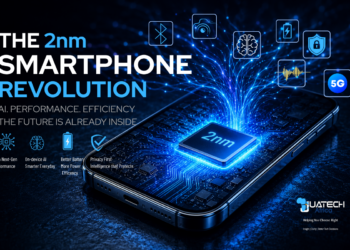
To run Gemini Nano effectively, your device needs a dedicated Neural Processing Unit (NPU) capable of handling “Agentic AI” through architectures like the NPU 890/990.
| Feature | Qualcomm Snapdragon 8 Elite G5 | MediaTek Dimensity 9500 | Tech Decoded Impact |
| NPU Model | Hexagon (Fused Architecture) | APU 890 (7th Gen) | Snapdragon leads in Quantization. |
| Peak AI TOPS | 50 – 55 TOPS | 48 – 52 TOPS | Both exceed the 40 TOPS standard. |
| LLM Speed | ~25 Tokens/Sec (7B Model) | ~22 Tokens/Sec (7B Model) | Instant “Human-Like” dialogue. |
| Efficiency | 0.8W / 10 TOPS | 0.75W / 10 TOPS | MediaTek edge in Battery Life. |
The RAM Factor: Gemini Nano is memory-hungry. We recommend at least 12GB of LPDDR5X RAM, as the system must “reserve” a portion of memory exclusively for the AI model to prevent “swap” lag.
4. The Context Window: Your Device’s “Infinite” Memory
A “token” is roughly 0.75 of a word. Gemini’s massive context window represents a shift in how we interact with data.
- Utility: You can upload a 1,000-page PDF (like the Kenyan Finance Act) and ask specific, contextual questions without the AI “forgetting” the beginning of the document.
- Target Audience: This is a game-changer for legal, academic, and financial professionals across the continent.
5. Local Nuance: AI in the African Ecosystem
Gemini’s strength in 2026 is its improved localization and hardware optimization for regional environments.
- Language: Support for Swahili and regional dialects has improved, enabling natural “Voice-to-Action” commands.
- Thermal Efficiency: Gemini Nano 3.1 is better optimized for the power-efficient architectures of 2026, reducing thermal throttling in high-heat environments like Nairobi or Lagos.
6. JuaTech Verdict: The “Buyer’s Shield” Check
When shopping for an “AI Phone” in 2026, use our technical checklist:
- Check the Silicon: Does it have a flagship-grade NPU (Snapdragon 8 Elite or Dimensity 9400/9500)?
- Verify the RAM: Avoid 8GB models; 12GB is the floor for a smooth Gemini Nano experience.
- Local vs. Cloud: Does the specific feature require a data plan or work natively on-device?