

From Fast Phones to Intelligent Systems
Smartphones have evolved far beyond communication devices. They are now intelligent systems capable of recognizing faces, enhancing photos in real time, translating languages instantly, and adapting to user behavior. This transformation is not driven solely by raw processing power. A new class of computing powers it within the chipset known as the Neural Processing Unit (NPU).
For many users, the question is simple. What is an NPU in smartphones, and why does it matter? More importantly, how does it affect performance, battery life, and long-term usability?

At JuaTech Africa, Tech Decoded exists to answer these questions with clarity and depth. This article explains what an NPU is, how it works, and why it is becoming one of the most important components in modern smartphones.
What Is an NPU in Smartphones?
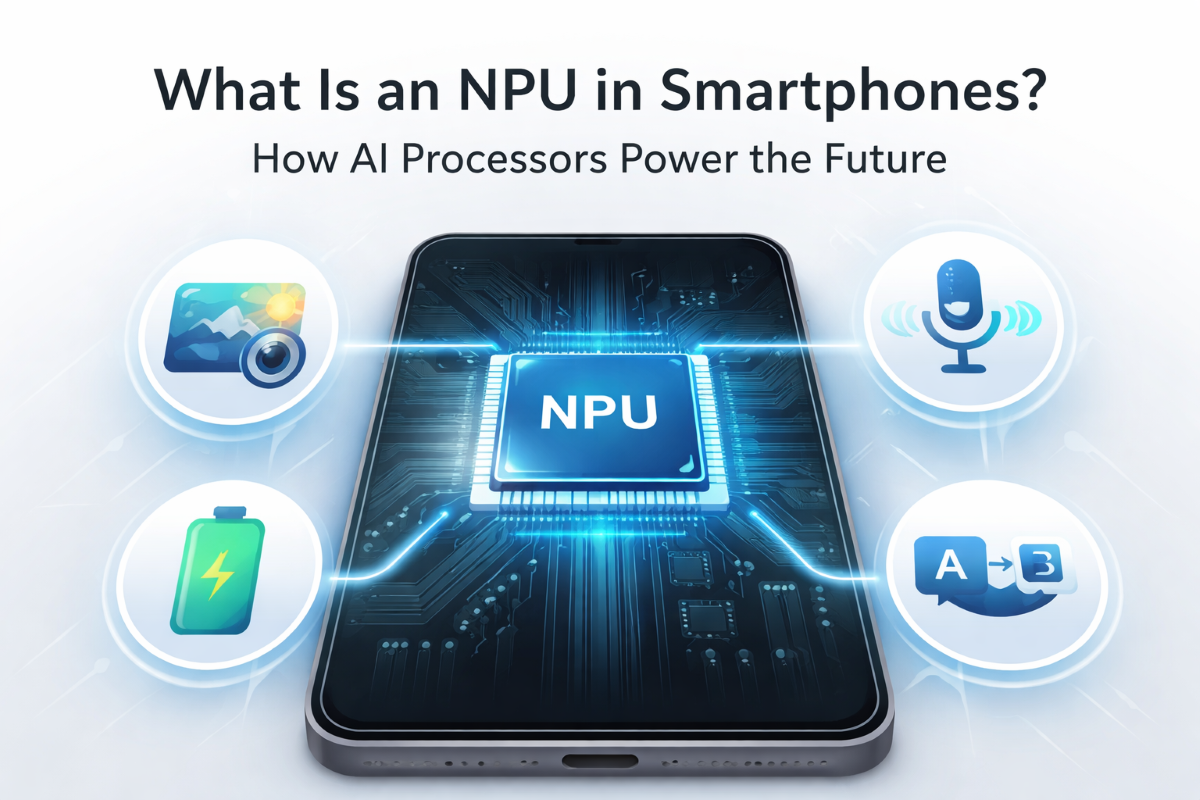
An NPU (Neural Processing Unit) is a specialized processor designed to handle artificial intelligence (AI) and machine learning (ML) tasks directly on a device. It is built to efficiently process complex data patterns, enabling smartphones to perform tasks that require learning, recognition, and prediction.
Unlike traditional processors:
- A CPU handles general-purpose operations
- A GPU handles graphics and parallel workloads
- An NPU handles AI-specific computations such as neural networks
This distinction is critical. AI workloads involve repetitive, parallel mathematical operations, particularly matrix multiplications. NPUs are optimized for these operations, allowing them to execute AI tasks faster and with significantly lower power consumption than CPUs or GPUs.
How an NPU Works: A Simplified Explanation
At its core, an NPU is designed to process neural networks, which are systems modeled after the human brain’s ability to recognize patterns. These networks analyze large datasets to identify relationships, make predictions, and improve over time.
When you take a photo, use voice commands, or unlock your phone with facial recognition, the NPU processes data through trained models. It identifies patterns in facial features, speech tones, and image elements, delivering results almost instantly.
Unlike CPUs, which process tasks sequentially, NPUs operate in parallel. This means they can process multiple data points simultaneously, making them significantly more efficient for AI workloads. The result is faster processing, lower latency, and reduced energy consumption.
Why NPUs Are Essential in Modern Smartphones
Modern smartphones are expected to do more than execute commands. They are expected to understand context, anticipate needs, and deliver intelligent responses in real time. NPUs make this possible.
AI Photography and Imaging
Smartphone cameras rely heavily on AI for tasks such as scene detection, HDR processing, and low-light enhancement. The NPU analyzes the scene, identifies objects, adjusts exposure, and enhances details in real time.
This is why modern smartphones can produce high-quality images without requiring manual adjustments.
Voice Recognition and Assistants
Voice assistants depend on fast and accurate speech recognition. NPUs enable on-device processing of voice commands, reducing reliance on cloud services.
This leads to faster responses, improved accuracy, and enhanced privacy since data does not always need to be transmitted externally.
Real-Time Translation and Communication
NPUs power real-time language translation, enabling users to communicate across languages instantly. This functionality is particularly valuable in diverse and multilingual environments.
Smart Battery and Performance Optimization
NPUs analyze user behavior and optimize system performance accordingly. They manage background processes, prioritize frequently used apps, and dynamically adjust power usage.
This contributes to longer battery life and more consistent performance.
NPU vs CPU vs GPU: Understanding the Difference
| Processor | Primary Role | Strength |
| CPU | General processing | Versatility |
| GPU | Graphics and parallel tasks | High throughput |
| NPU | AI and machine learning | Efficiency and intelligence |
The key advantage of an NPU lies in its specialization. Tasks that consume significant CPU power can be executed more efficiently on an NPU, resulting in better performance and lower energy consumption.
On-Device AI vs Cloud AI: A Fundamental Shift
One of the most important developments enabled by NPUs is the transition from cloud-based AI to on-device AI.
Previously, many AI tasks required sending data to remote servers for processing. This introduced delays, increased data usage, and raised privacy concerns.
With NPUs, these tasks are processed directly on the device. This results in:
- Faster response times
- Reduced latency
- Offline functionality
- Improved data privacy
This shift is not incremental. It represents a fundamental change in how smartphones operate.
Power Efficiency: The Hidden Advantage of NPUs
AI tasks are computationally intensive. Running them on CPUs or GPUs can quickly drain battery life. NPUs are designed to handle these tasks efficiently, reducing power consumption while maintaining performance.
This is one of the key reasons modern smartphones can deliver advanced AI features without compromising battery life. It also aligns with the broader trend of power-efficient chipsets, where performance is balanced with energy optimization.
Why NPUs Are the Future of Smartphones
1. Intelligence Is Becoming the Core Experience
The future of smartphones is not defined by faster processors alone. It is defined by how intelligently devices can interact with users. NPUs enable this shift by powering features that adapt, learn, and improve over time.
2. AI-Driven Features Are Expanding Rapidly
From photography and gaming to security and productivity, AI is becoming central to the smartphone experience. NPUs provide the foundation for these features, ensuring they are fast, efficient, and scalable.
3. Improved Longevity and Relevance
Devices with strong AI capabilities tend to age better. As software evolves, these devices can support new features and optimizations, extending their usability.
4. Reduced Dependence on Connectivity
On-device AI reduces reliance on internet connectivity. This is particularly important in regions where network access may be inconsistent, enabling users to access advanced features without interruption.
Common Misconceptions About NPUs
Many users assume that AI features are purely software-driven. In reality, hardware acceleration is essential for efficient AI processing. Without an NPU, performance and battery efficiency would suffer.
Another misconception is that NPUs are only relevant in flagship devices. Increasingly, mid-range smartphones are integrating NPUs, making AI capabilities more accessible across different price segments.
Practical Buying Insight: Should You Care About NPU?
When evaluating a smartphone, the presence and capability of an NPU should be considered alongside CPU, GPU, and battery performance.
A device with a capable NPU will:
- Deliver better AI-driven features
- Offer improved battery efficiency
- Provide faster and more responsive interactions
- Remain relevant for a longer period
Understanding this helps users make more informed decisions, especially in a market where specifications can be misleading.
Final Verdict: Intelligence Defines Modern Performance
The smartphone industry is shifting from performance-driven metrics to intelligence-driven experiences. The NPU is at the center of this transition.
It enables devices to process information faster, respond more intelligently, and operate more efficiently. As AI continues to shape the future of technology, the importance of NPUs will only grow.
The future of smartphones will not be defined by how fast they run, but by how intelligently they think, learn, and adapt in real time.
JuaTech Africa Perspective: Decoding the Future
At JuaTech Africa, the goal of JuaTech Decoded is to move beyond specifications and provide a meaningful understanding. The NPU is not just another component. It represents a shift toward smarter, more adaptive technology.
By understanding what an NPU is and how it works, users are better equipped to evaluate devices, anticipate future trends, and make decisions that align with real-world value.