

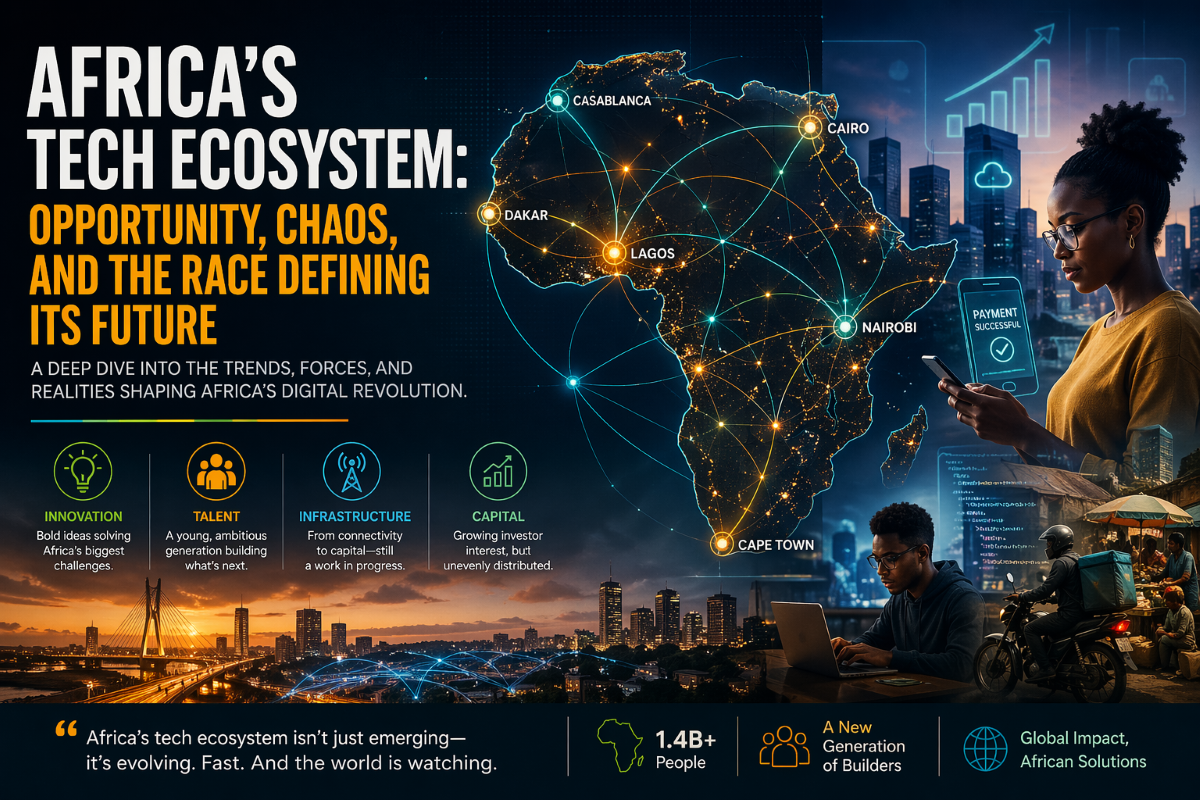
Africa’s tech ecosystem is accelerating—but not evenly, and not without friction. From capital gaps to infrastructure breakthroughs, this deep dive breaks down what’s really happening, where the real opportunities lie in Africa, and what it means for you if you want to build, invest, or stay ahead.
Africa’s Tech Ecosystem Is Not a Growth Story. It Is a Structural Response to Constraint
Africa’s tech ecosystem is widely presented as a story of acceleration. Funding rounds are announced in rapid cycles, valuations are rising, and a growing number of startups are signaling momentum across cities such as Lagos and Nairobi. The narrative is persuasive and, at a glance, easy to accept. A continent long constrained by structural limitations appears to be entering a phase of digital expansion driven by mobile connectivity, entrepreneurial energy, and increasing global capital.

The problem is not that this narrative is wrong. The problem is that it is incomplete.
Africa’s tech ecosystem is not simply growing. It is being forced into existence by structural inefficiencies that traditional systems have failed to resolve. Payments do not move seamlessly across borders. Access to financial services remains uneven. Logistics networks are inconsistent, and infrastructure gaps persist across critical sectors. These are not marginal constraints. They are systemic conditions that shape how technology is built, adopted, and scaled across the continent.
This distinction matters because growth, on its own, is a poor indicator of long-term value. Momentum attracts attention, but structure determines outcomes. For founders building companies, investors allocating capital, and professionals positioning themselves within the digital economy, the ability to interpret structure rather than react to headlines creates a measurable advantage. It enables earlier positioning, clearer prioritization, and a more accurate risk assessment.
At a structural level, Africa’s tech ecosystem operates through the interaction of three forces: constraint, capital, and adaptation.
A constraint defines the problem space. Limited financial inclusion, inefficiencies in cross-border payments, gaps in identity systems, and uneven infrastructure create persistent demand for alternative solutions. These constraints do not suppress innovation. They direct it. Entire categories, particularly in fintech and logistics, have emerged because existing systems could not meet the requirements of scale and accessibility.
Capital introduces a second layer of influence. Over the past decade, venture funding into African startups has increased materially, with fintech, mobility, and digital services attracting the largest share. However, this capital is not evenly distributed. It concentrates in a small number of ecosystems, shaping which markets scale, which founders gain visibility, and which problems receive sustained attention. Capital, in this context, does more than fund innovation. It defines its boundaries.
Adaptation connects constraint and capital. It reflects how founders, operators, and technologists design solutions that function within real-world limitations rather than ideal conditions. The rise of mobile-first platforms, interoperable payment systems, and infrastructure-light business models illustrates this adaptive process. Companies such as Flutterwave did not emerge from favorable conditions. They emerged from necessity, solving inefficiencies that were too significant to ignore and too widespread to remain unaddressed.
This interaction between constraint, capital, and adaptation produces an ecosystem that is both dynamic and uneven. Progress in one sector does not guarantee system-wide advancement. Success in one market does not easily translate into another. Opportunities exist, but they are tied to specific conditions that require careful interpretation rather than broad generalization.
For a reader operating within this environment, the implication is direct. It is not enough to recognize that Africa’s tech ecosystem is expanding. The more important task is to understand how that expansion is structured, where it is concentrated, and what signals it provides about future direction. Clarity at this level reduces exposure to hype and increases the ability to identify opportunities grounded in real demand.
This analysis is designed to provide that clarity. It moves beyond surface-level narratives to examine the underlying mechanics of Africa’s tech ecosystem, the forces shaping its trajectory, and the opportunities and risks that define its current phase. The objective is not simply to inform, but to equip you with a more precise understanding of how the system operates and where meaningful advantage can be found within it.
Africa’s Tech Ecosystem Isn’t What It Seems
The prevailing narrative around the African tech ecosystem is driven by visibility. Funding announcements, expansion headlines, and a growing list of venture-backed startups create the impression of a system moving in a clear upward trajectory. It signals progress and attracts attention, but it does not explain how the system actually works. For founders, investors, and technology professionals, understanding that difference is where real advantage begins.
At a structural level, Africa’s tech ecosystem does not operate as a unified market. It functions as a collection of distinct, unevenly developed environments shaped by regulatory differences, currency volatility, infrastructure gaps, and divergent consumer behavior. Generalizing the continent into a single narrative obscures the realities that determine success or failure. A solution that works in one market often encounters entirely different constraints in another. Fragmentation is not incidental. It is a defining condition.
Cities such as Lagos, Kigali, Nairobi, and Cape Town have emerged as focal points within this system, attracting disproportionate levels of capital, talent, and ecosystem support. Their prominence can suggest uniform progress across the continent. In reality, they are concentrated nodes within a broader, uneven landscape. Capital flows into these hubs reinforce their growth while leaving adjacent markets undercapitalized. For founders, this creates a strategic tension between operating in competitive, well-funded ecosystems and underserved markets where demand exists but support structures are thinner.
This concentration of capital introduces a critical dynamic. Venture funding into African startups has increased, particularly in fintech and digital services, but its distribution remains uneven. A small number of companies and markets absorb a disproportionate share, creating a feedback loop where visibility attracts capital and capital reinforces visibility. The result is not a balanced ecosystem but a layered one, where some segments scale rapidly while others struggle to reach viability.
As a result, growth metrics alone become unreliable indicators of ecosystem health. Headline figures signal momentum, but they do not capture sustainability or market depth. A startup may scale within a favorable environment yet face significant friction when expanding beyond its initial market. Cross-border scaling remains a persistent challenge, shaped by regulatory divergence, currency constraints, and logistical complexity. For builders and investors, scale in Africa is not simply a function of demand. It is a function of navigable complexity.
At the same time, constraints continue to drive innovation. In more mature ecosystems, innovation often builds on existing infrastructure. In Africa, it frequently emerges in response to its absence. The widespread adoption of mobile-first solutions reflects a practical adaptation to limited fixed infrastructure and the need for accessible, low-friction services. Payment systems, identity frameworks, and distribution models are designed to operate within these realities rather than assuming their resolution.
Companies such as Flutterwave illustrate a broader pattern. Solutions that succeed at scale tend to address systemic inefficiencies rather than incremental improvements. They integrate fragmented systems, enabling transactions and access that would otherwise remain constrained. For founders, the implication is direct. The most valuable opportunities are rarely found in replicating existing models. They are found in solving structural inefficiencies at scale.
For technology professionals, demand is increasingly shaped by practical capability rather than abstract specialization. Skills aligned with infrastructure development, interoperability, and scalable system design are becoming more relevant than those tied solely to mature markets. The ability to build within constraints, design for variability, and scale across fragmented environments is emerging as a defining advantage.
What emerges is a more precise view of the African tech ecosystem. It is not a uniform growth story. It is a layered system where opportunity is tied to context, capital accelerates selectively, and constraint continues to define both problems and solutions. Surface-level indicators provide visibility. The real advantage comes from understanding how the system actually behaves and positioning accordingly.
The Forces Driving Growth in Africa’s Tech Ecosystem
Growth in the African tech ecosystem follows identifiable patterns. It is shaped by structural demand, user behavior, and the practical realities of operating within constrained environments. For founders, investors, and technology professionals, understanding these forces provides a more reliable basis for decision-making than relying on funding headlines or valuation milestones.
The most visible of these forces is fintech. Financial services remain structurally underserved across large parts of the continent, with significant portions of the population operating outside formal banking systems. This gap has created sustained demand for payment infrastructure, digital wallets, lending platforms, and cross-border transaction solutions. Companies such as Flutterwave demonstrate that solving payment friction at scale is not only commercially viable but foundational to broader digital growth. In this context, fintech functions less as a standalone sector and more as an infrastructure layer that enables commerce, mobility, and digital services to operate efficiently.
Closely linked to fintech is the dominance of mobile-first behavior. In many African markets, mobile devices serve as the primary gateway to the internet, financial services, and digital platforms. This has shaped user expectations around accessibility, simplicity, and speed. Products that succeed are designed with these constraints in mind, prioritizing low data consumption, intuitive interfaces, and seamless onboarding. For builders, this reinforces a critical principle. Solutions must align with how users actually interact with technology, not how they are expected to in more developed ecosystems.
Talent represents another defining force, though it operates with different dynamics. Africa’s pool of developers, engineers, and digital professionals has expanded steadily, supported by remote work and increasing global demand for technical skills. This creates a dual effect. It strengthens local innovation capacity while introducing competition for talent from international companies. For technology professionals, this environment creates leverage. Skills developed within local ecosystems often have global relevance, enabling participation across both domestic and international markets.
These forces do not operate in isolation. They reinforce each other. Fintech growth increases demand for technical talent. Mobile-first adoption expands the addressable market for digital services. Talent availability accelerates product development and iteration. Together, they create a feedback loop that sustains momentum, even within structurally constrained environments.
However, these drivers do not eliminate underlying challenges. They operate within the same conditions defined by fragmentation, uneven infrastructure, and capital concentration. As a result, growth remains uneven and context-dependent. Opportunities that emerge from these forces are real, but they are shaped by the same constraints that define the broader ecosystem.
For anyone engaging with the African tech ecosystem, the implication is direct. Growth is not accidental, and it is not uniformly distributed. It follows patterns that can be understood, interpreted, and acted upon. The ability to recognize those patterns is what separates participation from positioning.
Where the Real Opportunities Are in Africa’s Tech Ecosystem
Opportunity in the Africa tech ecosystem does not sit where visibility is highest. It sits where systems are inefficient, fragmented, or absent. For founders, investors, and technology professionals, this distinction is critical because it shifts focus from replicating proven models to solving structural problems that persist at scale.
A significant portion of opportunity lies in infrastructure gaps. Across payments, logistics, identity systems, and data access, foundational layers remain underdeveloped or inconsistent across markets. These gaps are not temporary. They are persistent features of the ecosystem, shaped by regulatory variation, economic diversity, and uneven infrastructure development. For builders, this creates a different kind of opportunity. Instead of competing in saturated application-level markets, value can be created by enabling the systems that those applications depend on.
Payments illustrate this clearly. While consumer-facing fintech products continue to grow, the deeper opportunity lies in interoperability, cross-border transactions, and integration across fragmented financial systems. Companies such as Flutterwave have demonstrated that solving these challenges unlocks entire ecosystems of commerce. For investors, this signals a shift in focus. The most scalable opportunities are often found in infrastructure that enables multiple businesses rather than single end-user products.
Beyond core infrastructure, underserved markets present another layer of opportunity. Much of the ecosystem’s attention remains concentrated in major urban hubs such as Lagos and Nairobi, where capital, talent, and visibility are already established. However, significant demand exists beyond these centers, particularly in secondary cities and informal economies where digital adoption is increasing but solutions remain limited. For founders, this creates a strategic choice. Compete within established ecosystems or operate in markets where demand is clear but competition and support structures differ.
The informal economy represents one of the most underutilized opportunity spaces. A large share of economic activity across Africa operates outside formal systems, yet this segment is increasingly intersecting with digital tools. Payment digitization, inventory management, and access to micro-financing are areas where simple, well-designed solutions can create immediate value. These opportunities are often overlooked because they do not align with traditional venture narratives, but they reflect real demand at scale.
Another area of opportunity lies in business-to-business services. As startups scale and ecosystems mature, the need for operational infrastructure increases. This includes payment processing, logistics coordination, compliance tools, and data management systems. B2B solutions tend to receive less attention than consumer-facing products, yet they often provide more stable revenue models and deeper integration within the ecosystem. For investors and builders, this represents a shift from visibility-driven growth to sustainability-driven value creation.
It is important to recognize that these opportunities are shaped by the same constraints that define the ecosystem. Infrastructure gaps create opportunity, but they also introduce execution complexity. Underserved markets offer demand, but they require localized understanding and adaptability. B2B services provide stability, but they depend on the maturity of surrounding businesses. Opportunity, in this context, is not separate from constraint. It is a direct result of it.
For professionals looking to position themselves within this environment, the implications are practical. Skills aligned with infrastructure development, systems integration, and scalable operations are increasingly valuable. The ability to identify where systems break down and contribute to building solutions within those gaps creates relevance that extends beyond individual companies.
What defines opportunity in the Africa tech ecosystem is not visibility, but necessity. The most valuable solutions are those that align with how the system actually operates, not how it is expected to function. For those who understand this, the ecosystem becomes less about chasing trends and more about identifying patterns that consistently produce value.
The Structural Challenges No One Can Ignore in Africa’s Tech Ecosystem
Growth in the Africa tech ecosystem does not occur in stable conditions. It unfolds within environments defined by regulatory uncertainty, currency volatility, infrastructure limitations, and uneven access to capital. These are not temporary obstacles. They are structural realities that shape how businesses are built, scaled, and sustained. For founders, investors, and technology professionals, understanding these constraints is essential for making informed decisions and avoiding misaligned expectations.
Regulatory unpredictability remains one of the most significant challenges. Policy frameworks for digital services, fintech, and data management continue to evolve across many markets, often without consistent timelines or clear implementation pathways. This creates an environment in which rules can shift with little notice, affecting operations, compliance requirements, and business models. Startups in regulated sectors must remain adaptable, allocating resources to navigate policy changes rather than focusing solely on growth. For investors, this introduces a level of risk that extends beyond market demand.
Currency volatility further complicates operations. Fluctuations in exchange rates directly impact pricing, revenue stability, and cross-border transactions. Companies operating across multiple markets must manage financial models that are sensitive to currency movements, where revenue generated in one market may not translate predictably when converted. This affects margins, planning, and long-term sustainability, particularly for startups with cost structures tied to more stable global currencies.
Cross-border scaling remains a persistent structural hurdle. Africa’s ecosystem is fragmented across regulatory environments, payment systems, and logistics networks, making expansion from one country to another more complex than extending an existing model. Companies often need to rebuild operational frameworks for each new market, increasing both cost and execution risk. Scale, in this context, is not simply about demand. It is about the ability to navigate complexity across multiple systems.
Infrastructure limitations continue to influence product design and delivery. Inconsistent power supply, variable internet connectivity, and logistical inefficiencies affect reliability and user experience. While these constraints have driven innovation, they also impose limits that require additional layers of adaptability. Products must function within these conditions, not assume that they will be resolved.
Capital availability, while improving, remains uneven. Early-stage funding remains limited in many markets, and growth capital tends to concentrate in a few established ecosystems. This creates funding gaps that slow the progression of startups outside major hubs, even when demand exists. For investors, this concentration can lead to overexposure within specific markets while leaving broader opportunities underexplored.
These challenges do not operate independently. They reinforce each other, shaping the dynamics of the ecosystem as a whole. Regulatory shifts influence capital flows. Currency volatility affects expansion strategies. Infrastructure limitations impact adoption and scale. For anyone operating within the African tech ecosystem, the ability to navigate these interconnected pressures is as important as identifying opportunity.
The implication is not that these constraints limit growth. It is these conditions that define the conditions under which growth occurs. Those who understand this do not avoid the challenges. They build with them, design around them, and position themselves where complexity creates advantage.
The Disconnect Between Funding and Sustainability in Africa’s Tech Ecosystem
Funding has become one of the most visible signals of momentum in the African tech ecosystem. Investment announcements, rising valuations, and the emergence of high-profile startups create the impression that the market is moving toward maturity. Visibility, however, does not always reflect durability. The relationship between funding and long-term sustainability remains one of the least understood dynamics within the ecosystem.
Capital inflows have accelerated innovation, particularly in sectors such as fintech, mobility, and digital services. Access to venture funding enables startups to build infrastructure, expand operations, and acquire users at scale. Companies such as Flutterwave illustrate how capital can unlock growth within structurally constrained environments. However, funding does not guarantee that the underlying business model can sustain itself over time.
The tension between growth and sustainability is central. Startups often prioritize rapid user acquisition and market expansion to meet investor expectations, frequently operating at a loss in early stages. This approach can drive visibility and valuation, but it also introduces pressure to maintain growth trajectories that may not align with market realities. In environments where purchasing power varies and infrastructure costs remain high, scaling efficiently becomes more complex than headline growth suggests.
Venture capital structures further shape this dynamic. Investment models are typically built around expectations of rapid growth and defined exit timelines. These expectations do not always align with the pace at which markets across Africa develop. As a result, startups must navigate competing priorities between building sustainable operations and delivering short-term growth. For founders, this requires disciplined capital allocation and clarity on long-term viability.
Revenue generation adds another layer of constraint. Monetization strategies must account for price sensitivity, informal market structures, and uneven levels of digital adoption. A growing user base does not automatically translate into proportional revenue. This disconnect can mask underlying weaknesses in business models that only become visible over time. For investors, it reinforces the need to evaluate fundamentals beyond user metrics and surface-level growth.
Funding concentration also contributes to the imbalance. Capital tends to flow into a limited number of sectors and geographies, particularly fintech and established hubs such as Lagos and Nairobi. This reinforces existing growth centers while leaving emerging markets and alternative sectors underfunded. The result is a perception of ecosystem maturity that does not fully reflect the broader landscape.
What emerges is a more precise understanding of funding within the Africa tech ecosystem. Capital is essential for enabling growth, but it does not define success. Sustainability depends on building models that align with market realities, manage costs effectively, and scale within the constraints that characterize the environment.
The disconnect between funding and sustainability does not weaken the case for Africa’s tech ecosystem. It clarifies it. It separates visibility from viability and forces a more disciplined understanding of what success actually looks like. In a system defined by constraint, the companies that endure will not be those that grow fastest, but those that align most closely with how the market truly operates.
Africa’s Tech Ecosystem as a Connected System
Africa’s tech ecosystem cannot be fully understood through country-level analysis. While markets operate within national boundaries, the forces that shape growth, innovation, and scale extend beyond them. Capital, talent, and technology move across borders, creating patterns that connect otherwise fragmented environments. For founders, investors, and technology professionals, recognizing these connections is essential for understanding how opportunity develops and where it can be sustained.
Certain ecosystems act as primary nodes within this structure. Cities such as Lagos, Nairobi, and Cape Town have developed concentrations of capital, talent, and operational experience that influence broader regional dynamics. Innovations that emerge within these hubs often set patterns that are adapted across other markets, shaped by local regulatory and infrastructural conditions.
Fintech provides a clear illustration of this interconnected behavior. Payment solutions developed to address inefficiencies in one market frequently expand into others through adaptation rather than direct extension. Companies such as Flutterwave operate across multiple markets, integrating fragmented financial systems and enabling cross-border transactions. Their growth reflects a broader pattern where solving localized problems can generate regional impact when systems are sufficiently aligned.
Talent mobility reinforces these connections. Developers, engineers, and operators increasingly work across borders, either physically or through remote collaboration. This creates a shared layer of expertise that contributes to ecosystem development beyond individual markets. Knowledge, practices, and technical standards circulate more rapidly, reducing isolation between local ecosystems. For professionals, this expands opportunity, as skills developed in one market can be applied across multiple environments.
These connections, however, do not eliminate fragmentation. Regulatory differences, currency variations, and infrastructure gaps continue to limit seamless integration. Cross-border expansion requires adaptation to local conditions, and success in one market does not automatically translate into another. The system is connected, but not unified, and this distinction defines how scale is achieved.
Trade and logistics further illustrate this complexity. The movement of goods, services, and capital across borders depends on both physical infrastructure and policy frameworks. Improvements in regional trade agreements and digital payment systems have reduced some friction, but inconsistencies remain. For founders building logistics or commerce platforms, this creates both opportunities and constraints, making solutions that navigate these inconsistencies essential infrastructure.
What emerges is a system defined by partial integration. Markets are linked through capital flows, talent mobility, and shared problem spaces, yet separated by structural differences that require continuous adaptation. For investors, this means that ecosystem analysis must extend beyond national metrics to include regional dynamics and interdependencies.
Understanding Africa’s tech ecosystem as a connected system does not reduce its complexity. It makes it more predictable. It reveals patterns that are not visible in isolated analysis and provides a clearer basis for interpreting growth, opportunity, and risk across the continent.
What the Future Looks Like for Africa’s Tech Ecosystem
The next phase of the Africa tech ecosystem will be defined less by expansion and more by execution. Growth will continue, but it will become more selective, more disciplined, and more closely tied to the realities that have always shaped the market. For founders, investors, and technology professionals, the shift is already underway. The question is no longer where opportunity exists, but how effectively it can be converted into sustainable value.
Consolidation across key sectors will accelerate. As competition intensifies and capital becomes more disciplined, weaker business models will struggle to sustain themselves. Startups that depend primarily on funding to drive growth without clear paths to profitability will face increasing pressure. In contrast, companies built around real demand, operational efficiency, and adaptable models will strengthen their position. This transition reflects a maturing ecosystem where durability begins to outweigh visibility.
Infrastructure will define the next wave of value creation. The structural gaps that have shaped the ecosystem, particularly in payments, logistics, and identity systems, are increasingly being addressed by companies building foundational layers rather than end-user applications. This shift toward infrastructure-led innovation reflects a deeper alignment with how the market operates. Solutions that enable other businesses to function more efficiently will play a central role in determining long-term outcomes.
Technology adoption will follow a practical trajectory. Artificial intelligence, data-driven systems, and automation will integrate into existing workflows as tools for improving efficiency and decision-making rather than as standalone innovations. Their impact will be shaped by local constraints, including data availability, infrastructure readiness, and cost sensitivity. Adoption will be driven by use cases that deliver measurable value, not speculative trends.
Regional integration will continue to evolve, gradually reducing some of the friction that has historically limited scale. Improvements in digital payments, trade frameworks, and cross-border collaboration are already creating pathways for broader market access. While fragmentation will remain, the ability to operate across multiple environments will improve. For founders, this creates an opportunity to design with regional applicability in mind from the outset.
Talent will remain a decisive factor. The combination of local experience and global exposure is raising the standard of execution across the ecosystem. As more professionals gain cross-market experience, the quality of products, operations, and strategic decision-making will improve. This will further reinforce the shift toward sustainability and operational discipline.
What emerges is not a simpler ecosystem, but a more structured one. Growth will persist, but it will favor those who understand how to operate within constraints rather than assume they can be removed. Capital will remain available, but it will reward clarity and efficiency over scale for its own sake.
The future of the Africa tech ecosystem will not be shaped by momentum alone. It will be shaped by those who can interpret its structure, adapt to its constraints, and build systems that align with how the market actually functions.
What This Means for You in Africa’s Tech Ecosystem
Understanding the Africa tech ecosystem only matters if it changes how you act within it. The patterns that define this environment, from constraint and capital concentration to adaptation and uneven growth, are not theoretical. They shape where opportunity exists, how it scales, and who is best positioned to capture it. For founders, investors, and technology professionals, the advantage lies in applying this understanding with clarity and intent.
For founders, the implication is strategic focus. Opportunity does not come from replicating models that have already succeeded in more developed markets. It comes from identifying where systems fail and building solutions that align with those gaps. The more relevant question is not what works elsewhere, but what does not work here, and why. Solutions that address inefficiencies in payments, logistics, or service access do more than meet demand. They enable the system itself to function more effectively, creating value that can scale across markets.
For investors, the ecosystem demands disciplined evaluation. Visibility and funding momentum provide signals, but they do not define long-term viability. A deeper assessment of business models, cost structures, and market fit becomes essential. This includes understanding how startups generate revenue in price-sensitive environments, manage operational complexity, and expand across fragmented markets. In this context, capital allocation is not just about identifying growth. It is about identifying resilience.
For technology professionals, the opportunity lies in capability alignment. Demand is increasingly shaped by the need to build systems that operate under constraint. Skills related to infrastructure development, systems integration, data management, and scalable architecture are becoming more valuable than those tied solely to stable, mature environments. The ability to design for variability, optimize for efficiency, and build across different market conditions creates relevance that extends beyond individual roles or companies.
Across all three groups, a common principle applies. Decisions based on visibility tend to follow trends. Decisions based on structure anticipate them. This distinction becomes more important as the ecosystem matures and competition intensifies.
The Africa tech ecosystem rewards a different kind of positioning. It favors clarity over speed, execution over visibility, and adaptability over scale for its own sake. Those who understand this are not just participating in its growth; they are shaping it. They are positioning themselves to benefit from how that growth actually unfolds.
Opportunity Exists, But It Is Not Evenly Distributed
A single narrative does not define Africa’s tech ecosystem. It is shaped by a set of structural realities that determine where growth occurs, how it scales, and who benefits from it. Constraint, capital, and adaptation continue to drive its evolution, shaping everything from product design to market expansion. What emerges is not a uniform opportunity landscape, but a system where outcomes are uneven and context-dependent.
The visibility of growth, through funding rounds, startup expansion, and ecosystem activity, can create the impression of broad-based progress. In practice, that progress remains concentrated. Capital continues to flow into specific sectors and markets. Talent clusters around established hubs. Infrastructure improvements are uneven, often advancing in pockets rather than across entire regions. For anyone engaging with the ecosystem, this concentration is not a limitation to be ignored. It is a signal to be interpreted.
Understanding this distribution changes how opportunity is approached. It shifts the focus from chasing visible trends to identifying underlying patterns. It requires looking beyond where activity is highest and examining where systems remain inefficient or underserved. In many cases, the most meaningful opportunities are not in saturated areas but in those that are structurally overlooked.
This does not make the ecosystem less attractive. It makes it more precise. Opportunity exists, but it demands a higher level of awareness and discipline. Founders must build with a clear understanding of market conditions rather than assumptions of uniform demand. Investors must evaluate beyond momentum and assess how businesses align with structural realities. Technology professionals must develop capabilities that remain relevant across varying environments.
The Africa tech ecosystem rewards those who understand how it actually operates. It favors individuals and organizations that can interpret constraints, navigate complexity, and build within the conditions that define the market. Growth will continue, but it will not be evenly shared. The advantage will belong to those who recognize where value is concentrated, where it is emerging, and how to position themselves accordingly.
In that context, the question is no longer whether opportunity exists. It is whether it is being approached with the clarity required to capture it.