
JuaTech Africa
TRENDING
No Result
View All Result
  • Explore
    • Buying Guides
      • Smartphones
      • Tablets & Productivity
      • Wearables
      • Audio
      • Accessories
    • Creator Hub
      • Creator Phones
      • Creator Audio
      • Creatives Growth Strategy
      • Creator Business
    • About Us
      • Founder’s Letter: The Vision Behind JuaTech Africa
      • Mission & Vision | JuaTech Africa
      • Editorial Policy
      • Advisory
      • Work with Us
      • Contact Us
  • Intelligence
    • JuaTech Africa Intelligence
    • Brand Intelligence
    • Market Intelligence
    • Mobile Imaging Intelligence
    • Industry Intelligence
    • Market Signals
    • Analytica
    • Artificial Intelligence
    • Digital Assets Intelligence
  • Reviews
    • Smartphones
    • Tablets
    • Audio
    • Wearables
    • Accessories
  • Tech Decoded
    • Core Technology
    • Device Hardware
    • Software & Platforms
    • Connectivity & Networks
    • AI & Emerging Technology
    • Buying, Safety & Integrity
    • Tech Guides & How-To
    • Product Strategy & Value Analysis
  • Ecosystems
    • Mobile Ecosystems
    • African Tech Ecosystem
    • Company Ecosystems
    • Platform Ecosystems
SUBSCRIBE
  • Explore
    • Buying Guides
      • Smartphones
      • Tablets & Productivity
      • Wearables
      • Audio
      • Accessories
    • Creator Hub
      • Creator Phones
      • Creator Audio
      • Creatives Growth Strategy
      • Creator Business
    • About Us
      • Founder’s Letter: The Vision Behind JuaTech Africa
      • Mission & Vision | JuaTech Africa
      • Editorial Policy
      • Advisory
      • Work with Us
      • Contact Us
  • Intelligence
    • JuaTech Africa Intelligence
    • Brand Intelligence
    • Market Intelligence
    • Mobile Imaging Intelligence
    • Industry Intelligence
    • Market Signals
    • Analytica
    • Artificial Intelligence
    • Digital Assets Intelligence
  • Reviews
    • Smartphones
    • Tablets
    • Audio
    • Wearables
    • Accessories
  • Tech Decoded
    • Core Technology
    • Device Hardware
    • Software & Platforms
    • Connectivity & Networks
    • AI & Emerging Technology
    • Buying, Safety & Integrity
    • Tech Guides & How-To
    • Product Strategy & Value Analysis
  • Ecosystems
    • Mobile Ecosystems
    • African Tech Ecosystem
    • Company Ecosystems
    • Platform Ecosystems
No Result
View All Result
JuaTech Africa
No Result
View All Result
Home Tech Decoded Device Hardware

Why Chipsets Are More Power Efficient: Understanding the Technology Behind Better Battery Life

A complete guide to chipset efficiency, explaining how modern processors use less power to deliver better performance, longer battery life, and sustained thermal stability

Lewis Wafula by Lewis Wafula
March 21, 2026
in Device Hardware
Reading Time: 5 mins read
0
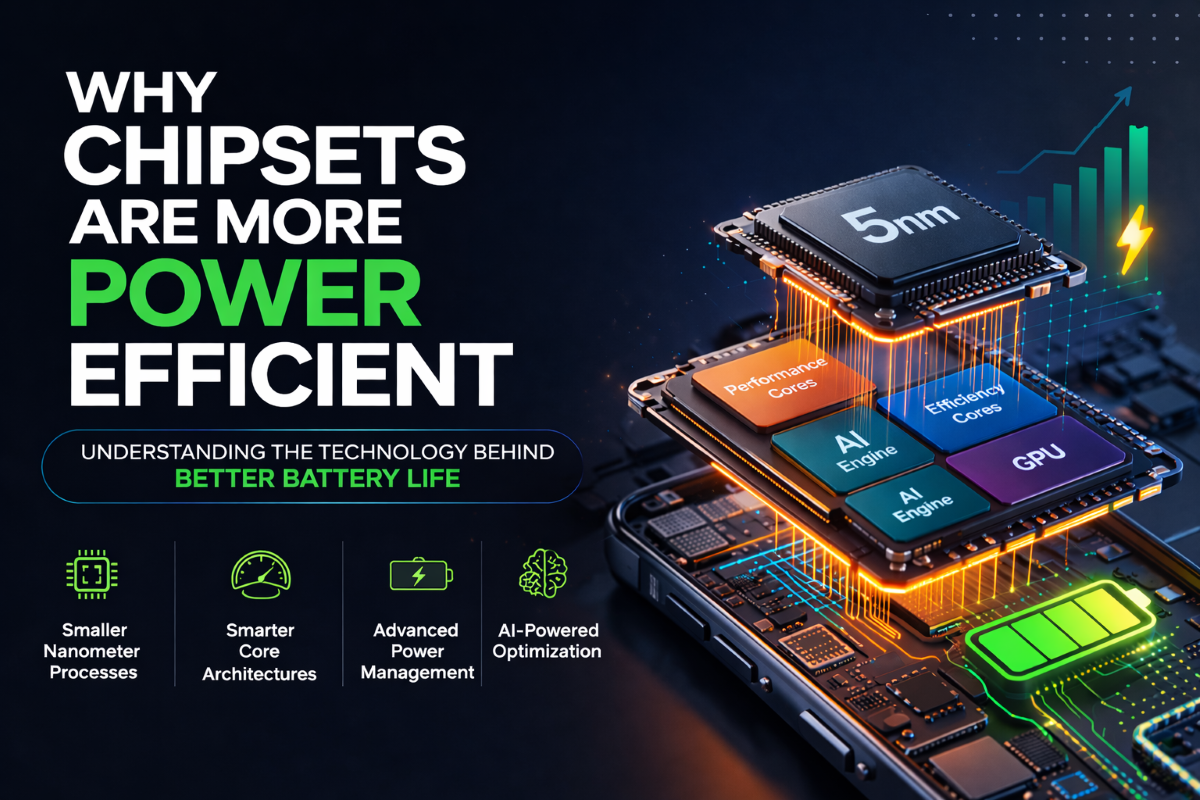
Illustration of a modern smartphone chipset showing power efficiency through smaller nanometer process, performance cores, efficiency cores, and battery optimization

Modern smartphone chipsets use smaller nanometer processes, hybrid core architectures, and intelligent power management to deliver better performance with improved battery life.

0
SHARES
44
VIEWS
Share on FacebookShare on Twitter

Jump Ahead

Toggle
  • The Shift Toward Smarter Performance
  • Why Are Chipsets More Power-Efficient Today?
  • Understanding Power Efficiency in Chipsets
  • The Impact of Smaller Nanometer Processes
  • Hybrid Architecture: Balancing Power and Efficiency
  • Advanced Power Management and Scheduling
  • Instruction Efficiency and Specialized Processing Units
  • Thermal Efficiency and Sustained Performance
  • Real-World Impact: What Users Actually Experience
  • Common Misconceptions About Power Efficiency
  • Practical Buying Guidance: What Should You Look For?
  • Final Verdict: Efficiency Defines Modern Performance
  • JuaTech Africa Perspective: Clarity That Drives Better Decisions

The Shift Toward Smarter Performance

Modern smartphones are faster, thinner, and more powerful than ever, yet they last longer on a single charge than devices from just a few years ago. This is not accidental. It reflects a fundamental shift in how chipsets are designed and optimized. Performance today is no longer defined solely by raw power. It is defined by how efficiently that power is used.

For most users, battery life remains one of the most important factors when choosing a smartphone. Questions such as why some phones last longer despite similar battery sizes, or why newer devices feel faster yet consume less power, are increasingly common. The answer lies within the chipset.

Strategic Marketing by Alpha Brands Consulting

At JuaTech Africa, JuaTech Decoded exists to provide clarity on such questions by translating complex technology into practical understanding. This article explains why modern chipsets are more power efficient, the technologies driving this improvement, and how it directly affects your everyday smartphone experience.

Why Are Chipsets More Power-Efficient Today?

Modern chipsets are more power-efficient because they combine smaller manufacturing processes, advanced core architectures, intelligent power management systems, and specialized processing units. These innovations allow processors to perform more work while consuming less energy, reducing heat generation and improving battery life without compromising performance.

Understanding Power Efficiency in Chipsets

Power efficiency refers to the ability of a processor to deliver performance while minimizing energy consumption. It is not simply about using less power. It is about maximizing the amount of work done per unit of energy.

An efficient chipset can complete tasks faster, reduce unnecessary background activity, and maintain stable performance over extended periods. This leads to longer battery life, cooler operation, and a more consistent user experience.

In practical terms, power efficiency determines how long your phone lasts during daily use, how well it handles demanding applications, and how reliably it performs over time.

The Impact of Smaller Nanometer Processes

One of the most significant drivers of power efficiency is the transition to smaller semiconductor manufacturing processes, measured in nanometers. The nanometer value represents the size of the transistors within a chip.

As chipsets evolve from larger nodes such as 10nm to smaller nodes like 5nm and 4nm, transistors become smaller, faster, and more efficient. Smaller transistors require less energy to switch on and off, thereby reducing power consumption. At the same time, more transistors can fit into the same physical space, enabling improved performance without increasing energy consumption.

This advancement also reduces heat generation, which is critical for maintaining consistent performance. Lower heat output means the processor can sustain higher performance levels without throttling, resulting in a smoother and more reliable user experience.

Hybrid Architecture: Balancing Power and Efficiency

Modern chipsets rely on hybrid architectures, commonly known as big.LITTLE design. This approach combines high-performance cores with energy-efficient cores within a single processor.

High-performance cores are designed to handle demanding tasks such as gaming, video editing, and intensive multitasking. These cores deliver strong performance but consume more power. Efficiency cores, on the other hand, handle lighter tasks such as messaging, browsing, and background processes while consuming significantly less energy.

The chipset dynamically assigns tasks to the appropriate cores based on workload. This ensures that high-power resources are used only when necessary, while everyday tasks are handled by low-power cores. This intelligent task allocation is one of the key reasons modern smartphones achieve better battery life without sacrificing performance.

Advanced Power Management and Scheduling

Power efficiency is not determined by hardware alone. Software plays an equally important role. Modern chipsets are equipped with advanced power management systems that monitor usage patterns and adjust performance in real time.

These systems regulate clock speeds, activate or deactivate cores based on demand, and optimize background processes to minimize unnecessary energy consumption. For example, when a user is scrolling through social media, the chipset reduces performance to conserve power. When launching a game or editing video, it increases performance to meet the demand.

Operating systems such as Android are designed to work closely with these chipsets, ensuring efficient resource allocation. This coordination between hardware and software allows devices to deliver smooth performance while maintaining energy efficiency.

Instruction Efficiency and Specialized Processing Units

Modern chipsets are designed to perform more work per cycle, a concept known as improved instruction efficiency. This means that even at lower clock speeds, newer processors can complete tasks faster than older ones.

In addition, many chipsets now include specialized processing units such as AI engines, image signal processors, and neural processing units. These components are optimized for specific tasks, allowing them to execute operations more efficiently than general-purpose CPU cores.

For example, image processing tasks such as HDR photography or video stabilization are handled by dedicated units that consume less power than the CPU would for the same task. Similarly, AI-driven features such as voice recognition and predictive behavior are processed more efficiently through specialized hardware.

By offloading these tasks from the main CPU, the chipset reduces overall power consumption and improves efficiency.

Thermal Efficiency and Sustained Performance

Power efficiency and thermal performance are closely linked. When a processor consumes excessive power, it generates heat. If this heat is not managed effectively, the device reduces performance to prevent damage, a process known as thermal throttling.

Efficient chipsets generate less heat, enabling consistent performance over longer periods. This is particularly important for tasks such as gaming, video recording, and extended usage sessions.

Improved thermal efficiency not only enhances user experience but also contributes to device longevity. Components that operate at lower temperatures are less prone to wear and degradation over time.

Real-World Impact: What Users Actually Experience

For users, the benefits of power-efficient chipsets are immediately noticeable. Devices last longer on a single charge, remain cooler during use, and deliver consistent performance throughout the day.

In practical terms, this translates to longer screen-on time, smoother multitasking, and reduced performance drops during demanding tasks. Applications open quickly, games run more smoothly, and background processes do not unnecessarily drain the battery.

For users in regions where access to reliable power may not always be guaranteed, power efficiency becomes even more valuable. A device that can sustain longer usage without frequent charging offers a clear and practical advantage.

Common Misconceptions About Power Efficiency

Many users assume that battery capacity alone determines how long a smartphone will last. While battery size is important, it is only one part of the equation. A poorly optimized chipset can drain even a large battery quickly, while an efficient processor can extend usage on a smaller battery.

Another common misconception is that older flagship processors are always better than newer mid-range chipsets. In reality, newer processors often offer improved efficiency, delivering better battery life and more consistent performance.

It is also widely believed that higher performance automatically leads to higher power consumption. While this was true in earlier generations, modern chipsets are designed to balance performance and efficiency, delivering both without significant compromise.

Practical Buying Guidance: What Should You Look For?

When choosing a smartphone, power efficiency should be a key consideration alongside performance and features. A device with a modern, well-optimized chipset will typically deliver better battery life and more consistent performance.

Users should prioritize devices with recent chipset generations, efficient architectures, and proven optimization. It is also important to consider real-world reviews and usage patterns rather than relying solely on specifications.

Understanding how chipsets manage power allows users to make more informed decisions, ensuring that their devices meet both performance and battery life expectations.

Final Verdict: Efficiency Defines Modern Performance

Power efficiency has become a defining characteristic of modern chipsets. It reflects a shift from raw performance to intelligent performance, where devices are designed to deliver the best possible experience with minimal energy consumption.

The most efficient chipsets are not necessarily the fastest on paper, but they provide the best balance between speed, battery life, and thermal stability.

JuaTech Africa Perspective: Clarity That Drives Better Decisions

At JuaTech Africa, the goal of JuaTech Decoded is to empower users with knowledge that goes beyond specifications. Understanding why chipsets are more power efficient enables users to evaluate devices based on real value rather than marketing claims.

True performance is no longer defined by how fast a device can run, but by how intelligently it uses power to sustain that performance over time.

Tags: battery lifebig.LITTLEchipset efficiencyCPU architectureMobile performancenanometer processpower efficiencyprocessor optimizationSmartphone hardwaresmartphone processorsTech Decodedthermal performance
ShareTweet
Strategic marketing and positioning by Alpha Brands Consulting Strategic marketing and positioning by Alpha Brands Consulting Strategic marketing and positioning by Alpha Brands Consulting
Previous Post

Clock Speed vs Core Count Explained: What Matters More?

Next Post

What is an NPU, and why is it the Future of Smartphones?

Lewis Wafula

Lewis Wafula

Tech Analyst | Reviewer | Founder of JuaTech Africa Tech analyst and founder of JuaTech Africa, delivering practical smartphone reviews, mobile tech insights, and digital solutions for professionals and businesses in Africa. Explore the latest insights on JuaTech Africa or get in touch for collaboration and consulting. Connect with Lewis.

Related Posts

Illustration of a smartphone chipset showing CPU, GPU, and AI components connected to speed, battery life, and performance indicators
Device Hardware

How Smartphone Chipsets Affect Speed, Battery Life, and Overall Performance

March 21, 2026
Illustration showing a smartphone chipset with a neural processing unit handling AI tasks such as image processing and voice recognition
Device Hardware

What is an NPU, and why is it the Future of Smartphones?

March 21, 2026
Illustration comparing CPU clock speed in GHz and core count in a smartphone processor to explain performance differences
Device Hardware

Clock Speed vs Core Count Explained: What Matters More?

March 21, 2026
Device Hardware

OLED vs LCD vs AMOLED Explained: Which Smartphone Display Is Best in 2026?

March 2, 2026
What Is a Smartphone GPU? Powering Gaming, Video & Performance
Device Hardware

What Is a Smartphone GPU and Why It Matters for Gaming and Performance

May 1, 2026
Smartphone lithium ion battery diagram showing energy flow and charging process.
Device Hardware

How Smartphone Batteries Work: Capacity, Charging, and Lifespan Explained

March 7, 2026
Next Post
Illustration showing a smartphone chipset with a neural processing unit handling AI tasks such as image processing and voice recognition

What is an NPU, and why is it the Future of Smartphones?

Leave a Reply Cancel reply

Your email address will not be published. Required fields are marked *

About the Founder

Lewis Wafula, Founder of JuaTech Africa

Lewis Wafula

Founder, JuaTech Africa

Helping Africans make smarter technology decisions through trusted reviews, buying guides, creator technology insights, and market intelligence.

Connect on LinkedIn

JuaTech Africa Intelligence

Independent research and market intelligence exploring the trends, technologies, and market forces shaping Africa's digital future.

📊 Flagship Research
  • 2025 Brand Performance Report
  • Q1 2026 Market Report
🧠 Research Areas
  • Analytica
  • Market Intelligence
  • AI Intelligence
Explore Intelligence

Join the JuaTech Intelligence Circle

Signal over noise. Get trusted reviews, market intelligence, buying guidance, and emerging technology insights shaping Africa's digital future.

Get Free Access

Essential Buyer Guides

Ultimate Smartphone Buying Guide Kenya 2025

The Ultimate Smartphone Buying Guide for Kenya (2026): How to Choose the Right Phone with Confidence

June 9, 2026
Best phones under KES 30,000 in Kenya 2026 including Samsung Galaxy A26, POCO M6 Pro, Tecno Camon 50, Infinix Note 40 and Oppo A60

Best Phones Under KES 30,000 in Kenya (2026): Smart Picks That Deliver Real Value

June 22, 2026
Best phones under 60000 Kenya 2026 including Samsung Galaxy A57, OnePlus Nord 6, Google Pixel 10a and Nothing Phone 4a comparison

Best Phone Under KES 60,000 (2026): 7 Phones That Actually Deliver Value Before You Spend Your Money

June 23, 2026
Battery Kings for power outages in Africa – editorial smartphone battery guide

Battery Kings: Best Smartphones for Power Outages, Value, and Daily Life in Africa

May 25, 2026
Best premium midrange smartphones in Kenya 2026 comparison featuring Samsung Galaxy A57, Vivo V70, Xiaomi Note 15 Pro Plus, Oppo Reno15 Pro and Nothing Phone 4a Pro

Best Premium Midrange Smartphones in Kenya (2026): Samsung, Redmi, HONOR, Pixel and More

May 25, 2026
Samsung Galaxy Z Fold8, Galaxy Z Fold8 Ultra and the Samsung Galaxy Z Fold8 Series showcased in JuaTech Africa's in-depth product review.

Samsung Galaxy Z Fold8 Review: Is This the Most Complete Foldable Smartphone Yet?

July 28, 2026

Tech Decoded

Beyond specifications and marketing claims. Deep analysis of the technologies, strategies, and emerging trends shaping how we build, buy, and use technology.

⚙️ Technology Explained

Breaking down complex technologies, specifications, and concepts into practical understanding.

💡 Product Strategy & Value Analysis

Understanding why products exist, how they are positioned, and the value they deliver.

🤖 AI & Emerging Technology

Exploring the technologies reshaping devices, industries, and digital experiences.

Explore Tech Decoded

Editor's Pick

Smartphone processors 2026 comparison showing Snapdragon, MediaTek Dimensity 9500 and Apple A19 Pro chips with flagship phones

Best Smartphone Processor 2026: Snapdragon vs Dimensity vs Apple What Actually Matters

April 24, 2026
MediaTek Dimensity 9500

Dimensity 9500 Unleashed: MediaTek’s 3nm Powerhouse Redefines Flagship Performance in 2025

June 19, 2026
HONOR smartphone naming explained showing X Series, Number Series and Magic Series lineup hierarchy for Kenyan buyers

HONOR Smartphone Naming Explained (2026 Kenya Master Guide)

Infinix Note Edge vs Samsung Galaxy A36 5G

Infinix Note Edge vs Samsung Galaxy A36 5G: Which Makes More Sense for Daily Use?

February 22, 2026

Work With JuaTech Africa

Reach technology consumers, creators, and decision-makers through trusted reviews, market intelligence, sponsored campaigns, and strategic partnerships.

Explore Opportunities

Helping You Choose Right

Insight | Clarity | Better Tech Decisions

  • JuaTech Africa Intelligence
  • Tech Reviews
  • Ecosystems Intelligence Hub
  • About Us

Connect With Us

  • About Us
  • Editorial Policy
  • Disclaimer
  • Our Services
  • Advertise
  • Newsletter
  • Contact Us
  • Media Kit

© 2026 JuaTech Africa. All rights reserved. Built for tech intelligence in Africa.

No Result
View All Result
  • Explore
    • Buying Guides
      • Smartphones
      • Tablets & Productivity
      • Wearables
      • Audio
      • Accessories
    • Creator Hub
      • Creator Phones
      • Creator Audio
      • Creatives Growth Strategy
      • Creator Business
    • About Us
      • Founder’s Letter: The Vision Behind JuaTech Africa
      • Mission & Vision | JuaTech Africa
      • Editorial Policy
      • Advisory
      • Work with Us
      • Contact Us
  • Intelligence
    • JuaTech Africa Intelligence
    • Brand Intelligence
    • Market Intelligence
    • Mobile Imaging Intelligence
    • Industry Intelligence
    • Market Signals
    • Analytica
    • Artificial Intelligence
    • Digital Assets Intelligence
  • Reviews
    • Smartphones
    • Tablets
    • Audio
    • Wearables
    • Accessories
  • Tech Decoded
    • Core Technology
    • Device Hardware
    • Software & Platforms
    • Connectivity & Networks
    • AI & Emerging Technology
    • Buying, Safety & Integrity
    • Tech Guides & How-To
    • Product Strategy & Value Analysis
  • Ecosystems
    • Mobile Ecosystems
    • African Tech Ecosystem
    • Company Ecosystems
    • Platform Ecosystems

© 2026 JuaTech Africa. All rights reserved. Built for tech intelligence in Africa.

JuaTech Africa

Typically replies within minutes

Any questions related to Why Chipsets Are More Power Efficient: Understanding the Technology Behind Better Battery Life?

WhatsApp Us

Online | Privacy policy

WhatsApp us