

As artificial intelligence adoption accelerates worldwide, AI infrastructure in Kenya is entering a decisive phase. While much of the public conversation continues to focus on models, applications, and innovation hubs, a more fundamental constraint is now shaping the direction of AI development: access to reliable, long-term power.
That reality was made clear in December 2025, when Alphabet, Google’s parent company, agreed to acquire U.S.-based clean energy developer Intersect Power in a $4.75 billion deal, CNBC reported. The decision was not driven by sustainability messaging or corporate optics. It was a strategic move to secure electricity for data centers as AI workloads push global power systems toward their limits.

Artificial intelligence is no longer constrained by imagination or talent. It is constrained by infrastructure.
The Global Shift from Software to Physical Systems
For more than a decade, progress in AI was largely software-driven. Advances came from better algorithms, faster chips, and more efficient training techniques. That phase is ending.
Today’s AI systems operate at an industrial scale. Training large models, running real-time inference, and supporting cloud platforms require continuous, high-density electricity. Industry projections show global data-center energy demand expected to more than double before the end of the decade, placing unprecedented pressure on national grids.
In response, technology companies are moving upstream. Rather than relying solely on public utilities, they are investing directly in energy generation, battery storage, and data-center-ready power sites.
Electricity has become a strategic asset in the AI economy.
What This Means for Kenya’s AI Ambitions
Kenya is widely recognised as one of Africa’s leading digital economies. The country has built a strong foundation through mobile innovation, fintech expansion, and a national AI strategy aimed at responsible adoption and local innovation.
However, artificial intelligence does not operate in abstract frameworks.
AI depends on physical systems: data centers, cooling infrastructure, high-capacity networks, and an uninterrupted power supply. Without these foundations, innovation remains external even when usage is local.
If AI infrastructure in Kenya is not intentionally developed, the country risks becoming primarily a consumer of intelligence built elsewhere. Local enterprises may deploy AI tools, but the underlying compute, data processing, and scale decisions will remain outside national control.
Renewable Energy Is an Advantage – If It Is Integrated
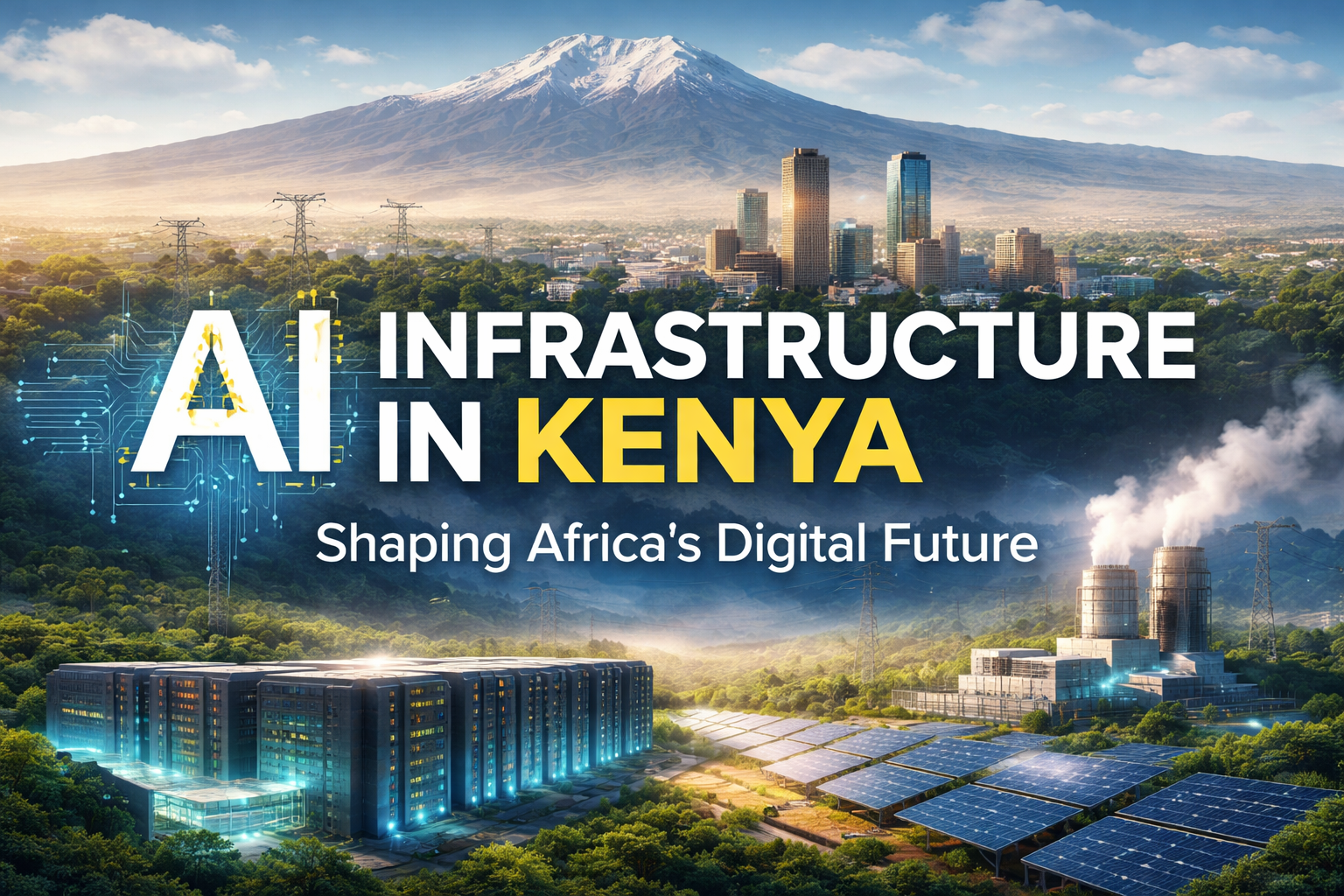
Kenya’s energy profile offers a rare strategic advantage. More than 80% of electricity generation comes from renewable sources, particularly geothermal, wind, hydro, and solar.
In a global environment where sustainability increasingly influences data-center investment decisions, this positions Kenya favourably.
Yet renewable availability alone does not translate into AI readiness.
Data centers require stable, predictable, high-density power delivered without interruption. They depend on grid resilience, redundancy, and long-term certainty that supports capital-intensive investment over decades.
Without deliberate alignment between renewable energy expansion and digital infrastructure planning, this advantage remains underutilised.
Africa’s Infrastructure Gap in the AI Era
Across Africa, AI adoption is accelerating. Businesses are integrating automation, governments are digitising services, and startups are building AI-enabled products.
At the same time, most of the infrastructure powering these systems remains externally owned.
Data is hosted abroad. Foreign providers control cloud capacity. Scaling decisions depend on infrastructure located outside the continent.
As global AI demand grows and energy constraints intensify, priority will naturally flow to regions that control their own infrastructure. Access becomes conditional; ownership becomes decisive.
The risk for Africa is not exclusion from artificial intelligence, but dependence on it.
Capacity Building as a Strategic Requirement
For Kenya, the conversation must now extend beyond adoption toward capability.
Sustainable AI development requires coordinated investment in local data centers, energy systems designed for high-density digital loads, long-term financing models, and partnerships that connect power generation with digital growth.
These are not short-term technology initiatives. They are structural decisions that determine competitiveness in an AI-driven global economy.
Countries that treat AI as a software opportunity alone will remain downstream of those that recognise its industrial nature.
Power as the New Currency of the Digital Economy
In earlier stages of digital transformation, advantage was shaped by connectivity and data. In the AI era, advantage is increasingly shaped by electricity.
Power enables compute.
Compute enables intelligence.
Intelligence enables economic leverage.
This is the logic guiding global investment decisions today.
Google’s move into energy development reflects a broader understanding taking hold across the technology sector: the future of AI belongs to those who can sustain it physically, not just design it digitally.
A Decision That Will Define the Decade Ahead
The question before Kenya is not whether artificial intelligence will influence its economy. That outcome is already assured.
The defining issue is whether Kenya will help build the systems that power AI — or remain dependent on infrastructure owned elsewhere.
AI infrastructure in Kenya will determine whether the country becomes a regional innovation hub or a downstream participant in the global AI economy.
As 2026 unfolds, this distinction will become increasingly visible.
The future of artificial intelligence is already being powered, planned, and positioned.
Where Kenya stands within it will depend on the choices made now.
Read also on JuaTech Africa’s exclusive article on how AI is Transforming Smartphones in and shaping the Future of Mobile Intelligence.