

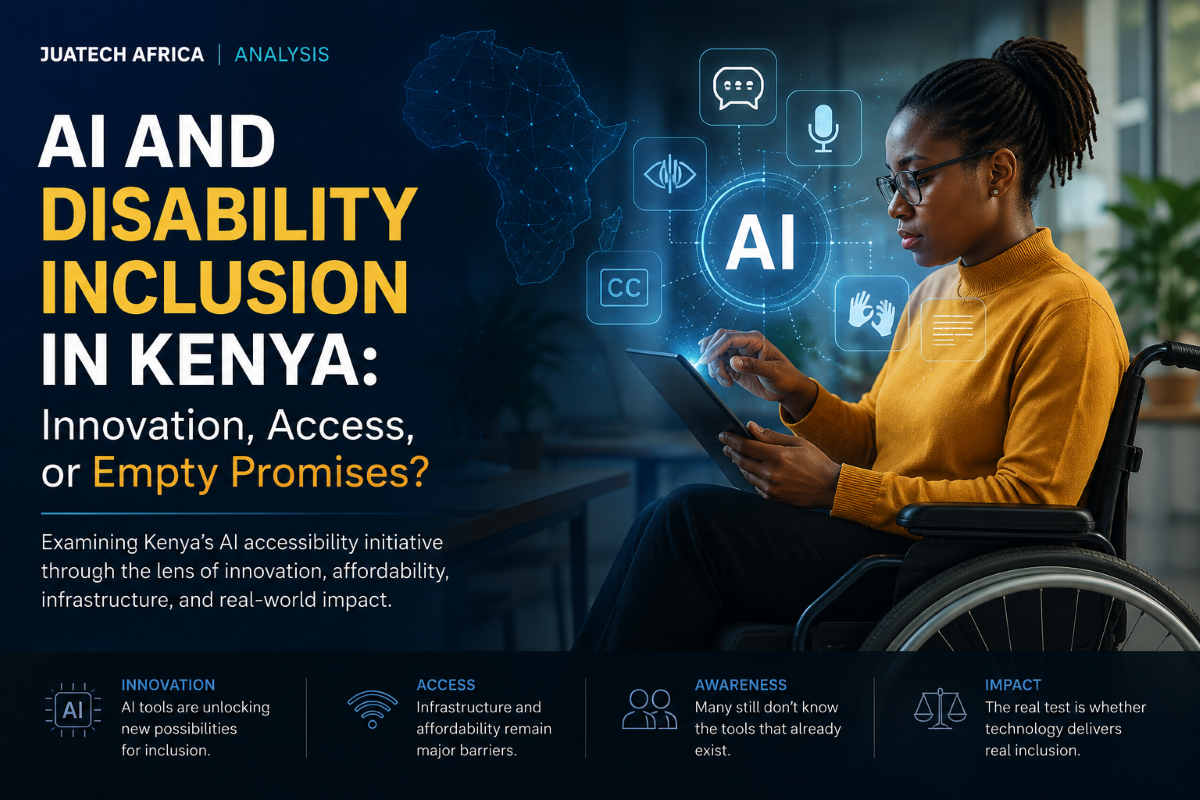
Kenya’s AI-driven accessibility initiative signals progress for inclusive technology in Africa, but its real impact will depend on affordability, infrastructure, accessibility, and long-term execution.
Artificial Intelligence is rapidly becoming part of modern life. It is reshaping how people communicate, work, learn, and access digital services worldwide. But as AI accelerates globally, one question remains urgent in Africa:

Who is it really being built for?
For millions of persons living with disabilities, technology has often evolved faster than accessibility. While digital platforms and smart devices continue to advance, barriers around affordability, communication, mobility, and inclusion remain widespread across Kenya and much of Africa.
This is what makes Kenya’s newly launched AI-focused disability initiative significant. Backed by stakeholders including Huawei, government agencies, and disability organizations, the initiative enters a growing conversation around inclusive innovation and the future of accessibility in Africa.
What Has Kenya Actually Launched?
Kenya has launched a new AI-driven accessibility initiative to improve digital inclusion for persons with disabilities through technologies such as speech recognition, intelligent communication systems, and AI-powered accessibility tools. The initiative brings together stakeholders across the technology, government, and advocacy sectors, reflecting a broader push toward inclusive innovation within Kenya’s growing digital economy.
Among the key players involved is Huawei, alongside government agencies, disability organizations, and ecosystem partners working within accessibility and digital transformation spaces. While still in its early stages, the initiative seeks to explore how artificial intelligence can help reduce communication barriers, improve access to digital services, and support greater participation in education, employment, and everyday digital experiences for persons with disabilities.
More importantly, the initiative enters a growing conversation across Africa’s technology ecosystem around whether the future of AI will be built with accessibility and inclusion as foundational priorities.
Why This Matters: The Inclusion Gap in Kenya and Africa
Across Kenya and much of Africa, persons living with disabilities continue to face barriers that extend far beyond physical mobility. Access to education, employment, healthcare, communication tools, and digital platforms remains uneven, particularly in regions where infrastructure, affordability, and accessibility are still developing. As societies become increasingly connected through technology, exclusion is no longer shaped only by physical limitations. It is increasingly defined by digital access and participation.
For millions of people, smartphones and internet services have opened new opportunities for learning, financial access, remote work, entrepreneurship, and communication. Yet for many living with hearing, visual, speech, or mobility impairments, large parts of the digital experience remain difficult to access or navigate effectively. Accessibility features are often limited, expensive, poorly localized, or dependent on stable internet connectivity and modern devices that remain financially out of reach for many users across Africa.
The challenge becomes even more significant as artificial intelligence begins shaping education, healthcare, public services, customer support, and workplace communication. If accessibility is not intentionally built into this transformation, existing inequalities risk becoming even more deeply embedded within Africa’s growing digital economy. This is why Kenya’s AI-focused disability initiative matters far beyond the technology itself.
The Technology Layer: What AI Actually Enables
As conversations around digital inclusion continue to grow across Kenya and Africa, artificial intelligence is becoming increasingly important not as a futuristic concept but as a practical accessibility tool that can improve how people interact with technology in everyday life. The real significance of AI lies not simply in technical sophistication, but in its potential to reduce barriers that have historically limited participation for persons living with disabilities.
For individuals with hearing impairments, speech-to-text technology can convert spoken conversations, meetings, classroom discussions, and video content into real-time text. On a smartphone in Kenya, this could improve access to digital learning, workplace communication, and online content that would otherwise remain difficult to engage with effectively.
For visually impaired users, AI-powered vision tools can identify objects, read text aloud, describe surroundings, and assist with navigation through smartphone cameras and intelligent recognition systems. Tasks that once required expensive, specialized hardware are increasingly accessible on mobile devices and through AI-driven applications.
Language-based AI tools also have the potential to reduce communication barriers through translation, voice assistance, predictive typing, and conversational support across digital platforms. Ultimately, what this looks like on a smartphone in Kenya is not just smarter technology, but potentially more independent access to information, communication, and digital participation for millions of underserved users across Africa.
The Access Problem: Where Reality Pushes Back
The promise of AI-powered accessibility is significant, but the gap between innovation and real-world adoption across Kenya and much of Africa remains equally important to examine. In many cases, technology does not fail because the tools are unavailable. It fails because access remains limited by infrastructure, affordability, awareness, and digital readiness.
Devices and Processing Power
Many advanced AI features are designed for newer smartphones with stronger processing power, larger memory capacity, and long-term software support. Yet across Kenya and many African markets, a large percentage of users still rely on entry-level or mid-range devices where storage limitations, battery efficiency, and performance constraints remain important considerations. Accessibility tools that depend heavily on cloud processing or premium hardware may struggle to achieve widespread adoption if they are not optimized for affordable smartphones.
Internet, Affordability, and Awareness
Reliable internet access also remains a major challenge. Many AI-powered services depend on stable connectivity for real-time translation, voice recognition, and cloud-based accessibility support. In regions where mobile data costs remain high or network reliability is inconsistent, continuous access becomes difficult for many users.
Cost is another barrier. While some accessibility features are integrated into smartphones and digital platforms, others rely on subscriptions or premium ecosystems that may not be financially sustainable. Awareness also remains limited, with many users still unfamiliar with the accessibility tools already available on their devices.
Ultimately, technology does not fail at innovation. It fails at access.
Stakeholder Analysis: Who Is Driving This, and Why?
Kenya’s AI-focused disability initiative is not simply a technology project. It is an ecosystem-level collaboration involving technology companies, government institutions, disability organizations, and digital economy stakeholders, each bringing different priorities, capabilities, and long-term interests into the conversation. Understanding those motivations is essential because the future of inclusive AI in Africa will depend as much on stakeholder alignment as it will on the technology itself.
Huawei and Technology Partners
For technology companies such as Huawei, accessibility-focused AI initiatives represent both a social inclusion opportunity and a strategic positioning exercise within Africa’s expanding digital ecosystem. Beyond smartphones and hardware, major technology players are increasingly competing for influence across cloud infrastructure, AI services, enterprise solutions, and government partnerships. Their technical expertise can accelerate innovation, but concerns around affordability, localization, and long-term accessibility remain important considerations for African markets.
Government and Ecosystem Players
Government institutions provide policy direction, institutional reach, and implementation authority, while disability organizations help ensure accessibility conversations remain grounded in lived experiences rather than purely technical ambitions. At the same time, startups, universities, and telcos have opportunities to localize AI tools, expand digital literacy, and develop solutions better suited for African realities and affordability levels.
Ultimately, the success of this initiative depends less on technology and more on alignment between innovation, policy, infrastructure, affordability, and the everyday realities of the people it is intended to serve
Timeliness, Sustainability, and Value: The Reality Test
Kenya’s AI-focused disability initiative arrives at a moment when artificial intelligence is becoming increasingly integrated into smartphones, digital platforms, education systems, workplaces, and public services worldwide. In many ways, the timing reflects a broader shift toward accessibility-driven innovation and more inclusive digital experiences. Yet the real question is no longer whether the technology is advancing fast enough. It is whether the surrounding ecosystem is prepared to support meaningful adoption at scale.
Timeliness
From speech recognition and intelligent assistants to computer vision and real-time translation, many of the technologies behind AI accessibility already exist and continue to improve rapidly. However, digital readiness across Kenya and many African markets remains uneven. Smartphone limitations, internet costs, digital literacy gaps, and infrastructure challenges still create barriers that technology alone cannot solve.
Sustainability
Long-term sustainability presents an even greater test. Accessibility initiatives often receive visibility during launch phases and pilot programs, but maintaining long-term impact requires continuous funding, software support, infrastructure investment, policy coordination, and ecosystem collaboration. In Africa, innovation often succeeds at launch and fails at continuity.
Value
The long-term value of AI accessibility will ultimately depend on usability, affordability, and scalability. If solutions remain expensive, internet-dependent, or disconnected from local realities, adoption will remain limited. The real measure of success will not be the sophistication of the technology itself, but whether it creates meaningful improvements in communication, education, employment, and digital participation for the people it is intended to serve.
Africa Perspective: Can This Scale Beyond Kenya?
Kenya’s AI-focused disability initiative may be national in scope, but the broader questions it raises extend far beyond its borders. Across Africa, governments, technology companies, and digital innovation ecosystems are increasingly exploring how artificial intelligence can improve access to education, communication, healthcare, and public services. Yet scaling accessibility-driven AI across the continent presents challenges far more complex than technology development alone.
Language diversity remains one of Africa’s biggest realities, and AI systems trained primarily around global languages may struggle to support local linguistic and cultural contexts. Infrastructure gaps also remain significant, particularly in regions where smartphone access, internet reliability, electricity stability, and digital literacy vary widely.
Policy fragmentation creates another challenge, as many African markets still lack clear frameworks for AI governance, accessibility standards, and inclusive technology policies.
For that reason, Kenya should be viewed as a potential test case for how inclusive AI could evolve across Africa’s rapidly changing digital landscape.
Opportunity Layer: What This Unlocks
Kenya’s AI-focused disability initiative may be national in scope, but the broader questions it raises extend far beyond its borders. Across Africa, governments and technology ecosystems are increasingly exploring how artificial intelligence can improve access to education, communication, healthcare, and public services. Yet scaling accessibility-driven AI across the continent presents challenges far more complex than technology development alone.
Language diversity remains one of Africa’s biggest realities, and AI systems trained primarily around global languages may struggle to support local linguistic and cultural contexts. Infrastructure gaps also remain significant, particularly in regions where smartphone access, internet reliability, electricity stability, and digital literacy vary widely.
Policy fragmentation creates another challenge, as many African markets still lack clear frameworks for AI governance, accessibility standards, and inclusive technology policies.
For that reason, Kenya should be viewed not as the endpoint of the conversation, but as a potential test case for how inclusive AI could evolve across Africa’s rapidly changing digital landscape.
Conclusion: The Bigger Question Africa Must Answer
Kenya’s AI-focused disability initiative arrives at an important moment for both the country and the wider African technology ecosystem. It reflects growing recognition that accessibility and digital inclusion can no longer remain secondary conversations as artificial intelligence becomes increasingly integrated into education, healthcare, communication, business, and public services.
Yet the long-term significance of this initiative will depend on far more than launch visibility or technology partnerships. The real test will be whether accessibility can move beyond pilot programs into practical, affordable, and scalable solutions that improve everyday life for the people they are intended to serve.
More importantly, the conversation now extends beyond Kenya. As AI adoption accelerates across Africa, governments, technology companies, and digital platforms will increasingly face the same challenge: ensuring that technological progress does not deepen existing inequalities.
The future of AI in Africa will ultimately be defined not only by innovation but by inclusion.
Will Africa build AI that includes everyone, or innovate for the few and announce it for the many?