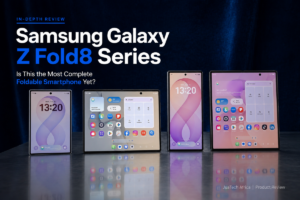


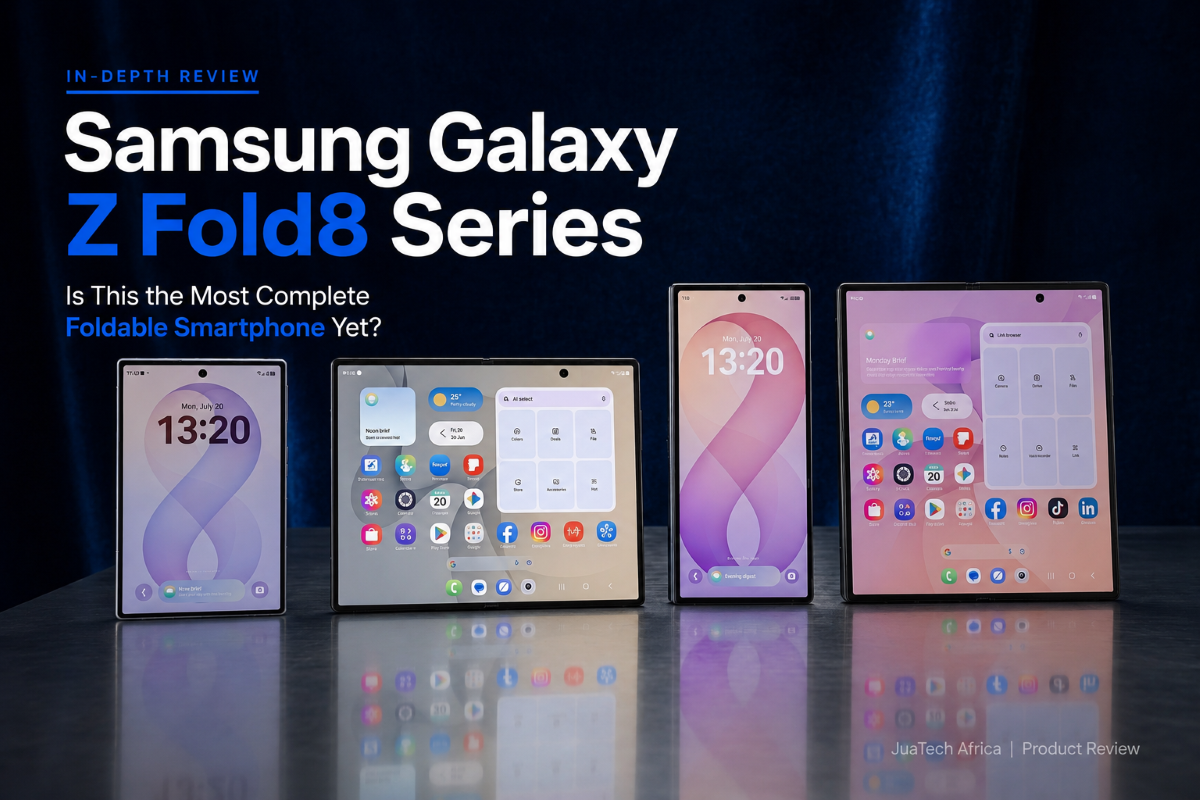
The Samsung Galaxy Z Fold8 is more than Samsung’s latest flagship foldable. It reflects the company’s evolving vision for AI-powered productivity, premium mobile computing, and the future of the smartphone. In this in-depth review, we go beyond specifications and marketing claims to evaluate its real-world experience, value proposition, competitive position, and whether it truly deserves to be called the most complete foldable smartphone available today.
Every premium technology purchase begins with a question that extends far beyond specifications. When a smartphone costs between KES 300,000 and KES 450,000, the decision is no longer about acquiring the latest gadget. It is about investing in a device capable of delivering measurable value every single day. For executives managing demanding schedules, entrepreneurs building businesses, creators producing professional work, consultants traveling between meetings, and professionals seeking to consolidate multiple devices into one, the expectations are fundamentally different. They are not searching for another premium smartphone. They are searching for a tool capable of becoming the center of their digital life.

The Samsung Galaxy Z Fold8 Series arrives carrying precisely those expectations. Comprising the Galaxy Z Fold8 and the Galaxy Z Fold8 Ultra, Samsung’s latest foldable smartphone lineup enters a market that has evolved far beyond novelty. Foldables have matured into legitimate productivity devices, while competitors including Huawei, HONOR, OPPO, vivo and Google continue to re-define what buyers should expect from premium mobile technology. Innovation alone is no longer enough. To justify its position at the top of Samsung’s portfolio, the Galaxy Z Fold8 Series must demonstrate that it delivers a more complete ownership experience than every credible alternative in one of the industry’s most competitive categories.
That challenge becomes even more significant when price enters the conversation. Depending on the model and storage configuration, prospective buyers could spend between KES 300,000 and KES 450,000 to own a device in the Galaxy Z Fold8 Series, placing it among the most expensive consumer smartphones available in Kenya. At that level, choosing either the Galaxy Z Fold8 or the Galaxy Z Fold8 Ultra becomes less a consumer electronics transaction than a long-term investment. Buyers are entitled to expect exceptional craftsmanship, meaningful productivity gains, years of software support, seamless ecosystem integration and an ownership experience capable of justifying such a substantial financial commitment. Specifications alone are no longer persuasive. Long-term value is.
This Samsung Galaxy Z Fold8 Series Review has therefore been written with a different objective. Rather than repeating specifications or echoing marketing claims, it evaluates both devices through the questions that matter most to discerning buyers. How do the Galaxy Z Fold8 and Galaxy Z Fold8 Ultra differ in everyday use? Which model delivers the stronger value proposition? How do they compare with the best foldable smartphones from Huawei, HONOR, OPPO, vivo and Google? And, perhaps most importantly, does Samsung still offer the most complete foldable smartphone lineup in an increasingly competitive market?
Those are the questions that ultimately determine whether a premium smartphone deserves serious consideration. Before arriving at that verdict, however, it is essential to examine exactly what Samsung has changed across the Galaxy Z Fold8 Series, where the Fold8 and Fold8 Ultra diverge, and whether those differences represent meaningful progress or simply another annual iteration in Samsung’s foldable journey.
Executive Verdict
The Samsung Galaxy Z Fold8 Series represents Samsung’s most mature and strategically complete foldable smartphone lineup to date. Rather than chasing headline-grabbing innovation, Samsung has refined the fundamentals that ultimately define the premium ownership experience: hardware reliability, software maturity, AI-powered productivity, ecosystem integration, long-term software support, and the confidence that comes from using a device designed to serve as a primary computing platform. Together, the Galaxy Z Fold8 and Galaxy Z Fold8 Ultra demonstrate a company that is no longer proving the viability of foldable smartphones, but refining what many professionals now expect from them.
That refinement, however, comes at a significant cost. With the Galaxy Z Fold8 Ultra approaching KES 450,000 in its highest configuration and the standard Galaxy Z Fold8 remaining firmly within the ultra-premium segment, neither device competes on affordability. Instead, they compete on long-term value. At the same time, rivals including Huawei, HONOR, OPPO and vivo continue to narrow the gap through increasingly sophisticated hardware, lighter designs, larger batteries and aggressive innovation. The decision is therefore no longer about choosing the most advanced specifications. It is about determining whether Samsung’s ecosystem, productivity experience, software longevity and overall ownership proposition justify the premium.
Based on our evaluation, this Samsung Galaxy Z Fold8 Series Review concludes that Samsung continues to offer one of the most complete foldable smartphone experiences available today. The Galaxy Z Fold8 stands out as the balanced choice for most professionals seeking a premium foldable that combines versatility, performance and long-term usability. The Galaxy Z Fold8 Ultra, meanwhile, is designed for buyers who demand Samsung’s most capable foldable experience and are prepared to pay for its additional capabilities. Both are worth buying for users who will fully exploit their productivity potential, while buyers primarily seeking the best camera system, gaming performance or outright hardware value may find stronger alternatives elsewhere.
The Verdict: The Samsung Galaxy Z Fold8 Series is more than Samsung’s latest generation of foldables. It is the company’s clearest statement yet that the future of premium mobile computing will be defined not by specifications alone, but by the seamless integration of hardware, software, artificial intelligence and productivity into a single, uncompromising user experience.
The remainder of this review examines how Samsung arrived at that conclusion by exploring the changes introduced across the Galaxy Z Fold8 Series, evaluating the differences between the Fold8 and Fold8 Ultra, and determining whether either device truly deserves a place at the top of today’s foldable smartphone market.
What’s New Across the Samsung Galaxy Z Fold8 Series?
With the Samsung Galaxy Z Fold8 Series, Samsung is no longer trying to prove that foldable smartphones are the future. That debate has largely been settled. The company’s challenge today is far more demanding. It must demonstrate that the Galaxy Z Fold8 and Galaxy Z Fold8 Ultra offer compelling reasons to upgrade from the Galaxy Z Fold7 while defending Samsung’s leadership against increasingly capable rivals from Huawei, HONOR, OPPO, vivo and Google.
That philosophy is reflected throughout the Samsung Galaxy Z Fold8 features. Rather than pursuing headline-grabbing innovation, Samsung has concentrated on refining every aspect of the ownership experience. The result is a foldable lineup that is lighter, faster, smarter and more durable, with improvements that matter most over years of everyday use rather than during the first week of ownership.
The first evolution is immediately visible in the hardware. The standard Galaxy Z Fold8 weighs just 201 grams, making it Samsung’s lightest book-style foldable to date. It measures 9.7 mm when folded and only 4.5 mm when unfolded, making it noticeably slimmer than previous generations. Samsung has also strengthened the chassis with an Advanced Armor Aluminum frame, Corning Gorilla Glass Ceramic 3 protecting the cover display, Victus 2 protecting the rear panel, and an IP48 rating for dust and water resistance. These specifications are not simply engineering achievements. They make the device easier to carry, more comfortable during prolonged use and better equipped to withstand the realities of everyday ownership.
Samsung has also refined the display experience. The Galaxy Z Fold8 features a 7.6-inch Dynamic LTPO AMOLED 2X inner display with a 120 Hz adaptive refresh rate and a peak brightness of 3,000 nits, complemented by a 5.5-inch AMOLED cover display. Together, they provide a larger and more comfortable workspace for multitasking, document editing, reading and media consumption. More importantly, Samsung continues to reduce the compromises traditionally associated with foldable displays, making the transition between phone and tablet feel increasingly seamless.
Performance receives one of the most meaningful upgrades. Both the Galaxy Z Fold8 and Galaxy Z Fold8 Ultra are powered by Qualcomm’s Snapdragon 8 Elite Gen 5 for Galaxy, paired with 12 GB of RAM on standard configurations and 16 GB on the 1 TB variant. Storage options extend to 1 TB, ensuring ample capacity for professional workflows, large media libraries and AI-powered applications. The new chipset delivers higher CPU and GPU performance alongside a more capable Neural Processing Unit, enabling smoother multitasking, faster AI processing, improved thermal management and greater power efficiency. These gains matter because they directly improve demanding workloads such as split-screen productivity, 4K video editing, image processing and console-quality gaming, rather than simply producing higher benchmark scores.
Software remains one of Samsung’s strongest competitive advantages. Running Android 17 with One UI 9, the Fold8 Series expands Galaxy AI with features such as intelligent writing assistance, Live Translate, document summarisation, multimodal search, enhanced photo editing and seamless cross-app workflows. Samsung’s objective is clear. Artificial intelligence should reduce friction, automate repetitive tasks and improve productivity instead of existing as a collection of isolated features.
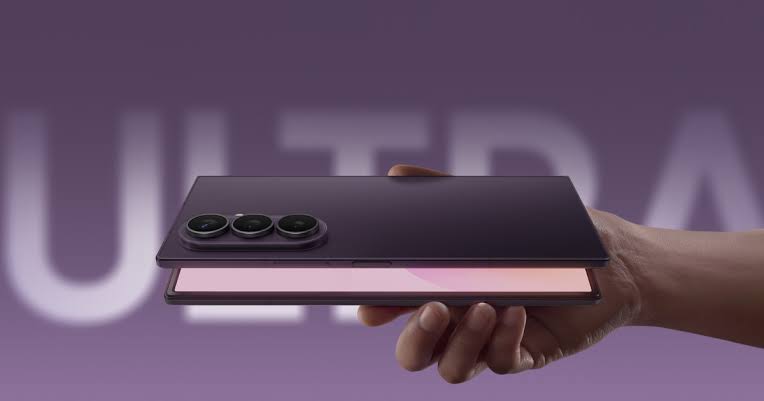
Samsung has also strengthened the Fold8 Series’ imaging capabilities while reinforcing its long-term ownership proposition. The Galaxy Z Fold8 features a dual 50 MP rear camera system comprising wide and ultra-wide cameras, delivering a versatile photography experience for everyday users. The Galaxy Z Fold8 Ultra builds on that foundation with a flagship triple rear camera system featuring a 200 MP wide camera, a 50 MP ultra-wide camera and a dedicated 10 MP telephoto lens, offering greater flexibility for photography enthusiasts and creators. Battery capacities of 4,800 mAh on the Fold8 and 5,000 mAh on the Fold8 Ultra are complemented by 45 W wired and 20 W wireless charging, while Samsung continues its commitment to seven generations of Android OS upgrades alongside seven years of security updates. Individually, these developments may appear incremental. Collectively, they reinforce Samsung’s ambition to deliver a foldable mobile computing platform designed to remain relevant, reliable and productive long after launch.
Viewed in isolation, none of these changes fundamentally redefines the foldable smartphone. Viewed together, however, they tell a different story. The Galaxy Z Fold8 Series is not about reinventing the category. It is about refining it with better engineering, more intelligent software and a stronger long-term ownership proposition. Samsung’s confidence is evident. The company is no longer asking whether foldables are ready for mainstream adoption. It is challenging the rest of the industry to match the maturity of its ecosystem and overall user experience.
Specifications, however, tell only part of the story. The real question is whether those improvements translate into a better experience in everyday use. That is where the Galaxy Z Fold8 Series must ultimately prove its value.
Real-World Experience: Living with the Samsung Galaxy Z Fold8 Series
Specifications explain what a smartphone can do. Living with it every day determines whether it deserves a place in your pocket. That distinction matters even more when you’re considering a device that costs between KES 300,000 and KES 450,000. Buyers at this level are not looking for another flagship smartphone. They are looking for a device capable of replacing several others while making work, communication and creativity noticeably more efficient.
Based on Samsung’s design decisions and the first wave of hands-on impressions, the Samsung Galaxy Z Fold8 Series feels less like an ambitious technology demonstration and more like a mature productivity platform. Rather than introducing one revolutionary feature, Samsung has refined dozens of small details that collectively reshape the ownership experience.
Design & Everyday Comfort: A Foldable That Finally Feels Practical
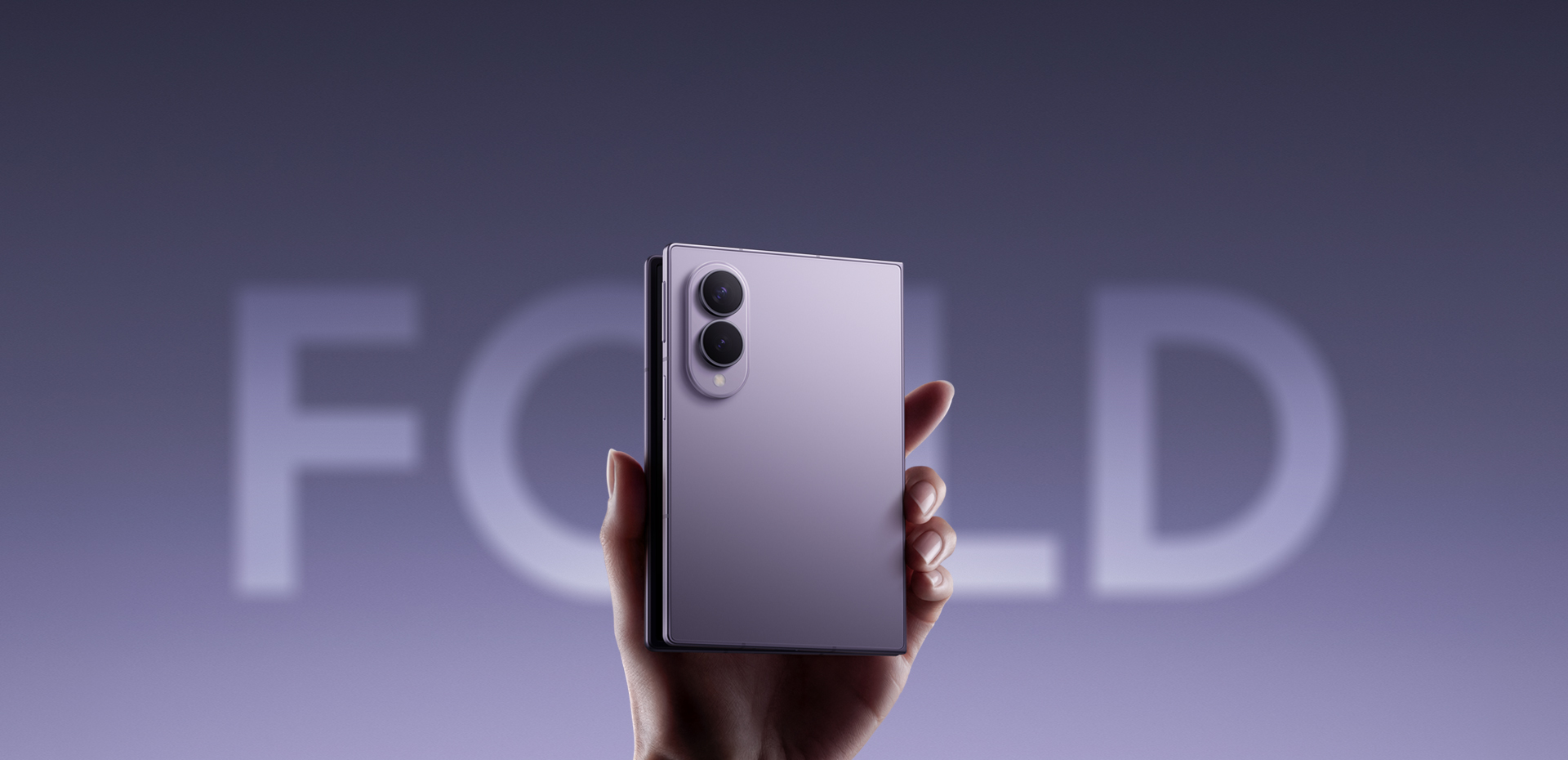
The first surprise is how quickly the Fold8 begins to disappear into everyday life. Weighing 201 grams and measuring 9.7 mm when folded, the standard Galaxy Z Fold8 feels noticeably less bulky than earlier generations. Those measurements are not merely engineering milestones. They reduce friction throughout the day.
Picture a marketing consultant moving between client meetings in Nairobi. The phone slides easily into a jacket pocket, remains comfortable to hold while responding to emails during an Uber ride, and no longer feels like a compromise simply because it folds. Likewise, an entrepreneur traveling between Mombasa and Kisumu is less likely to notice the device in a backpack already carrying a laptop and charger. These are small moments, but they accumulate over months of ownership.
Samsung’s redesigned hinge reinforces that maturity. Opening and closing the device feels deliberate, stable, and reassuring rather than mechanical or experimental. It creates confidence that this is a product designed for thousands of folds rather than occasional demonstrations.
Cover Display Experience: The Screen You’ll Use More Than You Expect
The cover display may prove to be the most important improvement in the Fold8 Series. Previous Fold generations often encouraged users to unfold the device for even simple tasks because the outer display felt restrictive. Early hands-on impressions suggest Samsung has addressed that weakness with a more usable cover display that makes replying to WhatsApp messages, approving documents, checking Google Maps, browsing the web or clearing emails feel far more natural.
Imagine waiting to board a flight. You quickly reply to a client on Outlook, approve a payment through your banking app, check your calendar and confirm your hotel reservation. None of those tasks require unfolding the device. That convenience changes the rhythm of everyday use. The Fold8 behaves like an excellent smartphone when speed matters, then transforms into a larger workspace only when additional screen real estate genuinely adds value.
That balance is one of the strongest signs that Samsung understands how people actually use foldable smartphones.
The Inner Display: A Workspace That Travels With You
Open the Galaxy Z Fold8 and its purpose becomes immediately clear. The expansive 7.6-inch Dynamic LTPO AMOLED 2X display is not simply larger. It fundamentally changes how work is organized.
Consider a journalist covering a technology launch. Samsung Notes occupies one side of the display while a livestream plays alongside it. Browser tabs remain open for fact-checking, and an email draft is ready to send before the presentation ends. The workflow feels fluid because information remains visible instead of constantly disappearing behind recently opened applications.
The same applies to professionals reviewing contracts, architects examining drawings, students reading research papers or entrepreneurs monitoring dashboards while communicating with clients. The Fold8 does not replace a laptop in every situation. It reduces the number of times you need to reach for one.
Samsung’s multitasking implementation continues to set the benchmark for foldable Android devices. Split-screen applications, floating windows and the persistent taskbar feel purposeful rather than experimental, making the larger display genuinely productive instead of merely impressive.
Samsung Galaxy Z Fold8 Performance: Confidence Under Pressure
The Snapdragon 8 Elite Gen 5 for Galaxy is not simply about achieving higher benchmark scores. Its greatest strength is consistency.
A demanding afternoon might involve editing high-resolution photographs, joining a Microsoft Teams meeting, summarizing documents with Galaxy AI, uploading files to cloud storage, and switching repeatedly between Chrome, Slack, and Samsung Notes. The Fold8 Series is designed to handle those transitions without hesitation.
Equally important is thermal behavior. Early hands-on reports indicate improved cooling under sustained workloads, helping maintain performance during extended gaming sessions, long video calls or prolonged multitasking. For professionals, that consistency matters more than peak performance figures that are rarely encountered outside benchmarking applications.
One UI 9 & Galaxy AI: Software That Works With You
Samsung’s greatest competitive advantage is no longer hardware alone. It is software.
Running One UI 9 on Android 17, the Fold8 Series integrates Galaxy AI into tasks people perform every day. Meeting notes can be summarized before they’re shared. Conversations in different languages can be translated in real time. Long documents become easier to digest, while intelligent writing tools help refine emails, reports and presentations.
The most successful AI features are also the least dramatic. They work quietly in the background, reducing repetitive work instead of demanding attention.
JuaTech Insight: The value of Galaxy AI is not measured by the number of features Samsung can demonstrate on stage. It is measured by how many minutes it quietly saves every day.
Samsung Galaxy Z Fold8 Camera & Battery: Reliability Over Spectacle
The Galaxy Z Fold8 continues with a refined 50 MP primary camera, while the Galaxy Z Fold8 Ultra introduces a 200 MP sensor aimed at users who place greater emphasis on photography. Yet the real advantage of the Fold8 Series lies in the flexibility of its design.
Flex Mode transforms almost any flat surface into a camera support for interviews, presentations, time-lapse videos, or group photographs. Content creators can monitor framing on the large inner display, while professionals conducting video conferences gain a stable, hands-free setup without additional accessories.
Battery life also appears to reflect Samsung’s focus on consistency. The Fold8’s 4,800 mAh battery and the Ultra’s 5,000 mAh battery are paired with the efficiency gains of the Snapdragon platform and intelligent power management. For many professionals, that should comfortably support a full working day of messaging, navigation, meetings, photography and document editing. When additional power is needed, 45 W wired charging reduces downtime between appointments.
Verdict: The Foldable Smartphone Comes of Age
The most significant achievement of the Samsung Galaxy Z Fold8 Series is not found in a brighter display, a faster processor or a lighter chassis. It lies in how those refinements work together to remove the compromises that once defined foldable smartphones.
Earlier generations often asked users to change their habits to accommodate new technology. The Galaxy Z Fold8 Series increasingly does the opposite. It adapts to the way people already work, travel and communicate. That shift transforms the Fold8 from an impressive piece of engineering into a dependable daily companion.
For buyers prepared to invest in Samsung’s flagship foldable lineup, that maturity may prove to be the most compelling upgrade of all.
AI, Software & Productivity: Can the Samsung Galaxy Z Fold8 Series Transform the Way You Work?
The smartphone industry has entered a new phase of competition. Faster processors, brighter displays and higher-resolution cameras remain important, but they are no longer enough to differentiate premium flagship devices. Increasingly, the conversation has shifted towards software intelligence and productivity. The question prospective buyers are asking is no longer, “How powerful is this smartphone?” Instead, they want to know, “Can it genuinely help me accomplish more?”
That question is particularly relevant for the Samsung Galaxy Z Fold8 Series. Starting at the premium end of the market, the Fold8 and Fold8 Ultra must justify their price through measurable improvements to the ownership experience. Samsung’s strategy is clear. Rather than treating Galaxy AI, One UI 9, Google Gemini and Samsung DeX as standalone features, the company has built an ecosystem designed to reduce friction across the entire working day. For professionals, entrepreneurs, researchers, students and creators, the value of the Fold8 Series lies less in what each feature does individually and more in how they work together.
Galaxy AI: Solving the Information Overload Problem
One of the biggest challenges facing modern professionals is not access to information but managing it. Meetings generate pages of notes, email inboxes fill with lengthy conversations, research reports stretch into hundreds of pages, and projects often require switching between multiple communication platforms. The administrative effort required to organize that information can easily consume hours each week.
This is where Galaxy AI demonstrates its greatest strength. Running alongside Android 17 and One UI 9, Samsung integrates AI directly into familiar applications instead of forcing users into separate AI environments. Features such as Writing Assist, Note Assist, Transcript Assist, Browsing Assist, Interpreter, Live Translate, Circle to Search with Google and Generative Edit are designed to simplify repetitive work rather than replace human judgment.
Consider a management consultant preparing recommendations after a client workshop. Transcript Assist can convert recorded discussions into searchable text, Note Assist can organize those ideas into structured summaries, and Writing Assist can refine a draft proposal before it is shared with stakeholders. None of these tools eliminates the need for critical thinking, but together they reduce the administrative burden surrounding knowledge work. Over weeks and months of ownership, those incremental time savings become one of the strongest arguments for investing in Samsung’s AI ecosystem.
One UI 9: The Foundation of Samsung Productivity
Powerful hardware means very little if the software cannot take advantage of it. This has historically been the defining challenge for foldable smartphones. A larger display alone does not create a better user experience unless the operating system is designed to support multitasking naturally.
The Samsung Galaxy Z Fold8 Series addresses this through One UI 9, built on Android 17 and backed by Samsung’s commitment to 7 generations of Android OS upgrades and 7 years of security updates. That long-term software support is more than a specification. It represents confidence that the Fold8 Series will remain secure, compatible and productive long after the initial purchase, an important consideration for businesses investing in premium mobile devices.
In everyday use, One UI 9 continues to set the benchmark for Samsung productivity. The persistent taskbar, intelligent split-screen management, floating windows and drag-and-drop functionality allow users to keep multiple applications active simultaneously without disrupting their workflow. A financial analyst can compare quarterly reports while updating a spreadsheet. A journalist can monitor a live product launch, verify information through a browser, and draft an article in Samsung Notes without repeatedly switching between applications. The larger display becomes a productive workspace because the software is designed around continuity rather than interruption.
Google Gemini: A Research Partner for the Modern Professional
Research has become one of the most valuable and time-intensive aspects of modern work. Whether evaluating market trends, preparing a board presentation, or analyzing competing products, professionals spend a significant portion of their day collecting, organizing, and interpreting information.
The integration of Google Gemini expands the Fold8 Series beyond the role of a traditional digital assistant. Rather than simply answering questions, Gemini helps users explore ideas, summarize lengthy documents, compare sources, and generate structured drafts that can be refined further using Galaxy AI tools. On the Fold8’s expansive 7.6-inch Dynamic LTPO AMOLED 2X display, that experience becomes even more practical because source material, notes and AI-generated insights can remain visible simultaneously.
Imagine preparing a presentation on Kenya’s smartphone market while travelling between Nairobi and Kigali. Gemini summarises industry reports, Samsung Notes captures emerging ideas, Chrome displays supporting research, and Outlook remains open for client communication. The Fold8 Series transforms what would normally require constant application switching into a single, uninterrupted workflow. For knowledge workers, this is where foldable productivity begins to demonstrate a meaningful advantage over conventional smartphones.
Samsung DeX: Can the Galaxy Z Fold8 Series Replace Your Laptop?
Few software features illustrate Samsung’s long-term vision better than Samsung DeX. Often overlooked in flagship smartphone reviews, DeX remains one of the most capable desktop computing environments available on any mobile device. By connecting the Fold8 Series to an external monitor, either wirelessly or through a compatible cable, users gain access to a desktop-style interface with resizable windows, keyboard and mouse support, and efficient multitasking across multiple applications.
The practical implications are significant. Professionals working in Microsoft 365, Google Workspace, Slack, Zoom, Microsoft Teams or browser-based enterprise applications can comfortably manage communication, presentations, spreadsheets and reports without immediately reaching for a laptop. For consultants, journalists, sales professionals and business travelers, Samsung DeX reduces the number of situations where carrying a notebook computer becomes necessary.
It is important, however, to remain realistic. Software developers compiling large projects, engineers running specialized design software or video editors producing complex multi-layer timelines will still require a dedicated workstation. Samsung DeX does not replace every computer. What it does exceptionally well is extend the capabilities of the Fold8 Series into environments traditionally reserved for laptops, making it one of Samsung’s most compelling productivity features.
Foldable Productivity: Why the Form Factor Still Matters
The greatest productivity advantage of the Samsung Galaxy Z Fold8 Series is not a single AI feature or software capability. It is the combination of intelligent software and a foldable form factor that reduces the cognitive cost of multitasking. Context switching is one of the biggest hidden drains on productivity. Every time users close one application to open another, they lose focus, momentum, and valuable seconds that accumulate throughout the day.
The Fold8 Series addresses this challenge by keeping more information visible at the same time. A content creator can review a video edit while responding to client feedback. A university student can annotate lecture notes alongside academic research. An entrepreneur can compare sales dashboards while coordinating with suppliers through WhatsApp and responding to customer emails. These are not demonstrations created for a keynote presentation. They are realistic workflows that reflect how professionals actually work.
JuaTech Insight: The real value of Galaxy AI, One UI 9, Google Gemini and Samsung DeX is not that they introduce new ways of working. Their value lies in removing the small interruptions that repeatedly slow productive people down. The Samsung Galaxy Z Fold8 Series succeeds because it allows users to remain focused on the task rather than the technology.
Verdict: Software Is the Fold8 Series’ Greatest Competitive Advantage
The Samsung Galaxy Z Fold8 Series Review ultimately reveals that Samsung’s strongest competitive advantage is no longer hardware alone. The combination of Galaxy AI, One UI 9, Google Gemini, Samsung DeX, and one of the industry’s most mature multitasking experiences creates a productivity ecosystem that extends far beyond traditional smartphone expectations.
For professionals evaluating whether the Fold8 Series is worth its premium price, the answer is unlikely to be found in benchmark scores or camera specifications. It lies in the cumulative effect of dozens of software refinements that reduce friction, improve organization and support better decision-making throughout the working day. In that respect, Samsung has achieved something more meaningful than adding another AI feature. It has built a foldable platform that feels increasingly capable of functioning as a true mobile computer, making the Fold8 Series one of the most compelling productivity devices currently available to Android users.
Value Proposition: Is the Samsung Galaxy Z Fold8 Series Worth the Investment?
The price of a flagship smartphone is easy to measure. Its value is considerably more difficult to quantify. That distinction lies at the heart of the Samsung Galaxy Z Fold8 Series Review because devices in this category are no longer purchased solely for communication or entertainment. They are expected to function as cameras, notebooks, research assistants, business tools, productivity platforms and, for many users, the primary computer they carry every day.
With expected pricing ranging from approximately KES 300,000 to KES 450,000 depending on the model and storage configuration, the Samsung Galaxy Z Fold8 Series is unquestionably expensive. However, asking whether it is expensive is the wrong question. The more meaningful question is whether it creates enough value over its lifetime to justify that investment. The answer depends not only on the purchase price, but also on software longevity, ownership costs, repairability, resale value, ecosystem integration and, perhaps most importantly, how effectively the device improves the way you work.
Looking Beyond Price: Understanding Total Ownership Value
The retail price represents only the first chapter of the ownership story. Every smartphone continues to generate value or lose value long after it leaves the store. Buyers should therefore evaluate the Fold8 Series through its total cost of ownership, which includes software support, maintenance, accessories, productivity gains, depreciation, and long-term reliability.
Viewed in isolation, spending more than KES 300,000 on a smartphone appears difficult to justify. Viewed across five or even seven years of daily use, the calculation changes considerably. A professional who depends on their smartphone for communication, research, client presentations, note-taking and business management may spend thousands of productive hours using the device. Spread across that ownership period, the daily cost becomes far easier to rationalize than the headline purchase price suggests.
The opposite is equally true. Buyers who primarily use their smartphones for messaging, social media, streaming and casual photography are unlikely to extract enough additional value from the Fold8 Series to justify its premium over more conventional flagship smartphones.
Software Longevity Is Part of the Investment
One of Samsung’s strongest competitive advantages is its long-term software commitment. The Galaxy Z Fold8 Series launches with Android 17 and One UI 9, backed by 7 generations of Android OS upgrades and 7 years of security updates. In practical terms, this means buyers are investing in a platform that is expected to remain secure, feature-rich and compatible with modern applications well into the next decade.
That commitment also extends the value of Galaxy AI. Samsung has consistently introduced new AI capabilities through software updates rather than restricting meaningful improvements to new hardware generations. As artificial intelligence continues to evolve, Fold8 owners are likely to benefit from productivity enhancements, security improvements, and workflow refinements without replacing their devices every two or three years.
For businesses, this level of software support reduces technology refresh costs. For individual buyers, it increases confidence that today’s investment will remain relevant tomorrow.
Ownership Costs: The Hidden Side of Premium Smartphones
Premium foldable smartphones inevitably cost more to own than traditional flagship devices, and buyers should factor those expenses into their decision. Protective cases, the S Pen, chargers, wireless earbuds and smartwatches all contribute to the total investment, while repairs involving a foldable display or hinge mechanism remain more expensive than repairs on conventional smartphones.
Samsung has worked to reduce these concerns through improved durability, including:
- an Advanced Armor Aluminum frame,
- Corning Gorilla Glass Ceramic 3,
- Victus 2 protection and IP48 resistance against dust and water.
These improvements strengthen long-term confidence, but they do not eliminate the realities of owning sophisticated foldable hardware.
For buyers in Kenya and across Africa, after-sales support is an equally important part of the value equation. Samsung’s established retail presence, authorized service centers, and access to genuine replacement parts provide reassurance that many newer foldable competitors cannot yet match. When evaluating the Samsung Galaxy Z Fold8 price in Kenya, that broader ownership ecosystem deserves as much attention as the hardware itself.
Opportunity Cost: What Else Could This Budget Buy?
Every premium purchase involves compromise. Choosing the Galaxy Z Fold8 Series means allocating resources that could otherwise fund a flagship smartphone, a premium laptop, a tablet, or even multiple mid-range devices.
The critical question, therefore, is not whether the Fold8 Series costs more. It is whether it replaces enough devices to justify costing more.
For a traveling consultant, entrepreneur, or executive, the answer may well be yes. The combination of a large foldable display, Galaxy AI, Google Gemini, Samsung DeX, and mature multitasking can reduce dependence on a tablet while handling many of the everyday tasks traditionally reserved for a laptop. Carrying one highly capable device instead of several has practical value that extends beyond financial considerations.
For buyers who rarely multitask, create content, or work away from a desk, however, those advantages become less significant. In those circumstances, Samsung’s own Galaxy S Ultra series or another premium flagship may represent the more sensible financial decision.
Productivity Is the Real Return on Investment
The strongest argument for the Galaxy Z Fold8 Series is not its hardware. It is the cumulative productivity gains created by combining intelligent software with a foldable form factor.
Imagine a typical working day. You begin by reviewing overnight emails, summarizing industry reports with Google Gemini, refining client proposals using Galaxy AI Writing Assist, joining a Microsoft Teams meeting, updating a presentation through Samsung DeX, approving invoices, reviewing contracts, and responding to customers while traveling between appointments. Individually, each task saves only a few minutes. Collectively, those uninterrupted workflows recover valuable time every day.
That is the true return on investment. A single breakthrough feature rarely transforms productivity. It improves because dozens of small interruptions disappear from the working day.
JuaTech Insight: The most valuable technology is not necessarily the one with the longest specification sheet. It is the one that consistently saves time, reduces friction, and helps users produce better outcomes over many years of ownership.
Resale Value and Long-Term Confidence
Value extends beyond the day you purchase a device. It also includes the amount of value you recover when it is time to upgrade.
Samsung’s flagship smartphones have historically retained stronger resale value than many Android competitors because of widespread brand recognition, consistent software support and an active second-hand market. While foldable smartphones generally depreciate faster during their early years than conventional flagship phones, Samsung’s leadership in the category, improving durability and broad service network help strengthen buyer confidence.
For owners who upgrade every 3 or 4 years, stronger resale demand helps reduce the effective cost of ownership and reinforces the Fold8 Series’ long-term financial proposition.
Verdict: Is the Samsung Galaxy Z Fold8 Series Worth Buying?
So, is the Samsung Galaxy Z Fold8 worth buying, particularly for buyers evaluating theSamsung Galaxy Z Fold8 price in Kenya?
The answer depends entirely on the role you expect your smartphone to play. If you need a premium device primarily for photography, messaging, entertainment and occasional productivity, a conventional flagship smartphone will almost certainly deliver better value for money.
If, however, your smartphone has become the center of your professional life, managing research, communication, presentations, documents, meetings, content creation and business operations, the equation changes dramatically. In that context, the Galaxy Z Fold8 Series is no longer competing solely with other smartphones. It is competing with the combined value of a smartphone, a tablet and, in many day-to-day scenarios, a lightweight laptop.
Viewed through that broader perspective, the Samsung Galaxy Z Fold8 Series value proposition becomes considerably stronger. It is not the most affordable flagship on the market, nor is it intended to be. It is a premium mobile computing platform designed for buyers who measure technology not by its purchase price, but by the value it creates over years of ownership.
For the right audience, that makes the Samsung Galaxy Z Fold8 Series one of the most compelling long-term technology investments available in the Android ecosystem today.
Market Context: Is the Samsung Galaxy Z Fold8 Series Still the Most Complete Foldable?
The Samsung Galaxy Z Fold8 Series Review arrives at a pivotal moment for the foldable smartphone industry. For much of the past decade, manufacturers competed to prove that foldable technology could move beyond concept devices and become practical for everyday use. Success was measured by thinner designs, stronger hinge mechanisms, less visible display creases, and increasingly sophisticated engineering. Those breakthroughs established confidence in the category, but they no longer define leadership.
Today’s premium foldables are expected to do far more than showcase engineering excellence. They are evolving into primary computing devices for professionals, entrepreneurs, creators and enterprise users who expect a single device to manage communication, productivity, creativity and entertainment. As foldables mature, the conversation has shifted from Can they replace a conventional smartphone? to Which foldable delivers the most complete ownership experience over the next five to seven years?
That evolution demands a different approach to evaluating premium smartphones. Buyers investing in a flagship foldable are not simply purchasing hardware. They are investing in a long-term technology platform. Display quality, processing power and camera performance remain important. Still, they now exist alongside software maturity, artificial intelligence, enterprise security, ecosystem integration, application compatibility, repairability, after-sales support and long-term software updates. These factors increasingly determine whether a premium device continues creating value long after launch.
Viewed through this broader lens, the Samsung Galaxy Z Fold8 Series enters the most competitive foldable market in history. Rather than relying on a single flagship, Samsung now addresses two distinct segments within the premium foldable category. The Galaxy Z Fold8 is designed for professionals seeking the ideal balance between portability, productivity, and long-term value. At the same time, the Galaxy Z Fold8 Ultra extends that proposition for creators, power users, and enterprise customers who demand Samsung’s most capable foldable experience. Together, they represent Samsung’s vision of mobile computing, providing buyers with a choice of capability without compromising the core Galaxy experience.
The Foldable Race Has Become a Competition of Strategies
One of the defining characteristics of today’s foldable market is that manufacturers are no longer competing with identical objectives. Instead, every major player is pursuing a different vision of what mobile computing should become. Understanding those philosophies provides far greater insight than comparing isolated hardware specifications.
Samsung’s strategy has evolved from proving that foldables work to refining the entire ownership experience. Both the Galaxy Z Fold8 and Galaxy Z Fold8 Ultra are built on the same software foundation, integrating Galaxy AI, One UI 9, Samsung DeX, Samsung Knox, seamless Galaxy ecosystem connectivity and Samsung’s commitment to seven generations of Android OS upgrades alongside seven years of security updates. They differ in capability and audience. The Fold8 delivers Samsung’s vision of mobile productivity in its most balanced form. At the same time, the Fold8 Ultra expands that vision through enhanced imaging capabilities, greater endurance and additional performance headroom for creators and demanding professional workflows. Samsung is therefore no longer simply manufacturing premium smartphones. It is building a family of mobile computing platforms designed to meet different user needs while maintaining a consistent software and ecosystem experience.
Huawei continues to demonstrate exceptional engineering ambition through devices such as the Mate X7, where advanced hinge design, premium materials and sophisticated imaging technology showcase some of the industry’s finest hardware innovation. HONOR’s Magic V6 pursues a different objective by making foldables lighter, thinner and easier to carry without sacrificing flagship capability. OPPO’s Find N6 focuses on ergonomic refinement and usability, while vivo’s X Fold6 continues to push mobile imaging towards professional-grade photography. Google’s Pixel 10 Pro Fold reflects an AI-first vision centered on Gemini and computational intelligence. At the same time, Xiaomi’s MIX Fold 6 demonstrates how flagship innovation can become increasingly accessible through aggressive value positioning.
Each of these manufacturers excels in a specific area, making the foldable market more competitive than ever before. Leadership is therefore no longer determined by who builds the thinnest device, the brightest display or the highest-resolution camera. Instead, it is defined by how effectively hardware, software, artificial intelligence, ecosystem integration and long-term support combine to create a dependable ownership experience. That is the benchmark against which both the Galaxy Z Fold8 and Galaxy Z Fold8 Ultra should ultimately be judged throughout this review.
Software Is Becoming the True Competitive Advantage
As premium foldable hardware continues to mature, software is rapidly emerging as the industry’s most significant competitive differentiator. Modern flagship chipsets deliver exceptional performance regardless of manufacturer, premium LTPO AMOLED displays have reached remarkable levels of refinement, and camera systems continue to converge in everyday use. While engineering innovation remains important, long-term ownership is increasingly shaped by the intelligence, stability and longevity of the software ecosystem supporting the device.
This is where Samsung has steadily strengthened its competitive position. Rather than treating Galaxy AI, One UI 9, Samsung DeX, Google Gemini integration and Samsung Knox as standalone features, the company has woven them into a unified productivity ecosystem. Whether buyers choose the Galaxy Z Fold8 or the Galaxy Z Fold8 Ultra, they gain access to the same intelligent software platform designed to enhance multitasking, communication, collaboration and creative workflows. Combined with Samsung’s commitment to seven generations of Android OS upgrades and seven years of security updates, the Fold8 Series is positioned not simply to retain its relevance over time, but to become more capable as new software capabilities are introduced.
That advantage should not be mistaken for uncontested leadership. Google’s Pixel 10 Pro Fold continues to set the pace for AI-driven software experiences through deep Gemini integration. At the same time, Huawei, HONOR, OPPO, vivo and Xiaomi have made significant progress in multitasking, battery optimization and foldable software refinement. MOTOROLA has officially jumped into the fray with its maiden Razr Fold device, with its ‘most approachable and human-centered book-style foldable philosophy ‘.
The competitive landscape has therefore become far more balanced than it was only a few years ago. Samsung can no longer rely on being the first company to commercialize foldable smartphones. Instead, it must demonstrate that years of ecosystem investment, software maturity and enterprise expertise translate into measurable advantages for everyday users. The Galaxy Z Fold8 Series suggests that Samsung continues to execute that strategy with remarkable consistency.
What Defines the Most Complete Foldable?
The question facing today’s buyers is no longer which company builds the most technologically impressive foldable. A more meaningful question is which manufacturer delivers the most complete ownership experience over the life of the device. At JuaTech Africa, we believe that assessment extends beyond industrial design or benchmark performance. A truly complete foldable should combine engineering excellence, software maturity, meaningful artificial intelligence, enterprise-grade security, productivity, long-term software support, ecosystem integration, broad application compatibility, dependable after-sales support and global availability. Premium smartphones succeed or fail as integrated platforms rather than collections of individual specifications.
Measured against those criteria, Samsung continues to present one of the most balanced propositions in the foldable market. Huawei’s Mate X7 represents the cutting edge of engineering refinement, HONOR’s Magic V6 continues to redefine portability, OPPO’s Find N6 emphasizes elegant usability, vivo’s X Fold6 pushes mobile imaging towards professional standards, Google’s Pixel 10 Pro Fold advances AI-driven computing, Motorola’s Razr Fold makes the book-style foldable more approachable through its familiar smartphone-first design philosophy. At the same time, Xiaomi’s MIX Fold 6 remains a compelling flagship value proposition. Each of these devices demonstrates genuine leadership within its respective area of focus. Samsung’s distinction lies elsewhere. Rather than pursuing leadership in a single category, it integrates reliable hardware, Galaxy AI, One UI 9, Samsung DeX, Knox security, long-term software support, and a mature ecosystem into a cohesive platform designed for sustained productivity.
For buyers in Kenya and across much of Africa, those advantages become even more meaningful. Investing in a premium foldable is not simply about purchasing advanced hardware. It is also about confidence in authorized service centers, genuine replacement parts, software continuity, warranty support, and long-term product availability. Samsung’s established regional presence and mature after-sales infrastructure strengthen the ownership experience in ways that specification comparisons rarely capture, making both the Galaxy Z Fold8 and the Galaxy Z Fold8 Ultra practical choices for professionals seeking a dependable mobile computing platform.
JuaTech Insight: The first generation of foldables was defined by engineering innovation. The next generation will be defined by ecosystem maturity, intelligent software, and long-term trust. Buyers are no longer choosing the smartphone with the most impressive specification sheet. They are choosing the platform they can confidently depend on every day for years to come.
Verdict: Samsung Leads Through Completeness, Not Perfection
The Samsung Galaxy Z Fold8 Series Review reflects a foldable market that has never been more competitive. Huawei continues to raise the standard for engineering, HONOR has challenged assumptions about portability, OPPO has refined usability, vivo has elevated mobile imaging, Google is redefining AI-first computing, Motorola continues to lead the flip-style foldable segment, and Xiaomi remains a powerful force in making flagship innovation more accessible. Every major manufacturer now contributes meaningfully to the evolution of foldable technology, making simplistic claims of superiority increasingly difficult to defend.
The Galaxy Z Fold8 and Galaxy Z Fold8 Ultra succeed for a different reason. Rather than attempting to dominate every individual specification, Samsung has built a family of foldables around a common vision of mobile computing. Buyers can choose the Fold8 for its balance of portability and productivity, or the Fold8 Ultra for its expanded creative and professional capabilities. Yet, both models benefit from the same mature software platform, Galaxy AI experiences, Samsung DeX, Knox security, ecosystem integration, and long-term software commitment. That consistency is Samsung’s greatest competitive advantage.
Ultimately, the best foldable phone depends on individual priorities. Some buyers will favor Huawei’s engineering, HONOR’s portability, vivo’s imaging, or Google’s AI-first software experience. For professionals, businesses and creators seeking a complete long-term mobile computing platform, however, the Samsung Galaxy Z Fold8 Series continues to set the benchmark. In a market where sustained ownership value increasingly matters more than headline specifications, completeness has become the new measure of leadership, and that remains Samsung’s defining strength.
The Competitive Landscape: Is the Samsung Galaxy Z Fold8 Series Still the Most Complete Foldable?
The foldable smartphone market has reached an important inflection point. During its early years, the conversation revolved around engineering achievements. Manufacturers competed to produce thinner hinges, lighter chassis, less visible display creases, and increasingly durable folding mechanisms. Those innovations were necessary because the industry was still proving that foldable smartphones could move beyond technological demonstrations into dependable everyday devices.
That era is largely behind us. Today’s premium foldables have reached a level of hardware maturity where outright engineering superiority is becoming increasingly difficult to sustain. Instead, the market is shifting towards a more demanding measure of success: ownership experience. Buyers investing in devices that cost as much as a premium laptop want more than impressive hardware. They expect intelligent software, productive workflows, long-term software support, dependable after-sales service, and an ecosystem that becomes more valuable over time.
That shift fundamentally changes how the Samsung Galaxy Z Fold8 Series should be evaluated. The question is no longer whether Samsung has built another excellent foldable smartphone. The more important question is whether Samsung still offers the most complete foldable experience in a market where every major competitor has found its own area of excellence.
Every Foldable Represents a Different Vision
One of the biggest misconceptions surrounding today’s foldable market is that manufacturers are pursuing the same destination. They are not. Every company is solving a different problem, and each flagship reflects a distinct philosophy about the future of mobile computing.
Samsung’s vision is built around continuity. The Galaxy Z Fold8 Series is designed to become the center of a connected productivity ecosystem where Galaxy AI, One UI 9, Samsung DeX, Knox security and seamless integration with Galaxy tablets, watches and PCs work together as a unified platform. Samsung’s long-term strategy is not to build the most spectacular foldable every year. It is to build the foldable that professionals can depend on every day for years.
Huawei continues to pursue engineering leadership. Devices such as the Huawei Mate X7 and Huawei Pura X Max demonstrate extraordinary industrial design, sophisticated hinge engineering, and class-leading imaging capabilities. Huawei’s philosophy is simple: push hardware innovation as far as possible. That ambition has elevated the entire industry. Yet outside China, productivity depends as much on software as hardware. The absence of Google Mobile Services inevitably shapes the ownership experience for professionals whose daily work revolves around Gmail, Google Drive, Google Meet and Google’s wider productivity ecosystem.
HONOR has taken a different path. The HONOR Magic V6 is less concerned with showcasing engineering milestones than eliminating the compromises traditionally associated with foldables. Slimmer dimensions, lighter construction and improved battery efficiency make the device feel increasingly indistinguishable from a conventional flagship smartphone. OPPO follows a similar philosophy with the OPPO Find N6, focusing on refined ergonomics, premium craftsmanship and making foldables feel intuitive rather than experimental. Together, these companies have transformed expectations around industrial design and portability.
vivo continues to approach the category through imaging. The vivo X Fold6 is designed for buyers who see their smartphone primarily as a creative tool, combining premium optics with computational photography to position the foldable as a flagship camera that also unfolds into a productivity device. Google, meanwhile, believes software intelligence will define the next generation of smartphones. The Pixel 10 Pro Fold reflects an AI-first philosophy where Gemini, contextual assistance, and computational photography are not supporting features but the foundation of the entire user experience. Motorola has remained committed to the flip form factor, with the latest Razr Ultra demonstrating that innovation is not limited to book-style foldables. Its maiden Motorola Razr Fold is no pushover. Rather than competing on productivity, Motorola prioritizes portability, style, and the convenience of a compact device that fits effortlessly into everyday life. Xiaomi, through the MIX Fold 6, continues to challenge the market by making flagship innovation more accessible through aggressive pricing without abandoning premium ambitions.
Viewed together, these devices reveal a market that a single winner no longer defines. Every flagship now represents a different interpretation of what the future of mobile computing should become.
The Real Battle Has Moved Beyond Hardware
The first generation of foldables was won through engineering. The next generation will be won through integration.
As processors become universally powerful, displays increasingly similar, and hardware innovation more incremental, competitive advantage is shifting toward software maturity, artificial intelligence, and ecosystem integration. Buyers are no longer investing in hardware alone. They are investing in digital environments that will shape how they work, communicate, create, and collaborate over the next five to seven years.
This is where Samsung continues to distinguish itself. The Galaxy Z Fold8 Series combines Galaxy AI, One UI 9, Samsung DeX, Knox security, enterprise partnerships, and seven years of Android OS and security updates into a cohesive platform rather than presenting them as independent features. The objective is not simply to deliver an impressive launch product but to create a device that remains secure, productive, and relevant long after newer hardware enters the market.
That philosophy reflects a broader shift across the industry. Artificial intelligence only becomes valuable when it integrates naturally into everyday workflows. Productivity only matters when software remains reliable throughout years of ownership. Hardware innovation only creates lasting value when it serves real work instead of marketing headlines. The companies that understand this transition will define the next decade of foldable computing.
What Does “The Most Complete Foldable” Actually Mean?
Calling a device the best foldable phone requires a broader definition than specification leadership. A complete foldable combines durable hardware, mature software, meaningful AI, enterprise-grade security, productive multitasking, long-term software support, global application compatibility, dependable repair infrastructure, accessory availability, and an ecosystem that continues to improve throughout the ownership lifecycle.
Measured against those criteria, Samsung remains one of the most balanced players in the industry. Huawei arguably leads in engineering ambition. HONOR and OPPO continue to redefine portability. vivo pushes mobile imaging further. Google is setting the pace in AI-driven Android experiences, while Motorola has successfully revitalized the premium flip/fold segment. Xiaomi remains the benchmark for aggressive flagship value. Each company leads a meaningful part of the conversation. Yet, none currently combines every aspect of ownership into a single ecosystem with the same level of maturity, particularly for users operating across international markets.
This distinction becomes even more important in Kenya and across Africa, where premium smartphone ownership extends beyond the device itself. Buyers also invest in authorized service centers, genuine replacement parts, software updates, warranty support, and confidence that the device will remain practical for years. Samsung’s regional presence and established support infrastructure strengthen its ownership proposition in ways that rarely appear on specification sheets but become increasingly valuable over time.
JuaTech Insight: The future of foldables will not be decided by who builds the thinnest smartphone, the brightest display or the highest-resolution camera. It will be decided by who creates the most dependable mobile computing ecosystem, where hardware, software, artificial intelligence, security and long-term ownership reinforce one another instead of competing for attention.
Verdict: Samsung Leads Through Completeness, Not Perfection
The Samsung Galaxy Z Fold8 Series Review reflects an industry that has become stronger, more competitive and more diverse than at any point in its history. The Huawei Mate X7 and Pura X Max continue to redefine engineering ambition. The HONOR Magic V6 and OPPO Find N6 challenge conventional assumptions about size and usability. The vivo X Fold6 demonstrates how foldables can become serious creative tools, while the Pixel 10 Pro Fold argues convincingly that artificial intelligence will shape the future of Android. Motorola’s Razr Ultra & Razr Fold prove there is still room for innovation in compact foldables, and Xiaomi continues to pressure the premium market through exceptional value.
Each of these devices excels because it optimizes for a particular strength. Samsung has chosen a different path. Rather than building the thinnest foldable, the most camera-focused foldable or the most experimental foldable, it has spent seven generations refining the complete ownership experience. The Galaxy Z Fold8 Series brings together reliable hardware, Galaxy AI, One UI 9, Samsung DeX, enterprise-grade security, long-term software support, mature multitasking, global application compatibility and one of the most established after-sales networks in the Android ecosystem. None of those advantages is revolutionary on its own. Together, they create a level of confidence that few competitors currently match.
For buyers comparing the Samsung Galaxy Z Fold8 vs Huawei Mate X7, HONOR Magic V6, OPPO Find N6, vivo X Fold6, Google Pixel 10 Pro Fold, Motorola Razr Fold or Xiaomi MIX Fold 6, the decision ultimately depends on what role the device will play in their lives. If your priority is engineering ambition, imaging leadership, ultra-thin design or AI experimentation, there are outstanding alternatives that may align more closely with those goals. If your priority is owning a foldable that consistently balances productivity, software maturity, ecosystem integration, global support and long-term ownership, the Galaxy Z Fold8 Series remains one of the strongest contenders for the title of the best foldable phone available today. In a market that is steadily shifting from hardware innovation to ownership excellence, completeness has become the new benchmark for leadership, and that remains Samsung’s greatest competitive advantage.
Is the Samsung Galaxy Z Fold8 Series Right for You?
Choosing a premium foldable is fundamentally different from choosing a conventional flagship smartphone. Buyers considering the Samsung Galaxy Z Fold8 Series are not simply upgrading their cameras or processors. They are deciding whether a foldable can become the center of how they work, create, communicate, and organize their digital lives. That makes this decision less about specifications and more about fit. The right question is not whether the Fold8 Series is a great device. It is whether it matches the way you think, work, and solve problems every day.
Executive: The Professional Who Lives Between Meetings
Executives spend their day switching between emails, presentations, documents, calendars, and video conferences, often while traveling between offices or client meetings. For this buyer, the ability to review contracts on a large display, join Microsoft Teams or Google Meet calls, annotate documents, manage multiple conversations, and connect to an external display through Samsung DeX delivers practical value every day.
For most executives, the Galaxy Z Fold8 offers the strongest balance between capability and value. The Galaxy Z Fold8 Ultra becomes relevant for leaders who also place significant importance on photography, premium hardware refinement, or want Samsung’s most capable foldable regardless of price.
Entrepreneur: The Business Runs Wherever You Are
Entrepreneurs rarely have the luxury of doing one job at a time. A single afternoon may involve approving payments, responding to customers, reviewing marketing campaigns, editing presentations, and researching competitors. The Fold8 Series complements that reality because it is designed around multitasking rather than sequential task switching.
The Galaxy Z Fold8 is likely to be the better fit for most entrepreneurs because it delivers the same software ecosystem, Galaxy AI capabilities, and productivity experience as the Ultra while leaving more budget available for other business investments. The Fold8 Ultra becomes easier to justify for founders whose work also depends heavily on premium photography, executive branding, or high-end content production.
Creator: Productivity Meets Creativity
Content creators spend as much time planning, reviewing, and editing as they do capturing content. A foldable display transforms that workflow by providing a larger canvas for reviewing images, editing short-form videos, managing publishing schedules, and collaborating with brands without constantly moving between devices.
The Galaxy Z Fold8 is an excellent tool for creators focused on productivity and publishing. The Galaxy Z Fold8 Ultra, with its more advanced imaging hardware, is better suited to creators who expect the phone itself to play a larger role in producing professional-quality photos and videos rather than simply managing creative workflows.
Consultant: Your Office Travels With You
Consultants are evaluated by how quickly they access information and respond to clients. Whether reviewing financial models, preparing presentations, analyzing reports, or conducting virtual workshops, the Fold8 Series reduces the need to open a laptop for routine work constantly.
For most consultants, the Galaxy Z Fold8 represents the sweet spot. It delivers nearly the entire productivity experience of the Ultra while maintaining a more balanced value proposition. Unless advanced camera capabilities directly support client work, the additional investment in the Ultra may offer diminishing returns.
Researcher and Knowledge Worker: Built for Information, Not Distraction
Researchers, analysts, journalists, and policy professionals consume more information than they create. Reading academic papers, comparing reports, annotating documents, organizing references, and summarizing research all benefit from the Fold8’s expansive internal display and AI-powered productivity tools.
Because both models share the same software platform, Galaxy AI, One UI 9, and Samsung DeX, the Galaxy Z Fold8 is the more rational choice for most knowledge workers. The Ultra adds premium hardware refinement, but it does not fundamentally change the research experience.
Frequent Traveler: Carry Less, Do More
Frequent travelers value simplicity. The ability to replace a smartphone and, in many situations, a tablet with a single device reduces travel weight while maintaining access to documents, entertainment, communication, and productivity.
The Galaxy Z Fold8 will satisfy the needs of most business travelers. The Fold8 Ultra is more appropriate for travelers who regularly create visual content, document projects on location, or want Samsung’s highest-end foldable without compromise.
Student: Powerful, But Is It Practical?
For university students studying business, engineering, medicine, architecture or technology, the Fold8 Series offers genuine academic advantages. Reading textbooks, taking lecture notes, reviewing research papers and managing assignments are all more comfortable on a foldable display than on a conventional smartphone.
However, value must remain part of the conversation. The Galaxy Z Fold8 is already a significant investment. At the same time, the Fold8 Ultra is difficult to justify unless the student also earns income through content creation, freelancing, or another profession that can benefit directly from its premium capabilities.
Who Should Look Elsewhere?
The Galaxy Z Fold8 Series is not designed to satisfy every type of buyer, and that is entirely intentional. If your smartphone is primarily used for messaging, streaming, casual photography, social media and occasional web browsing, a premium slab flagship will likely deliver a better balance of value and performance.
Likewise, buyers who prioritize a single defining strength over an all-round ownership experience have compelling alternatives. The Huawei Mate X7 and Huawei Pura X Max appeal to those who admire engineering ambition and cutting-edge hardware. The HONOR Magic V6 and OPPO Find N6 prioritize portability and refined industrial design. The vivo X Fold6 is particularly attractive for photography enthusiasts, while the Google Pixel 10 Pro Fold offers one of the clearest demonstrations of Google’s AI-first vision for Android. Motorola’s latest Razr Ultra remains an excellent option for buyers who prefer the compact convenience of a flip foldable.
Editor’s Final Perspective
The Galaxy Z Fold8 Series is not trying to be the perfect smartphone for everyone. It is designed for people who view technology as a tool for thinking, creating, managing, and making decisions. Within that vision, the distinction between the two models becomes clear. The Galaxy Z Fold8 is the productivity-focused choice, delivering the core Samsung foldable experience with exceptional balance and value. The Galaxy Z Fold8 Ultra is the aspirational flagship, aimed at buyers who want Samsung’s most refined foldable and are willing to pay for the final layer of capability and polish.
Ultimately, choosing between them is less about which device is objectively better and more about which one aligns with the way you work. The best technology is rarely the one with the longest specification sheet. It is the one that fits naturally into your daily life, removes friction from your workflow, and continues to deliver value long after the excitement of launch day has passed.
JuaTech Final Verdict: Is the Samsung Galaxy Z Fold8 Series Worth Buying?
The Samsung Galaxy Z Fold8 Series represents far more than another annual smartphone release. It marks the continued evolution of Samsung’s vision for mobile computing, where a single device can serve as a smartphone, tablet, workstation, and creative platform. Throughout this review, one conclusion has remained consistent: the Galaxy Z Fold8 and Galaxy Z Fold8 Ultra are not simply premium foldables. They are mature productivity platforms designed for professionals, creators, business leaders, and anyone seeking a more capable way to work, communicate, and create.
Competition has never been stronger. Huawei continues to demonstrate exceptional engineering ambition; HONOR has redefined portability; OPPO has refined usability; vivo continues to raise the standard for mobile imaging; Google is accelerating AI-first computing; and Motorola and Xiaomi continue to broaden innovation across the foldable market. The result is a healthier and more competitive industry where buyers have genuine choice.
Samsung’s leadership no longer rests on being first. Instead, it comes from bringing together premium hardware, Galaxy AI, One UI 9, Samsung DeX, Knox security, ecosystem integration and an industry-leading software support commitment into one cohesive ownership experience. Whether buyers choose the Galaxy Z Fold8 for its balance of portability, productivity and long-term value, or the Galaxy Z Fold8 Ultra for its expanded creative capabilities and flagship experience, both devices reflect the same philosophy of dependable mobile computing.
If your priority is to own the foldable with the most aggressive hardware specification in a single category, there are compelling alternatives. If your goal is to invest in one of the most complete, reliable, and future-ready foldable platforms available today, the Samsung Galaxy Z Fold8 Series remains one of the strongest recommendations in the premium smartphone market.
Continue Exploring Foldable Technology
This review is part of JuaTech Africa’s continuing research into foldable smartphones, mobile computing, and the future of premium mobile experiences. If you’re evaluating the category or planning your next upgrade, these companion articles provide deeper context.
Industry Intelligence
- Samsung Galaxy Z TriFold: What It Means for Kenya and Africa – Explore how Samsung’s next-generation foldable ambitions could influence the African smartphone market.
- Foldable Smartphones in 2026: The Industry at a Turning Point – A strategic analysis of how Samsung, Google, HONOR, OPPO, Motorola, vivo and Xiaomi are shaping the next generation of foldable devices.
Buying Guides
- Best Fold Phones to Buy in 2026 – Compare today’s leading foldable smartphones across productivity, photography, battery life, durability and value.
- Foldables in Kenya: Smart Investment or Status Symbol? – Understand whether premium foldables deliver meaningful long-term value for buyers in Kenya and across Africa.
Together, these resources form JuaTech Africa’s growing Foldables Knowledge Hub, connecting product reviews, buying advice, and market intelligence to help readers make confident, informed technology decisions.
Stay Connected with JuaTech Africa
Technology moves quickly, but informed decisions are built on trusted insight rather than headlines.
Subscribe to the JuaTech Africa Intelligence Brief
Receive expert smartphone reviews, buying guides, market intelligence, industry analysis, and emerging technology insights delivered directly to your inbox. Whether you’re a consumer, creator, technology professional or business leader, the Intelligence Brief helps you stay ahead of the trends shaping Africa’s digital future.
Join the JuaTech Africa WhatsApp Channel
Be among the first to receive breaking smartphone news, major product launches, buying recommendations, exclusive insights and curated updates from the JuaTech Africa editorial team as they happen.
Join thousands of readers building the knowledge to make smarter technology decisions.
About This Review
This review forms part of JuaTech Africa’s ongoing editorial coverage of foldable smartphones and mobile computing. Every review, buying guide, and industry analysis is produced with one objective: to help individuals, businesses, and organizations across Kenya and Africa make better technology decisions through trusted research, independent analysis, and practical insight.
If you found this review valuable, consider exploring our wider library of smartphone reviews, buying guides, market intelligence, and technology explainers at JuaTech Africa.
JuaTech Africa | Helping Africa Make Better Technology Decisions.