
Part 2 of 2: The Mid-Range Productivity Shift Series
In Part 1, we examined why mid-range tablets for productivity in Africa are gaining legitimacy in 2026 and why the automatic premium default is weakening. This analysis shifts from structural shift to practical evaluation, examining how this recalibration manifests between the Realme Pad 3 and the Oppo Pad Air 5.

If the middle tier is now strategically viable, which of these devices aligns more closely with real-world professional workflows?
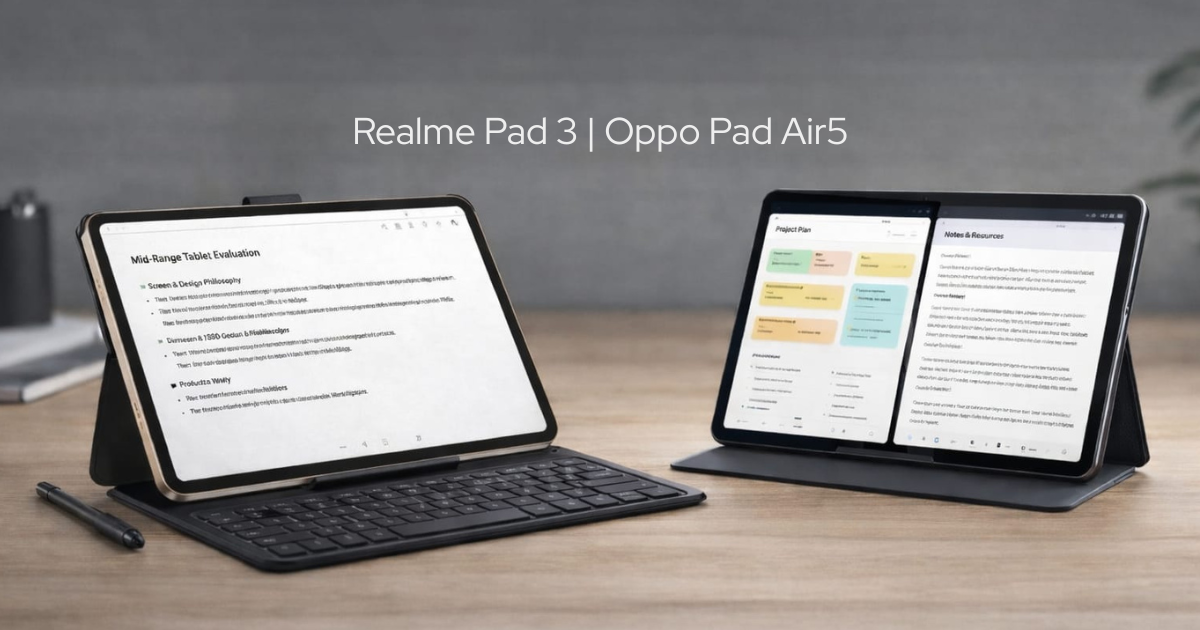
Realme Pad 3 vs Oppo Pad Air5: Category Evidence in Motion
The discussion of mid-range tablets for productivity in Africa is meaningful only when examined through real devices. The Realme Pad 3 and Oppo Pad Air 5 are priced similarly in Kenya, are powered by MediaTek’s Dimensity 7300-class 4nm architecture, run Android 16 with tablet-optimized skins, and target professionals, students, and digital workers.
Yet their philosophies diverge in subtle but important ways.
a) Design & Build Philosophy
Screen Size and Physical Presence
- Oppo Pad Air5: 12.1-inch IPS LCD, 1980 × 2800 resolution, up to 120Hz, peak brightness up to 900 nits (HBM)
- Realme Pad 3: 11.6-inch IPS LCD, 2000 × 2800 resolution, 120Hz, 550 nits HBM
The Oppo’s 12.1-inch footprint immediately feels expansive. It favors users who treat a tablet as a semi-desk replacement. Reading full documents, reviewing spreadsheets, or watching lecture material feels immersive. Its larger surface encourages extended seated productivity.
The Realme Pad 3, slightly smaller and lighter at 578g, feels more agile. It balances portability with screen density. Its higher pixel density at roughly 297 ppi produces sharper text, which benefits prolonged reading and annotation.
This distinction matters. Some users prioritize screen real estate. Others prioritize daily mobility.
Build Quality and Professional Identity
Both tablets use aluminum unibody construction. Neither feels budget nor cheap.
- Oppo leans toward a lifestyle-professional crossover aesthetic.
- Realme projects minimal, efficient functionality with a cleaner industrial tone.
For a consultant walking into a meeting or a trainer presenting slides, both pass the credibility test. The difference is ergonomic personality, not prestige hierarchy.
b) Performance & Workflow Reality
Both devices are powered by Dimensity 7300-class silicon fabricated on a 4nm process, featuring Cortex-A78 performance cores and a Mali-G615 GPU.
On paper, they appear similar. In practice, tuning and thermal consistency shape workflow.
Multitasking and App Stability
With 8GB RAM minimum across configurations:
- Split-screen browsing and document editing remain stable.
- Google Docs, Sheets, Slack, Zoom, Notion, Canva, and browser tabs operate without aggressive reloads.
- Background app retention performs consistently during moderate multitasking.
The Oppo offers up to 12GB RAM in select variants. That configuration provides more headroom for users juggling heavier app stacks or light media editing.
Realme compensates by optimizing the UI and delivering a cleaner multitasking experience on Realme UI 7.0.
Neither is a desktop-class powerhouse. Both comfortably handle:
- Writing and research
- Online teaching
- Video conferencing
- Presentation management
- Cloud-based admin work
- Light content editing
This is where the category matures. For many workflows relevant to African professionals, flagship-level silicon is no longer mandatory.
c) Display & Productivity Comfort
Reading and Split-Screen Efficiency
Both panels run at 120Hz. Scrolling is fluid. Text rendering is clean.
- Oppo’s larger canvas favors side-by-side app use.
- Realme’s slightly sharper pixel density favors extended reading clarity.
For academic work, legal review, and long document sessions, eye strain depends more on brightness tuning and panel calibration than raw resolution.
Oppo’s higher peak brightness improves outdoor visibility and usability in bright rooms. Realme performs well indoors but is less effective in direct sunlight.
Audio and Media Support
Both support quad stereo speakers. Oppo integrates Dolby Atmos. Realme delivers balanced stereo separation.
In hybrid work environments, clear audio is essential for calls and recorded lectures. Both perform reliably here.
d) Battery & Practical Longevity
- Realme Pad 3: 12,200 mAh, 45W fast charging, reverse wired charging.
- Oppo Pad Air5: 10,050 mAh, 33W fast charging.
In real-world use:
- Realme’s larger battery supports multi-day moderate use.
- Oppo reliably delivers full-day productivity sessions.
For mobile professionals traveling between meetings or campuses, Realme provides extended battery life. Oppo balances endurance with slightly higher display brightness and more efficient tuning.
Charging speed also affects workflow. Realme’s 45W advantage reduces downtime during tight schedules.
Battery confidence directly impacts productivity trust.
e) Software & Ecosystem Confidence
Both run Android 16 with tablet-optimized skins:
- ColorOS for Pad
- Realme UI 7.0
Android’s maturity in 2026 includes:
- Stable split-screen multitasking
- Floating windows
- Improved stylus input support
- Better app scaling for larger displays
Accessory and Expansion Considerations
- Both support stylus and keyboard accessories.
- Realme offers expandable storage via a dedicated microSD slot.
- Oppo supports microSD in cellular models.
For professionals who store documents, lecture materials, or offline media, flexibility in expansion increases long-term viability.
5G support on both devices enhances independence from Wi-Fi infrastructure. In regions with inconsistent broadband coverage, cellular connectivity becomes a productivity enabler rather than a luxury.
Interpreting the Category
The Realme Pad 3 and Oppo Pad Air5 do not represent compromise tablets. They represent recalibrated expectations.
Both devices demonstrate that mid-range tablets for productivity in Africa now meet core professional demands:
- Stable multitasking
- Long battery endurance
- Large, high-refresh displays
- Mature Android software
- Credible build quality
The differences lie in ergonomics, emphasis on endurance, brightness performance, and configuration flexibility.
The real significance is not which device wins.
The significance is that the middle tier no longer appears to be a concession.
It feels intentional.
Realme Pad 3 vs Oppo Pad Air5: Structured Comparison Summary
| Feature | Realme Pad 3 | Oppo Pad Air5 |
| Approx. Price in Kenya | ~KES 75,000* | ~KES 65,000* |
| Approx. Price (USD) | ~$307 | ~$272 |
| Display Size & Resolution | 11.61-inch, 2800×2000 (2.8K), 120 Hz, 296 ppi | 12.1-inch, 2800×1980 (2.8K), 120 Hz, ~284 ppi |
| Display Quality | High pixel density is great for reading and split-screen work | Larger canvas, smoother visuals with a wide color gamut |
| Processor | Mediatek Dimensity 7300 Max (4 nm) | MediaTek Dimensity 7300-Ultra 4 nm |
| RAM / Storage Options | 8 GB / 128 GB or 256 GB | Up to 12 GB / 256 GB |
| Operating System | Android 16, Realme UI | Android 16, ColorOS 16 |
| Battery Capacity | 12,200 mAh with 45W fast charge | 10,050 mAh with 33W fast charge |
| Camera | 8 MP rear, 8 MP front | 8 MP rear, 8 MP front |
| Connectivity | Wi-Fi + 5G | Wi-Fi (5G variant expected) |
| Stylus / Keyboard Support | Yes | Yes |
| Best Use Case | Long endurance productivity, reading, and multitasking. | Balanced productivity, larger workspace, immersive display |
How to Decide: A Productivity-First Framework
Most buyers do not choose tablets. They choose reassurance. Reassurance that the device will not slow them down, undermine their credibility, or limit their ambition.
A productivity-first decision starts with a more fundamental question: What does my daily work actually require? Where do I lose momentum? What friction can I not afford?
The Realme Pad 3 and Oppo Pad Air 5 both belong to the emerging class of mid-range tablets for productivity in Africa. They are not status symbols. They are work tools. The difference lies in how each supports your specific workflow.
Choose based on output, not perception.
The Pro Writers and Researchers
If your day revolves around documents, annotations, citations, and long reading sessions, clarity and endurance define your experience. Text sharpness reduces fatigue. Stable multitasking protects focus. Battery reliability removes background anxiety.
The Realme Pad 3 aligns strongly with this rhythm. Its higher pixel density enhances text clarity, and its 12,200 mAh battery supports extended deep-work sessions without frequent interruptions for charging. You can enter research mode without monitoring the battery percentage.
The trade-off is slightly lower peak brightness than that of the Oppo Pad Air 5. For primarily indoor work environments, this remains a minor consideration.
If sustained concentration defines your productivity, choose the device that protects your focus.
The Student and those in the Academia Space
Students operate in motion. Lectures, hostels, study groups, transit, and late-night revision sessions demand flexibility. You split screens between live lectures and handwritten notes. You open multiple browser tabs while managing assignments.
The Oppo Pad Air5’s 12.1-inch display provides more visual breathing room. Split-screen feels less compressed. In higher RAM configurations, it manages concurrent apps smoothly, supporting lecture playback, note-taking, and research without noticeable friction.
Battery capacity is lower than Realme’s, so power planning becomes more important during long campus days.
If visual space improves information absorption, choose the larger canvas.
The Consultant and Trainer
Consultants measure reliability in minutes. Your device must activate quickly, sustain video calls without lag, and hold a charge across back-to-back sessions. Downtime costs momentum.
The Realme Pad 3’s larger battery and 45W fast charging reduce recharge windows between engagements. That operational confidence matters when moving between client meetings or training environments.
The Oppo Pad Air5 features a brighter display, which may perform better in well-lit conference rooms.
If uptime defines your professional rhythm, prioritize endurance and charging efficiency.
The Digital Entrepreneur
Entrepreneurs manage complexity. Dashboards, analytics, messaging apps, content drafts, invoices, and social platforms often run simultaneously. Stability matters more than raw peak performance.
Both devices handle moderate multitasking effectively. Realme provides additional flexibility through expandable storage and longer battery endurance for file-heavy workflows. Oppo offers a broader display surface for reviewing layouts, marketing creatives, and data dashboards.
Neither tablet replaces a desktop-class machine for advanced creative production. Both are credible tools in the evolving mid-range tablet landscape for productivity in Africa.
Choose the device that strengthens revenue-generating activity, not the one that signals prestige.
A disciplined decision shifts the question from “Which tablet is superior?” to “Which workflow am I optimizing?” When professionals answer that honestly, overspending declines and intentional investment increases. That is where smarter productivity begins.
Market Implications: What This Signals for Africa
The arrival of devices like the Realme Pad 3 and Oppo Pad Air5 does not merely expand consumer choice. It signals a deeper recalibration of how mid-range productivity tablets in Africa are understood and valued.
For years, premium tablets carried an almost unquestioned psychological authority. In many professional environments, a higher price is associated with greater credibility. The device itself became part of the performance. To carry a flagship tablet signaled seriousness.
That assumption is now under pressure.
The Legitimization of the Middle Tier
Mid-range tablets no longer appear to be diluted alternatives. They arrive equipped with high-refresh displays, efficient 4nm processors, meaningful RAM configurations, stylus support, and battery capacities that sustain full workdays. For a growing segment of African professionals, that performance tier exceeds daily operational needs.
When a device delivers stable multitasking, clear displays, reliable connectivity, and durable battery life, the gap between mid-range and premium narrows in practical terms. The difference becomes incremental rather than essential.
Legitimacy follows capability. The middle tier is no longer tolerated; it is increasingly chosen with intention.
The Erosion of Automatic Premium Default
Premium brands remain powerful, and their ecosystems continue to attract loyal users. However, the automatic equation between price and productivity is weakening. African professionals operate within economic realities that demand discernment. Capital allocation carries weight. A device purchase competes with investment in business expansion, education, or infrastructure.
As digital participation expands across the continent, buyers are evaluating tools more analytically. They are asking not only what a device can do, but whether its additional cost meaningfully enhances output. When the answer becomes ambiguous, default behavior begins to shift.
This is not a rejection of the premium. It is the maturation of judgment.
Ecosystem Investment as the New Competitive Advantage
Hardware improvements alone will not define the next phase of competition. Chipsets will converge. Display quality will standardize. The brands that endure will be those that invest in ecosystem depth.
Software optimization, consistent update cycles, accessory availability, localized service networks, and after-sales reliability shape long-term trust. Tablets are increasingly embedded in workflows that extend beyond casual use. They function as operational tools in classrooms, consulting rooms, and digital businesses.
In that context, ecosystem continuity becomes a strategic differentiator rather than a secondary feature.
The Rise of the Sophisticated African Buyer
Search patterns reveal this transformation. Buyers are no longer searching only for “best tablet overall.” They are asking more pointed questions: “best tablet for work in Kenya,” “Android tablet for productivity,” “mid-range tablets for productivity in Africa.”
These queries reflect outcome-driven thinking. They reflect users who recognize that tools must align with workflow, not prestige. They reflect a buyer who understands that productivity is a function of fit rather than mere specification.
For retailers and sales professionals, this evolution demands a shift in conversation. Status-based selling loses traction. Use-case clarity gains influence. Brands that acknowledge this transition early will build loyalty that extends beyond a single purchase cycle.
Devices such as the Realme Pad 3 and Oppo Pad Air5 constitute more than merely competitive entries. They illustrate a market recalibrating itself. They reflect buyers growing more deliberate. They signal a continent whose digital workforce is maturing in both ambition and judgment.
That shift deserves attention.
The Reframe
The debate is no longer about whether mid-range tablets are capable. That question has already been answered by real-world performance. The more pressing issue is whether buyers are evaluating technology with clarity or simply inheriting assumptions.
In an economy in which digital tools shape income, credibility, and opportunity, every device functions as infrastructure. Infrastructure demands discipline. It demands alignment with workflow. It demands that cost and capability remain proportionate. When premium hardware delivers incremental gains at exponential price differences, the responsibility shifts back to the decision-maker.
Are we investing in output, or in optics?
Devices such as the Realme Pad 3 and Oppo Pad Air5 illustrate a maturing category. They show that mid-range tablets for productivity in Africa now meet the functional threshold required by writers, consultants, students, and entrepreneurs. That reality does not diminish the value of flagship devices. It sharpens the standard by which all devices should be judged.
Smarter capital allocation compounds. Brand symbolism depreciates.
As Africa’s digital workforce expands, competitive advantage will not belong to those who default to prestige. It will belong to those who assess needs honestly, allocate resources intentionally, and choose tools that strengthen results rather than appearances.
The question was never which tablet wins.
The question is whether we are ready to choose with greater discipline.
And that decision, more than any specification sheet, will shape the next phase of productivity across the continent.