

Across Africa’s fast-evolving digital economy, the conversation about mid-range tablets for productivity is no longer theoretical. It is urgent. For years, serious work has been culturally associated with premium devices. Apple and Samsung have dominated boardrooms, lecture halls, and co-working spaces, reinforcing the idea that credibility must come at a premium price. Over time, that perception hardens into default behavior.
But the default behavior is not always rational.

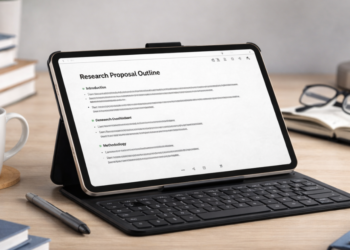
For many African professionals, every technology purchase carries weight. A tablet is not a fashion accessory. It is a writing desk for the consultant, a research hub for the graduate student, a pitch-deck screen for the entrepreneur, and a mobile office for the remote worker. When tools are tied directly to income, growth, and opportunity, overspending is not just expensive. It can be strategically limiting.
The middle of the market has long been dismissed. Devices priced below the premium tier were often viewed as compromises rather than serious productivity tools. That assumption may no longer hold in 2026.
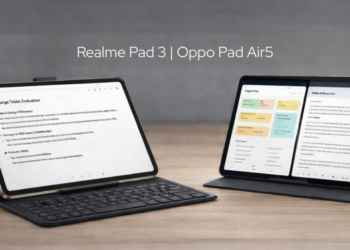
After spending time with the Realme Pad 3 and Oppo Pad Air 5, it became clear that the rise of mid-range tablets for productivity in Africa is not a marketing narrative. It is a structural shift. The real question is whether buyers are ready to rethink what serious productivity actually requires.
The Real Problem: The Productivity Illusion
The debate around tablets in Africa has quietly been reduced to a false binary. At the top sits the premium tier, powerful, refined, and aspirational. At the bottom sits the budget tier, accessible but often constrained. Between these lies a category that has rarely been examined seriously. That oversight has shaped buying behavior more than most people realize.
Premium Power Comes at a Psychological and Financial Cost
Premium tablets deliver undeniable performance. They offer well-engineered ecosystems, powerful processors, reliable build quality, and long-term software support. For professionals whose workflows are complex and whose income comfortably covers the cost, that investment makes sense.
However, in the Kenyan and many African markets, the purchasing context differs. Income growth is steady but uneven. Digital participation is rising rapidly, yet disposable income remains measured and deliberate. A tablet purchase can equal months of savings. When a device is acquired primarily for signaling credibility rather than for fully leveraging its capabilities, overspending becomes normalized.
That normalization is the productivity illusion. Buyers equate a higher price with guaranteed productivity gains. In reality, many workflows, such as writing, research, online teaching, presentations, light editing, remote collaboration, and administrative work, do not always require top-tier hardware. The assumption persists, and it drives purchasing patterns across urban tech hubs from Nairobi to Lagos to Accra.
Budget Affordability Often Means Functional Limitation
At the other end of the spectrum, budget tablets promise affordability. For students and early-stage entrepreneurs, that price point is attractive. However, limitations quickly appear. Slower processors, constrained RAM, inconsistent software optimization, and limited accessory ecosystems reduce long-term productivity comfort.
The result is frustration. Multitasking becomes restrictive. App reloads interrupt workflow. Support for external keyboards or styluses may be compromised. The device functions, but it does not elevate work. For anyone attempting to build income, credibility, or digital capacity, those compromises accumulate.
This is why conversations about mid-range tablets for productivity in Africa matter. They sit at the tension point between aspiration and limitation.
The Overlooked Middle and the African Professional Reality
The middle segment has historically been misunderstood as a compromise zone. In truth, it may represent the most strategic alignment for African professionals navigating growth. As the continent’s digital economy expands, more individuals are working remotely, launching online businesses, teaching virtual classes, and consuming global knowledge streams. Their tools must balance cost discipline with performance reliability.
User intent in 2026 is clear. Buyers are not searching only for “best tablet overall.” They are searching for “best tablet for work in Kenya,” “Android tablets vs iPad for productivity,” and “mid-range tablets for productivity in Africa.” These searches reflect a shift from brand loyalty to outcome-driven evaluation.
The real problem, therefore, is not that premium tablets exist or that budget tablets sell. The real problem is that purchasing decisions are often driven by perception first and workflow analysis second. African professionals find themselves caught between the desire to signal seriousness and the need to invest wisely.
That tension sets the stage for a deeper look at whether the middle category has finally matured into a credible productivity solution.
Why 2026 Is Different: A Market Inflection Moment
The rise of mid-range tablets for productivity in Africa is not happening in isolation. It is unfolding at a time when the structure of work itself has changed.
Remote Work Is No Longer Experimental
What began as a global disruption has matured into a normalized operating model. Across Kenya and much of Africa, remote collaboration, hybrid offices, and distributed teams are now standard practice. Professionals attend strategy meetings over video calls, manage projects in cloud dashboards, and submit deliverables across borders without ever stepping into a traditional office.
This normalization alters device expectations. A productivity tablet in 2026 must handle video conferencing, document editing, research, file sharing, and multitasking without friction. It must feel dependable during client calls and responsive during tight deadlines. That baseline expectation raises the standard for what qualifies as a serious work device.
The Expansion of Digital Side-Hustles and Micro-Entrepreneurship
Beyond formal employment, digital entrepreneurship is accelerating. Online tutoring, content creation, digital marketing, consulting, coding, design, and small e-commerce operations are increasingly common. For many, a tablet is not a supplementary device. It is central.
Search intent reflects this shift. Queries such as “best tablet for work in Kenya” and “Android tablet for productivity 2026” are tied to income-building decisions. Buyers are evaluating tools based on output potential, not entertainment value.
Android Ecosystem Maturity and Mid-Range Hardware Evolution
The Android ecosystem has matured significantly. App optimization has improved. Multitasking features are more refined. Cloud integration is seamless. At the same time, mid-range chipsets now deliver performance levels that previously belonged to flagship devices. Efficient processors, higher RAM configurations, and better battery management are closing historical performance gaps.
These developments converge in 2026. Portable productivity tools are no longer optional accessories. They are operational infrastructure. That convergence signals an inflection point. The middle tier is no longer defined by compromise alone. It is defined by strategic viability.
——————————————————————————-
Next in the Series
Realme Pad 3 vs Oppo Pad Air 5: A Productivity-First Evaluation for African Professionals
In Part 2 of this analysis, we move from structural shift to practical evaluation, examining how this recalibration plays out between the Realme Pad 3 and Oppo Pad Air 5 and what their real-world performance reveals about choosing mid-range tablets for productivity in Africa.