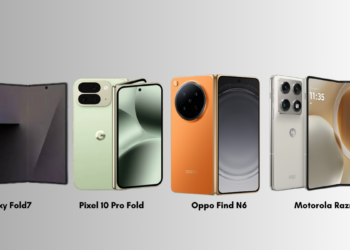


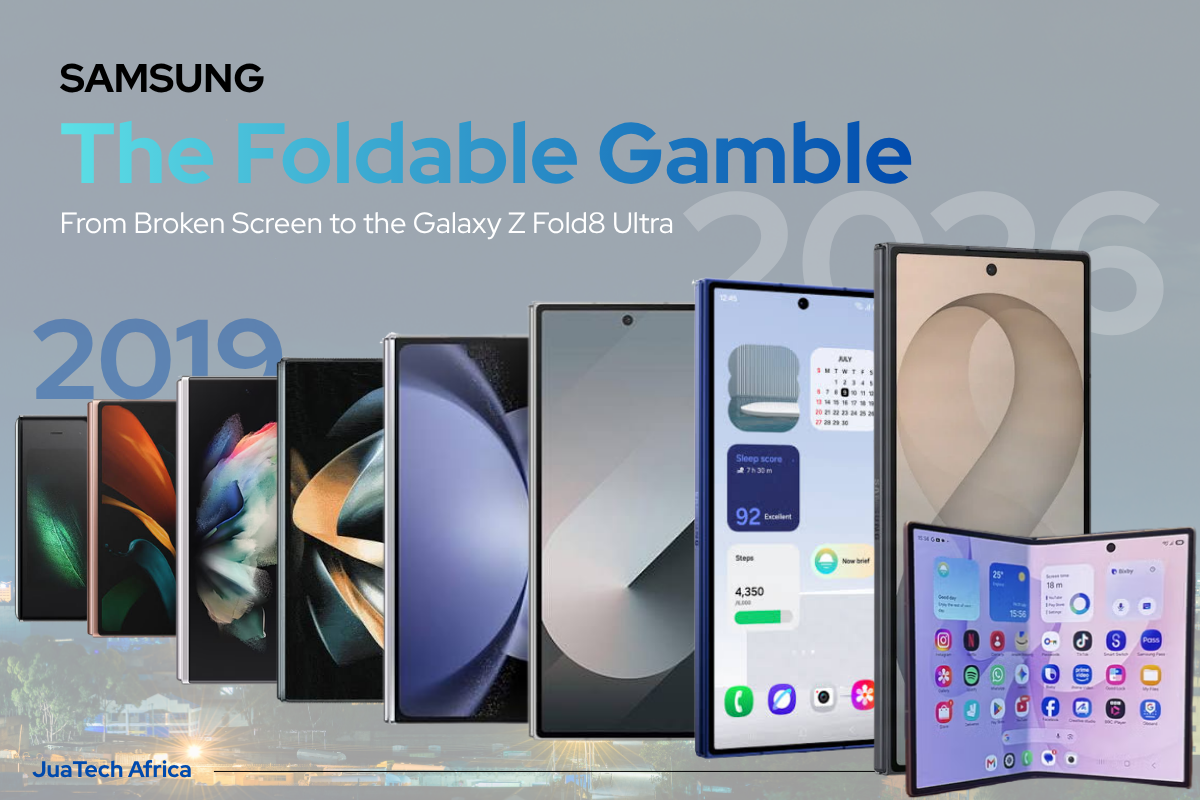
How Samsung spent eight generations solving the hardest problems of foldable phones, transforming a fragile experiment into a flagship platform while pushing the smartphone into entirely new forms.
Executive Summary

Samsung’s foldable smartphone journey began with a difficult proposition: could a smartphone move beyond the fixed slab design that had defined the category for more than a decade and become physically larger without becoming a tablet? The answer arrived in 2019 with the original Galaxy Fold. It demonstrated the potential of a phone that could open into a much larger display, but its early display and hinge failures also exposed the enormous engineering challenge involved in making a flexible device reliable enough for everyday use. Samsung postponed the original launch, redesigned critical elements of the product and eventually brought it to market later that year. What could have become a failed experiment instead became the starting point for one of the industry’s longest-running attempts to establish a new smartphone architecture.
Across eight generations, the nature of that challenge changed substantially. The original Galaxy Fold was primarily about proving that a smartphone could fold. Fold2 concentrated on usability and making the form factor more practical. Fold3 strengthened the device, introduced water resistance and established the foldable as a more credible productivity platform. Fold4 and Fold5 refined the hinge, cameras, performance and physical design, while Fold6 and Fold7 entered a much more competitive environment in which thickness, weight and portability became central measures of progress. With Fold8 and the Galaxy Z Fold8 Ultra, Samsung has moved the conversation toward flagship positioning. The foldable is no longer being presented simply as an alternative form factor. Samsung is increasingly treating it as a premium computing platform capable of competing at the highest level of its smartphone portfolio.
The significance of this progression lies in the fact that Samsung did not solve the same problem eight times. Each generation exposed another constraint that had to be addressed. Making a foldable thinner affected internal space and component placement. Strengthening the structure affected weight. Increasing display area created greater demands on battery capacity and thermal management. Camera hardware competed for limited internal volume, while productivity ambitions required software and application developers to take advantage of the changing screen configuration. Progress therefore depended on making multiple competing requirements work together rather than simply adding another specification to the product sheet.
That process has changed the relationship between the smartphone and its physical form. A conventional smartphone provides a largely fixed display within a fixed physical footprint. A foldable allows the same device to operate in different configurations, moving between compact communication and a larger environment for reading, entertainment, multitasking, creation and productivity. Samsung’s development of Multi-Active Window, Taskbar, App Continuity, DeX and Galaxy AI demonstrates that the larger display only creates value when software converts the additional physical space into useful computing capability. The deeper innovation is therefore not the hinge itself, but the emergence of a device whose physical configuration can become part of the user interface.
The progress, however, has not removed the fundamental compromises of the technology. Foldables remain expensive and mechanically complex products, with flexible displays and hinge systems introducing engineering requirements that conventional smartphones largely avoid. Thickness, weight, battery capacity, cameras, thermal management and structural durability compete for the same internal space. The crease remains part of the physical experience, repairs can be more complicated, and software optimization remains essential to extracting value from the larger display. Samsung’s pursuit of extreme thinness has also involved trade-offs, including the removal of S Pen support from recent Fold generations. These compromises matter because technological sophistication does not automatically translate into commercial value.
Competition has made the category considerably more demanding. Samsung is no longer developing foldables in relative isolation. Huawei, HONOR, OPPO, Xiaomi and other manufacturers have pushed different combinations of thinness, weight, battery capacity, camera capability, hinge engineering and durability. Samsung’s Galaxy Z TriFold represents another stage of experimentation, using two hinges and three panels to create a much larger mobile workspace. At the same time, developments in slidable and other variable-display technologies indicate that the industry’s longer-term objective may extend beyond perfecting the conventional book-style fold. The competitive question is increasingly about which architecture can create meaningful additional utility without introducing unacceptable complexity, cost, weight or reliability concerns.
The commercial reality remains important. Foldables have developed from experimental products into a credible premium category, but they have not displaced conventional smartphones. Their relatively limited penetration means that technological progress should not be confused with mass-market adoption. The decisive commercial issue is whether the additional capability created by the form factor provides enough value to justify the premium and the additional ownership complexity. That calculation becomes particularly important as manufacturers push the category into increasingly expensive territory.
For African markets, the more useful question is therefore not simply whether consumers can afford a foldable. It is whether the additional utility justifies the complete ownership equation. Purchase price is only one component. Financing, warranty coverage, protection, repair costs, parts availability, resale value, software support, and the productivity generated by the device all influence its economic value. This creates a potentially meaningful opportunity among executives, entrepreneurs, consultants, creators, enterprise professionals and other mobile workers whose livelihoods already depend heavily on smartphones. For these users, the relevant comparison may extend beyond one phone versus another and become a question of whether a foldable can consolidate communication, content consumption, creation and productive computing into one device.
The Galaxy Z Fold8 Ultra therefore represents more than another annual hardware release. Its significance lies in what Samsung’s eight-generation investment has produced: a foldable platform that is thinner, lighter, more capable and more closely integrated with the company’s highest-end smartphone strategy than the original Galaxy Fold could have suggested. The Ultra designation is particularly significant because it places the foldable directly within Samsung’s flagship hierarchy and signals that the company sees the form factor as capable of supporting the performance, camera, display, software, and productivity expectations associated with its most advanced mobile devices.
The future remains open. Samsung and its competitors are continuing to investigate thinner architectures, denser batteries, improved hinges, larger multi-folding displays, slidable and potentially rollable screens, while AI increasingly provides the software layer through which changing physical configurations can become useful. These developments suggest that the long-term opportunity may not be limited to making the existing Fold architecture incrementally better. The industry may ultimately be moving toward mobile devices whose physical dimensions and interfaces can adapt more dynamically to the work users need to perform.
The Foldable Gamble is therefore ultimately a study of how an established technology category can be challenged and gradually redefined through sustained engineering, software development, manufacturing capability, competitive pressure and market learning. Samsung’s journey from the troubled Galaxy Fold of 2019 to the Galaxy Z Fold8 Ultra demonstrates both the possibilities and the limits of that approach. The company has made the foldable far more credible, capable, and useful, but the category still has to show that its added capabilities create enough value to justify the added cost and complexity. The next stage of the story will be determined not simply by how far the industry can push the technology, but by how convincingly it can translate that engineering progress into a product that people and businesses consider worth owning.
The Gamble
In 2019, Samsung asked the smartphone industry to believe in something that still looked almost unreasonable: a phone that could open into a much larger display without becoming a tablet. The idea challenged one of the most established assumptions in mobile technology, that the smartphone would remain a rigid slab whose screen could only grow within the limits of its physical footprint. Samsung’s answer was the Galaxy Fold, a device designed to carry a conventional smartphone experience in one hand and expand into a larger workspace when opened. The proposition was compelling. The first implementation exposed just how difficult it was to make that proposition work.
Before the original Galaxy Fold reached consumers, review units revealed serious problems involving the display and hinge area. Samsung postponed the launch and, following its investigation, said it would strengthen the display protection, improve the hinge area, and provide clearer guidance on handling the device. The company eventually relaunched the Fold later in 2019.
That episode became more important than a troubled product launch. It exposed the fundamental engineering challenge at the heart of the foldable smartphone. Samsung had demonstrated that a large smartphone display could physically fold. It had not yet demonstrated that the mechanism, flexible display, protective layers, and software could survive the demands of everyday use while delivering the reliability consumers expected from a flagship phone.
Seven years later, the physical and strategic distance between that first Fold and Samsung’s eighth-generation foldables is considerable. The Galaxy Z Fold8 Ultra, introduced in 2026, is Samsung’s first Ultra-branded foldable. It combines an 8-inch main display with a 5,000mAh battery and a 200MP main camera, while measuring 4.1mm thick when unfolded and weighing 215g. Samsung describes the 2026 Galaxy Z lineup as its eighth generation of foldable devices, following seven generations of development and learning.
That transformation is the real story. Across eight generations, Samsung has had to solve a succession of problems that conventional smartphones rarely encounter at the same scale: protecting a flexible display, engineering a durable hinge, managing the crease, improving resistance to water and dust, reducing thickness and weight, adapting software to multiple screen configurations, and making a foldable feel less like an experimental device and more like a serious flagship platform. Samsung itself describes the evolution in terms of advances across form factor, displays, durability, multitasking, cameras, and Galaxy AI.
But the journey has not been simply about making the Fold better. It has also been about discovering what a foldable smartphone could become. Samsung refined the original book-style concept, responded to a changing competitive landscape, pushed aggressively on portability, and explored more radical form factors. The Galaxy Z TriFold represents another stage in that thinking, asking what happens when a smartphone does not fold once, but twice.
The Galaxy Z Fold8 Ultra therefore represents more than another generation of hardware. It is the latest expression of a strategy that began with an uncertain experiment in 2019 and survived enough engineering, market, and competitive pressure to reach its eighth generation. The Foldable Gamble tells how Samsung made that journey, what it learned along the way, and what the evolution of the Fold reveals about the smartphone’s next shape.
Before the Fold: Why Samsung Bet on a Foldable Smartphone
By the end of the 2010s, the smartphone had become one of the world’s most mature consumer technology products. The explosive experimentation of the early smartphone era had given way to a remarkably standardized design: a rectangular device dominated by a touchscreen, built around increasingly powerful processors, better cameras, faster networks and larger batteries. Manufacturers could continue improving almost every component, but the fundamental relationship between the phone and its display had barely changed. The screen could become brighter, sharper and larger, but it still occupied one rigid surface.
That created a problem for companies competing at the premium end of the market. The smartphone was becoming better, but not necessarily becoming fundamentally different. Samsung had built its flagship business around pushing display technology, industrial design and mobile features forward, yet the conventional smartphone increasingly offered limited room for dramatic changes in physical form. The next meaningful leap could not simply be another processor upgrade or another camera. Samsung needed to find a way to create more usable screen space without asking consumers to carry a physically larger device.
The idea of folding a display didn’t originate with the Galaxy Fold. Samsung had shown flexible-display concepts for years, including a flexible-display prototype in 2011. The difficulty was turning a demonstration of flexible technology into something that could survive mass production and everyday use. Samsung Display established a dedicated foldable development task force in July 2018 because commercializing foldable OLED required new approaches to manufacturing, materials and components that were fundamentally different from conventional OLED production. The company later described that transition from research to commercialization as one of its biggest challenges because durability and product quality could not be compromised simply because the technology was new.
The timing was significant. Samsung had already spent years developing OLED display technology, giving it capabilities that could be brought to bear on the problem from inside the company’s broader technology ecosystem. Flexible OLED could bend, but making a smartphone around it required much more than a flexible panel. The display had to withstand repeated folding, the hinge had to move with precision, the internal components had to accommodate a new mechanical architecture, and the resulting device still had to behave like a premium smartphone. Samsung was not merely changing the screen. It was being forced to rethink the physical architecture around the screen.
In November 2018, the company moved the idea from a technology story into a product proposition. At the Samsung Developer Conference in San Francisco, Samsung introduced the Infinity Flex Display and demonstrated the central principle behind its foldable strategy: a compact smartphone that could open into a much larger display for viewing and multitasking. The company also introduced One UI and announced collaboration with Google and the Android developer community, making clear that the foldable experience would have to be solved at the software level as well. Applications needed to transition between the smaller and larger displays, while Android itself needed to accommodate the new form factor.
This was an important shift in Samsung’s thinking. The objective was not simply to build a phone with a screen that could bend. Samsung was trying to resolve a longstanding contradiction in mobile design: how do you increase the amount of screen available to the user without increasing the physical size of the device to the same extent? A conventional smartphone could offer more display by becoming larger. A foldable could change the relationship between the device’s closed footprint and its usable screen area.
The strategic proposition became clearer when Samsung unveiled the Galaxy Fold in February 2019. The device combined a 4.6-inch cover display with a 7.3-inch Infinity Flex Display that opened from a smartphone-sized form into a substantially larger workspace. Samsung positioned the Fold around multitasking, content consumption and the combination of smartphone portability with a larger-screen experience. It was a fundamentally different proposition from simply making the next Galaxy flagship incrementally better.
There was also an important element of timing. Samsung was entering a smartphone market where the conventional form factor was becoming increasingly difficult to differentiate, while its own display capabilities gave it a credible opportunity to attempt something that most competitors could not yet commercialize at scale. The company had the display expertise, manufacturing infrastructure, premium smartphone business, and software relationships needed to attempt a new category. What remained uncertain was whether it could bring all those pieces together into a product reliable enough for ordinary consumers.
That uncertainty was the real gamble. Samsung had spent years proving that a display could bend. It now had to prove that a smartphone could fold repeatedly, remain useful, and survive the realities of everyday life. The Galaxy Fold would provide the first serious test of that proposition, and its troubled arrival would reveal just how much harder the second problem was than the first.
2019: The Galaxy Fold — When the Future Arrived Too Early
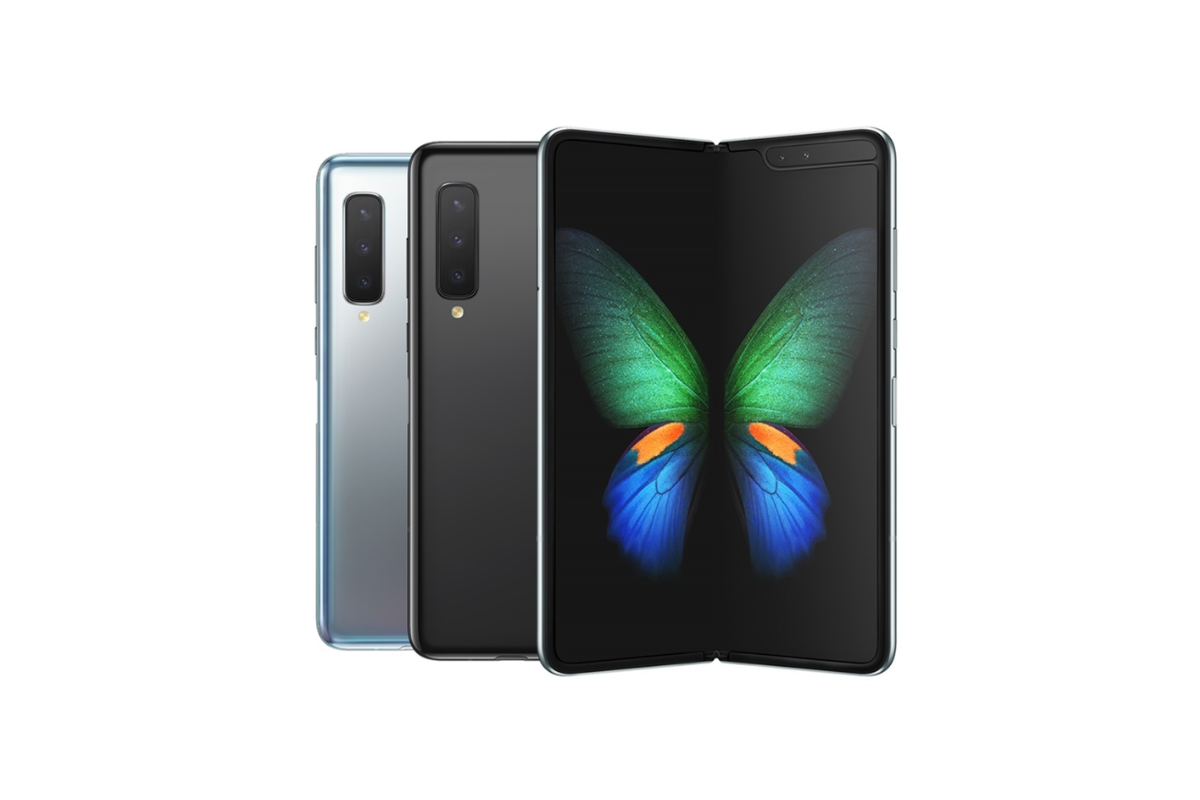
When Samsung unveiled the Galaxy Fold in San Francisco on February 20, 2019, it was not presenting another variation of the smartphone it had been making for years. The company was attempting to establish an entirely new category. The Fold could function as a conventional phone when closed, using a 4.6-inch cover display, but opening it transformed the device into something closer to a compact tablet, with a 7.3-inch Infinity Flex Display at its center. Samsung’s proposition was deliberately simple: carry one device that could remain compact when portability mattered and expand when a larger screen became useful. The company had spent eight years developing the technology behind the product, and its unveiling marked the moment when years of flexible-display research finally became a consumer device.
The hardware was remarkable because so many components had to work together differently than in a conventional smartphone. Samsung developed a new polymer-based display structure that was substantially thinner than a typical smartphone display and designed the screen to fold inward rather than merely flex. Around it sat a new hinge mechanism built with interlocking gears, allowing the two halves of the phone to open like a book and close into a compact form. Samsung also divided the battery into two cells and distributed internal components across the device to manage its unusual physical architecture. The result was a 276-gram device that measured 15.7 to 17.1mm thick when folded and 6.9 to 7.6mm when open, with 12GB of RAM, 512GB of storage and a 4,380mAh battery in the LTE version.
The dual-screen concept was more important than the numbers themselves. The cover display allowed the Fold to behave like a phone, while the inner display provided the larger canvas Samsung believed could unlock a different class of mobile activity. The company demonstrated multitasking across multiple applications, content consumption, gaming and productivity scenarios, while its software team worked with Google and Android developers to make applications transition between the two displays. Samsung said this software work had begun at the framework level in April 2018, months before the hardware reached the market, because a foldable could not create useful experiences through hardware alone.
Yet the very technologies that made the Fold possible also created its greatest vulnerability. A conventional smartphone display is protected by a rigid structure and a layer of glass designed to withstand everyday contact. The Fold’s inner display had to remain flexible, which meant Samsung could not simply apply the same architecture. The protective layer became part of the engineering challenge. The screen also had to coexist with a hinge and a mechanism that created openings and movement where a conventional phone had none. Samsung had succeeded in making the display fold. The more difficult question was whether it could protect that display through the unpredictable conditions of ordinary use.
That question arrived sooner than Samsung expected. In April, selected reviewers received early units ahead of the planned April 26 retail launch. Within days, several review units developed serious display problems. In some cases, reviewers had removed what appeared to be a screen protector but was actually integrated into the display structure; other reported failures were associated with the hinge area and foreign material entering the device. Samsung’s own investigation identified problems associated with impact on exposed areas around the top and bottom of the hinge and an instance in which substances inside the device affected display performance. On April 22, Samsung postponed the launch rather than proceed with the product in that state.
The significance of the delay was larger than the embarrassment of a troubled launch. Samsung had reached the point at which its technological demonstration was being tested by reality. A controlled demonstration could show a display folding smoothly, a hinge opening and closing, and software moving between screens. A consumer product had to survive pockets, dust, handling, repeated opening and closing, accidental pressure and the ordinary assumption that a premium phone should not require specialist treatment. The first Fold exposed the gap between those two standards.
Samsung’s response was therefore instructive. It did not abandon the category. Instead, it returned to the device’s physical architecture. By July, the company had announced several changes: the protective layer was extended beyond the bezel so that its role as part of the display structure was clearer; the top and bottom of the hinge received additional protection caps; metal layers were added beneath the display; and the gap between the hinge and the body was reduced to improve protection against external particles. Samsung also continued optimizing applications and said it was conducting additional testing before bringing the revised device to market.
The Galaxy Fold finally reached consumers in September 2019, starting in South Korea on September 6 and then rolling out to selected international markets. Samsung presented the revised product as the result of months spent evaluating the original design, implementing changes, and testing them. The company also treated the ownership experience as part of the product, adding customer support and guidance around the new form factor.
This is where the first Fold becomes foundational to the entire history that follows. Samsung did not learn simply that foldable phones needed stronger hinges or better display protection. It learned that a new technology becomes a product only when engineers remove its weaknesses from the user’s everyday experience. The distinction would shape every subsequent generation. Fold2 would have to make the concept more usable. Fold3 would have to make it more durable and credible as a mainstream smartphone. Later generations would have to address thickness, weight, software, cameras, battery life, portability, and the compromises that remained.
The original Galaxy Fold therefore deserves to be remembered neither simply as a failure nor as an uncomplicated triumph. It was a proof of concept that reached the market before the category was ready for the standards consumers naturally applied to a premium smartphone. Its most important contribution wasn’t proving a phone could fold. Samsung already knew that. Its importance was that the product revealed, in public and under real-world conditions, the enormous distance between making the future possible and making the future dependable. The seven generations that followed would be Samsung’s attempt to close that distance.
The Fold3: The Foldable Becomes a Serious Smartphone
The Galaxy Z Fold3 arrived in August 2021 at a very different stage of Samsung’s foldable journey. The original Galaxy Fold had established the concept, while Fold2 had made the experience substantially easier to use. The next obstacle was more fundamental: consumers needed evidence that a foldable could withstand the ordinary demands placed on a premium smartphone. A device could have a remarkable screen and sophisticated hinge, but if users still had to treat it as fragile hardware, the category would remain a technological curiosity rather than a credible alternative to the conventional flagship.
Samsung therefore attacked durability at almost every layer of the Fold3. It introduced Armor Aluminum for the frame and hinge cover, Corning Gorilla Glass Victus on the external surfaces, and a new stretchable PET protective film with optimized display panel layers. Samsung said the resulting main-screen construction was 80 percent more durable than its predecessor. More significantly, the Fold3 became the first foldable smartphone with an IPX8 water-resistance rating, tested for submersion in up to 1.5 metres of fresh water for up to 30 minutes. The rating did not make the phone dust-resistant, but it removed one of the anxieties that had made earlier foldables fundamentally different from conventional premium smartphones. Samsung also subjected the hinge to a folding test verified by Bureau Veritas for 200,000 folds.
These changes mattered for more than durability. Samsung was beginning to change the expected relationship between the user and the device. The first Fold had required an unusual degree of care because its flexible display and hinge were unfamiliar technologies with obvious vulnerabilities. By the third generation, Samsung was engineering those vulnerabilities into the product rather than expecting the user to compensate for them. Durability was becoming part of the product experience itself. A serious smartphone has to disappear into everyday life: it has to survive rain, pockets, bags, repeated handling and the accumulated wear of ownership without constantly reminding the user that its technology is unusual.
The Fold3 also made the larger display more convincing as a primary interface. Samsung retained the 7.6-inch inner display but introduced an under-display camera, placing the front camera beneath the display rather than using a conventional hole. The result was a less interrupted viewing area for content on the large panel, reinforcing Samsung’s attempt to make the unfolded screen feel like the device’s central workspace rather than a novelty surface. Samsung also improved the underlying display construction and brightness, continuing to adapt the panel around the specific demands of a foldable device.
More consequential was Samsung’s decision to bring the S Pen to the Fold for the first time. The move connected the foldable directly to one of Samsung’s strongest productivity traditions. The large inner display gave handwriting, annotation, sketching, and document work more room than a conventional smartphone, while Flex Mode and multitasking allowed the device to support more deliberate forms of interaction. The S Pen was sold separately and worked with the Fold3’s main display through the S Pen Fold Edition and S Pen Pro, both of which incorporated a specially engineered tip designed for the foldable screen. Its arrival changed the proposition. Samsung was no longer presenting the Fold simply as a larger screen that happened to fold. It was beginning to define a form of mobile computing in which the larger display could support tasks traditionally associated with a tablet or another productivity device.
The software architecture reinforced that direction. Samsung continued developing Multi-Active Window, App Pair, Flex Mode and a new Taskbar, allowing users to run applications together, save combinations of frequently used apps and switch between them more efficiently. Flex Mode also demonstrated that the hinge could become part of the interaction model, allowing the device to remain partially folded while different functions occupied different areas of the screen. Samsung continued working with Google and other partners to expand the ecosystem around foldable and large-screen experiences. The objective was becoming clearer: the value of the Fold did not come from having two screen sizes for their own sake. It came from allowing the physical state of the device to change how applications, information and tasks were arranged.
Samsung also changed how it positioned the product. The Fold3 launched alongside the Galaxy Z Flip3 as part of a more coherent Galaxy Z family, with Samsung explicitly presenting the devices as premium foldables that incorporated the durability and flagship features users expected from its smartphones. This mattered because Samsung was no longer asking consumers to interpret the Fold as a one-off experiment. It was establishing foldables as a product line with different form factors and use cases, supported by a growing software and partner ecosystem.
The commercial response provided another signal, though it needs careful interpretation. Samsung reported that, in its first month of launch, the Galaxy Z Fold3 and Z Flip3 together exceeded the cumulative sales of Samsung’s foldable devices for all of 2020. That was company-reported data and did not mean foldables had suddenly become mainstream across the entire smartphone market. It did, however, indicate that Samsung’s third-generation strategy was generating substantially greater consumer traction than its earlier foldable products.
So when did the Fold become a serious smartphone? There is no single specification or launch-day moment that provides the answer. The evidence accumulates across the generation. Samsung had strengthened the materials, introduced meaningful water resistance, made the main display more durable, brought the S Pen into the architecture, refined multitasking, and continued building a software ecosystem around the form factor. Most importantly, it was addressing the reasons a consumer might hesitate to make a foldable their primary phone rather than asking the consumer to overlook those concerns.
Fold3 therefore marks an important transition in the eight-generation story. The first Fold proved that Samsung could build the category; Fold2 demonstrated that the concept could become usable; Fold3 began to demonstrate that the form factor could satisfy the expectations attached to a serious flagship smartphone. It still had compromises, and Samsung still faced difficult problems ahead, particularly around thickness, weight, cameras, battery capacity, and the device’s physical feel. But the nature of the challenge had changed. Samsung was no longer trying to convince the world that a foldable could exist. It was trying to make the foldable good enough to belong in the mainstream conversation about what a smartphone should be.
Fold4 & Fold5: From Innovation to Refinement
By the time Samsung reached the Galaxy Z Fold4 in 2022, the nature of the foldable problem had changed again. The first Galaxy Fold had forced Samsung to prove that a folding smartphone could survive at all. Fold2 had made the concept substantially more usable, and Fold3 had strengthened its durability and established a clearer productivity proposition. The fourth generation did not need to persuade the market that the category existed. It needed to make the device better at being a smartphone, particularly in the areas where foldables still felt compromised when compared with conventional flagships.
Fold4: Improving the flagship fundamentals
Samsung’s response was most visible in the areas consumers could experience immediately. The Galaxy Z Fold4 introduced a wider cover-screen aspect ratio, a redesigned hinge, a lighter body and a more capable camera system. At 263 grams, it was 8 grams lighter than Fold3, while the redesigned hinge moved from a rotary mechanism to a linear motion system, reducing the number of components and contributing to a thinner and lighter construction. The cover display also became wider and shorter, bringing its proportions closer to those of a conventional smartphone and making typing and everyday interaction more natural when the phone remained closed.
The camera system was another important correction. Previous Fold generations had made considerable progress, but their cameras remained one of the clearest areas where the foldable could be perceived as a compromise compared with Samsung’s conventional flagship phones. Fold4 moved to a 50MP main camera and a 10MP telephoto camera with 3x optical zoom, alongside a 12MP ultrawide camera. Samsung also increased the main sensor’s pixel size and said it was 23 percent brighter, while the Snapdragon 8+ Gen 1 platform added image-processing capability. These were not foldable-specific inventions, but they mattered strategically because the Fold was increasingly expected to perform like a flagship phone in every conventional category, while also delivering its distinctive large-screen experience.
The larger screen also became more useful rather than simply remaining larger. Samsung refined the software around the 7.6-inch inner display, expanding the Taskbar and improving Multi-Active Window, App Pair and drag-and-drop interactions. The company increasingly positioned the Fold as a mobile workspace, with applications such as Microsoft’s Office suite taking advantage of the additional display area. The result was a more coherent relationship between hardware and software: the screen was not merely available for multitasking; Samsung was making multitasking one of the reasons to own the device.
Another important change happened beneath the surface. Fold4 retained the IPX8 water-resistance rating introduced with Fold3 and continued using Armor Aluminum and Gorilla Glass Victus+ on the external surfaces. Samsung was no longer making durability a headline rescue operation. It carried the progress forward while focusing engineering effort elsewhere. That is an important marker of maturity: once a problem becomes sufficiently solved, it stops consuming the entire development story and becomes part of the platform’s baseline.
Fold5: Making refinement visible

Fold5 arrived in 2023 with a different kind of headline improvement. The Flex Hinge replaced the previous Hideaway Hinge with a mechanism that allowed the two halves of the phone to close with virtually no gap between them. Samsung described a dual-rail structure and four drive shafts that let the display curve into the hinge rather than maintain the larger hinge gap of earlier generations. The result was not a new foldable concept, but a better physical expression of the one Samsung had already chosen.
The consequences were tangible. Fold5 measured 13.4mm at its thickest point when folded, compared with 14.2mm for Fold4, and weighed 253 grams, 10 grams less than its predecessor. The reduction may look modest in isolation, but it addressed one of the form factor’s fundamental compromises: a device that opened into a large screen still had to be carried in a pocket when closed. Every millimeter and every gram removed from that closed configuration made the foldable more compatible with ordinary smartphone ownership.
Samsung also continued strengthening the Fold’s productivity identity rather than attempting to reinvent it. Fold5 retained the 7.6-inch 120Hz inner display and 6.2-inch cover display, while software improvements included an enhanced Taskbar, two-handed drag-and-drop and a hidden pop-up feature for more flexible multitasking. Samsung also introduced a slimmer S Pen Fold Edition, making the productivity accessory easier to carry with the device. The processor moved to the Snapdragon 8 Gen 2 Mobile Platform for Galaxy, delivering the expected generational gains in performance and efficiency without changing the Fold’s core proposition.
Taken individually, neither Fold4 nor Fold5 represents the kind of dramatic technological break that defined the original Galaxy Fold. That is precisely why these generations matter. Samsung was no longer spending every cycle proving that its central concept could work. It was working through the accumulated compromises that stood between an impressive foldable and a genuinely polished flagship. The camera system improved. The cover screen became easier to use. The hinge became slimmer and eventually closed with a smaller gap. The body became lighter. Multitasking became more mature. The S Pen became more integrated into the productivity proposition. None of these changes reinvented the category, but together they reduced friction.
This is where the distinction between innovation and iteration becomes important. Innovation is often easiest to recognize when a product introduces something that did not previously exist. Iteration is harder to appreciate because its achievements can appear incremental when examined one by one. Yet technological maturity frequently comes through iteration: removing a little weight, improving a hinge, widening a display, strengthening a component, refining software, improving cameras and eliminating small frustrations that accumulate across thousands of interactions.
Fold4 and Fold5 therefore mark the point at which Samsung’s foldable strategy increasingly resembles the development of a mature technology platform. The company was not abandoning innovation; it was redirecting it. Instead of repeatedly asking what the Fold could become, Samsung was asking how much better the existing idea could become without sacrificing the characteristics that made it distinctive.
That is an important shift in the history of the Fold. The early generations were defined by proving what was possible. Fold4 and Fold5 were increasingly defined by removing the reasons users might hesitate. The foldable was becoming less of an experiment that happened to be a smartphone and more of a smartphone whose defining advantage happened to be its ability to change shape. The next challenge would be even harder: competitors were no longer watching from the sidelines, and thinness, weight and form factor were about to become central battlegrounds in the foldable market.
Fold6 & Fold7: The Thinness Race and the Competitive Pressure
By 2024, Samsung was no longer developing the Galaxy Z Fold in a relatively open field. The company had helped establish the book-style foldable as a viable product category, but competitors had spent several years studying the same engineering problems and attacking them from different directions. Huawei had pushed hardware and form-factor experimentation in China, HONOR had made thinness and weight central to its Magic V series, Xiaomi had pursued aggressive component integration and camera capability, while OPPO had demonstrated how far a book-style foldable could be reduced in thickness without abandoning a large battery or durability features. The competitive question was beginning to change. It was no longer enough for a company to have a foldable. The device itself had to justify why it should be chosen over another company’s interpretation of the same idea.
Fold6: Samsung responds to a changing category
The Galaxy Z Fold6, introduced in July 2024, showed that Samsung understood the direction of the market, even if it did not immediately erase the gap that had emerged around physical design. Fold6 weighed 239 grams and measured 12.1mm when folded and 5.6mm when unfolded, improvements over Fold5 but still substantial by the standards being established by the thinnest Chinese competitors. Its 6.3-inch cover display also adopted a slightly wider 22.1:9 ratio, making the outer screen more natural for conventional smartphone tasks, while the 7.6-inch inner display retained the large workspace that defined the Fold proposition.
Samsung simultaneously strengthened the areas in which it had accumulated an important advantage: software integration, productivity and ecosystem services. Fold6 arrived with Galaxy AI features integrated into the foldable experience, including Circle to Search, Note Assist and Interpreter, alongside Google’s Gemini. The significance was not simply that Samsung had added AI features to a large screen. The Fold’s proposition increasingly depended on turning that additional screen area into useful computing space for translation, note-taking, document work, research and multitasking. The hardware created the opportunity; software determined how much of that opportunity the user could actually exploit.
But the market was moving faster than Samsung’s annual refinement cycle. By the middle of 2024, the physical dimensions of competing book-style foldables were making Samsung’s remaining compromises increasingly visible. HONOR’s Magic V3 measured 9.2mm when folded and weighed 226 grams, while retaining a 5,150mAh battery and IPX8 water resistance. Xiaomi’s MIX Fold 4 measured 9.47mm folded, 4.59mm unfolded and 226 grams, while combining the slim design with a Leica-branded quad-camera system. These products were not identical in software, availability or market strategy, but their existence changed the benchmark against which Samsung’s hardware could be judged.
OPPO pushed the same argument even further with the Find N5 in 2025. At 8.93mm when folded and 229 grams, it demonstrated that a book-style foldable could approach the physical dimensions of a conventional flagship while retaining a large folding display. OPPO also combined the design with IPX8 and IPX9 water resistance. The significance was not that OPPO had solved every foldable problem. It was that thinness, lightness and durability were no longer mutually exclusive engineering ambitions. They had become competitive targets.
The competitive landscape could therefore be understood through several dimensions rather than one headline specification.
| Dimension | Why it matters |
| Thickness | Determines whether a foldable still feels unusually bulky when closed. |
| Pocketability | Connects physical dimensions to whether the device can realistically replace a conventional smartphone. |
| Weight | Affects carrying comfort, one-handed use and long-session handling. |
| Hinge | Influences folding reliability, thickness, viewing angles and mechanical feel. |
| Durability / crease | Determines how closely the flexible display approaches the expectations of a conventional flagship. |
| Display | A foldable needs both a practical outer screen and a compelling inner workspace. |
| Productivity | Provides one of the clearest reasons to carry a larger device that folds. |
| Cameras | Tests whether the foldable can compete with conventional flagship and Ultra-class phones. |
| Battery | Thinness has limited value if it compromises useful endurance. |
| Software | Determines whether additional screen area creates real utility rather than simply more space. |
| Multitasking | Converts the larger display from a viewing advantage into a computing advantage. |
| Price | Remains a major barrier to broader adoption. |
| Availability | A technically impressive device has limited impact if consumers cannot readily buy it. |
| Market reach | Distribution, services, software ecosystems and after-sales support determine how widely the hardware can compete. |
These dimensions also reveal why the competitive story cannot be reduced to thickness. Huawei, HONOR, Xiaomi and OPPO could demonstrate exceptional hardware in particular areas, but their commercial reach differed substantially by market. China’s foldable market had become particularly important, while Samsung retained a strong position in several international markets. Counterpoint reported that Samsung remained the largest foldable vendor in Europe in Q1 2025 even as competition intensified from HONOR, Motorola, Google, Xiaomi and others. The category was therefore becoming more competitive without becoming uniform: different manufacturers were emphasizing different combinations of hardware, software, ecosystem, pricing and distribution.
This distinction matters because market leadership and product leadership are not necessarily the same thing. A manufacturer can possess greater distribution, brand recognition and ecosystem reach without leading every hardware dimension. Conversely, a competitor can produce a thinner or lighter foldable without having comparable global availability, software infrastructure or after-sales coverage. The emerging market was becoming multidimensional, and the relevant question increasingly depended on what the buyer valued and where the device could actually be purchased and supported.
Fold7: When thinness becomes a strategic trade-off
Samsung’s response arrived with the Galaxy Z Fold7 in July 2025, and the scale of the physical redesign showed how seriously the competitive pressure had registered. Fold7 reduced the folded thickness to 8.9mm and weight to 215 grams, while reaching 4.2mm when unfolded. Samsung also widened the cover display to 6.5 inches with a 21:9 aspect ratio and expanded the main display to 8 inches. The result was a foldable that moved much closer to the physical proportions of a conventional premium smartphone while simultaneously offering a larger internal display.
The hinge was redesigned again as the Armor FlexHinge, using a multi-rail structure and a revised mechanism intended to distribute stress more evenly while reducing visible creasing. Samsung also strengthened the frame through Advanced Armor Aluminum, introduced Gorilla Glass Ceramic 2 on the cover display and restructured the inner display with a titanium plate layer and thicker Ultra Thin Glass. The engineering objective was becoming increasingly clear: reduce the physical burden of the foldable without weakening the structure that makes folding possible.
Fold7 also addressed another longstanding criticism of the Fold series: cameras. For the first time, Samsung brought a 200MP main camera to the Fold line, paired with its ProVisual Engine and the Snapdragon 8 Elite for Galaxy platform. This mattered because the Fold was increasingly being judged against Samsung’s own conventional Ultra phones, not merely against previous foldables. If the company wanted the Fold to occupy the highest tier of its smartphone portfolio, the uniqueness of the form factor could no longer excuse weaknesses in conventional flagship capabilities.
Yet Fold7 also introduced a revealing reversal. Samsung removed S Pen support. The decision mattered because the stylus had been part of the Fold’s productivity identity since Fold3. The large inner display had provided a natural canvas for handwriting, annotation and other precision tasks, giving Samsung a way to argue that the Fold was not simply a larger phone but a different kind of mobile workspace. By Fold6, Samsung’s official S Pen compatibility extended across four generations, from Fold3 through Fold6. Fold7 broke that continuity.
Samsung’s official specifications confirm that Fold7 does not support S Pen. The significance of the decision lies in what it says about the direction of the hardware. Samsung was pursuing a substantially thinner and lighter architecture, and the Fold7’s redesigned display and internal construction were built around that objective. The company itself emphasized the engineering challenge of reducing display layers, hinge dimensions and internal components while maintaining structural integrity. The result was a device that was materially thinner and lighter, but one that no longer carried a productivity feature that had previously helped define the Fold proposition.
That trade-off is important because it complicates the idea of technological progress. A newer generation is not necessarily one in which every capability increases. Sometimes a mature platform reaches a point where improving one characteristic requires sacrificing another. In Fold7, Samsung pushed aggressively toward pocketability and a more conventional smartphone profile, while giving up native stylus input. The decision illustrates the increasingly difficult balancing act at the centre of foldable engineering: thinness, durability, battery capacity, cameras, productivity and portability all compete for limited physical space.
The market data provided another piece of context. Foldables were attracting more competitors, but they were not yet a mass-market replacement for conventional smartphones. Counterpoint reported modest global foldable shipment growth in 2024, while foldables remained a niche portion of smartphone sales in Europe in early 2025. Samsung still held the largest share in that European market, but its position had weakened as competitors introduced thinner and lighter alternatives. The competitive pressure was therefore arriving before the category had reached mass adoption.
That is what makes Fold6 and Fold7 so important in the larger history. Samsung had spent the first half of the Fold’s existence teaching the market why a foldable could exist. By this stage, the market itself was teaching Samsung what a modern foldable had to become. Thinness mattered because a foldable had to fit naturally into everyday life. Weight mattered because a large screen was not useful if carrying the device became uncomfortable. Hinge engineering mattered because the mechanism was both the defining feature and the primary source of mechanical complexity. Cameras mattered because users increasingly expected flagship-level imaging regardless of form factor. Software mattered because a large inner display needed applications and interfaces that could exploit it. Price, availability and market reach mattered because technological capability had limited commercial value if consumers could not afford or access it.
Fold7 therefore should not be interpreted simply as Samsung finally becoming thin enough. Its significance lies in the fact that Samsung was now responding to a competitive system rather than solving an isolated Samsung problem. HONOR, Huawei, Xiaomi and OPPO had helped redefine the physical and functional expectations of book-style foldables, while Samsung’s own ecosystem, software, distribution and long-term investment remained important competitive assets. The category had moved beyond the stage where being first was sufficient.
The question was no longer, “Can Samsung make a foldable?” It had become considerably harder: “Can Samsung make a foldable that competes convincingly across all the dimensions that now define the category?” That is the point at which a technological experiment becomes an industry race. And as Samsung had just demonstrated, competing in that race could require difficult choices about what the foldable should become, what it should retain and even what it could afford to leave behind.
The TriFold Experiment: When Two Folds Were No Longer Enough
For six generations, Samsung’s foldable strategy had been built around one fundamental transformation: take a conventional smartphone, fold it once, and give the user access to a much larger display when needed. The original Galaxy Fold established the book-style architecture, and every subsequent generation refined it through better hinges, stronger materials, thinner construction, improved software and greater portability. By the time Samsung reached the Galaxy Z Fold7, however, the basic proposition was no longer uniquely Samsung’s. Other manufacturers had pushed the same category toward thinner bodies, larger batteries and, increasingly, different physical architectures. The next question was no longer simply how to make a single-fold phone better. It was whether one fold had become a limitation in itself.
That question had become considerably more important after Huawei unveiled the Mate XT in September 2024. Huawei’s device folded twice and opened into a 10.2-inch display, making the multi-fold smartphone a visible commercial product rather than a concept confined to research laboratories. Reuters reported that Huawei had already taken more than four million pre-orders before launch, while the broader foldable market remained a small portion of total smartphone shipments. The Mate XT therefore demonstrated both the technical possibility and the competitive signalling power of a device that could move beyond the conventional phone-to-tablet transformation.
Samsung’s arrival with the Galaxy Z TriFold should consequently be understood through two realities operating at the same time. The company already possessed the engineering capabilities required to pursue a multi-fold device after years of work on flexible displays, hinges, materials and foldable software. At the same time, Huawei had changed the competitive context by showing the industry what a two-fold smartphone could look like in a commercial product. There is no evidence that Samsung simply reproduced Huawei’s approach, and Samsung describes the TriFold as being built on a decade of foldable-category innovation. The more defensible interpretation is that Samsung had the capability to pursue multi-folding, while Huawei helped make that frontier strategically difficult to ignore.
The significance of the TriFold therefore lies beyond its unusual shape. It represents the point at which Samsung’s accumulated foldable capabilities met a competitive environment that was beginning to ask a more ambitious question about the future of the smartphone: how far can the form factor be stretched before the benefits of additional screen outweigh the complexity required to deliver it?
The Proposition: A Smartphone That Becomes a 10-Inch Workspace
The Galaxy Z TriFold extends Samsung’s original foldable proposition by changing the scale of the transformation. Instead of opening once from a conventional smartphone into a tablet-sized workspace, it starts with a 6.5-inch cover display and unfolds twice to reveal a 10-inch Dynamic AMOLED 2X main screen. When closed, the device measures 159.2 by 75.0 by 12.9mm and weighs 309g. When fully open, Samsung lists the thickness at 3.9mm at its thinnest point, 4.2mm through the centre section and 4.0mm around the side-button area. These figures are remarkable from an engineering perspective, but they also reveal the physical price of pursuing a larger transformation.
The attraction is not simply that the user gets more pixels. Samsung designed the 10-inch display around a different kind of mobile workflow, with support for running up to three full-sized applications simultaneously through Samsung DeX and using the expanded screen for research, editing, communication and other productivity tasks. The device can therefore move from a conventional smartphone experience to something closer to a portable workstation without requiring a separate tablet. Samsung positions this as the largest workspace yet offered on a Galaxy smartphone, and that framing is important because the TriFold is attempting to redefine what a smartphone can contain rather than merely improve what an existing foldable already does.
That proposition has obvious relevance for professionals whose computing lives are increasingly mobile. A consultant could review a document while keeping reference material visible; a creator could edit content with substantially more workspace; a trader could monitor several information streams without constantly switching applications; and an executive could move between communications and documents on a single device. These are not theoretical benefits of screen size alone. They are attempts to reduce the number of devices required to perform increasingly complex mobile work.
Yet the larger canvas also exposes the fundamental limitation of the TriFold proposition. Hardware can create physical space, but software determines whether that space becomes useful. A 10-inch display is valuable only when applications make intelligent use of it, when multitasking feels natural and when the operating system can maintain continuity as the device changes shape. Samsung therefore did not merely build a larger foldable. It was testing whether the smartphone operating system and application ecosystem could support a device that occupies territory traditionally divided between phones, tablets and lightweight computers.
Capability Meets Competitive Pressure
The most important strategic question surrounding the TriFold is whether Samsung built it because Huawei got there first or because Samsung had already been moving in that direction. The available evidence points to a more nuanced answer. Samsung says the TriFold is built on a decade of foldable innovation and that its research and development process has increasingly explored new form factors based on how people use mobile devices. The company’s manufacturing and engineering work on the TriFold also demonstrates that this was not simply an improvised response to a competitor. It required a new mechanical architecture, new display engineering and new manufacturing processes.
Huawei nevertheless changed the strategic environment. The Mate XT showed that the industry could move from a single hinge to two and from a phone-to-tablet transformation to a larger multi-stage device. More importantly, Huawei made that idea visible to consumers, media and competitors at scale. Reuters reported that the Mate XT attracted millions of pre-orders and quickly became a symbol of Huawei’s technological ambitions, even as its high price and production constraints limited its mass-market potential.
This distinction between capability and competitive urgency is important. A company can possess the engineering knowledge to build a product long before it decides that the product belongs in the market. Once another manufacturer demonstrates that a new form factor can be turned into a commercial device, however, the strategic question changes. The company must consider not only whether the technology works, but also who gets to define the next stage of the category.
Samsung’s answer was not to reproduce Huawei’s Mate XT architecture. The TriFold uses an inward-folding design that keeps the main display protected when the device is closed. Its two hinges are differently sized and use a dual-rail structure designed around the unequal weight and component distribution across the three panels. Samsung also engineered the device to alert users if they attempt to fold it incorrectly, an indication of just how different the operating discipline of a multi-fold device is from that of a conventional smartphone.
That makes the TriFold a particularly useful case study in technology strategy. Huawei demonstrated that the frontier had moved. Samsung demonstrated how it wanted to occupy that frontier. The distinction matters because technological competition rarely consists of one company inventing something and another simply copying it. More often, one company changes the boundaries of what appears commercially possible, forcing others to decide whether to respond, differentiate or allow the new category to develop without them.
Two Hinges, Three Panels and a Harder Engineering Problem
Adding a second fold does not simply add another hinge. It multiplies the number of mechanical, structural and display problems that must be solved simultaneously. A conventional Galaxy Z Fold contains one hinge, two panels and one principal bending area. The TriFold introduces two hinges, three panels and a much larger flexible display that has to survive repeated movement while maintaining structural integrity across the entire device.
Samsung consequently had to redesign much of the architecture around the foldable experience. The two Armor FlexHinges are not identical because the different sections of the device carry different weights and components. Their dual-rail structures are designed to coordinate the movement of the panels while allowing the display sections to meet with a minimal gap when folded. The inward-folding arrangement also means that the main display is enclosed when the device is closed, providing a degree of physical protection that became one of Samsung’s central design choices.
The engineering challenge extends well beyond the hinge. Samsung says TriFold production involves automated hinge assembly, specialized display attachment, three-dimensional laser scanning and CT scanning of the flexible printed circuit board. These processes matter because the tolerances become increasingly demanding when multiple moving structures, an ultra-thin flexible display and complex internal electronics must operate together. The manufacturing process therefore becomes part of the product story itself. A multi-fold smartphone is not simply a Fold with another hinge attached. It is a fundamentally more complicated mechanical and manufacturing system.
Samsung also subjected the main display to a 200,000-cycle multi-folding test, which it equates to approximately 100 folds per day over five years. That is a manufacturer-controlled test rather than a guarantee of identical behaviour under every real-world condition, but it demonstrates the reliability burden Samsung understood it was taking on. The company was asking a flexible display and two hinge systems to withstand the repeated mechanical movement of a device that was simultaneously thinner and larger than previous foldables.
The battery architecture illustrates the same problem from another direction. Samsung distributed a 5,600mAh three-cell battery system across the three panels and paired it with 45W wired charging. The arrangement allows the company to spread the power system across the device rather than concentrating the entire battery in one section, but it also demonstrates how every additional fold creates secondary engineering consequences. The form factor changes the battery, the battery changes the internal layout, and the internal layout feeds back into the hinge, thickness and weight of the entire device.
The TriFold therefore reveals something important about foldable innovation: the visible breakthrough is only the final layer of a much larger engineering system. The user sees a screen opening twice. Samsung has to make every internal component tolerate the physical consequences of that movement.
From More Screen to More Computing
The real test of the TriFold is not whether it can become 10 inches. It is whether those additional inches change what a person can accomplish.
A conventional Fold already creates a meaningful jump from smartphone to tablet. The TriFold goes further by giving the user enough horizontal space to maintain several applications within a single visual field. Samsung’s DeX implementation allows up to three full-sized applications to operate across the 10-inch display, with support for multiple desktops and external keyboard and mouse input. The resulting experience begins to resemble a compact computing environment rather than a conventional enlarged phone interface.
That distinction matters for the evolution of mobile computing. For years, smartphones became more powerful without fundamentally changing their physical interaction model. Processing power increased, cameras improved, displays became brighter and artificial intelligence became more capable, but the basic interface remained a small rectangle. Foldables introduced physical adaptability into that equation. The TriFold takes the idea further by making the physical configuration itself part of the computing experience.
There is, however, a danger in equating physical flexibility with functional transformation. A larger display does not automatically replace a laptop or tablet. Professional workflows often depend on a full keyboard, desktop-class applications, file management, peripherals and sustained workloads that a smartphone may not reproduce completely. The TriFold can reduce the need for another device in some situations, but whether it actually consolidates devices depends heavily on the user’s work.
That is why Samsung’s inclusion of DeX and multi-application workflows is more significant than the headline 10-inch specification. The company is not merely selling screen area. It is attempting to establish a use case for the additional physical complexity. Without that software layer, the TriFold would risk becoming an impressive demonstration of engineering rather than a meaningful evolution in mobile computing.
When Engineering Becomes Expensive
The complexity of the TriFold inevitably reaches the economics of ownership. Samsung launched the device in the United States at $2,899 for the 512GB model, placing it far above the price of conventional flagship smartphones and even above Samsung’s already expensive book-style foldables. The company initially positioned it as a limited, premium innovation, with availability beginning in South Korea before expanding to China, Taiwan, Singapore, the United Arab Emirates and the United States.
The price therefore communicates something about the product’s strategic position. Samsung was not asking the mass market to replace its conventional smartphone with a TriFold. It was testing the willingness of a smaller group of users to pay for an entirely new relationship between phone and workspace. The economics are closer to those of an early premium form factor than a conventional flagship refresh.
That distinction is important when evaluating the TriFold commercially. A limited-volume device can create strategic value without becoming a mass-market product. It can validate manufacturing techniques, reveal how users interact with a new form factor, generate software requirements and establish a design language that later influences more affordable products. The first Galaxy Fold itself demonstrated how a difficult early product could become the foundation for a much broader platform.
The TriFold also makes the African ownership question more difficult. In a market such as Kenya, the value proposition cannot be separated from warranty access, repair capability, replacement displays, insurance, financing, resale and service turnaround. A premium smartphone with one hinge already requires consumers to think differently about ownership. A device with two hinges, three panels and a much larger flexible display increases the consequences of anything going wrong.
This is why the TriFold’s engineering story and its market story should not be treated separately. The more sophisticated the hardware becomes, the more important the surrounding ownership ecosystem becomes. For a mobile-first market, the ability to carry phone and tablet functionality in one device is attractive. But that value can be undermined quickly if the device is difficult to finance, insure, repair or resell.
Reception, Scarcity and the Reality of a Frontier Product
The TriFold generated the kind of attention that Samsung would expect from a device designed to demonstrate the limits of mobile hardware. It was introduced as Samsung’s first multi-folding smartphone and attracted considerable consumer and industry interest. Samsung’s U.S. product page now describes it as a limited-run device that is completely sold out, while the company continues to present the product as a showcase for its approach to the next generation of foldable design.
Its limited commercial run should nevertheless be interpreted carefully. Reports in March 2026 said Samsung was winding down sales after roughly three months, with Samsung not publicly providing a reason. Ars Technica reported that the company had confirmed the sales wind-down and cited Bloomberg reporting on the decision. The same report noted that the device had attracted strong demand relative to its limited production, although those observations do not establish Samsung’s internal commercial rationale.
This is where the distinction between product success and strategic value becomes useful. The TriFold does not have to become a mass-market smartphone to matter. Its purpose can include testing a new architecture, learning how customers use a much larger mobile workspace, validating manufacturing techniques and determining which elements can eventually move into more conventional foldables.
There is also a broader lesson in the way the device was sold. Samsung did not attempt to disguise the TriFold’s experimental character. Its limited market availability, extremely high price and specialized construction positioned it as a premium frontier device. The company was effectively asking the market to participate in an experiment: here is what a smartphone can become when the constraints of the single fold are removed. The market’s response would help determine which parts of that vision deserve to survive.
That makes the TriFold more useful as an industry signal than as a conventional sales story. It tells us that Samsung considers multi-folding technically credible enough to commercialize, but the limited positioning also suggests that the company does not yet regard the architecture as a straightforward replacement for the Galaxy Z Fold.
What the TriFold Really Means for the Foldable Era
Seen from the beginning of Samsung’s foldable journey, the TriFold represents a significant change in the question being asked.
The original Galaxy Fold asked whether a smartphone could fold at all. Fold2 concentrated on usability and made the basic proposition easier to live with. Fold3 attacked durability and established the foldable as a more credible productivity device. Fold4 and Fold5 showed that maturity could come through refinement, with Samsung reducing weight, improving the hinge and removing physical compromises rather than reinventing the category. Fold6 and Fold7 then arrived in a market where competitors such as Huawei, HONOR, Xiaomi and OPPO were challenging Samsung on dimensions that had once been largely associated with Samsung’s own engineering progress.
The TriFold moves the conversation to another level because it does not simply refine the established Fold architecture. It questions the architecture itself. Instead of asking how thin, light or durable a single-fold phone can become, Samsung is asking whether the smartphone can carry enough physical screen space to serve as a genuinely different class of mobile workspace.
Huawei’s Mate XT is essential to understanding why this matters. Huawei showed that the multi-fold concept could become a commercial product and attracted enormous attention. Samsung then brought its own interpretation to the same frontier, using an inward-folding architecture, dual hinges and a software experience built around a 10-inch workspace. The evidence does not justify saying Huawei caused Samsung to build the TriFold, but it does show that Samsung entered a competitive environment in which multi-folding had already become part of the industry’s visible technological contest.
That is the more consequential story. The TriFold is both an expression of Samsung’s accumulated engineering capability and a response to a changing definition of the foldable category. Its importance does not depend on whether it becomes the dominant form factor. Its importance lies in pushing the industry beyond the assumption that the smartphone must transform only once.
The first Fold changed the question from whether a phone should remain a rigid slab to whether its screen could physically expand. The TriFold pushes the question further: if a smartphone can fold twice, what should it become when it opens? A tablet is one answer. A mobile workstation is another. A future category that hasn’t been properly defined may be the more important possibility.
Samsung is therefore no longer merely improving the Fold. It is exploring how radically the smartphone can change shape, while competitors are forcing that exploration to happen faster and in public. The TriFold may ultimately prove to be a limited branch of the foldable story rather than its destination, but that does not make the experiment insignificant. It is the moment in Samsung’s journey when the company stopped asking only how to perfect the fold and began testing how far the idea could go.
Fold8: The Foldable Matures
By the eighth generation, Samsung was no longer trying to prove that a foldable smartphone could work. The original Galaxy Fold had demonstrated the concept, Fold2 made it more usable, Fold3 established greater durability and productivity credibility, and later generations steadily reduced the physical compromises. Galaxy Z Fold8 therefore arrives at a different point in the story. The question is no longer whether Samsung can make a foldable. It is whether the company can make one that feels increasingly natural to carry, use, and live with, while preserving the advantages that justified folding in the first place.
Solving the compromises simultaneously
Fold8 shows the cumulative effect of that engineering journey. At 201g, it is Samsung’s lightest Fold yet, while its 4.5mm unfolded and 9.7mm folded profile represents another substantial reduction in the physical burden that has followed the category since 2019. Samsung has also changed the device’s proportions, using a 5.5-inch cover display with a 10:16 aspect ratio and a 7.6-inch inner display with a wider 4:3 format. The objective is not simply to make the Fold smaller or thinner. It is to make both states of the device more appropriate to what people actually do with them, from quick scrolling and messaging on the outside to reading, video, multitasking and deeper work on the inside.
The same philosophy extends to durability. Samsung has introduced a dual titanium structure beneath the inner display, alongside its Armor FlexHinge and strengthened frame materials, allowing the company to pursue lower weight without simply sacrificing structural support. The important change is therefore not any single material or hinge. It is Samsung’s ability to solve thickness, weight, structural strength and display protection as one engineering problem. That is a significant marker of maturity because early foldables often required consumers to accept one compromise in order to gain another capability.
From a foldable phone to a flagship computing platform
The Fold8 also demonstrates how far the category has moved beyond the original proposition of “phone that opens into a tablet.” Samsung equips it with the Snapdragon 8 Elite Gen 5 for Galaxy and up to 16GB of memory with 1TB of storage, giving the device flagship-class processing capacity for demanding applications, gaming, multitasking and Galaxy AI. Its dual 50MP wide and ultrawide cameras also represent a substantial improvement in the everyday imaging experience, while Samsung continues to build around Multi Window, DeX and other large-screen productivity capabilities.
The more important development, however, is what Samsung is doing with the available space. The wider 4:3 inner display provides a more useful canvas for multiple applications and longer-form content, while Galaxy AI is increasingly integrated into the workflow rather than presented as a collection of isolated features. This matters because the Fold’s competitive advantage has never been the existence of a second screen by itself. Its value comes from what that second screen allows a person to accomplish. The evolution from display innovation toward computing utility is therefore one of the clearest signs that Samsung now treats the Fold as a platform rather than an experiment.
The compromises have moved
Fold8 is mature, but it is not without compromises. The most revealing is the continued absence of S Pen support. Samsung introduced stylus support with Fold3 and made it a key part of the productivity argument for the large inner display, but the company dropped S Pen support with Fold7 as it pursued a thinner architecture and has not restored it on Fold8. That trade-off demonstrates something important about mature technology: progress is not always additive. Samsung can make the Fold lighter and thinner, but some capabilities compete for the same internal space and structural architecture.
The standard Fold8 also stops short of matching every camera capability found in Samsung’s Ultra-class phones. Its dual 50MP system is far more capable than the cameras on earlier Folds, but it lacks a dedicated telephoto lens. The crease also hasn’t disappeared completely, and the IP48 rating still offers a different level of environmental protection than what consumers may expect from a conventional flagship. These are no longer the existential weaknesses that confronted the original Fold. They are higher-order compromises that become more noticeable precisely because the rest of the device has become so capable.
Price adds another dimension to that maturity. Samsung’s regional African pricing places the Fold8 firmly in the premium segment, with South Africa’s recommended retail price starting at R40,999 for 256GB and R45,999 for 512GB. Samsung’s Africa purchase page lists 256GB, 512GB and 1TB configurations, while noting that storage availability and promotions vary by market. For African consumers, that matters because the value proposition is not simply whether the Fold8 is technologically impressive. At this level of expenditure, buyers also have to consider warranty coverage, financing, repair access, resale value and how much of the tablet-like functionality they will actually use. The Fold therefore remains a productivity investment as much as a smartphone purchase.
When the category becomes strategically important
Fold8’s significance becomes clearer when viewed beyond Samsung. In September 2026, Apple entered the foldable market with the iPhone Duo, giving consumers another major book-style foldable and bringing Apple’s ecosystem into a category Samsung had spent seven generations developing. Apple’s entry does not prove that foldables have suddenly become mass-market devices, but it does change the strategic meaning of the category. A technology that once required Samsung to persuade consumers that folding was worthwhile has now become important enough for Apple’s iPhone business to adopt its own interpretation.
That puts Fold8 at an unusual point in Samsung’s journey. The company has spent years reducing the compromises that made foldables difficult to recommend, while competitors have pushed the category in different directions and Apple has now entered the field. Samsung’s eighth-generation Fold is therefore less about demonstrating that folding is possible and more about demonstrating that the form factor can withstand mainstream flagship expectations.
The remaining question is whether refinement alone is enough. Samsung has made the Fold lighter, thinner, stronger, more capable and more useful, but the premium price, missing S Pen support, remaining camera compromises and complexity of ownership show that the engineering problem has not disappeared. It has simply become more sophisticated. And that is precisely why the arrival of the Galaxy Z Fold8 Ultra matters: Samsung is now testing whether the mature Fold platform can move beyond compromise reduction and become an uncompromising flagship in its own right.
The Fold8 Ultra: Has the Fold Finally Become an Ultra?
The Galaxy Z Fold8 Ultra arrives at a pivotal moment in foldable smartphone history. Samsung has spent seven generations developing the book-style Fold, gradually solving the problems that made the original Galaxy Fold feel experimental. But by 2026, Samsung is no longer operating in a market where simply having a mature foldable is enough to define the category. Huawei, HONOR, Motorola, Xiaomi, vivo and other manufacturers have pushed the form factor in different directions, challenging Samsung on thinness, battery capacity, cameras, durability, software and, increasingly, price. The Galaxy Z Fold8 Ultra is Samsung’s response to that broader contest, and the most important part of the product may therefore be the name itself.
When Fold became Ultra
Samsung has used the Ultra badge to establish the highest performance tier within its conventional flagship portfolio. Applying that name to a foldable changes the strategic role of the device. The Fold is no longer being presented simply as the premium alternative for customers who want a larger screen. The Fold8 Ultra is intended to occupy the top tier of Samsung’s foldable portfolio, combining the company’s highest-end foldable hardware with the productivity and content-creation advantages of an expanded display.
That matters because Samsung is effectively collapsing two previously separate ideas. The Galaxy S Ultra represented the company’s conventional definition of an uncompromising flagship, while the Galaxy Z Fold represented a different proposition built around flexibility and a larger workspace. With Fold8 Ultra, Samsung is testing whether those two identities can become one. The company describes the device as the first Ultra model in the Galaxy Z portfolio and positions it around Ultra-level performance, productivity and a larger workspace. The implication is significant: the foldable is no longer asking for special treatment because it folds. Samsung wants it to compete from the top of the flagship hierarchy precisely because it folds.
The hardware has to justify the badge
The physical architecture shows how much of the previous Fold journey has been absorbed into the product. Fold8 Ultra is 4.1mm thick when unfolded, weighs 215g and opens from a 6.5-inch cover display to an 8-inch main display. The device uses a redesigned Armor FlexHinge and a titanium-supported internal structure, while the main display reaches up to 3,000 nits of peak brightness and supports adaptive refresh rates up to 120Hz.
None of these figures is important in isolation. Together, however, they address the historical argument against foldables: that the technology required consumers to carry too much hardware in exchange for a larger screen. Samsung has spent years pushing that penalty downward. The Ultra is not as thin as a conventional slab phone and its mechanical architecture remains inherently more complex, but at 215g it is no longer an obviously unwieldy device for a phone that becomes an 8-inch tablet-like workspace.
The larger display also matters because Samsung is trying to make the fold itself the premium capability. The question is no longer whether an 8-inch screen is impressive. It is whether the additional canvas enables a different class of mobile work. Reading long documents, comparing information, editing content, running multiple applications and using Samsung DeX all become more credible when the available workspace approaches small-tablet territory.
The camera problem finally becomes an Ultra problem
Cameras have historically exposed one of the contradictions of foldables. A device can offer an extraordinary display experience while still carrying camera hardware that falls short of the company’s conventional Ultra flagship. Samsung addresses that gap more aggressively with Fold8 Ultra.
The rear system combines a 200MP wide camera, a 50MP ultrawide and a 10MP telephoto with 3x optical zoom. The ultrawide is itself a significant upgrade, giving the Ultra a more complete imaging system than the standard Fold8. The 200MP main camera also brings the Fold closer to the imaging language Samsung has established around its highest-end slab phones.
The significance is strategic rather than numerical. If Samsung wants consumers to think of the Fold8 Ultra as an Ultra rather than simply a more expensive Fold, the device cannot afford to feel like a second-tier camera phone. The company has therefore used the Ultra model to attack one of the remaining areas where the conventional flagship retained an obvious advantage.
It has not eliminated every limitation. The 10MP 3x telephoto remains less ambitious than some competitors’ long-range systems, and the physical constraints of a foldable continue to influence how much camera hardware can be accommodated. But the direction is clear: Samsung is attempting to make the camera compromise less central to the foldable decision.
Performance, battery and AI become part of the same proposition
The performance story follows the same logic. Fold8 Ultra uses Qualcomm’s Snapdragon 8 Elite Gen 5 for Galaxy, putting it firmly into the flagship performance class. Samsung combines that processor with up to 16GB of RAM and 1TB of storage, giving the device the headroom required for intensive multitasking, gaming, content creation and increasingly demanding AI workloads.
The 5,000mAh silicon-carbon battery and 45W charging system matter for a different reason. An 8-inch display encourages more demanding use, yet the device cannot simply become thicker every time Samsung increases the screen or adds another component. Battery capacity, thickness, and weight therefore form another three-way engineering problem. Fold8 Ultra does not completely escape that tension, but it demonstrates how Samsung is trying to increase capacity while continuing to reduce the physical burden of the foldable architecture.
AI is where these hardware decisions begin to converge. Samsung’s agentic Galaxy AI features are designed to work across applications and interpret context, while the large display provides room for several information sources to remain visible at the same time. Together, they matter more than any individual AI feature. A foldable gives AI more physical workspace, while AI can make that workspace more useful by reducing the friction of finding, organizing, and acting on information.
This is the larger evolution of the Fold. The first generations were about making a screen physically larger. The mature generations are increasingly about making the larger screen computationally useful.
The game within the game
This is where Fold8 Ultra needs to be understood against the wider 2026 foldable market. Samsung is still building on the advantage of having spent years developing the category, but competitors are no longer simply following its template.
HONOR’s Magic V6, for example, pushes hard on the physical dimensions Samsung has spent years improving. HONOR lists an 8.75mm folded thickness, 219g weight, 6,660mAh silicon-carbon battery, 80W wired charging and IP68/IP69 protection. It also uses the same Snapdragon 8 Elite Gen 5 class of flagship silicon. Huawei’s Mate X7 offers an 8-inch inner display, 236g weight, a 5,600mAh battery and a three-camera system with a 50MP main, 40MP ultrawide and 50MP telephoto. These devices demonstrate that Samsung no longer controls the engineering agenda. Competitors are choosing different areas in which to stretch the definition of a premium foldable.
Motorola’s Razr Fold adds another dimension to the competition by bringing its first book-style foldable into a category Samsung historically dominated, while Xiaomi and vivo continue to push their own interpretations of large-screen foldables. The result is a more fragmented market with no single definition of what a premium foldable must optimize. Some manufacturers prioritize thinness and battery, others cameras and durability, while Samsung is increasingly emphasizing the combination of hardware maturity, software, AI and ecosystem integration.
That is the game within the game. The competition is no longer simply over who can build a foldable. It is over which compromises consumers are willing to accept and which advantages they consider valuable enough to pay for.
The Kenyan question: what does Ultra value actually cost?
That question matters even more in Kenya. Samsung’s Kenyan retail channel currently lists the Galaxy Z Fold8 Ultra from about KES 237,900, while the U.S. launch price for the 256GB model was $2,099.99. Third-party Kenyan retail pricing can be higher, with FoneXpress currently listing the device at KES 298,000, illustrating why local street pricing should be treated separately from an official reference price.
For a Kenyan buyer, the difference between roughly KES 238,000 and KES 298,000 is not a technical footnote. It can materially change the value equation. At this level, the buyer is not simply purchasing a smartphone. They are deciding whether one device can credibly replace some combination of a flagship phone, tablet and mobile productivity machine.
That is where the Fold8 Ultra’s proposition becomes more interesting for JuaTech Africa. A consultant who spends the day moving between documents, calls, presentations and research may extract considerably more value from the large display than someone who primarily uses a phone for messaging, social media and photography. A creator may value the expanded workspace differently from an executive. A business owner may value having one premium device rather than maintaining multiple devices. The technology therefore has genuine productivity potential, but its value is highly dependent on the user’s workflow.
Ownership economics matter just as much. Foldables remain mechanically more complicated than conventional smartphones, and a premium flexible display is not the sort of component a buyer wants to treat casually. Samsung’s Kenya Care+ terms now specifically cover the Fold8 Ultra under its Z Premier service plan, with a listed KES 15,693 repair fee for an eligible single front or inner foldable-screen repair under that plan. Samsung also restricts eligibility to qualifying locally purchased devices and sets conditions around service and repair. That is a useful reminder that at this price level, protection and after-sales support are part of the product’s real value, not optional extras.
Is the Ultra premium buying a better foldable, or a different class of device?
The Fold8 Ultra therefore sits at the intersection of two markets. It is competing against other premium foldables, but it is also competing against conventional Ultra smartphones and, increasingly, against the idea that consumers should carry separate devices for different kinds of work.
That makes its $2,099.99 starting price and roughly KES 237,900 Kenyan reference price more meaningful than the headline specifications. Samsung is asking the customer to believe that the ability to move from a 6.5-inch phone to an 8-inch workspace creates enough additional utility to justify a substantial premium. The answer will depend less on benchmark scores than on whether users actually change their workflows around the device.
This is also why the arrival of the Fold8 Ultra should not be interpreted as Samsung having “won” the foldable market. Current industry reporting shows how competitive the category has become, with Huawei, Motorola and HONOR taking meaningful portions of global foldable shipments and Chinese manufacturers continuing to introduce aggressive hardware. Samsung’s advantage is increasingly less about being the only serious foldable manufacturer and more about combining mature hardware, global distribution, software, AI and an established foldable ecosystem.
The Ultra badge is therefore a strategic bet. Samsung is betting that the next stage of foldable adoption will not be driven simply by making devices thinner or adding larger batteries. It will be driven by convincing premium users that the foldable itself offers a superior way to work, create and consume information.
That brings the Galaxy Z Fold journey to an important point. The original Fold asked consumers to accept a fragile new form factor in exchange for a glimpse of the future. Seven generations later, the Fold8 Ultra asks a much more demanding question: if the foldable is now mature enough to wear the Ultra badge, what should consumers expect it to replace, and what should they be willing to pay for the privilege?
Samsung has not eliminated every compromise. It has changed the nature of the compromises. The remaining question is whether the additional screen, camera capability, AI, performance and productivity are valuable enough to make those compromises worthwhile.
That is the real test of the Ultra.
Eight Generations, One Evolution
The Galaxy Z Fold is easier to understand when viewed not as eight separate phones, but as one long engineering and commercial experiment. Each generation inherited unresolved problems from the previous one, solved some, exposed others and moved the product closer to a different standard of smartphone. The original Fold had to prove the concept. Fold2 had to make it usable. Fold3 had to establish durability and credibility. By Fold8 and Fold8 Ultra, Samsung is no longer asking whether a foldable can work. It is deciding what a mature foldable should be.
Samsung itself now describes the 2026 Galaxy Z range as the result of eight generations of development since the first Galaxy Fold in 2019, with progress spanning form factor, displays, durability, multitasking, cameras and Galaxy AI.
The Eight-Generation Evolution
| Generation | Major problem | Samsung’s response | What changed |
| Galaxy Fold (2019) | Viability | Flexible display, new hinge architecture, dual-screen concept | Proof of concept |
| Fold2 (2020) | Usability | Hideaway Hinge, Flex Mode, improved displays and software | Product viability |
| Fold3 (2021) | Durability and credibility | Stronger materials, IPX8, improved display protection, S Pen support | Everyday credibility |
| Fold4 (2022) | Flagship capability | Lighter hinge, better cameras and performance | Premium competitiveness |
| Fold5 (2023) | Thickness and closure | Flex Hinge and gapless folding | Physical refinement |
| Fold6 (2024) | Competitive usability | Wider cover display, thinner design and Galaxy AI | Broader usability |
| Fold7 (2025) | Portability | Major reduction in thickness and weight, 200MP camera | Thinness as a capability |
| Fold8 / Fold8 Ultra (2026) | Flagship positioning | New proportions, lighter architecture and Ultra positioning | Category maturation |
The physical progression makes the cumulative nature of the work visible. The original Galaxy Fold weighed 276g and reached 17.1mm at its thickest point when folded. Fold5 was 253g and 13.4mm, Fold6 reached 239g, and Fold7 reduced the weight to 215g while reaching 8.9mm folded. Fold8 takes the standard model to 201g and 9.7mm, demonstrating how Samsung has progressively reduced the physical penalty associated with carrying a large foldable.
But the numbers alone miss the more important story. Foldable engineering is a system of connected constraints. Reducing thickness affects the hinge and internal components. Strengthening the display affects weight. Increasing camera capability competes for internal space. Enlarging the display increases demands on the battery and processor. Improving productivity requires software and application support. Samsung’s progress therefore came less from repeatedly adding features than from learning how to make competing requirements coexist inside the same device.
The Eight-Generation Maturation
That progression can be expressed through a JuaTech framework:
1. Prove it.
The first Galaxy Fold demonstrated that a smartphone could physically transform into a larger display device. Its launch problems exposed how far the engineering still had to go, but the category had been established.
2. Stabilize it.
Fold2 converted the demonstration into a more usable product through a redesigned hinge, improved displays, Flex Mode and stronger software continuity. Samsung began turning possibility into repeatable use.
3. Protect it.
Fold3 attacked the credibility problem with stronger materials, water resistance and a more durable display structure. The foldable became more plausible as an everyday smartphone rather than a fragile showcase.
4. Equip it.
Fold4 improved cameras, processing and productivity while reducing weight. Samsung was increasingly treating the Fold as a flagship rather than a specialist device.
5. Refine it.
Fold5 demonstrated that mature innovation often comes through removing friction. Its Flex Hinge enabled a more compact closure and reduced one of the most visible physical compromises of the earlier architecture.
6. Compete it.
By Fold6, Samsung was no longer defining the foldable category alone. Huawei, HONOR, Xiaomi, OPPO and others were competing aggressively on thinness, weight, batteries, cameras and form factors. Samsung’s engineering advantages had become competitive dimensions.
7. Optimize it.
Fold7 pushed portability aggressively, reaching 215g and 8.9mm folded while introducing a 200MP main camera. Yet the removal of S Pen support showed that optimization creates trade-offs. Samsung could remove physical bulk, but not every capability could remain unchanged.
8. Institutionalize it.
Fold8 and Fold8 Ultra place foldables inside a broader flagship architecture. Samsung now has distinct Fold and Flip experiences, including an Ultra model at the top of the foldable hierarchy. The category has moved from an experimental product line toward an established part of Samsung’s mobile strategy.
The final stage is important because institutionalization is different from perfection. Samsung has not eliminated the crease, the mechanical complexity, the cost of foldable displays, or every compromise created by the form factor. Instead, it has built enough engineering, software, manufacturing, and market infrastructure around folding for those compromises to become manageable rather than existential.
That is the larger lesson of eight generations. Samsung did not solve the same problem eight times. It moved the problem. The original question was whether a smartphone could fold. Later questions became whether it could survive, become useful, get thin, compete, scale, and eventually occupy the highest tier of the flagship market.
By Fold8 Ultra, the debate has moved again. The issue is no longer whether foldables are viable. It is what role they should play in the future of the smartphone.
12. What Samsung Actually Changed About the Smartphone
The eight generations of Galaxy Z Fold development reveal something larger than the evolution of a single product line. Section 11 showed how Samsung progressively moved the engineering problem from viability to durability, refinement, competition, and institutionalization. The more important question now is what all that engineering changed once the technology became usable. If the original Galaxy Fold was an attempt to make a smartphone physically transform, the generations that followed tried to discover what that transformation was actually good for.
That distinction matters because Samsung did not simply introduce another shape of smartphone. It challenged an assumption that had become deeply embedded in mobile computing: that the smartphone should have a fixed physical form and that users should adapt their activities to the screen size available. The Fold introduced a different proposition. The device could change its physical configuration to suit the task, allowing the same hardware to serve as a conventional phone at one moment and a larger workspace at another.
The smartphone became a phone and a tablet
The first and most obvious change was the relationship between portability and display area. Conventional smartphones have always forced users to make a compromise. A smaller device is easier to carry and handle, while a larger display provides more room for reading, viewing, editing and multitasking. The Galaxy Z Fold created a way to carry a relatively compact device while accessing a substantially larger display when the task required it.
Samsung gradually made this transition useful rather than merely physical. App Continuity allowed applications to move between the cover and main displays, while Multi-Active Window, Taskbar functionality, App Pair and drag-and-drop interactions increasingly treated the unfolded screen as a working environment. Android development evolved alongside the hardware, with Google’s large-screen and adaptive-app frameworks encouraging developers to build interfaces that respond to different screen sizes, orientations and foldable postures.
The important change was therefore not the number of inches Samsung added to the device. It was the introduction of variable computing space. A user could stay on the cover display for a message, call or quick task, then open the device when a document, spreadsheet, website or research workflow demanded more room. The phone and tablet were no longer necessarily separate products. They could become different states of the same computing device.
The Galaxy Z TriFold pushed that idea further by expanding the workspace to a 10-inch display. Its significance was not simply that Samsung had added another folding panel. It demonstrated where the underlying idea could lead when the industry continued trying to separate portable computing from the physical limitations of the traditional smartphone footprint.
Communication and productivity began to converge
The larger canvas also changed the practical boundary between using a smartphone for communication and using it for work. Smartphones have been productivity devices for years, but productivity on a conventional display often involves repeated app switching, limited visibility and a constant trade-off between portability and workspace. Foldables reduce some of those constraints by allowing several pieces of information to remain visible at the same time.
That is why Samsung’s current Fold8 Ultra is positioned around multitasking and productivity rather than folding as an end in itself. Its 8-inch main display, Multi Window capabilities, DeX and newer AI features are designed to make the expanded display useful for activities that require several sources of information or applications at once. Samsung describes the Fold8 Ultra specifically around demanding workflows, content creation and expanded productivity.
The practical implication is significant. A professional can communicate with a client while reviewing a document, research a subject while drafting an article, or examine information in one window while working in another without immediately reaching for a second device. The foldable does not suddenly turn every user into a desktop worker, but it makes the smartphone a more credible place to perform work that previously felt better suited to a tablet or laptop.
This is where the value proposition becomes clearer. The larger display is valuable not because it is impressive to look at, but because it can reduce friction in the user’s workflow. The more often that additional space saves a device switch, an application switch or a compromise in visibility, the more meaningful the foldable becomes.
Consumption and creation began to share the same device
The same change affects the relationship between consuming information and creating it. The smartphone has become the dominant device for watching video, browsing the web, communicating and consuming social media, but the same hardware increasingly serves as a camera, editing tool, publishing terminal and professional workspace. Foldables give those activities more physical room without requiring the user to abandon the phone altogether.
This matters particularly for creators, entrepreneurs and mobile-first professionals. A larger display can make it easier to review footage, examine images, work through research material, edit documents, manage communications and coordinate several applications. The camera captures the material, the processor and AI systems increasingly assist with processing and organization, while the expanded display provides more room to manipulate the result.
The result is a gradual convergence of functions that were once distributed across several devices. A smartphone can remain a communication device while becoming a research terminal, creative workstation or entertainment screen when the user changes its physical configuration. The important point is not that a foldable replaces every other device. Rather, it increases the amount of useful work that can be consolidated into one device.
The pocket became a workspace
This may be the most important conceptual shift created by the foldable era. Much of smartphone development historically pursued miniaturization: more processing power, better cameras, larger batteries, and more capability inside an increasingly portable object. Foldables introduced another engineering objective alongside miniaturization: preserve portability while expanding the usable workspace.
Samsung’s progression illustrates the change. The original Galaxy Fold weighed 276g, while the Fold8 weighs 201g. The Fold8 Ultra weighs 215g while providing an 8-inch main display, a 5,000mAh battery, and flagship processing. Samsung’s current generation therefore demonstrates that foldable engineering is no longer principally about proving that a display can survive being bent. It is about balancing display area, weight, thickness, durability, battery capacity, cameras, performance and software within a device that remains practical to carry.
That changes hardware’s role. In a conventional smartphone, the physical body largely determines the boundaries within which software operates. In a foldable, physical configuration becomes part of the interface. The device’s state can determine how much information is presented, how applications are arranged, and what kind of interaction makes sense. The hardware is no longer merely a container for software. Its changing physical form becomes part of the computing experience.
The contribution goes beyond Samsung
This is why the Galaxy Fold story should not be judged only by how many units Samsung sells or how many competitors have entered the foldable market. Samsung’s larger contribution has been conceptual. It helped establish that the smartphone does not have to be a fixed-size computing environment.
The conventional smartphone remains dominant, and foldables still carry substantial compromises involving price, complexity, durability, repair, and software support. Samsung has not eliminated those constraints, nor has it demonstrated that every user needs a foldable. What it has demonstrated is that the boundaries between smartphone, tablet, and mobile workstation can become less rigid when the hardware itself is capable of changing shape.
The industry can now think about the smartphone differently. It can be a phone and a tablet within the same physical product, allowing communication and productivity to coexist at different scales. It can bring consumption and creation closer together by giving the user a larger canvas without abandoning portability. Most importantly, it can turn the pocket itself into a workspace by making the device’s physical state responsive to the task.
That is the deeper legacy of Samsung’s eight-generation gamble. The company did not prove that every smartphone should fold. It proved that the smartphone’s physical form does not have to remain fixed, and that changing that form can change the relationship between the user, the software and the work being performed.
The significance of the Galaxy Fold, therefore, is not ultimately the hinge, the crease or even the larger display. It is the idea that the smartphone can change its physical state to change its computing role. Once that idea became technically credible, the industry gained a new direction for mobile computing. The question is no longer whether a smartphone can become larger when it opens, but whether the advantages of that transformation justify the compromises that still come with it.
The Foldable Reality Check
The eight-generation Samsung Galaxy Z Fold story can make the evolution of foldable smartphones look almost inevitable. Samsung began with a device whose display and hinge problems forced a launch delay and has since developed a 215g Fold8 Ultra with an 8-inch main display, flagship processing, a 200MP main camera and a position at the top of Samsung’s smartphone hierarchy. The engineering progress is difficult to dispute. The commercial conclusion requires more restraint.
A technologically impressive foldable does not automatically become a mass-market smartphone. The industry has spent years solving the problems that made the first generation difficult to trust, but each solution has exposed another layer of the commercial challenge. Consumers still have to decide whether the larger workspace is worth the premium price, whether the mechanical complexity is acceptable for long-term ownership, whether the software consistently makes use of the additional screen and whether the device offers enough practical value to justify replacing a conventional flagship.
The market data reinforces that distinction. Counterpoint reported that foldables represented only 1.5% of smartphone sales in Europe in the first quarter of 2025, even as competition intensified among Samsung, HONOR, Motorola, Google, Xiaomi and other manufacturers. The research identified price, durability, longevity and uncertainty around use cases among the barriers limiting wider adoption. At the same time, Counterpoint expects global foldable smartphone shipments to grow by about 21% in 2026, showing that the category is expanding even though it remains a small proportion of the overall smartphone market.
The correct reading is therefore neither that foldables have failed nor that they have already replaced the conventional smartphone. They have reached a more interesting stage: the technology has become credible, but the market still has to prove that the value it creates is large enough to overcome the compromises that come with it.
Price remains the first barrier to broader adoption
The economics of a foldable are difficult because consumers are not comparing it only with another premium smartphone. They are deciding whether the additional screen and flexibility justify paying substantially more than they would for a conventional flagship with comparable processing, cameras and software support.
The Galaxy Z Fold8 Ultra illustrates the point. Samsung launched it in the United States at $2,099.99, placing it firmly in the super-premium segment. In South Africa, Samsung’s official launch price starts at R50,999 for the 512GB model and reaches R60,999 for 1TB. In Kenya, where premium technology purchases already have to contend with significant price sensitivity, the equivalent expenditure can represent a major portion of the budget available for technology equipment.
That does not make the Fold8 Ultra poor value. It changes the question the buyer has to answer. Someone who uses the large display for research, documents, multitasking, content production and mobile presentations may be able to consolidate functions that would otherwise require a phone and tablet, making the premium easier to justify. Someone whose smartphone use consists primarily of communication, photography, social media and entertainment may gain much less from the additional hardware. The foldable therefore has to sell additional utility, not simply superior specifications.
This is one reason affordability remains important to the category’s future. A foldable smartphone becomes easier to recommend at scale when its defining capability is available at prices that more consumers can rationally absorb. Until then, the category will naturally concentrate on users for whom the additional functionality has unusually high value.
The engineering constraints have become trade-offs rather than disappearing
Samsung has made enormous progress in thickness, weight, hinge design, display protection and durability, but folding introduces physical requirements that conventional smartphones simply do not have. A flexible display must repeatedly bend while maintaining brightness, touch sensitivity and structural integrity. The hinge must move precisely while protecting that display. Batteries, cameras, processors, cooling systems and structural materials then have to fit around a mechanism that occupies valuable internal space.
This creates a system of competing constraints. Making a foldable thinner can reduce the internal volume available for other components. Increasing battery capacity can increase weight. Larger camera hardware competes for space with the hinge and other internal systems. Stronger structural materials can improve durability while adding mass or manufacturing complexity. The engineering achievement of modern foldables is therefore not that Samsung has eliminated these constraints, but that it has become increasingly capable of managing them simultaneously.
The crease provides another reminder of this physical reality. It has become less prominent across successive generations, but it remains a consequence of the technology’s defining feature. A rigid slab display never has to bend thousands of times along the same area. A foldable display does. The industry can reduce the visual and tactile compromise, but it cannot simply wish away the mechanical problem.
Durability and repair now belong to the ownership equation
The durability question has consequently evolved. Early foldables had to prove that they could survive ordinary use at all. Modern models have moved much further, with stronger materials, improved hinges, and water and dust resistance across parts of the premium category. The more relevant question is now how a foldable behaves over a multi-year ownership period and what happens when something eventually goes wrong.
Repair becomes particularly important because the complexity of the device does not disappear when it leaves the showroom. A foldable contains a flexible display, hinge mechanisms, and structural components that a conventional smartphone does not need. Damage to any of these systems can have significant consequences for the usability and value of the device.
Samsung’s current Care+ structure in Kenya illustrates how material this issue has become. The Z Premier plan covers current Z-series models including the Fold8 Ultra and lists a KES 15,693 repair fee for one qualifying front-screen or inner-foldable-screen repair claim. This is a Care+ service fee rather than the universal cost of every possible repair, but it demonstrates that protection and repair have become an explicit part of the ownership proposition.
For markets such as Kenya, availability matters as much as the nominal repair fee. A premium foldable is more compelling when authorized repair facilities, replacement parts, warranty support, and financing are accessible. If getting a replacement component requires long waits or specialized servicing available only in limited locations, effective ownership costs rise even when the device performs exceptionally well.
Software has to convert screen area into useful work
Hardware alone also cannot justify the category. A larger foldable display creates potential, but the user receives that value only when software makes effective use of the additional space.
Samsung and Google have invested heavily in multitasking, adaptive layouts and foldable-aware experiences, and the progression from the original Fold to current devices shows how much the software proposition has matured. Yet application optimization remains an ecosystem challenge. A large display can provide substantially more physical space without delivering a proportionate increase in productivity if applications simply enlarge their interfaces without making better use of the available canvas.
This is why the foldable smartphone is ultimately more than a hardware category. Its success depends on Samsung’s hardware, One UI, Android’s adaptive framework and third-party applications working together. The better those layers cooperate, the more convincing the argument becomes that a foldable can serve as both phone and workspace rather than merely being a phone with a larger screen.
Consumer adoption is the final test
The market ultimately settles the argument. Counterpoint’s European data is particularly useful because it demonstrates the difference between industry enthusiasm and consumer behavior. Foldables have attracted enormous investment from manufacturers and generated sustained interest among technology buyers, yet they remained only a small share of smartphone sales in Europe in 2025. At the same time, Counterpoint’s 2026 forecast expects meaningful global growth, with book-style foldables becoming an increasingly important part of the category.
Those two facts are not contradictory. A category can grow rapidly from a small base while remaining a niche within the broader smartphone market. That is precisely why the foldable market should be assessed carefully. Samsung’s eight-generation commitment, the entry of additional manufacturers, and Apple’s arrival in the foldable category indicate that major industry players see strategic value in the form factor. They do not, by themselves, establish that consumers will eventually abandon conventional smartphones.
The stronger test is whether buyers increasingly identify a problem that a foldable solves better than a slab phone. For some professionals, creators and mobile-first users, the ability to carry a device that expands into a tablet-sized workspace already has meaningful value. For many other consumers, the additional display may not justify the higher price, greater mechanical complexity, repair considerations and remaining physical compromises.
That is where the foldable smartphone now stands. Samsung has largely answered the engineering question that defined the first Galaxy Fold: it is possible to build a dependable smartphone around a flexible display and develop that architecture through multiple generations. The harder commercial question remains open. Can the additional capability become valuable, affordable and reliable enough for a sufficiently large number of consumers to choose a foldable because it materially improves how they use a smartphone?
Until that happens, foldables should be understood neither as a failed experiment nor as the inevitable replacement for the slab smartphone. They are a credible, rapidly developing premium category whose long-term significance will ultimately depend on whether the benefits of changing the form factor outweigh the costs of doing so.
What Foldables Mean for Africa
The foldable smartphone enters Africa at an interesting point in the continent’s digital development. Smartphones are no longer simply communication devices for many users. They increasingly function as banking terminals, business tools, cameras, entertainment systems, workstations, and gateways to digital services. GSMA estimates that mobile technologies and services contributed $240 billion to Africa’s economy in 2025, equivalent to 7.8% of GDP, while almost one billion people across the continent still do not use mobile internet. Device affordability remains a barrier to closing that usage gap.
That context makes the foldable opportunity more complicated than asking whether African consumers can afford an expensive smartphone. The more useful question is whether the additional capability of a foldable creates enough economic value for particular users to justify its premium. The answer will not be the same for every consumer, business or country. For an executive who spends much of the week traveling, a creator producing content from the field, a consultant working across client environments or an entrepreneur managing a business primarily through a smartphone, the larger workspace can have a practical value that a conventional flagship does not provide. For someone whose phone is primarily used for communication, social media and entertainment, the calculation can be very different.
The strongest opportunity is among mobile professionals
The first African market for advanced foldables will therefore be defined less by income alone than by how intensively the device is used for work. Executives, entrepreneurs, consultants, enterprise users, creators and other mobile professionals already depend on smartphones for activities that extend beyond communication. They review documents, manage calendars, conduct meetings, analyze information, create content, respond to customers and move between applications throughout the day. A foldable can make some of those activities more practical by providing substantially more screen space without requiring the user to carry a second device.
The Galaxy Z Fold8 Ultra illustrates the proposition. Its 8-inch main display, multitasking capabilities, and DeX environment allow Samsung to position the device as more than a conventional smartphone with a larger screen. The value comes from being able to move between a compact phone interface and a larger working environment while keeping the same device, data, and applications.
This creates a useful way to evaluate the premium. The relevant question is not simply whether a Fold8 Ultra costs more than another flagship. It is whether the additional display and computing capability save enough time, reduce enough device switching or replace enough functionality from another device to justify the difference. For a professional who can use those capabilities every day, the premium can become an operating expense associated with productivity rather than simply a luxury purchase.
Financing changes the ownership equation
The second consideration is how the device is paid for. Africa has already developed substantial experience with alternative smartphone financing because the upfront cost of a handset can be a barrier to mobile internet access. Safaricom’s Lipa Mdogo Mdogo program, for example, has supported more than 1.3 million customers with smartphones through installment payments, while M-KOPA has used asset financing and small recurring payments to expand smartphone access in Kenya and other African markets.
Those models do not prove that consumers will finance a KES 200,000-plus foldable, and the economics of premium-device financing differ considerably. They do demonstrate something important about the African market: the ownership decision does not always have to be made at the point of purchase. Financing can change the relationship between a device’s headline price and its monthly economic burden.
For a professional or business owner, this introduces a more meaningful calculation. If a premium foldable is financed over an appropriate period and the device genuinely contributes to revenue-generating work, client service or operational efficiency, its monthly cost can be evaluated against the value it creates. That does not automatically make financing sensible. Interest, fees, repayment duration and the risk of owning an expensive device that does not generate sufficient utility still matter. The financing structure becomes part of the product’s commercial proposition, not simply a payment convenience.
Protection, repair and resale determine the real cost
The purchase price is only the beginning of the foldable ownership equation. Because a foldable contains a flexible display and a mechanical hinge, protection and repair become more important than they are for many conventional smartphones. Samsung’s current Kenya Care+ terms place the Fold8 Ultra and Fold8 within the Z Premier plan and list a KES 15,693 repair fee for one qualifying front-screen or inner-foldable-screen repair claim. Samsung also directs customers to authorized service centers for repair support.
That figure is not the complete cost of every possible repair, and the Care+ terms contain specific coverage conditions, but it illustrates why after-sales infrastructure matters to the African foldable market. A premium device becomes more commercially credible when warranty support, authorized technicians, and replacement parts are accessible. The opposite is also true: if a damaged hinge or display creates long periods of downtime or requires specialized servicing that is difficult to obtain locally, the effective cost of ownership increases.
Resale introduces another consideration. Premium smartphones circulate through strong secondary markets across Africa, allowing consumers to recover some of an existing device’s value when upgrading. Foldables will have to establish similar confidence among second-hand buyers. A device that remains durable, repairable and supported for several years can retain meaningful residual value. A mechanically complex device whose display or hinge condition creates uncertainty may depreciate more heavily because the next owner inherits more risk. The true cost of a foldable therefore depends not only on what the first owner pays, but also on what the device is worth after several years of use.
Productivity determines whether the premium makes sense
This is where the African foldable proposition becomes most interesting. The continent’s digital economy is expanding, but the benefits of mobile technology are not distributed evenly. GSMA continues to identify device affordability as a significant barrier to mobile internet adoption, while Kenya’s experience demonstrates how financing and device access can influence participation in the digital economy.
Foldables therefore should not initially be evaluated as devices for everyone. Their strongest commercial case is with users for whom the smartphone already represents an important productive asset. An entrepreneur managing operations from the road may value the larger workspace differently from a consumer who uses the phone mainly for social media. A consultant who regularly reviews presentations and documents away from a desk may derive more value from a Fold than someone who already carries a laptop everywhere. A creator who captures, edits, and publishes from one device may value the larger canvas differently from someone who primarily consumes content.
That distinction also explains why the African opportunity should not be reduced to a question of wealth. Utility matters as much as purchasing power. A KES 250,000 device can be expensive and still make economic sense for one user while being poor value for another person with a similar income. The deciding factor is what the device enables over its useful life.
The African foldable market will be built on total ownership value
The long-term African opportunity for foldables will therefore depend on several parts of the ecosystem improving together. Prices need to become more competitive, financing needs to become more accessible without becoming prohibitively expensive, warranty and repair networks need to provide confidence, replacement parts need to be available, software needs to exploit the larger displays and the secondary market needs to develop confidence in foldable longevity.
As those conditions improve, the addressable market can expand beyond affluent early adopters. But the first meaningful opportunity does not require mass adoption. It exists wherever the additional capability of a foldable can produce enough value to justify the premium and the ownership risk.
That gives Africa a more useful position in the global foldable story. The question is not whether the continent is ready for foldables in some abstract sense, nor whether every consumer should want one. The question is at what point the additional utility of a foldable becomes greater than the additional cost of owning it.
For an executive, entrepreneur, creator or mobile professional, that point may arrive earlier because the device can become part of the working infrastructure. For the broader consumer market, it will likely depend on falling prices, stronger financing, greater confidence in durability, better repair access and higher residual values. The commercial opportunity therefore sits at the intersection of technology and economics: when a foldable stops being valuable because it is impressive and becomes valuable because it enables more work, more mobility and more productive use of a single device.
That is ultimately the question JuaTech Africa should ask of every premium technology entering the continent. Not simply whether the product is advanced, but whether the value created by that advancement is large enough to justify the total cost of ownership in the market it is entering. For foldables, that calculation has only begun.
15. What Comes After the Fold?
The Galaxy Z Fold8 Ultra represents how far Samsung can still push the original book-style foldable. Its thinner structure, improved display architecture, 5,000mAh battery, and 8-inch main screen show that the conventional Fold still has engineering runway. Samsung’s latest development work demonstrates that progress increasingly depends on solving several constraints simultaneously: reducing thickness without sacrificing battery capacity, strengthening the display without adding bulk, and improving durability while preserving portability. The more useful way to consider what comes next, therefore, is through signals rather than predictions. Several are already visible across Samsung’s products, research, and the wider foldable industry.
i. The Fold will continue to become thinner, lighter and more capable
The most immediate signal is that Samsung has not exhausted the original Fold architecture. Advances in materials, display construction, battery chemistry, hinge design and internal component placement can continue improving the existing form factor. Samsung’s latest engineering work combines new structural materials with a silicon-carbon battery system, allowing the Fold8 Ultra to maintain a 5,000mAh battery while becoming thinner and lighter.
The S Pen illustrates how this progress involves difficult trade-offs. Samsung introduced S Pen support with the Fold3 but removed the required digitizer from the Fold7 as it pursued a thinner architecture, and the Fold8 and Fold8 Ultra retain that decision. Samsung executives have nevertheless indicated that the company continues to explore ways of bringing stylus capability back without compromising its thinness objectives. If that eventually happens, the significance would extend beyond restoring an accessory. It would demonstrate that a compromise created by the thinness race had finally been engineered away.
ii. The TriFold shows that one fold may not be enough
The Galaxy Z TriFold provides the clearest evidence that Samsung is willing to move beyond the architecture that established the Fold category. Instead of opening once, the device uses two hinges and three panels to create a 10-inch-class workspace from a smartphone-sized device. Samsung had to develop differently sized Armor FlexHinges, reinforce the display structure, and distribute a 5,600mAh battery across three cells to make the configuration practical.
The TriFold does not prove that three-panel smartphones will become dominant. Its price, complexity, weight, and limited availability demonstrate the distance between proving a new architecture and making it broadly accessible. Its greater significance is that Samsung now has a commercial product through which it can study multi-folding, larger mobile workspaces, new durability requirements, and software designed around more physical configurations. The single-fold architecture is no longer the physical limit of Samsung’s experimentation.
iii. Competitors are attacking the same constraints from different directions
Samsung is no longer defining the foldable category simply by being willing to build one. HONOR, Huawei, OPPO, Xiaomi and other manufacturers have pushed the industry on thickness, weight, battery density, hinge engineering, cameras and durability. That competition has changed the problem Samsung must solve. The question is no longer whether a company can manufacture a functioning foldable, but which combination of portability, display area, battery life, durability, cameras and software creates enough utility to justify the additional complexity and cost.
That pressure should continue producing thinner devices, larger displays and better durability, but it also creates incentives to explore architectures that do not resemble today’s Fold.
iv. The industry is investigating ways to expand displays without folding them
Mobile World Congress 2026 provided an important signal through Samsung Display’s Mobile Slidable concept, which expands a 5.1-inch display to 6.7 inches by moving part of the screen through the body of the device. The concept remains under development rather than being a confirmed consumer product, but it demonstrates another way of solving the fundamental problem of limited smartphone display area. Samsung Display has also continued research into technologies applicable to slidable, rollable and other flexible-display architectures.
The implication is important. The future of variable mobile computing may not be defined by one particular mechanism. Folding, sliding and potentially other forms of flexible displays are different engineering approaches to the same underlying objective: increasing usable computing space without making the device permanently larger.
v. Batteries and AI could determine which architectures become useful
Battery technology is easy to treat as another specification, but it may become one of the most important enablers of new form factors. Higher energy density can let manufacturers maintain battery capacity while freeing up physical space for displays, cameras, thermal systems, and mechanical components. Samsung’s use of silicon-carbon battery technology in the latest Fold generation illustrates how battery chemistry is increasingly connected to industrial design rather than operating as an isolated specification.
AI is the other half of the equation. As devices acquire more physical states, software has to make those states useful. AI-driven multitasking, contextual interfaces and adaptive application layouts could allow a device to behave differently when closed, unfolded, partially folded or expanded through another mechanism. The value of flexible hardware will ultimately depend on whether software can turn that physical flexibility into meaningful productivity, communication and creation rather than novelty.
These signals point in different directions, but they share a common trajectory. The Fold is still being perfected, the TriFold is expanding the architecture, competitors are attacking its constraints, and new display technologies are questioning whether folding should remain the dominant solution.
After eight generations, the central question has therefore changed. Samsung no longer needs to prove that a smartphone can fold. The industry now has to determine what physical form creates the greatest useful computing space within the constraints of portability, durability, battery life and cost.
The future of foldables may ultimately depend on whether the industry can perfect the Fold’s original architecture or eventually escape it.
Conclusion: Was the Gamble Worth It?
It has been quite a ride through the Galaxy Fold series. In 2019, Samsung introduced a smartphone that could transform into a larger computing device, but the first Galaxy Fold also exposed just how difficult that transformation would be to make reliable. Display failures among early review units forced Samsung to postpone the launch, investigate the problems and reinforce the device before bringing it back to market. The episode became an important distinction between demonstrating that a technology is possible and making that technology dependable enough for everyday ownership.
What followed was eight generations of progressively harder problems. Fold2 made the concept more usable, with a more practical cover display, improved hinge and software designed around multiple screen states. Fold3 addressed durability, water resistance and productivity, while Fold4 and Fold5 refined the cameras, hinge, performance and physical design. Fold6 and Fold7 arrived as competition intensified, forcing Samsung to respond to increasingly aggressive demands for thinner and lighter hardware. Fold8 and Fold8 Ultra then pushed the proposition further, bringing the foldable closer to the expectations of Samsung’s conventional Ultra flagship line. Across those generations, the problem moved from whether a smartphone could fold to how thin, durable, capable, useful and commercially defensible a folding smartphone could become.
The physical progression tells part of the story. The original Fold weighed 276g and measured up to 17.1mm thick when folded. Fold8 Ultra is 215g and 4.1mm thick when unfolded, while offering an 8-inch main display, a 200MP main camera and a 5,000mAh battery. Those numbers matter because they show that Samsung has not simply repeated the original experiment eight times. It has progressively redesigned the relationship between the display, hinge, internal structure, battery, cameras, software and the user’s expectations of what a flagship smartphone should be.
Yet the evidence does not support reducing the journey to a simple story of technological victory. Foldables remain expensive and mechanically complex. The crease remains part of the physical architecture, while durability, repair, battery capacity, thermal management, camera design and software optimization continue to involve trade-offs. The TriFold demonstrates that Samsung can move beyond the original single-fold architecture, but it also introduces new mechanical and commercial challenges. Meanwhile, competing manufacturers continue to attack the same constraints through thinner designs, larger batteries, alternative hinges and different form factors. Samsung’s own display research is also exploring technologies such as slidable displays, suggesting that the company does not regard today’s Fold architecture as the final destination.
That may ultimately be Samsung’s greatest contribution to the category. It did not merely make a smartphone that folds. Across eight generations, it made the concept progressively less strange, less fragile and more useful. It helped establish the idea that the physical configuration of a smartphone could become part of the user interface, allowing one device to shift between communication, consumption, creation and productivity depending on what the user is trying to accomplish. The broader industry is now competing around that same idea, even when its products take different physical forms.
But engineering progress does not automatically create commercial value. A foldable only earns its premium when the additional screen, flexibility, and productivity produce enough practical utility to justify the higher purchase price, greater mechanical complexity, and ownership considerations. That calculation will differ by user and market. For some, carrying an 8-inch workspace in a pocket may meaningfully change how they work. For others, a conventional flagship may provide everything they need with fewer compromises.
That is why the Fold story is not really about whether Samsung managed to make a phone fold. It is about what happened after it proved that it could. Eight generations transformed an improbable demonstration into a credible product category and, in the process, forced the smartphone industry to reconsider whether the slab form factor was the only possible endpoint.
The original Galaxy Fold asked whether a smartphone could become something physically different. The Fold8 Ultra shows how far that idea can be taken. The next stage of the story will depend on whether that transformation creates enough value for people to want it, pay for it, and build their workflows around it.
The next challenge is no longer proving that a smartphone can fold. It is proving why it should.
Continue the Foldable Conversation
The story does not end with the Galaxy Z Fold8 Ultra. Across JuaTech Africa, we are following the foldable category from several angles: the technology driving its evolution, the devices competing for the premium market, the economics of ownership in Kenya and Africa, and the new form factors that could shape what comes next.
Go Deeper Into Foldables
The Foldable Smartphone Landscape in 2026
Samsung is no longer developing foldables in isolation. Explore how Samsung, Google, OPPO and Motorola are approaching the category, the forces shaping competition, and what their different strategies reveal about the future of the smartphone.
Samsung Galaxy Z Fold8 Series Review
Move from the eight-generation story to the device itself. Our detailed review examines the Galaxy Z Fold8 as a product, its hardware and software experience, and the question of whether Samsung has finally produced a genuinely complete foldable flagship.
Best Fold Phones of 2026: Buying Guide
Considering a foldable yourself? This guide takes the analysis from industry evolution to the buying decision, helping you assess the leading foldable phones against your needs, priorities and budget.
Foldables in Kenya: Smart Investment or Status Symbol?
The economics change when the global foldable story reaches the Kenyan market. This analysis examines price, productivity, ownership value, support and resale to ask a more practical question: when does a premium foldable become a smart investment?
Samsung Galaxy Z TriFold: Kenya & Africa Analysis
The TriFold represents a significant departure from the conventional Fold. Explore what Samsung’s two-hinge architecture means for mobile computing, premium device ownership and the emerging foldable opportunity in Kenya and Africa.
Stay Connected to JuaTech Africa
Technology is moving quickly. JuaTech Africa follows the products, technologies and market forces behind that change, with independent analysis designed to help you understand not only what is happening, but why it matters.
Join the JuaTech Africa Intelligence Circle
Subscribe to receive new industry intelligence, market insights, technology analysis, reviews and important developments directly in your inbox.
Follow JuaTech Africa on WhatsApp
Get new articles, important technology updates and selected JuaTech Africa insights directly on WhatsApp.
Read deeper. Understand better. Stay ahead.