

From the 2nm smartphone race and Apple’s $1,999 foldable to Africa’s affordability wall, network-native AI and the rise of the phone as business infrastructure, these are the developments redefining mobile technology and the digital economy.
EXECUTIVE INTELLIGENCE SUMMARY

September’s signals point to a smartphone industry becoming more powerful, more intelligent and more deeply embedded in the digital economy, even as access becomes more difficult. The arrival of 2nm smartphone silicon, Apple’s entry into foldables and the continued movement of flagship capabilities into lower price segments show how quickly the device itself is evolving. At the same time, AI is moving beyond the handset into the network, while smartphones are increasingly becoming tools for content production, commerce, payments and business operations.
Africa presents a more complicated picture. Smartphone shipments declined 7% in Q2 2026 while average selling prices rose to $202, and the sub-$100 segment contracted sharply. GSMA data also highlights the affordability barrier facing the continent, with an entry-level smartphone representing a substantial share of monthly income for the poorest consumers in Sub-Saharan Africa. Meanwhile, Kenya is moving deeper into smartphone-led connectivity, mobile commerce and digital payments.
The central signal is clear: the smartphone is becoming essential infrastructure for participation in the digital economy. The strategic question for Africa is whether affordability, networks, financing and supporting ecosystems can keep pace with that transformation.
At JuaTech Africa, we track mobile technology beyond launches, specifications and headlines. Our September 2026 smartphone market signals examine the developments revealing where the industry is moving, how those changes are affecting Africa, and what they could mean for consumers, businesses and the wider digital economy.
Our August edition identified 16 signals shaping the market, from rising smartphone costs and larger batteries to on-device AI, satellite connectivity, longer device lifecycles and the phone’s expanding role in finance. September moves that analysis forward. The smartphone industry has entered the 2nm era, Apple has introduced a $1,999 foldable, Africa’s sub-$100 smartphone segment has contracted sharply, and GSMA data shows that an entry-level smartphone represents 76% of monthly income for the poorest 20% in Sub-Saharan Africa.
These are not isolated developments. They point to a deeper shift: the smartphone is becoming more powerful, more intelligent and more economically important while access is becoming more difficult. This second JuaTech Africa Market Signals edition brings together 25 developments to examine that tension, connect the evidence, and identify what the changing smartphone economy means for Africa.
The Device Is Being Rebuilt
The smartphone entering the market in 2026 is not simply a faster version of last year’s device. Its underlying architecture is changing. Semiconductor manufacturers are pushing into 2nm, premium brands are testing new form factors, flagship capabilities are moving down the price ladder, and smartphone cameras are adopting tools and workflows once associated with dedicated production equipment. The result is a device that is becoming more computationally powerful, more specialised and harder to define by the traditional categories of budget, mid-range and flagship.
1. The 2nm Smartphone War Has Begun
September brought the smartphone industry into a new semiconductor era. MediaTek unveiled the Dimensity 9600 Pro on September 15, built on a 2nm process, while Qualcomm followed on September 22 with the Snapdragon 8 Elite Gen 6, also built on 2nm. MediaTek says its new platform delivers up to a 61% reduction in multi-core power consumption, while Qualcomm is combining its 2nm silicon with custom Oryon CPU technology, a new Adreno GPU and Hexagon NPU. The significance is not the smaller number itself. It is the attempt to convert advances in silicon into better efficiency, sustained performance, AI processing, imaging and battery life. The smartphone silicon race is becoming a consumer-value race.
2. The $2,000 Foldable Ceiling
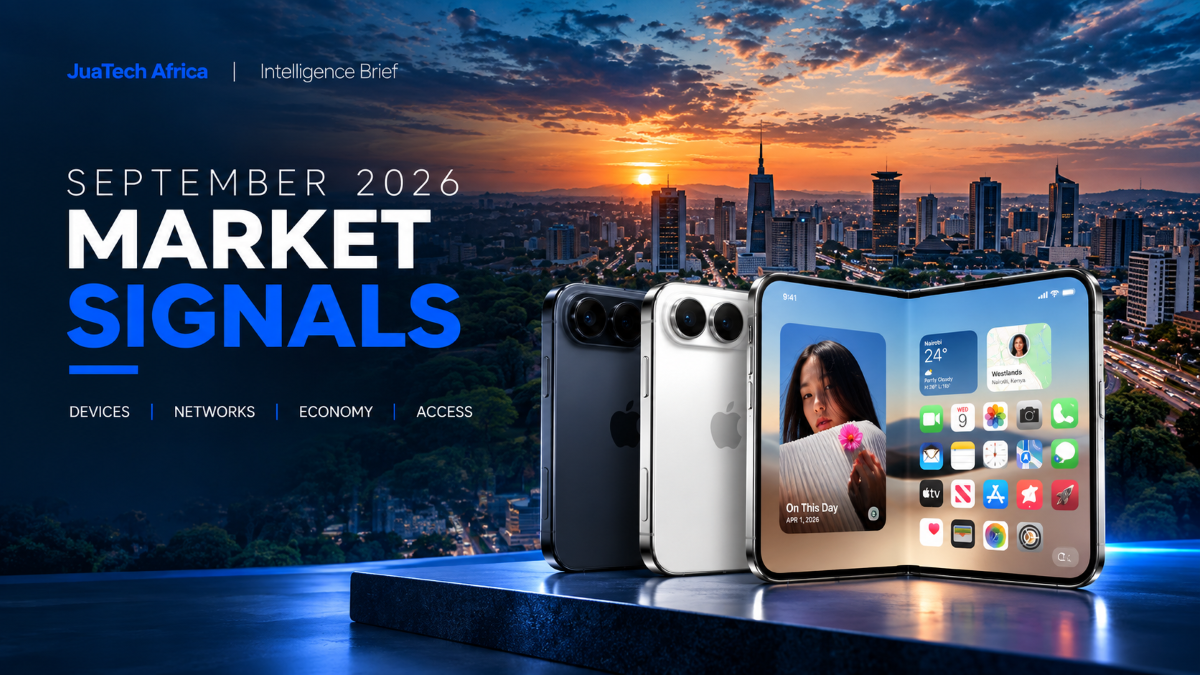
Apple has now entered the foldable smartphone market with iPhone Duo, starting at $1,999. The device opens into a 7.6-inch display, uses Apple’s A20 Pro platform and employs a dual-battery architecture with dedicated thermal management. Apple’s arrival matters because it gives the category a new reference point at the very top of the smartphone market. The question is no longer whether foldables can become mainstream. It is how much consumers will pay for a device that fundamentally changes the relationship between pocketable phone and large-screen computer.
3. The New Mid-Range Is Being Redefined
Samsung’s Galaxy S26 FE illustrates another shift. With an Exynos 2500 processor, 6.7-inch 120Hz AMOLED display, triple-camera system, Galaxy AI and seven generations of OS upgrades, the FE increasingly sits in territory once reserved for more expensive flagship models. That changes what “mid-range” means. As premium capabilities move downward while device costs rise, the boundaries between flagship, premium mid-range and conventional mid-range are becoming less distinct. Value is increasingly defined by how much flagship experience a device can deliver for its price.
4. The Smartphone Camera Is Becoming A Cinema Platform
The camera story is moving beyond megapixels and zoom numbers. Log recording, high-frame-rate video, computational imaging, stabilisation and professional colour workflows are pushing smartphones deeper into content production. HONOR’s collaboration with ARRI is particularly telling: its Robot Phone incorporates ARRI LogC3, ARRI Wide Gamut 3 and ARRI Looks, with footage designed to move into professional editing and colour-grading workflows. Leica, ZEISS and Hasselblad are similarly becoming part of the competitive language of premium smartphone imaging. The phone is increasingly becoming a capture, processing, editing and publishing platform.
5. The 10,000mAh Utility Shift
In August, JuaTech identified the 10,000mAh smartphone as an early signal of changing battery priorities. September does not require us to repeat that story. Instead, it raises the next question: whether ultra-large batteries are becoming a broader product strategy as smartphones take on heavier AI, gaming, video and connectivity workloads. Battery capacity is increasingly part of the device’s utility proposition.
6. Custom Silicon Is Moving Deeper Into The Device
The 2nm race is part of a wider strategic shift. Smartphone manufacturers increasingly want greater control over the silicon that powers AI, imaging, connectivity, efficiency and the user experience. Apple’s A-series, Samsung’s Exynos and Google’s Tensor demonstrate the strategic value of differentiated silicon, while Android chipset competition continues to intensify. The smartphone battle is no longer being fought only on the screen or in the camera. Increasingly, it is being fought inside the device.
Africa’s Smartphone Market Is Splitting
The global smartphone industry may talk about flagship innovation, but Africa’s more consequential story is happening at the other end of the market. Rising component costs, changing consumer purchasing power and uneven digital adoption are producing increasingly different smartphone economies across the continent. The result is not simply a market that is growing or contracting. Africa’s smartphone market is beginning to move at different speeds.
7. Africa Is Becoming A Two-Speed Smartphone Market
Omdia describes a widening divide between African markets. South Africa, Egypt, Morocco and Tunisia are moving toward replacement demand, 5G adoption and higher-value devices, while much of Sub-Saharan Africa remains dominated by first-time smartphone buyers and affordability-led purchasing. At the same time, Africa’s overall smartphone shipments fell 7% year on year in Q2 2026, while the average selling price rose by $41 to $202.
This changes the meaning of “the African smartphone market.” There is increasingly no single African buyer, price point or replacement cycle. A consumer upgrading a premium device in Johannesburg operates within a very different market dynamic from a first-time smartphone buyer in a lower-income Sub-Saharan African market. For manufacturers, distributors and retailers, Africa is becoming a collection of smartphone economies requiring different products, financing models, distribution strategies and value propositions.
8. Kenya Has Crossed The Smartphone Tipping Point
Kenya provides a useful local expression of that transition. By June 2026, 52.26 million smartphones were connected to Kenyan mobile networks, compared with 27.42 million feature phones. Smartphones therefore represented about 65.6% of connected mobile devices, while mobile data subscriptions reached 64.26 million and mobile broadband subscriptions reached 54.93 million.
The distinction matters: these are connections, not individual owners. But the direction is clear. Kenya is moving beyond a simple feature-phone-to-smartphone transition and toward a smartphone economy, where the handset increasingly sits at the centre of financial services, commerce, entertainment, communication and digital work.
9. The 76% Sub-Saharan Income Wall
The growth story has another side. GSMA’s September 2026 State of Mobile Internet Connectivity research warns that an entry-level internet-enabled handset costs the poorest 20% of people in Sub-Saharan Africa the equivalent of 76% of monthly income. Globally, 3.1 billion people live within mobile broadband coverage but do not use mobile internet, while GSMA and the Partnership for Digital Access in Africa estimate Africa’s mobile internet usage gap at around 906 million people, almost 60% of the continent’s population.
The implication is significant. The next connectivity problem is increasingly economic, not geographical. Networks can reach people who still cannot afford the device, data or skills required to use them meaningfully.
10. The Sub-$100 Smartphone Is Under Pressure
The entry-level smartphone has historically been one of Africa’s most important bridges into the digital economy. That bridge is now under pressure. Omdia reports that shipments of smartphones priced below $100 fell 34% year on year in Q2 2026, a decline of nearly three million units. At the same time, Africa’s average smartphone selling price reached $202. Omdia describes this as a “forced upward shift”, with vendors struggling to manufacture $75 smartphones profitably while consumers stretch toward $200-plus devices.
The tension is straightforward: Africa needs affordable smartphones to expand digital participation while the economics of producing those smartphones are moving in the opposite direction.
11. Financing Is Becoming Part Of Smartphone Access
When the upfront price becomes the barrier, financing becomes part of the product itself. Omdia identifies financing partnerships as an increasingly strategic capability in lower-income African markets, alongside stronger channel partnerships and more disciplined inventory management.
That changes the competitive equation. The smartphone seller is no longer competing only on specifications and price. Access to credit, repayment structures, distribution and the ability to manage affordability can determine whether a consumer reaches the smartphone market at all. In Africa’s next smartphone phase, how a device is paid for may become almost as important as what the device can do.
The Network Is Becoming Intelligent
The smartphone does not operate alone. Its capabilities depend on the infrastructure around it, and that infrastructure is changing too. Africa is beginning to confront the retirement of legacy networks while operators and network vendors are experimenting with AI that can operate inside the network itself. At the same time, AI-enabled devices are changing the direction and intensity of mobile traffic. The network is moving from a passive transport layer toward a more intelligent computing and service platform.
12. The 2G/3G Sunset Is Becoming Real
An entire generation of mobile infrastructure is moving toward retirement. The GSMA and Partnership for Digital Access in Africa now identify migration from 2G and 3G toward smartphone-based participation on 4G and 5G as a priority, with more than 600 million legacy connections across Africa targeted for migration into meaningful internet use. The challenge is not simply switching off old networks. It is ensuring that affordable smartphones, coverage and services are available before those networks disappear.
13. AI is Moving into the Network
August examined AI moving inside the smartphone. September reveals the next layer: AI moving around the smartphone. Vodafone and Ericsson have successfully trialled network-native AI services that provide real-time noise cancellation and language translation directly through the mobile network, without requiring a specialised app or new handset. That changes the economics of AI. Some intelligence can increasingly become a network capability rather than a device feature, allowing operators to add new services across existing handset fleets.
14. AI Is Changing The Direction Of Network Traffic
AI is also changing what mobile networks carry and where that traffic flows. Ericsson says AI-enabled devices are increasingly sending video, audio, sensor data and contextual information upstream to cloud systems for real-time inference. Its analysis estimates that around 40% of 5G networks currently fall below a minimum uplink requirement identified for AI services. The phone is no longer simply consuming intelligence. It is increasingly feeding intelligence systems, making uplink capacity, latency and reliability more strategically important.
15. The Network is Becoming a Programmable Intelligence Layer
The deeper shift is from intelligent devices using networks to intelligent networks actively participating in the service. Ericsson’s September technology outlook describes an emerging network architecture that can sense, predict and act in real time, while its work on AI-native networks points toward infrastructure that combines connectivity, computing, data and intelligence. This matters for Africa because the future value of mobile infrastructure may increasingly come from what the network can enable beyond connectivity: automation, enterprise services, AI applications and new digital business models.
The Phone is Becoming Economic Infrastructure
In Africa, the smartphone is increasingly more than a communications device. It is becoming part of the infrastructure through which people earn, sell, market, receive payments and manage businesses. September provides several signals of that transition, particularly in Kenya, where creator income is becoming more formally recognised, mobile commerce is moving into conversational channels and the handset itself is beginning to replace dedicated payment hardware.
16. The Creator Economy Is Becoming Formal Business
Google has confirmed that it will withhold 5% Kenya tax from applicable YouTube earnings paid to AdSense for YouTube accounts based in Kenya, with the first withholding applying to September 2026 earnings paid in October. Creators must provide a verified Kenyan PIN to receive payments. The development is more than a tax administration change. It is another sign that digital creators are becoming formal economic participants whose income flows, obligations and commercial activity increasingly intersect with established financial systems.
17. The Phone Is Becoming A Business Terminal
The business phone is becoming a compact operating system for commerce. A merchant can communicate with customers, promote products, take orders, receive payments, manage relationships and increasingly complete transactions without moving between disconnected systems. Mastercard and Flowcart’s September partnership in East Africa illustrates the direction: payments are being embedded directly into social and conversational journeys, initially in Kenya, allowing customers to discover products, order and pay within the same chat-based experience.
18. Softpos is Turning Phones into Merchant Infrastructure
The next step is physical payment acceptance. Safaricom has added Tap to Pay to the M-PESA Business App, allowing merchants with compatible NFC-enabled Android phones to accept payments directly on their handsets without a separate payment terminal. This changes the economics of merchant acceptance. The smartphone is no longer merely helping a business manage transactions. It can become the transaction terminal itself, reducing the hardware required to participate in digital commerce.
19. Mobile Money is Moving into a More Interoperable Payment System
Kenya is not discovering mobile-money interoperability in September. CBK established full interoperability across mobile-money operators in 2022. The September development is broader: the draft National Payment System Policy and Bill 2026 place interoperability, openness and competition at the centre of the country’s next payment-system framework, including provisions allowing CBK to require interoperability arrangements. The signal is that mobile payments are evolving from individual wallet ecosystems toward a more connected national payments architecture.
The Secondary & Production Economy
The smartphone economy does not end when a device leaves the retail shelf. As new-device prices rise, secondary markets become more important, while increasingly capable hardware and software are expanding what users can produce from the handset itself. September’s signals point to an economy developing around both the extended life of devices and the expanding productive value of the devices already in people’s hands.
20. Certified Pre-Owned is Becoming a Strategic Alternative
August asked whether consumers should choose a refurbished flagship or a new mid-range smartphone. September takes that question further. As new-device prices rise and replacement cycles stretch, professionally refurbished and certified pre-owned smartphones can become a more structured supply channel rather than an informal alternative. The opportunity is not simply to sell used phones. It is to create a reliable secondary market where consumers can access higher-specification devices at lower acquisition costs.
21. Trust is Becoming Infrastructure In the Secondary Market
A secondary smartphone market cannot scale on price alone. Buyers need transparent grading, diagnostics, battery-health disclosure, IMEI verification, accurate condition reports and meaningful warranty protection. Sellers need consistent processes that distinguish professionally refurbished devices from phones of uncertain history or condition. Trust therefore becomes part of the product itself. The larger the secondary market becomes, the more important these verification and disclosure mechanisms will be.
22. The Smartphone is Becoming a Production Platform
The latest flagship smartphones increasingly combine capabilities that once required several pieces of production equipment. Pro iPhones support professional formats such as ProRes and Log, including workflows involving external storage, while Samsung’s Galaxy S26 Ultra supports its APV professional video codec, APV Log and recording to external USB storage. The handset is therefore evolving beyond the role of camera. It is becoming part of the camera, recorder, storage and production system itself.
23. Mobile-Native Video is Becoming a Real Workflow
Hardware is only half the transition. Adobe’s Premiere for Android brings multi-track editing, trimming, effects, audio tools and publishing capabilities into the smartphone environment, pushing more of the post-production workflow onto the device. The emerging workflow is increasingly capture → edit → enhance → publish → distribute, without necessarily moving to a conventional computer at every stage. For creators and small businesses, that compression can materially reduce the equipment and time required to produce commercially usable video.
24. Africa’s Smartphone Brand Battle is Being Rewritten by Price Pressure
The affordability squeeze is also reshaping competition between vendors. Omdia’s Q2 2026 data shows African smartphone shipments falling 7%, while TRANSSION shipments declined 14% and Samsung shipments increased 15%. HONOR continued to grow in the $300-plus segment. The market is therefore not simply contracting. Demand is being redistributed across price bands and brands, forcing manufacturers to reconsider where volume, margin and growth can still be found.
The Bigger Signal
25. The Smartphone is Becoming the Interface to The AI Economy
The smartphone has evolved from a computer in the pocket into a camera, AI interface, financial terminal, business terminal and network endpoint. Each transition has increased what the device enables people to do and how deeply it connects them to the digital economy. The central contradiction is therefore becoming harder to ignore: the more important the smartphone becomes to economic participation, the more consequential its affordability becomes. Africa’s next smartphone challenge is not simply getting people connected. It is making sure they can afford meaningful participation in what comes next.
THE BIGGER PICTURE
The September signals point to a smartphone market undergoing a deeper transformation than the monthly launch cycle suggests. The device is becoming more powerful at its core, more capable as a camera and production platform, more intelligent through AI, and more deeply embedded in networks, payments, commerce and everyday economic activity. At the same time, Africa’s smartphone market is becoming more divided, with rising device costs placing greater pressure on the very consumers for whom the smartphone is becoming essential infrastructure.
That creates the defining tension of this market. The smartphone is no longer simply a communications device. It is becoming an interface to computing, imaging, AI, finance, commerce and economic participation. As its importance grows, affordability becomes more consequential, not less.
For Africa, the next phase of smartphone adoption will therefore be measured by more than how many devices enter the market. It will depend on whether consumers, creators and businesses can access the capabilities that increasingly sit behind meaningful participation in the digital economy. This is the signal worth watching.
October Watchlist: Global Signals vs. African Market Realities
September showed that several global smartphone shifts are moving beyond product launches and into questions of affordability, infrastructure and economic participation. October will test whether those signals are becoming commercially measurable in Africa. JuaTech Africa will track five developments through their effects on pricing, access, distribution, device economics and everyday consumer value, with Kenya providing a practical market lens where evidence is available.
- Memory Costs and the New Smartphone Price Floor:
Memory is moving from a component-industry concern into a consumer affordability issue. JuaTech Africa will track how rising memory costs affect smartphone pricing, RAM and storage configurations, specifications, inventory and product availability. The key question is whether the economics of memory are establishing a new minimum price for a capable smartphone, particularly at the entry level. - The $2,000 Foldable Meets the African Market:
Apple’s entry into foldables established a new premium reference point. October will examine what happens when that proposition reaches African consumers: Kenyan landing prices, official and grey-market availability, import economics, competing foldables and potential effects on the pre-owned flagship market. The signal to watch is whether Apple’s entry changes the value expectations of the premium smartphone category beyond the ultra-premium segment. - AI Smartphones: From Demonstration to Utility:
September showed AI moving deeper into both the smartphone and the network. October will examine what happens at the user level: which AI functions are actually useful, whether they support African languages and workflows, how much processing occurs on-device, what data they consume and whether users return to them after the initial novelty. The question is shifting from what smartphone AI can do to what consumers will continue using. - Satellite-to-Phone Connectivity and the Access Frontier:
Satellite-to-phone technology continues to move from technical demonstration toward commercial deployment. JuaTech Africa will track operator partnerships, regulatory approvals, compatible devices, pricing and actual service availability across African markets. The central question is whether satellite connectivity can become a practical extension of mobile coverage in places where conventional networks remain difficult or expensive to deploy. - The Smartphone Lifecycle Economy: Financing, Repair and Refurbishment:
Rising device prices are changing the economics of ownership. Consumers may finance devices, delay upgrades, repair existing smartphones or choose refurbished and certified pre-owned models. October will track financing models, repair economics, spare-parts availability, warranty practices, resale values and secondary-market development. The question is whether Africa is moving from a new-device economy toward a broader smartphone lifecycle economy.
Sources And Further Reading
This brief draws on market intelligence reports, industry research, institutional publications, regulatory data, company announcements and established technology and business reporting. These sources informed the market figures, technology developments, competitive movements and broader industry analysis presented throughout the September 2026 Market Signals.
The source base combines global evidence with African and Kenyan market data, allowing JuaTech Africa to examine how developments in the wider smartphone industry may translate into local pricing, access, distribution, consumer behaviour and commercial opportunity.
- Omdia. Beyond the $100 Smartphone: How Rising Costs Are Reshaping Africa’s Budget Smartphone Market.
Provides Q2 2026 data on Africa’s smartphone shipments, average selling prices, the contraction of the sub-$100 segment, vendor performance and the changing economics of entry-level devices. - Omdia. Global Smartphones Priced Below $400 Will Decline by 22% as Memory Costs Soar.
Examines the impact of rising memory costs on smartphone bill-of-materials expenditure, device pricing and the availability of lower-cost smartphones. - GSMA. The Mobile Economy Africa 2026 and related September 2026 mobile internet and digital inclusion research.
Provides evidence on Africa’s mobile economy, smartphone affordability, the mobile internet usage gap, connectivity and the economic contribution of mobile technologies. - GSMA / Partnership for Digital Access in Africa. September 2026 roadmap and connectivity research.
Informs the analysis of Africa’s 2G and 3G migration, the mobile internet usage gap, smartphone access and the infrastructure required to expand meaningful mobile internet participation. - Communications Authority of Kenya. Sector statistics and telecommunications market data.
Provides the Kenyan market evidence used to examine smartphone connections, feature-phone connections, mobile data subscriptions, mobile broadband adoption and the continuing transition toward smartphone-led connectivity. - MediaTek. Dimensity 9600 Pro product and technology announcements.
Provides technical information on MediaTek’s 2nm smartphone platform, processing architecture and reported efficiency improvements. - Qualcomm. Snapdragon 8 Elite Gen 6 and related Snapdragon platform announcements.
Informs the analysis of 2nm mobile silicon, custom CPU architecture, GPU and NPU development, AI processing, imaging and next-generation smartphone performance. - Samsung. Galaxy S26 FE and Galaxy S26 Ultra product and technology information.
Provides information on the FE segment, Exynos 2500, Galaxy AI, display and camera capabilities, professional video features and the movement of higher-end smartphone technologies into broader price categories. - Apple. iPhone Duo product and technology announcements.
Provides primary information on Apple’s entry into the foldable smartphone category, including design, display architecture, processing platform, battery configuration and starting price. - Ericsson. Research and technology analysis on AI-native networks, intelligent network infrastructure and AI-driven uplink traffic.
Informs the analysis of how AI is changing network architecture, traffic patterns and the role of mobile networks beyond conventional connectivity. - Vodafone and Ericsson. Network-native AI announcements and technology trials.
Provides evidence for the development of network-based AI services including real-time translation and noise cancellation without requiring specialised applications or new handset hardware. - Google / YouTube. Official information on Kenya tax withholding for YouTube earnings.
Provides the basis for the analysis of the increasing formalisation of creator income and the relationship between digital content businesses and established financial and tax systems. - Central Bank of Kenya. National payment-system policy and regulatory publications.
Informs the analysis of payment-system interoperability, digital payments and the evolving infrastructure surrounding mobile commerce. - Safaricom. M-PESA and merchant-payment announcements.
Provides evidence for the development of smartphone-based merchant payment acceptance and the expanding role of the handset in business transactions. - Mastercard and Flowcart. Announcements relating to social commerce and embedded payments in East Africa.
Informs the analysis of conversational commerce and the integration of product discovery, ordering and payment into mobile-first customer journeys. - Adobe. Premiere for Android announcements and product information.
Provides evidence for the movement of professional video-editing capabilities into mobile workflows and the increasing ability to capture, edit and publish from a smartphone. - ARRI. Technical and collaboration information relating to HONOR’s Robot Phone.
Provides evidence for the incorporation of professional imaging technologies and workflows into smartphone video production. - Counterpoint Research and other established industry research sources.
Used where relevant to provide additional market context on smartphone specifications, battery technology, device adoption and competitive developments. - Reuters and other established business and technology publications.
Used selectively for independent reporting, market context and developments where primary company or institutional sources were not sufficient on their own.
Source And Interpretation Note
Market figures and reported developments are attributed to their original sources, with primary sources and original datasets prioritized where available. JuaTech Africa separates documented evidence from analysis and forward-looking questions. Our role is to connect the evidence, interpret its African and commercial implications, and identify what matters and what to watch next.
The market is moving. Stay close to the signals. Follow JuaTech Africa for the next Market Signals brief, deeper industry intelligence and analysis of what changing technology means for Africa. Read our August Market Signals to see how these shifts are evolving, and explore Analytica for deeper analysis beyond the headlines.
Subscribe to the JuaTech Africa newsletter for the next intelligence brief, and join us on WhatsApp for timely market updates and conversations. If your brand or business needs sharper intelligence on mobile technology, consumer behaviour and Africa’s digital economy, talk to JuaTech Africa.
Read the signal. Understand the technology. See what it means for Africa.