

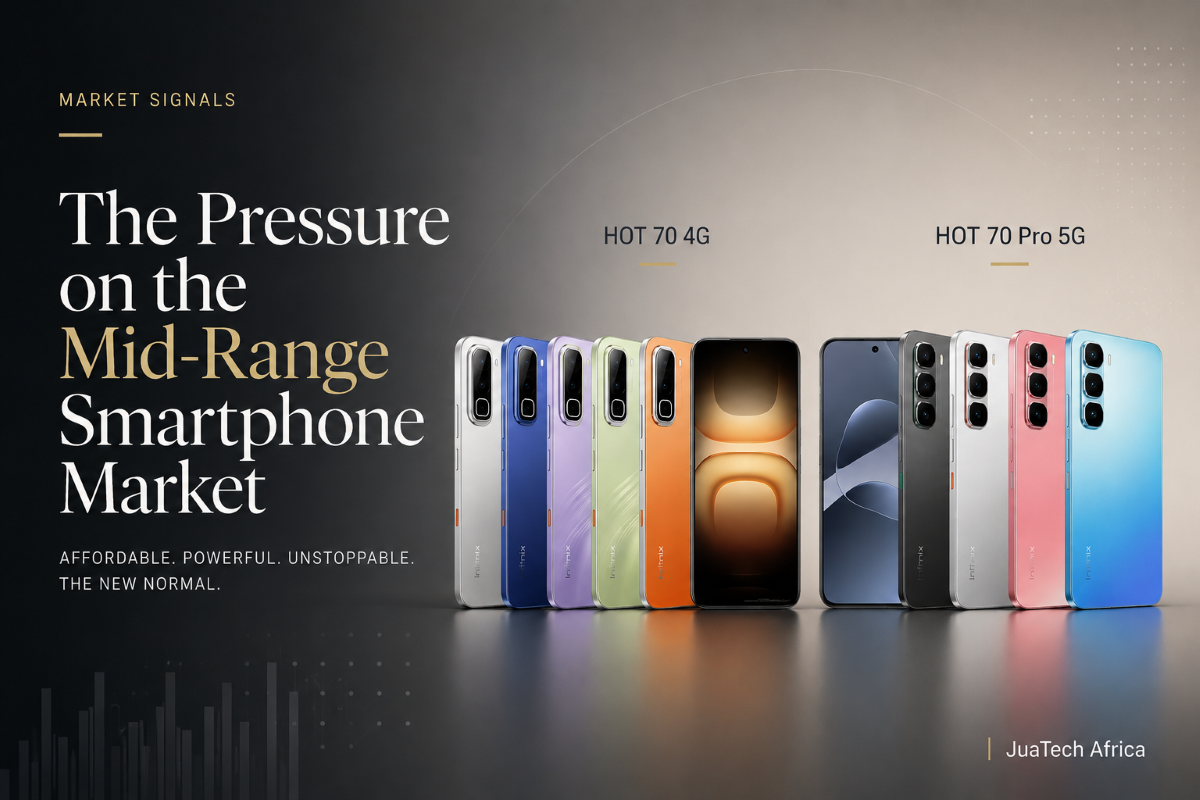
As affordable smartphones rapidly absorb premium-tier features, the traditional boundaries of the mid-range market are becoming increasingly difficult to sustain.
The smartphone market is entering a difficult phase for traditional mid-range devices, as affordable smartphones continue to narrow the gap between necessity and premium experience. Features that once justified higher pricing tiers are increasingly becoming standard across lower price categories. High-refresh-rate displays, gaming-oriented performance, AI-powered software tools, fast-charging capabilities, large batteries, and premium-inspired designs are no longer limited to expensive smartphones. As this transition accelerates, the boundaries separating budget and mid-range devices are becoming harder for both brands and consumers to define clearly.

The launch of the Infinix Hot 70 Series reflects this shift in a particularly important way. While the devices themselves arrive with the expected attention around performance, design, and user experience, the broader significance of the launch extends beyond hardware specifications. The Hot 70 Series signals growing strain across the mid-range smartphone segment as manufacturers compete aggressively to deliver stronger experiences at lower prices. At the same time, consumers become increasingly selective about what truly deserves a higher financial commitment.
This transition is especially evident in Africa’s mobile-first economies, where smartphones have evolved far beyond mere communication tools. For millions of users across Kenya and other African markets, smartphones now function as business companions, creator platforms, learning tools, entertainment centers, and gateways to financial access. In many cases, they remain the primary computing devices people rely on daily for productivity, content creation, digital transactions, and social participation. That reality has fundamentally reshaped how consumers evaluate smartphone value.
As affordable smartphones continue to improve rapidly, many consumers are beginning to question what truly separates the traditional mid-range smartphone segment from increasingly capable, lower-priced alternatives. The significance of the Infinix Hot 70 Series, therefore, lies not only in the devices themselves but also in what the launch reveals about a smartphone market undergoing deeper recalibration around affordability, value perception, and changing consumer expectations.
The Budget Smartphone Is No Longer “Basic”
The global smartphone market has spent years conditioning consumers to associate premium experiences with higher pricing tiers. Smooth displays, gaming-oriented performance, fast charging, refined designs, and advanced software experiences were traditionally positioned as features reserved for more expensive devices. That distinction, however, is becoming increasingly difficult to sustain as affordable smartphones continue evolving at a far more aggressive pace than many traditional market assumptions anticipated.
Across the budget smartphone market, devices that once focused primarily on affordability are now arriving with 120Hz and even higher refresh rate displays, gaming-oriented chipsets, AI-powered software tools, larger batteries, improved camera systems, storage expansion, and increasingly premium-inspired industrial designs. Features that previously served as major differentiators for the mid-range smartphone segment are steadily moving downward into more accessible pricing categories, reshaping consumer expectations in the process.
This transition is especially visible across affordable smartphones Africa markets, where smartphones have become deeply integrated into everyday economic and social life. For students attending online classes, creators producing short-form content, young professionals managing work across multiple apps, SME owners running businesses directly from their devices, and mobile gamers seeking smoother performance, smartphones are no longer secondary lifestyle accessories. In many cases, they serve as primary computing tools that support communication, entertainment, productivity, learning, and digital participation.
That shift has fundamentally changed the psychology surrounding affordable smartphones. Many consumers no longer feel “left behind” when purchasing lower-priced devices because the practical gap between budget and mid-range experiences is narrowing. What users now expect from smartphones has evolved rapidly, particularly as AI smartphones, immersive displays, stronger battery endurance, and creator-focused experiences become more accessible across lower pricing tiers.
The transition from the Hot 60 generation to the newer HOT 70 lineup reflects how aggressively this evolution is accelerating. Earlier generations within the category focused more heavily on affordability, battery value, and mainstream usability. The newer direction increasingly signals something broader: affordable smartphones are no longer simply attempting to imitate premium experiences. They are increasingly positioned to satisfy a growing percentage of mainstream consumer needs on their own terms.
That shift matters because it places growing pressure on the traditional logic of smartphone segmentation itself. As affordable devices continue to absorb experiences once associated with higher pricing tiers, smartphone brands across the market are being forced to rethink how value, differentiation, and long-term positioning are defined in an increasingly competitive mobile landscape.
Why the Infinix Hot 70 Series Matters Beyond the Hardware
The significance of the Infinix Hot 70 Series lies less in the devices themselves and more in what the launch reveals about the current direction of the smartphone market. In mobile-first economies, smartphone brands are facing increasing pressure to deliver experiences that feel progressively more premium without exceeding the financial realities of mainstream consumers. The HOT 70 lineup reflects how intensely competitive that environment has become.
Positioned around gaming-oriented performance, premium-inspired aesthetics, AI-powered software experiences, large batteries, high-refresh-rate displays, and creator-focused usability, the latest HOT lineup enters a smartphone market where affordable devices are expected to deliver far more than basic functionality. The introduction of both an advanced Infinix Hot 70 4G model and a more ambitious 5G variant also signals a broader strategic shift. Infinix appears increasingly focused on narrowing the practical gap between affordability and premium-adjacent smartphone experiences across multiple consumer segments simultaneously.
The Rise of Aggressive Value Positioning
Affordable smartphones are no longer competing solely on price. They are increasingly competing on perception, experience, and lifestyle relevance. Features such as 5G connectivity, AI-powered tools, premium-inspired industrial design, immersive displays, stronger camera systems, software longevity commitments, and advanced durability positioning are steadily moving into lower-priced categories that have traditionally operated around compromise.
The HOT 70 Series reflects how aggressively feature democratization is accelerating throughout the smartphone market. Compared to earlier HOT generations that focused more heavily on affordability and mainstream usability, the newer lineup appears increasingly positioned around reducing the practical need for consumers to stretch toward higher pricing tiers. That transition reveals a broader industry recalibration in which smartphone brands are competing not simply to offer cheaper devices but to redefine what affordable smartphones can deliver.
Infinix’s Relevance Across African Markets
Infinix did not build credibility across African markets accidentally. The brand gained relevance partly because it understood the realities shaping younger mobile-first consumers across countries such as Kenya and other rapidly expanding digital economies. Affordability mattered, but so did aspiration, battery reliability, gaming performance, creator-focused experiences, and modern design language.
For many users, smartphones increasingly represent participation in digital culture rather than simple ownership of technology. The popularity of Infinix phones Kenya and across broader African markets reflects a company that recognized this transition early. As smartphone market trends continue to shift toward value-driven innovation, the HOT 70 Series signals a market in which changing consumer expectations, aggressive value positioning, and rising competitive pressure are beginning to reshape the traditional logic of the mid-range smartphone segment itself.
The Mid-Range Smartphone Segment Is Losing Its Traditional Identity
The growing pressure surrounding the mid-range smartphone segment is no longer being driven solely by innovation from flagship devices above it. Increasingly, the pressure is emerging from affordable smartphones rising rapidly beneath it. As lower-priced devices continue absorbing features once associated with higher pricing tiers, the traditional logic that historically separated budget and mid-range smartphones is becoming more difficult for consumers to clearly recognize.
For years, the mid-range category occupied a relatively stable position within the smartphone market. It represented the balance point between affordability and premium experience. Consumers willing to spend slightly more expected noticeably better cameras, stronger performance, smoother displays, superior build quality, and more refined software experiences. That separation, however, is becoming increasingly compressed as smartphone value compression accelerates across multiple pricing tiers.
The Shrinking Gap Between Budget and Mid-Range Experiences
Affordable smartphones are evolving faster than many consumers expected. Gaming-oriented chipsets, AI-powered software tools, premium-inspired designs, immersive displays, fast charging capabilities, and larger batteries are no longer limited to traditional mid-range categories. Camera improvements have also become increasingly visible across lower price tiers, particularly as software processing and AI enhancements continue improving smartphone photography experiences beyond raw hardware limitations.
Display standardization is further narrowing the distinction between categories. High refresh rate displays, once viewed as premium differentiators, are increasingly becoming common expectations across affordable devices. AI features are also moving downward rapidly as brands attempt to strengthen value perception without significantly increasing prices. The result is a smartphone market where many consumers now experience lower-priced devices as “good enough” for the overwhelming majority of daily tasks.
That psychological transition matters deeply because modern smartphone purchasing decisions are becoming increasingly practical rather than aspirational. Many consumers are no longer asking whether affordable smartphones can imitate premium experiences. Instead, they are asking whether mid-range devices still deliver enough additional value to justify noticeably higher costs.
Smartphone Pricing Pressure and Changing Consumer Psychology
This growing smartphone pricing pressure is reshaping how consumers evaluate upgrades altogether. Longer device usage cycles are becoming increasingly common as users hold onto smartphones for extended periods before replacing them. Improvements across affordable categories mean many devices remain capable for years, particularly for consumers whose primary priorities revolve around social media, communication, content consumption, mobile gaming, photography, and productivity.
Pricing fatigue is also becoming more visible across the smartphone market. As economic realities continue to affect purchasing decisions in many regions, consumers are becoming more selective about where additional spending genuinely improves their everyday experience. For many buyers, the practical difference between affordable smartphones and traditional mid-range alternatives no longer feels as dramatic as it once did.
That does not mean the mid-range smartphone segment is disappearing. Far from it. The category still plays an important role for consumers seeking stronger camera systems, better long-term software support, more refined hardware, and improved ecosystem integration. What appears increasingly evident, however, is that smartphone segmentation itself is entering a more unstable phase, in which historical pricing assumptions and category distinctions are facing growing pressure from below.
The significance of this transition extends beyond individual brands or product cycles. It reflects a broader recalibration taking place across the smartphone market as affordable devices continue narrowing the experiential gap that once defined the traditional mid-range category itself.
Africa’s Mobile-First Consumers Are Accelerating the Shift
The growing pressure surrounding the smartphone market cannot be fully understood without examining the realities shaping Africa’s mobile-first economies. Across many African markets, smartphones are not secondary companion devices connected to larger digital ecosystems. They are often the primary gateways through which millions of users access the internet, financial services, education, entertainment, communication, and business opportunities. That reality is accelerating demand for smartphones capable of delivering stronger everyday experiences without moving beyond financially accessible pricing categories.
This dynamic is reshaping the African smartphone market in particularly important ways. For many mobile-first consumers, smartphone purchasing decisions are closely tied to practical everyday survival, productivity, and long-term reliability rather than simple hardware enthusiasm. Battery endurance matters because users rely heavily on smartphones throughout long working days. Dual-SIM functionality remains important because many consumers actively manage multiple networks to reduce communication costs and improve connectivity flexibility. Smartphone affordability also remains central because rising economic pressure continues influencing how carefully users evaluate long-term device value.
Smartphones as Everyday Economic Tools
Across Kenya and many other African markets, smartphones increasingly serve as personal workstations rather than mere communication devices. Small business owners manage customer conversations, digital payments, inventory coordination, and social media marketing directly from their devices. Creators edit short-form videos, capture photography, manage livestreams, and distribute content across multiple platforms using smartphones as primary production tools. Students learn, research, attend online classes, and access educational materials directly from mobile devices.
That level of dependence fundamentally changes consumer expectations. Many buyers are no longer evaluating smartphones purely in terms of status or specifications. They are evaluating reliability, battery consistency, multitasking capability, camera usability, connectivity flexibility, and overall long-term usefulness within demanding everyday environments.
The Creator Economy and Smartphone Value Perception
The rapid growth of TikTok, short-form video culture, livestreaming, and mobile content creation is also accelerating demand for creator smartphones capable of handling increasingly demanding workloads. Especially among younger demographics, smartphones now function as tools for participation in digital culture, entrepreneurship, entertainment, and online visibility.
This shift helps explain why premium-inspired experiences are becoming increasingly important even within affordable categories. Smooth displays, gaming-oriented performance, improved cameras, larger batteries, AI-powered editing tools, and stronger software optimization are no longer viewed simply as luxury additions. They increasingly influence how users work, create, communicate, and participate digitally on a daily basis.
Financing pressure across many markets further intensifies this behavior. As consumers hold onto devices longer and become more selective about upgrades, expectations surrounding smartphone value continue rising sharply. That reality is one of the strongest forces accelerating smartphone value compression across the market. For many African mobile-first consumers, the question is no longer whether affordable smartphones can deliver meaningful experiences. Increasingly, the expectation is that they should.
AI Is Accelerating Feature Democratization in Smartphones
Artificial intelligence is rapidly becoming one of the most important forces reshaping the value of smartphones across the market. What was once positioned primarily as a premium differentiator is increasingly moving into affordable categories, accelerating the pace at which traditional smartphone segmentation becomes harder to sustain. The rise of AI smartphones is no longer limited to flagship ecosystems. Increasingly, AI-powered experiences are becoming central parts of the broader smartphone value conversation across multiple pricing tiers.
This transition is already visible in areas such as AI photography, software optimization, battery intelligence, smart performance allocation, voice assistance, and AI-assisted editing tools. Features that previously required expensive hardware ecosystems are increasingly being delivered through software-driven optimization designed to improve everyday usability rather than simply benchmark performance. In practical terms, this means many affordable smartphones are becoming more capable of adapting to user behavior, improving battery management, enhancing the photography experience, optimizing multitasking performance, and simplifying content creation workflows.
AI Is Redefining Everyday Smartphone Expectations
The significance of this transition extends beyond technical innovation itself. AI is increasingly reshaping what consumers expect from smartphones in lower price categories. As AI-powered smartphones continue to improve camera processing, performance efficiency, background resource management, and creator-focused editing tools, many users are beginning to experience capabilities that once were strongly associated with premium devices.
This matters because smartphone innovation is becoming increasingly software-driven rather than purely hardware-dependent. The practical experience gap between affordable and mid-range smartphones is no longer determined solely by processor strength or camera hardware. Intelligent software optimization is now playing a larger role in shaping how smooth, capable, and responsive devices feel during everyday use.
For smartphone brands, this creates a growing strategic challenge. The more AI capabilities spread downward into affordable devices, the harder it becomes to justify sharp pricing separation across the market. Consumers are increasingly evaluating smartphones based on practical, everyday outcomes rather than technical positioning alone. If affordable devices can already deliver strong photography experiences, smoother multitasking, creator-friendly editing tools, battery optimization, and reliable long-term usability through AI enhancements, the traditional premium advantages in the mid-range smartphone segment become increasingly difficult to defend.
That transition does not eliminate the importance of higher-end smartphones. However, it suggests that the future of smartphone competition may increasingly revolve around how effectively brands integrate intelligent software experiences across accessible price points rather than relying solely on hardware differentiation.
Smartphone Brands Must Now Compete Beyond Specs
The smartphone market is gradually entering a phase where hardware advantages alone are becoming increasingly difficult to sustain as long-term differentiators. High-refresh-rate displays, gaming-oriented chipsets, AI-powered software tools, large batteries, premium-inspired designs, and capable camera systems are now spreading rapidly across multiple price categories. As feature democratization accelerates, smartphone competition is shifting toward a deeper, potentially more important battleground centered on ecosystem value, trust, software experience, and long-term usability.
For smartphone brands, this transition creates growing strategic pressure. Consumers are no longer evaluating devices purely around isolated hardware specifications. Increasingly, they are evaluating reliability, software consistency, long-term updates, ecosystem integration, creator-focused usability, repair confidence, and overall ownership experience. In many markets, particularly across Africa’s mobile-first economies, purchasing a smartphone often represents a major financial commitment rather than a short-term upgrade cycle. That reality naturally increases the importance of trust and long-term dependability within the broader consumer technology landscape.
The Next Competitive Battle Is Experience
The next phase of smartphone competition may therefore revolve less around who can deliver the most aggressive specifications and more around which brands can build stronger long-term relationships with users. Software experience is becoming increasingly important as smartphones evolve into primary tools for communication, business, learning, content creation, entertainment, and financial participation. Long-term software support, AI integration, ecosystem continuity, and reliable optimization are steadily becoming more valuable parts of the ownership experience itself.
Creator ecosystems are also becoming strategically important. As more users build businesses, audiences, and professional identities through smartphones, brands that support mobile-first creation workflows may gain greater long-term relevance. Accessibility of financing, after-sales support, retail availability, and repair infrastructure are becoming equally significant because they directly influence how secure consumers feel about investing in devices over extended periods.
Hardware remains important, but hardware alone is becoming easier to replicate across the smartphone ecosystem. The deeper competitive battle increasingly revolves around the quality of experience, ecosystem trust, long-term usability, and how effectively brands integrate into the practical realities of everyday digital life. In that environment, the future winners within the smartphone market may not necessarily be the brands with the most powerful specifications, but the ones that build the strongest long-term consumer confidence.
The Real Signal Behind the Infinix Hot 70 Launch
The significance of the Infinix Hot 70 Series in the mid-range smartphone segment ultimately extends far beyond another smartphone release within an already crowded market. What the launch reveals more clearly is a smartphone industry entering a deeper phase of recalibration, shaped by changing consumer expectations, intensifying pressure in the smartphone market, and the growing collapse of traditional pricing boundaries between affordable and mid-range devices.
For years, the mid-range smartphone segment occupied a relatively stable position in the market by balancing affordability with experiences considered meaningfully superior to those in lower-priced categories. That distinction is becoming increasingly difficult to maintain as affordable smartphones continue to evolve more aggressively in performance, software capabilities, battery endurance, design quality, AI integration, and creator-focused usability.
The importance of this transition is especially evident in mobile-first economies such as Kenya and many other African markets, where smartphones serve as essential tools for communication, productivity, business, learning, entertainment, and financial participation. As consumers hold onto devices longer and become more selective about upgrades, expectations for long-term smartphone value continue to rise sharply. That reality is placing growing pressure on smartphone brands to compete beyond hardware specifications alone.
The Infinix Hot 70 launch therefore matters not simply because of the devices themselves, but because it reflects where the smartphone market is increasingly heading. The boundaries separating affordability, capability, and premium experience are becoming less rigid than they once were. As smartphone segmentation continues evolving, competition across the market may increasingly revolve around who can deliver the most meaningful and reliable digital experiences at pricing levels that remain realistically accessible to larger groups of consumers.
Ultimately, that competition matters because it expands access to increasingly capable digital experiences for millions of people whose smartphones now sit at the center of everyday modern life.
Sign-up to our bi-weekly Newsletter for Mobile Tech Industry Intelligence and Market Signal Briefs.