

Qualcomm’s Snapdragon 8 Elite Gen 6 brings 2nm manufacturing, a 5GHz Oryon CPU, advanced on-device AI, next-generation graphics and AI-enhanced connectivity to flagship smartphones. Here’s what has changed, how it compares with Snapdragon 8 Elite Gen 5 and MediaTek Dimensity 9600 Pro, and what it means for phone users.
Qualcomm Has Taken Snapdragon to 2nm
The smartphone processor is entering another important phase. For years, chipmakers have pursued smaller process nodes, higher clock speeds and greater efficiency to put more computing capability into devices that still have to operate within the physical and power constraints of a smartphone. Qualcomm’s latest flagship generation takes that progression to 2nm, but the significance of the Snapdragon 8 Elite Gen 6 extends well beyond the manufacturing process.

Qualcomm has introduced two flagship platforms in this generation: the Snapdragon 8 Elite Gen 6 and the higher-end Snapdragon 8 Elite Extreme Gen 6. Both build on the company’s Oryon CPU architecture and combine dedicated processing for general computing, graphics, and artificial intelligence. The Extreme platform pushes further into high-performance graphics, AI processing, and professional video, creating a distinct top tier within Qualcomm’s flagship portfolio.
This generation also marks another step in Qualcomm’s longer transition toward more intelligent mobile computing. The Snapdragon 8 Elite introduced Oryon to the flagship smartphone platform, while the Snapdragon 8 Elite Gen 5 extended its performance, efficiency and on-device AI capabilities. Gen 6 takes that foundation to 2nm and deeper AI integration.
The bigger question is not simply how fast the new Snapdragon is. It is what Qualcomm’s move to 2nm changes about the smartphone itself.
Snapdragon 8 Elite Gen 6 Series at a Glance
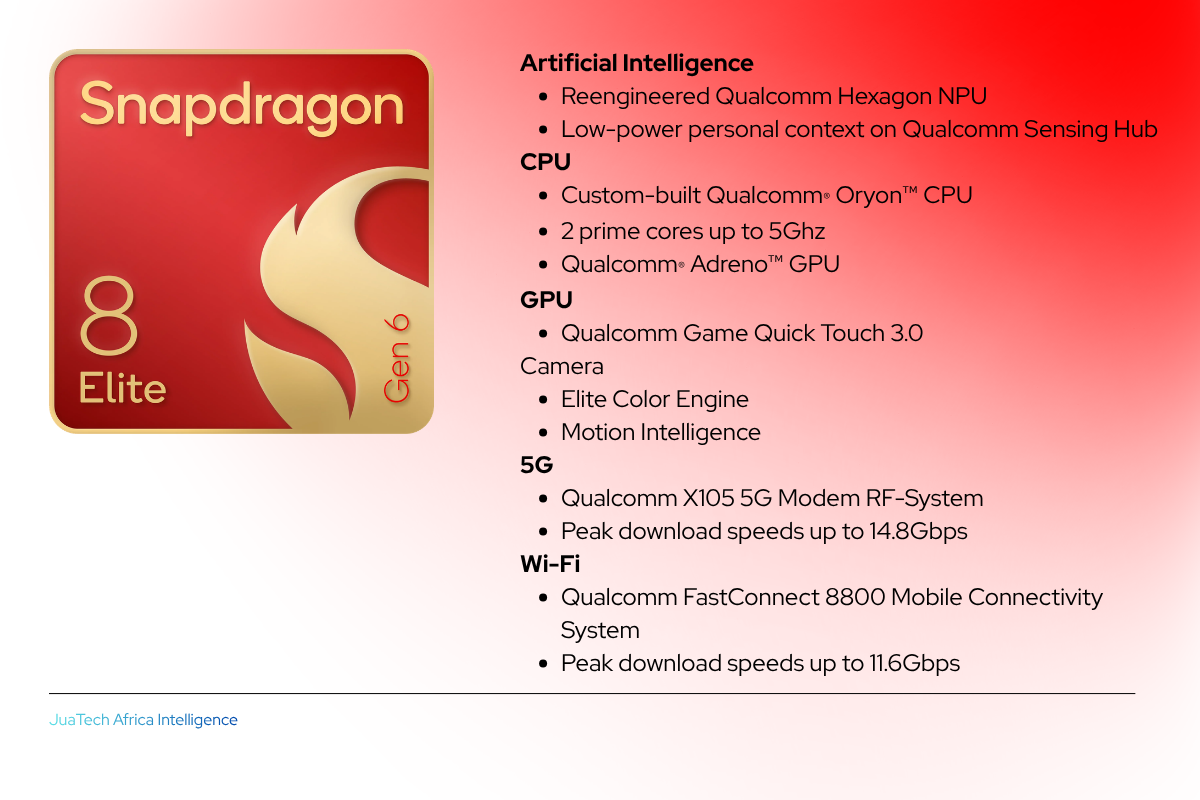
Qualcomm’s Snapdragon 8 Elite Gen 6 generation consists of two distinct flagship platforms: the Snapdragon 8 Elite Gen 6 and the Snapdragon 8 Elite Extreme Gen 6. Both use a 2nm process and Qualcomm’s latest Oryon CPU, Adreno GPU, Hexagon NPU, X105 5G Modem-RF and FastConnect 8800 connectivity platform. The difference lies in how aggressively Qualcomm pushes performance, graphics and AI processing on each platform.
| Specification | Snapdragon 8 Elite Gen 6 | Snapdragon 8 Elite Extreme Gen 6 |
| Process | 2nm | 2nm |
| CPU | Qualcomm Oryon | Qualcomm Oryon |
| Peak CPU speed | Up to 5GHz | Up to 5GHz |
| GPU | Qualcomm Adreno | Qualcomm Adreno with Matrix Cores |
| NPU | Qualcomm Hexagon | Qualcomm Hexagon |
| Neural Fusion | No | Yes |
| CPU performance vs previous generation | Up to 10% higher | Up to 13% higher |
| GPU performance vs previous generation | Up to 35% higher | Up to 44% higher |
| NPU performance vs previous generation | Up to 14% higher | Up to 35% higher |
| Peak 5G download | Up to 14.8Gbps | Up to 14.8Gbps |
| Peak 5G upload | Up to 4.2Gbps | Up to 4.2Gbps |
| Wi-Fi | Wi-Fi 8 | Wi-Fi 8 |
| Peak Wi-Fi speed | Up to 11.65Gbps | Up to 11.6Gbps |
| Storage | UFS 5.0 | UFS 5.0 |
| Memory | LPDDR5x / LPDDR6 | LPDDR5x / LPDDR6 |
| Advanced video | Advanced mobile video | Up to 8K60, 4K240 and APV |
Performance figures are Qualcomm’s stated comparisons with the previous generation. Peak network speeds represent theoretical platform capabilities, not guaranteed real-world performance.
The standard Gen 6 is the broader flagship platform, while the Extreme Gen 6 establishes a higher-performance tier for demanding graphics, AI, and professional video workloads. That distinction becomes important later when assessing what the 2nm transition actually delivers to smartphone users.
More importantly, these specifications describe what the silicon can support, not necessarily what every phone will deliver. Cooling, battery capacity, sustained power limits, memory, display resolution, camera hardware, and software optimization will determine the experience manufacturers build around the chip.
Before 2nm: How Snapdragon Got Here
The Snapdragon 8 Elite Gen 6 is the latest step in a progression that has steadily changed what Qualcomm expects of a smartphone processor. The story begins not with 2nm, but with a gradual shift in where computing happens and what the processor is expected to understand.
With the Snapdragon 8 Gen 3, on-device generative AI has firmly become part of Qualcomm’s flagship strategy. Instead of treating AI as a background feature, Qualcomm designed the platform to run increasingly capable generative models directly on the smartphone, bringing more intelligence closer to the user.
The next major shift came with the Snapdragon 8 Elite, when Qualcomm introduced its custom Oryon CPU to flagship mobile devices. The CPU architecture became a new foundation for performance and efficiency, while the platform continued to expand its on-device AI and graphics capabilities.
By the time Snapdragon 8 Elite Gen 5 arrived, Oryon had matured into its third generation. Qualcomm pushed performance and efficiency further and expanded the platform toward more personalised, agentic AI.
Now Gen 6 brings those strands together. Oryon reaches 5GHz, the platform moves to 2nm, and AI extends deeper into computing, graphics, imaging, and connectivity. What changed over these generations is therefore bigger than clock speed. Snapdragon is becoming an increasingly heterogeneous computing platform built around AI.
What Does 2nm Actually Mean?
“2nm” sounds like a measurement of the chip itself, but it is better understood as a label for the semiconductor manufacturing process used to build it. At each new process generation, chipmakers aim to fit more transistors into a given area while improving the balance between performance, power consumption, and density. TSMC’s 2nm technology, for example, uses nanosheet transistors and is designed to deliver gains across those three areas.
For a smartphone, that matters because the processor has to do more work inside a very small thermal and power envelope. Greater transistor density can create more room for computing resources, while improved efficiency can allow demanding workloads to run with less energy. That creates performance headroom: manufacturers can pursue higher performance without every increase in computing capability translating directly into higher power consumption and heat.
But 2nm does not mean the Snapdragon 8 Elite Gen 6 is automatically twice as fast as a 3nm or 4nm chip. The process is only one part of the equation. CPU architecture, clock speed, instructions per clock, cache design, memory bandwidth, power management, cooling, and software optimization all influence the final result. TSMC itself notes that modern process gains increasingly involve design and technology working together, rather than simply making the same chip smaller.
Why Are There Two Snapdragon 8 Elite Gen 6 Chips?
Two flagship platforms built on the same 2nm generation might seem unnecessary at first. The distinction becomes clearer when you look at what Qualcomm is trying to cover.
The Snapdragon 8 Elite Gen 6 is the broader flagship platform. It brings Qualcomm’s latest Oryon CPU, 5GHz peak CPU frequency, Hexagon NPU, Adreno graphics, X105 connectivity, and Wi-Fi 8 into a platform designed for high-end smartphones across a wider range of designs.
The Snapdragon 8 Elite Extreme Gen 6 takes the same foundation and pushes specific workloads further. Its Adreno GPU adds Matrix Cores and Adreno Neural Fusion, while the platform supports more advanced graphics and video capabilities, including 8K60, 4K240, and APV. Qualcomm positions it as its most powerful mobile platform, aimed at devices where maximum graphics, AI, and video capability matter more than simply having the latest Snapdragon name.
| Capability | Snapdragon 8 Elite Gen 6 | Snapdragon 8 Elite Extreme Gen 6 |
| Platform role | Flagship | Highest-performance flagship |
| Process | 2nm | 2nm |
| CPU | Oryon | Oryon |
| Peak CPU speed | Up to 5GHz | Up to 5GHz |
| GPU | Adreno | Adreno + Matrix Cores |
| Neural Fusion | No | Yes |
| AI processing | Advanced | More advanced |
| Video | Advanced mobile video | Up to 8K60, 4K240 and APV |
| Gaming | Flagship gaming | Maximum graphics capability |
The important point is that the Extreme is not simply a “better” version for everyone. Qualcomm is creating two performance envelopes from the same technological generation: one broad enough for flagship smartphones, and another designed for manufacturers building devices around the most demanding graphics, AI, and video workloads.
That segmentation will become increasingly relevant as flagship phones themselves become more specialized.
The 5GHz Oryon CPU: What Does It Actually Mean?
One of the easiest specifications to notice on the Snapdragon 8 Elite Gen 6 is its 5GHz Oryon CPU. But does a 5GHz processor automatically make a phone faster? Clock speed describes how quickly a CPU cycles through its operating rhythm. At 5GHz, the Oryon CPU can reach 5 billion clock cycles per second. Qualcomm describes it as the first mobile CPU to reach 5GHz, making the figure a genuine milestone in smartphone processor development.
The important part is what happens during those cycles. A 5GHz CPU is not automatically twice as fast as a 2.5GHz CPU because performance also depends on instructions per clock, CPU architecture, cache, memory, thermals, workload, and software optimization. A processor that can sustain high performance efficiently can matter more than one that simply reaches a higher peak frequency.
For someone using the phone, the difference is rarely experienced as “5GHz.” It appears as how quickly demanding tasks respond, how smoothly workloads run together, and how long the phone can maintain that performance before heat and power limits intervene. The headline number matters, but sustained performance is where the specification becomes an experience.
The Bigger Change Is AI
The most consequential change in the Snapdragon 8 Elite Gen 6 may have little to do with its 2nm process. Qualcomm is positioning this generation around agentic AI, where the smartphone moves beyond answering individual prompts toward understanding context, reasoning across information, and helping carry out tasks.
The progression is easier to see in three stages. Traditional smartphone AI follows ask – answer. Generative AI expanded that into ask – generate, producing text, images, audio and other content. Agentic AI moves toward understanding context, reasoning, and acting, allowing an AI system to work through multiple steps toward an intended outcome.
That requires more than a faster CPU. The Oryon CPU handles general-purpose computing and complex tasks, while the Hexagon NPU efficiently accelerates AI inference. The Adreno GPU handles highly parallel workloads, while the Sensing Hub processes contextual sensor information with low power consumption. Together, these components form a heterogeneous computing system in which different parts of the platform perform different kinds of work.
For the person using the phone, the potential change is significant. Instead of repeatedly telling an assistant what to do, a future device could use context to understand intent, retain relevant information, and complete several steps toward a desired outcome.
That experience, however, will not come from the processor alone. Qualcomm provides the computing foundation; Android, manufacturers, applications, and AI models determine what developers and users can actually do with it.Simply put, the AI upgrade is not simply a smarter chatbot. It is the move toward a smartphone that can increasingly understand what you are trying to accomplish and help get it done.
When the GPU Starts Working With AI
The Snapdragon 8 Elite Extreme Gen 6 takes smartphone graphics in a more interesting direction than simply adding more GPU performance. Qualcomm has added Adreno Matrix Cores and Adreno Neural Fusion, bringing dedicated AI processing deeper into the graphics pipeline. The aim is to let AI contribute to the production of images, rather than simply enhancing them after rendering.
That changes what the GPU can do. AI-assisted super-resolution can reconstruct higher-detail images from lower-resolution inputs, while frame generation can create additional frames to make motion appear smoother. Image reconstruction can recover detail and improve visual quality, while hardware-accelerated ray tracing makes lighting, reflections, and shadows more realistic. Neural Fusion is designed to bring these AI techniques closer to the graphics workload itself rather than treating AI and graphics as completely separate tasks.
The bigger idea is what happens when AI stops working only on the finished image and becomes part of how that image is rendered. Instead of spending all its resources brute-forcing every pixel, a smartphone can increasingly use AI to decide where computation matters most and reconstruct what the user needs to see.
For gamers and creators, that could mean richer visuals without demanding a proportional increase in raw rendering workload. At JuaTech Africa, we interpret this to mean that the GPU is no longer working on its own. AI is becoming part of the rendering process itself.
The Camera Is Becoming a Computing System
A smartphone camera no longer ends at the sensor. Light hits the camera sensor, but the resulting data still has to pass through the image signal processor and increasingly through the CPU, GPU, and NPU before the phone turns it into the photograph or video you see.
That is where the Snapdragon 8 Elite Gen 6 architecture comes into play. Qualcomm’s Intelligent Pixel Control operates at the pixel level to help manage image information, while the Elite Color Engine applies more sophisticated color and video processing. Motion Intelligence can use scene and motion information to improve the camera’s response to moving subjects. Together, these capabilities show how much of modern smartphone photography happens computationally after the shutter is pressed.
The Extreme Gen 6 pushes the video side further with support for APV, Qualcomm’s professional video codec, and capabilities such as 8K60 and 4K240 capture. The implication is straightforward: the camera sensor captures the information, but the silicon increasingly determines what that information becomes.
Connectivity Is Now Part of the Processor Story
The processor is increasingly responsible for more than computing and AI. The Snapdragon 8 Elite Gen 6 integrates Qualcomm’s X105 5G Modem-RF, with support for 5G Advanced, AI-enhanced connectivity and satellite communication capabilities. Qualcomm rates the modem for peak speeds of up to 14.8 Gbps downlink and 4.2 Gbps uplink. The platform also pairs with FastConnect 8800, bringing Wi-Fi 8 and peak Wi-Fi speeds of up to 11.65Gbps.
Those numbers describe what the silicon can support, not necessarily what a user will see in a speed test. A 14.8Gbps modem does not mean your phone will download at 14.8Gbps. Actual performance depends on spectrum, carrier infrastructure, network congestion, signal conditions, location, and how the device manufacturer implements the platform.
That distinction matters as connectivity becomes more intelligent. The modem is no longer simply moving data; Qualcomm is also using AI to optimize how the device connects to changing network conditions.
Snapdragon 8 Elite Gen 6 vs Snapdragon 8 Elite Gen 5
The move from Snapdragon 8 Elite Gen 5 to Snapdragon 8 Elite Gen 6 is not simply a clock-speed increase. Qualcomm has changed the manufacturing process, raised the Oryon CPU ceiling, improved performance and efficiency across the CPU and GPU, and upgraded the connectivity platform. The comparison shows where the generation-to-generation gains are concentrated.
| Specification | Snapdragon 8 Elite Gen 5 | Snapdragon 8 Elite Gen 6 |
| Process | 3nm | 2nm |
| Oryon CPU peak frequency | Up to 4.74GHz | Up to 5GHz |
| CPU performance | Baseline | Up to 10% higher |
| CPU efficiency | Baseline | Up to 37% higher |
| GPU performance | Baseline | Up to 35% higher |
| GPU efficiency | Baseline | Up to 40% higher |
| NPU performance | Baseline | Up to 14% higher |
| 5G Modem-RF | X85 | X105 |
| Wi-Fi | Wi-Fi 7 | Wi-Fi 8 |
Gen 5 frequency and platform specifications are based on Qualcomm’s published specifications. Gen 6 performance and efficiency figures are Qualcomm’s stated improvements versus the previous generation, not independent benchmark results.
The numbers point to several changes happening together. 5GHz raises the CPU frequency ceiling, while the move to 2nm gives Qualcomm a new manufacturing foundation for performance and efficiency. The larger efficiency gains are particularly significant because sustained performance matters more on a smartphone than a short-lived peak.
For users coming from a Gen 5 phone, the practical difference will depend on the device built around Gen 6. Cooling, power limits, software optimization, battery capacity and workload all influence how much of the platform’s additional capability becomes visible.
The right question, therefore, is not whether every percentage translates directly into a faster phone. It is where the new headroom allows manufacturers to do more without demanding proportionally more power.
Snapdragon 8 Elite Extreme Gen 6 vs Dimensity 9600 Pro
The Snapdragon 8 Elite Extreme Gen 6 and MediaTek Dimensity 9600 Pro arrive at the same 2nm destination, but they take different routes to get there. Qualcomm builds around its custom Oryon CPU, Hexagon NPU, Adreno graphics, and Sensing Hub. MediaTek takes a more integrated approach, bringing CPU, GPU, NPU, and ISP together through its Native AI Architecture.
| Capability | Snapdragon 8 Elite Extreme Gen 6 | Dimensity 9600 Pro |
| Process | 2nm | 2nm |
| CPU platform | Custom Qualcomm Oryon | 4th-gen All Big Core |
| CPU configuration | 2 Prime cores + undisclosed additional configuration | 2× C2-Ultra + 3× C2-Pro + 3× C2-Pro |
| Peak CPU frequency | 5GHz | 4.55GHz |
| Other CPU frequencies | Not publicly specified | 4.35GHz + 3.1GHz |
| AI architecture | Hexagon NPU + CPU/GPU AI + Sensing Hub | Dual NPU + Native AI Architecture |
| GPU | Adreno + Matrix Cores | Arm Mali-G2 Ultra NX |
| AI graphics | Adreno Neural Fusion | Neural Graphics Architecture |
| Memory | LPDDR6 | LPDDR6 / LPDDR5X |
| Storage | UFS 5.0 | UFS 5.0 |
| Imaging | Elite Color Engine, Intelligent Pixel Control, APV | AI Imaging Fusion Architecture |
| 5G | X105, up to 14.8Gbps downlink | 5G Advanced, over 7.4Gbps |
| Wi-Fi | Wi-Fi 8, up to 11.6Gbps | Wi-Fi 7, up to 7.3Gbps |
Peak CPU frequency refers to the highest published core frequency. Qualcomm specifies two Oryon Prime cores reaching 5GHz. MediaTek specifies two C2-Ultra cores reaching 4.55GHz, three C2-Pro cores at 4.35GHz, and three C2-Pro cores at 3.1GHz.
The 5GHz versus 4.55GHz difference is striking, but it should not be mistaken for a direct measure of overall processor performance. Clock speed tells us how quickly the cores operate, not how much useful work they complete in each cycle. Architecture, instructions per clock, cache, memory bandwidth, software and thermal management all influence the final result.
The more revealing difference lies in how each company builds around its CPU. Qualcomm distributes specialized work across Oryon, Hexagon, Adreno, and Sensing Hub, with Matrix Cores and Neural Fusion allowing AI to participate directly in graphics rendering. MediaTek’s Native AI Architecture connects CPU, GPU, NPU and ISP, while its dual-NPU design separates demanding generative and agentic workloads from low-power, always-on intelligence.
The contrast continues into imaging and connectivity. Qualcomm combines its platform with Elite Color Engine, Intelligent Pixel Control and APV, while MediaTek connects its ISP and NPU through AI Imaging Fusion and supports 17EV HDR video, H.266 decoding and 4K240 capture. Qualcomm’s X105 reaches 14.8Gbps downlink and Wi-Fi 8 reaches 11.6Gbps; MediaTek’s 5G Advanced modem exceeds 7.4Gbps, and Wi-Fi 7 reaches 7.3Gbps.
For the smartphone buyer, this is the bigger story. Both companies now have a 2nm foundation, but they are using that headroom to build different computing systems. The meaningful comparison, therefore, moves beyond the process node to CPU design, AI execution, graphics, imaging, connectivity, and the software that manufacturers build around the silicon.
Insightfully, the 2nm race is becoming less about reaching the node and more about what each company does with the computing headroom it creates.
What Will You Actually Notice as a Phone User?
Specifications become useful when they explain something you can actually experience. The Snapdragon 8 Elite Gen 6’s improvements are most likely to show up in demanding workloads, sustained performance, AI features, gaming, imaging, and connectivity rather than as one dramatic change you can point to.
| Chip technology | What it can mean to you |
| 2nm process | Greater efficiency and performance headroom |
| 5GHz Oryon | Faster response in demanding CPU workloads |
| Hexagon NPU | More capable on-device AI |
| Neural Fusion | More advanced AI-assisted graphics on Extreme |
| Advanced imaging | More sophisticated photography and video processing |
| X105 | Greater 5G connectivity capability |
| Wi-Fi 8 | Higher wireless performance potential |
| Efficiency gains | More performance per watt |
The important word throughout this table is potential. A 2nm chip does not guarantee longer battery life, a 5GHz CPU does not guarantee a visibly faster phone, and a powerful NPU does not automatically produce better AI features.
The manufacturer decides how much of the silicon reaches you. Cooling, battery capacity, RAM, display, cameras, software optimization, and power limits all shape the final experience.
By our own interpretation, the chipset sets the ceiling. The phone determines how close you get to it.
What Snapdragon 8 Elite Gen 6 Does Not Automatically Mean
The Snapdragon 8 Elite Gen 6 brings impressive numbers to the smartphone conversation. But specifications describe what the platform can support, not necessarily what the finished phone will deliver.
2nm does not mean twice the performance
The move to 2nm creates more room for performance and efficiency gains. It does not make the chip twice as fast. Architecture, memory, thermals, and software determine how that headroom is used.
5GHz does not mean twice the speed
A 5GHz CPU can reach five billion clock cycles per second, but clock speed is only one part of performance. Architecture, instructions per clock, cache, and sustained thermal performance also matter.
14.8Gbps does not mean 14.8Gbps downloads
That is the modem’s theoretical peak capability. Real-world speeds depend on spectrum, carrier infrastructure, congestion, signal conditions, and device implementation.
More AI processing does not automatically mean better AI
The NPU provides the computing capacity. AI models, software, applications and operating-system integration determine what that capacity becomes for the user.
Greater efficiency does not automatically mean longer battery life
Manufacturers can use efficiency gains to extend endurance, but they can also spend that headroom on higher performance, AI, cameras or displays. Battery life remains a system-level outcome.
A powerful chipset does not automatically make a better phone
Cooling, battery, RAM, display, cameras, software, and power management all influence how much of the Snapdragon’s capability reaches the user.
Who Is the Extreme Gen 6 Actually For?
The difference between the two platforms becomes clearer when you look at the workloads they are designed to handle. Qualcomm is effectively creating two performance envelopes within its flagship smartphone portfolio.
Extreme Gen 6: Built Around Maximum Workloads
The Snapdragon 8 Elite Extreme Gen 6 is designed for smartphones where graphics, AI, and video processing are central to the user experience. That makes it particularly relevant to:
- Serious mobile gamers demanding advanced graphics and sustained performance
- Mobile filmmakers working with high-resolution video
- Professional creators handling demanding image, video, and graphics workloads
- Users running intensive on-device AI workloads
- Enthusiasts seeking maximum graphics and processing capability
Gen 6: The Broader Flagship Platform
The standard Snapdragon 8 Elite Gen 6 brings the same 2nm generation, Oryon CPU architecture, and advanced AI foundation to a wider range of premium smartphones. It fits users who want:
- Flagship performance for demanding everyday workloads
- Heavy multitasking across demanding applications
- Mainstream high-end gaming
- Advanced AI and computational photography
- Premium Android experiences built around Qualcomm’s latest platform
Where Are These Chips Appearing?
The distinction between the two platforms is already moving beyond specifications and into commercial smartphones. Qualcomm has identified HONOR, iQOO, Motorola, OnePlus, OPPO, REDMI, RedMagic, vivo and Xiaomi among the manufacturers adopting the Snapdragon 8 Elite Gen 6 generation. The first products make the positioning of the two platforms easier to see.
The standard Snapdragon 8 Elite Gen 6 has already appeared in the Xiaomi 18 Pro, while the Snapdragon 8 Elite Extreme Gen 6 powers devices including the Xiaomi 18 Pro Max, HONOR Magic9 Pro Max, Motorola Signature 27, OnePlus 16, iQOO 16,and RedMagic 12 Pro+. These products position the Extreme platform at the upper end of the flagship market, where graphics, gaming, AI, and imaging capabilities can play a larger role in the device experience.
The list is still developing. Qualcomm has confirmed the wider manufacturer ecosystem, but not every partner has publicly identified its specific Gen 6 handset. That makes this a snapshot of the September 2026 launch cycle, rather than a definitive catalog.
What matters at this stage is the transition itself. Snapdragon 8 Elite Gen 6 has moved from a semiconductor announcement into real smartphones, giving Qualcomm’s two-platform strategy a physical presence in the flagship market.
What Snapdragon 8 Elite Gen 6 Means for the Smartphone Industry
The Snapdragon 8 Elite Gen 6 matters beyond the smartphones that will use it. Its architecture reflects a broader shift in the industry, where AI, semiconductor design, and device computing are becoming increasingly interconnected.
AI Is Moving Deeper into the SoC
AI is no longer confined to applications running on top of the processor. The CPU, GPU, NPU, imaging system, and sensing hardware are increasingly designed to contribute to AI workloads. More processing can therefore occur locally, improving responsiveness and privacy while reducing reliance on cloud computing for certain tasks.
2nm Is Becoming a Competitive Platform
Qualcomm and MediaTek have reached the 2nm generation with different approaches to CPU architecture, graphics, and AI. The competition is consequently moving beyond the manufacturing node itself. The question is increasingly what each company can build around the computing headroom that 2nm creates.
The Smartphone Is Becoming a Computing Platform
A flagship phone now brings together computational photography, generative AI, gaming, professional video, high-speed connectivity and productivity in one device. The processor sits at the center of these experiences, distributing different workloads across specialized computing engines.
That makes the modern flagship less like a phone with a powerful chip and more like a compact computing platform whose silicon increasingly determines what the device can see, create, understand and do.
What It Eventually Means for Kenyans and Africa
The arrival of 2nm flagship silicon will not immediately change the Kenyan smartphone market. Its importance lies further down the technology curve, as capabilities introduced at the premium end gradually influence what becomes possible across more affordable devices. Longer device lifecycles, on-device AI, computational photography, mobile content creation, gaming and smarter connectivity are all likely to become increasingly important as these technologies mature. For Kenya and other African markets, the question is therefore not when consumers will suddenly move to 2nm phones, but how quickly the capabilities pioneered in today’s flagships become accessible across the wider smartphone market.
Conclusion | 2nm Is the Foundation, Not the Story
The Snapdragon 8 Elite Gen 6 is important not simply because Qualcomm has reached 2nm. Its significance lies in what Qualcomm is building around that manufacturing process. The new node creates additional room for performance and efficiency, while the Oryon CPU provides the general-purpose computing foundation, the Hexagon NPU brings more AI processing onto the device, and Adreno handles increasingly sophisticated graphics. Neural Fusion pushes AI deeper into graphics on the Extreme platform, while Qualcomm’s imaging architecture and X105 Modem-RF System extend that computing capability into photography, video and connectivity.
Taken together, these developments point to a fundamental change in smartphone architecture. The processor is no longer simply responsible for making applications run faster. It increasingly provides the computing foundation for AI, imaging, gaming, video, connectivity and productivity, with specialized engines working together across the device. That makes 2nm a foundation rather than the story itself. The more important question is how much intelligence a battery-powered device can performlocally, efficiently and usefully, and what manufacturers can build around that capability.
The Snapdragon 8 Elite Gen 6 offers one answer to that question. The Dimensity 9600 Pro offers another approach to the same 2nm opportunity from a different architectural direction. What follows is therefore larger than another processor generation. The next phase of the smartphone race will be shaped not simply by who reaches smaller process nodes, but by what each company enables those nodes to do inside the smartphone.
Continue Exploring JuaTech Intelligence
Want to go deeper into the technologies behind today’s smartphones?
2nm Smartphone Chips: What They Mean
Understand what the 2nm transition actually changes inside a smartphone, and why the manufacturing process matters beyond smaller numbers.
Read the analysis →
MediaTek Dimensity 9600 Pro: What the 2nm Chip Changes
Explore MediaTek’s approach to 2nm, from its All Big Core architecture and AI capabilities to graphics, efficiency and connectivity.
Read the analysis →
MediaTek Dimensity 9500: Review, Specs and Benchmarks
See how MediaTek’s previous flagship generation translates silicon architecture into real-world performance, efficiency and smartphone experience.
Read the review →
Stay connected with JuaTech Africa Intelligence.
Get our latest technology analysis and market intelligence through the newsletter or JuaTech WhatsApp.