

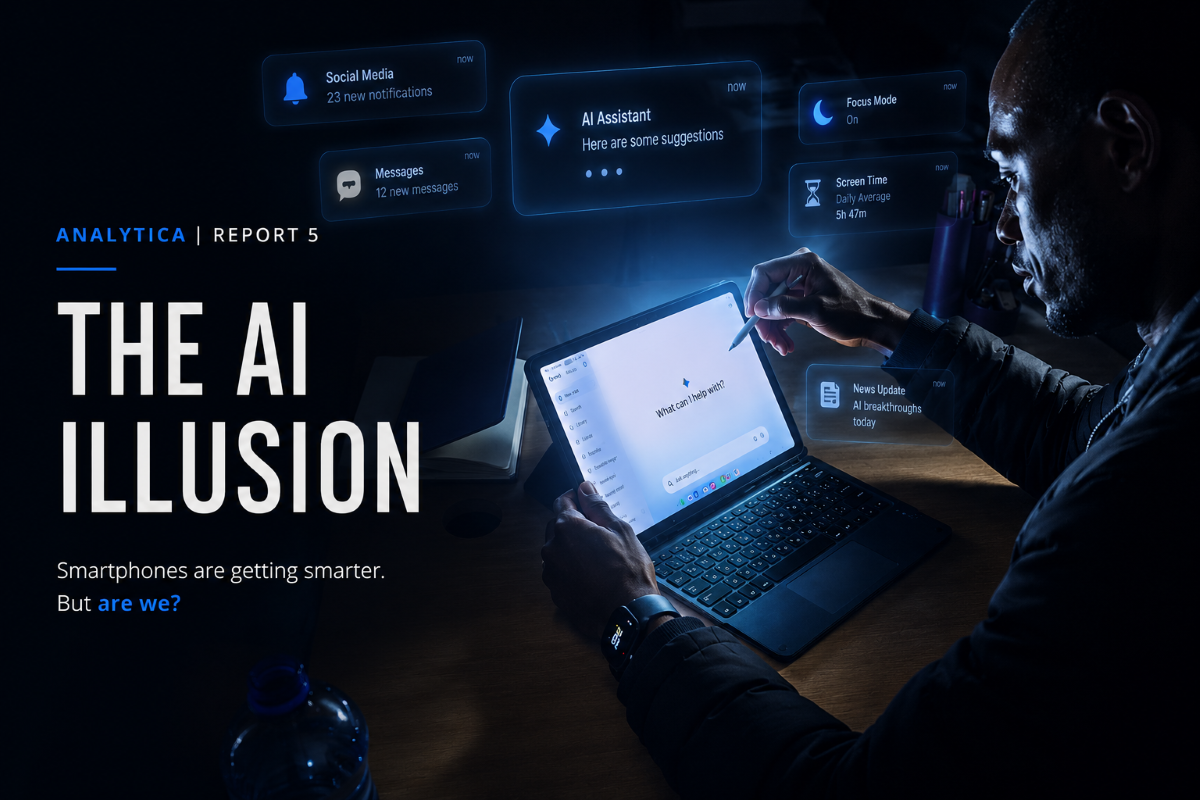
Smartphone brands are selling AI as the future of mobile productivity, but beyond the hype, many of these features rarely change how people actually work, create, or communicate.
Analytica Report #5
Executive Summary
Artificial intelligence has rapidly become the smartphone industry’s newest obsession, transforming modern devices into aggressively marketed “AI phones” promising smarter productivity, creativity, and everyday convenience. But beyond launch events and software demos, many users still experience smartphones in remarkably familiar ways, shaped by distraction, fragmented attention, app switching, and deeply ingrained digital habits.
This analysis explores the growing gap between smartphone AI marketing and everyday behavioral reality. It examines why the smartphone industry needed a new innovation narrative, how AI became central to that strategy, and why many current AI features improve convenience more consistently than they fundamentally transform workflows or productivity.
The article also explores the psychological power behind AI marketing, the unique realities shaping smartphone usage across African markets, and the deeper contradiction between AI-powered productivity and engagement-driven digital ecosystems. Ultimately, the future of smartphone intelligence may depend less on spectacle and more on subtle, contextual systems that integrate naturally into human behavior while reducing friction, cognitive overload, and digital fragmentation in meaningful ways.
About Analytica
Analytica is JuaTech Africa’s long-form editorial series exploring the intersection of technology, human behavior, productivity, culture, and modern digital life through grounded analysis, behavioral insight, and African perspective.
Every Smartphone Is Suddenly an “AI Phone”
Not long ago, smartphone brands competed on cameras, battery life, charging speeds, and raw performance. Today, artificial intelligence dominates nearly every smartphone launch. Brands no longer market devices as powerful tools alone. They now position them as intelligent companions designed to improve productivity, creativity, communication, and everyday life.
From keynote stages and product trailers to billboards and social media campaigns, smartphone AI features now sit at the center of the mobile industry’s biggest marketing push. AI photo editing, AI writing tools, AI-powered search, AI summaries, live translation, and generative image features now define how companies present modern smartphones. Every launch promises devices that feel smarter, more personal, and better at simplifying digital life.

The shift has happened remarkably fast. Only a few years ago, artificial intelligence operated mostly in the background of the smartphone experience through features like computational photography, predictive typing, and battery optimization. Today, brands place AI at the center of the conversation itself. The modern smartphone is no longer being sold simply as hardware. It is increasingly being sold as intelligence.
Launch events reinforce that message aggressively. Executives demonstrate real-time translation tools during live presentations. AI instantly removes unwanted objects from photos. Notes become summaries with a tap. Writing assistants rewrite messages automatically. Search becomes conversational. Everyday tasks suddenly appear faster, smoother, and almost frictionless. The message behind these demonstrations remains consistent across the industry: AI-powered smartphones are changing how people work and live.
And for a moment, the experience feels convincing.
The tension begins after the launch event ends and everyday routines return. Most people still spend the majority of their time messaging, scrolling social media, watching videos, taking photos, browsing the web, and switching between the same familiar apps that already dominated smartphone life long before AI became the industry’s defining buzzword.
That contrast now sits at the center of a growing conversation around smartphone AI features. For all the promises surrounding AI phones and mobile productivity, many users quietly return to the same habits, workflows, and digital routines that shaped their relationship with technology years ago. The modern smartphone may feel smarter, but everyday behavior often feels remarkably familiar.
Part of the reason this conversation matters is that smartphone AI currently operates in two very different realities. The first exists inside launch events and marketing campaigns, where artificial intelligence appears revolutionary, seamless, and central to the future of productivity. The second exists in everyday life, where many AI smartphone features still feel experimental, situational, or secondary to the core mobile experience.
That does not mean smartphone AI lacks value. Some tools genuinely improve convenience and reduce friction in meaningful ways. Voice transcription, intelligent search, live translation, accessibility tools, and advanced computational photography already make modern smartphones more capable than they were only a few years ago. But the industry increasingly markets AI as more than just convenience. Brands now frame smartphone AI features as transformational tools that can reshape how people think, create, organize, and communicate.
Real productivity, however, depends more on behavior than on features. Habits shape productivity. Attention shapes productivity. Workflow design shapes productivity. And despite the intelligence packed into modern smartphones, much of mobile life still revolves around distraction, fragmented attention, notifications, and engagement-driven platforms competing endlessly for user attention.
In many ways, smartphones are becoming smarter faster than human behavior is evolving around them. And that raises a question the smartphone industry still struggles to answer honestly: if smartphone AI features are truly reshaping productivity and digital life, why do so many AI-powered smartphones still feel fundamentally similar in everyday use?
The Smartphone Industry Needed a New Story
The growing gap between AI marketing and everyday smartphone behavior reflects a deeper shift that has quietly reshaped the smartphone industry over the past several years. Long before artificial intelligence became the center of launch events and advertising campaigns, the modern smartphone market had already entered a more mature and increasingly difficult phase.
For more than a decade, smartphone innovation felt immediate and easy for consumers to recognize. Better cameras produced noticeably sharper photos. Faster processors improved gaming, multitasking, and app performance. Larger batteries reduced charging anxiety, while thinner designs and brighter displays created a visible sense of progress with every generation. Smartphone companies did not struggle to explain their innovations because users could immediately feel the improvements in daily use.
That dynamic gradually changed as smartphones became more refined and capable across nearly every price category. Flagship devices continued to improve, but the difference between generations started to feel smaller in everyday use. At the same time, mid-range smartphones improved dramatically, delivering strong cameras, reliable performance, high-refresh-rate displays, and long battery life at more accessible prices. For many users, especially outside enthusiast circles, older devices still handled messaging, photography, social media, streaming, mobile payments, and productivity tasks without major problems.
The result was a market facing a growing perception challenge, in which consumers still appreciated innovation, but fewer people felt an urgent need to upgrade their smartphones every year. A device purchased two or three years earlier could still deliver a smooth experience for most daily activities, making it harder for smartphone brands to create the same level of excitement that once surrounded major launches. Better hardware still mattered, but it no longer carried the emotional impact it once did during the smartphone industry’s rapid growth years.
That pressure intensified as flagship smartphone prices continued climbing. Premium devices increasingly crossed into price ranges once associated with laptops and professional equipment, forcing companies to justify why consumers should spend significantly more money replacing devices that already worked well. The challenge was no longer simply building powerful smartphones. Companies now needed to convince users that meaningful innovation still existed in a market where many hardware improvements felt incremental rather than transformative.
Artificial intelligence entered that environment at the perfect time, allowing smartphone companies to shift the conversation away from hardware specifications alone and toward future potential. Instead of focusing solely on megapixels, benchmark scores, or charging speeds, brands could market smartphones as intelligent systems that adapt, learn, assist, and evolve. AI created a broader, more emotionally compelling narrative about what smartphones could become, rather than simply what they were.
The timing also aligned with a larger shift happening across the technology industry. As generative AI tools captured global attention, artificial intelligence quickly became associated with progress, relevance, and the future of computing itself. Consumers began hearing about AI everywhere, from workplaces and software platforms to search engines and creative tools. Smartphone companies recognized that remaining absent from that conversation carried its own risk because, in a rapidly changing technology environment, brands needed to appear connected to the future.
Once major smartphone companies aggressively embraced AI-powered experiences, the rest of the market followed quickly. Artificial intelligence stopped being a secondary software capability and became a competitive positioning strategy. Every major brand now needed its own AI ecosystem, AI assistant, AI editing tools, and AI productivity features to remain relevant in the premium smartphone conversation.
None of this makes smartphone AI artificial or meaningless. Many AI-driven tools already improve convenience in practical ways, and some will likely become deeply integrated into future computing experiences. But the speed and intensity of the industry’s AI pivot also reveal something important about the current state of the smartphone market itself. Hardware innovation alone no longer creates enough excitement to sustain long-term differentiation in a mature industry, and AI filled that gap by giving smartphone companies a new language of innovation built around intelligence, adaptability, and future possibility.
In a market where hardware differences continue shrinking for everyday users, artificial intelligence has become the smartphone industry’s most powerful new story.
The Rise of the AI Feature Economy
As smartphone companies searched for a new language of innovation, artificial intelligence quickly evolved from a technical capability into a commercial strategy. AI no longer operates quietly in the background of the smartphone experience. It now sits at the center of product launches, software updates, advertising campaigns, and increasingly, consumer perception itself.
That shift has created what increasingly looks like an AI feature economy, where the value of artificial intelligence is measured not only by usefulness but also by visibility. Smartphone brands no longer compete simply on whether they have AI capabilities. They compete on how many AI experiences they can present, package, demonstrate, and market as part of a broader narrative of intelligence.
The result is a smartphone market where AI often operates across multiple layers simultaneously, although consumers rarely experience all those layers equally in daily life.
Useful AI
Some smartphone AI features genuinely improve workflows in practical and meaningful ways. Voice transcription reduces the friction of note-taking. Live translation lowers communication barriers. Intelligent search surfaces information faster. Accessibility tools help users interact with devices more naturally. Computational photography continues improving image quality in ways most people immediately notice, even without understanding the technical systems behind it.
These features succeed because they solve visible problems without demanding too much behavioral change from users. They integrate naturally into existing habits instead of forcing people to adopt entirely new ways of using technology. In many cases, the best AI experiences feel less like futuristic tricks and more like quiet reductions in digital friction.
That distinction matters because convenience often creates more long-term behavioral impact than spectacle. A user may stop caring about an AI-generated wallpaper after a week. Still, they will continue using reliable voice transcription, spam filtering, predictive typing, or image processing if those tools consistently save time and mental effort.
Ironically, the most useful smartphone AI is often the least advertised. Many consumers already rely on artificial intelligence daily without consciously thinking about it because the technology works quietly in the background rather than presenting itself as the main attraction.
Invisible AI
Long before smartphone companies started aggressively marketing AI phones, artificial intelligence already shaped much of the mobile experience; modern smartphone photography depends heavily on computational processing. Battery optimization systems learn user behavior over time. Keyboards predict language patterns. Apps recommend content algorithmically. Navigation systems estimate traffic conditions dynamically. Spam calls get filtered automatically.
Most users never describe these experiences as “AI,” even though artificial intelligence powers many of them.
That disconnect reveals an important truth about technology behavior. The most transformative technologies often stop feeling like technologies once they become normal. Consumers rarely think about how much machine learning already shapes the smartphone experience because useful systems tend to disappear into habit over time.
In many ways, invisible AI represents the most mature version of smartphone intelligence. It works quietly, consistently, and without demanding attention. Users do not open their phones specifically to experience AI. They expect their devices to work better, faster, and more intuitively than before.
That expectation may ultimately matter more than the number of AI features companies can place on a launch slide.
Performative AI
At the same time, the modern smartphone market increasingly rewards visible AI experiences because visibility creates marketing momentum. This is where performative AI enters the conversation.
Performative AI refers to features designed as much for demonstration and excitement as for long-term utility. AI-generated wallpapers, automated message rewriting, novelty image generators, avatar systems, and certain summary tools often create strong first impressions during launch events because they translate easily into short demos, viral clips, and social media reactions.
That does not automatically make these features useless. Some users will genuinely enjoy or benefit from them. But many exist within a novelty cycle where the emotional impact of trying the feature becomes more important than sustained behavioral adoption.
Consumers recognize this pattern intuitively, even when they cannot fully articulate it. Many people experiment with AI features immediately after buying a smartphone, then gradually return to the apps, workflows, and habits that already define their digital lives. The technology feels impressive in isolated moments, but not every impressive moment creates lasting behavioral change.
That tension explains why the smartphone AI conversation increasingly feels both exciting and strangely familiar. The industry continues presenting AI as a transformational leap forward, while many users experience it as a growing collection of tools that range from genuinely useful to occasionally interesting.
And perhaps that is the clearest way to understand the current state of smartphone AI. The industry is not only building intelligence into devices. It is also learning, in real time, which forms of intelligence people will actually continue using once the novelty fades.
The Productivity Question Nobody Is Asking
The smartphone industry increasingly presents artificial intelligence as a productivity revolution. AI-powered smartphones now promise faster communication, smarter organization, improved creativity, better time management, and reduced digital friction. Across launch events, advertisements, and software updates, the message remains remarkably consistent: AI will help people work better, think faster, and navigate everyday life more efficiently.
But beneath that narrative sits a quieter and far more uncomfortable question that the industry rarely confronts directly. Are modern smartphone AI features fundamentally changing how people work and think, or are they simply making existing smartphone behavior slightly more convenient?
That distinction matters more than it first appears because most smartphone AI features optimize moments rather than workflows. They accelerate small actions, automate short tasks, and reduce micro-friction inside existing habits. AI can summarize notes faster, clean up photos more quickly, rewrite messages more smoothly, or surface information more intelligently. Those improvements are real, and in some situations they genuinely save time. But saving a few seconds inside fragmented digital behavior is not necessarily the same thing as transforming productivity itself.
Real productivity is deeply behavioral. It depends on focus, attention, consistency, workflow design, communication habits, mental clarity, and the ability to sustain meaningful work without constant interruption. And despite the intelligence packed into modern smartphones, much of smartphone life still revolves around distraction, fragmented attention, and endless engagement loops competing aggressively for user attention.
People still unlock their phones to reply to one message and end up scrolling for twenty minutes. They still switch constantly between apps while trying to focus on work. They still re-read emails manually even after AI summaries appear above them because trust and context still matter. Creators still spend hours adjusting edits themselves because automation rarely fully captures creative intent. Professionals still juggle screenshots, tabs, meetings, voice notes, emails, and messaging platforms across digital environments that often feel optimized more for activity than concentration.
This is where the tension surrounding smartphone AI becomes difficult to ignore. Many AI-powered smartphone features improve convenience without fundamentally improving the conditions required for deep productivity. Faster transcription does not automatically reduce distraction. AI-generated summaries do not solve information overload. Smart replies do not necessarily improve communication quality. Automated editing tools may reduce effort in isolated moments, but they rarely eliminate the deeper mental workload surrounding creative or professional tasks.
In many ways, smartphone AI currently functions more like workflow assistance than workflow transformation. That difference explains why many people experience modern smartphone AI with a mixture of fascination and emotional distance. The technology often feels impressive during demonstrations because it compresses visible actions into faster outcomes. Watching AI remove an unwanted object from a photo in seconds feels remarkable. Watching a device summarize a long article instantly feels efficient. But once the novelty fades, users still return to the same broader realities shaping digital life: notifications, multitasking fatigue, endless app switching, and platforms designed to maximize engagement rather than sustained focus.
The contradiction becomes even clearer when viewed through the lens of everyday behavior. A smartphone may summarize messages automatically, yet many users still open entire conversations to make sure context was not lost. AI writing tools can rewrite text instantly, but people still manually adjust tone because communication remains deeply personal and situational. AI photo editing can automate certain creative tasks, but creators still refine content manually because automation rarely completely replaces human judgment.
Even productivity itself has become increasingly difficult to define in the smartphone era. Many people now spend large portions of their day inside devices marketed as productivity tools while simultaneously feeling more distracted, mentally fragmented, and digitally exhausted than before. Smartphones excel at compressing activity, but compressed activity does not always translate into meaningful progress.
That reality reveals something important about the current state of smartphone AI. The technology often succeeds at reducing friction inside existing digital systems, but those systems themselves still revolve heavily around interruption, attention competition, and constant behavioral switching. In that environment, intelligence alone cannot automatically create focus.
None of this means smartphone AI lacks value. Some tools already provide meaningful assistance, especially for accessibility, communication, search, organization, and routine digital tasks. Over time, artificial intelligence will likely become more contextual, more personalized, and more deeply integrated into everyday workflows. But the gap between convenience and transformation remains significant, and much of today’s smartphone AI still operates closer to convenience than meaningful behavioral change.
That may ultimately explain why the current AI smartphone era feels simultaneously advanced and strangely incomplete. The devices themselves are becoming increasingly intelligent, but many users still experience digital life through the same cycles of distraction, multitasking fatigue, fragmented attention, and digital overload that defined the smartphone era long before AI became its newest promise.
The Psychology of the AI Phone
Part of what makes the modern smartphone AI race so powerful is that it operates far beyond software features and technical capability. Smartphone companies are no longer selling artificial intelligence simply as a tool. They are increasingly selling it as a symbol of relevance, progress, intelligence, and participation in the future. That distinction helps explain why AI marketing resonates so strongly even when many users may never fully integrate certain features into their daily routines.
People rarely buy smartphones through logic alone. Performance, battery life, cameras, and pricing still matter, but emotional psychology has always shaped consumer technology purchasing behavior just as strongly as technical specifications. Smartphones occupy a uniquely personal position in modern life because they function simultaneously as communication tools, workspaces, entertainment systems, creative platforms, social identities, and status symbols. As a result, buying a smartphone often reflects not only what people need today, but also how they see themselves and how they want to position themselves within a rapidly changing technological world.
Artificial intelligence fits naturally into that emotional space because AI represents something larger than functionality alone. It signals modernity, adaptability, and future relevance. In a smartphone market where many devices already feel powerful enough for everyday use, AI gives consumers a renewed sense that the next device may offer access to a different era of technology rather than simply another hardware upgrade.
That emotional pull becomes even stronger because artificial intelligence still carries a sense of mystery and possibility for many consumers. Most people do not fully understand the technical systems behind machine learning models, computational processing, or generative AI. What they understand instead is the cultural meaning surrounding AI. It has become associated with intelligence, speed, efficiency, automation, creativity, and the future of computing itself. Smartphone brands understand that symbolism clearly, which is why AI now dominates launch events, advertising campaigns, software updates, and product positioning across the industry.
In many ways, AI is currently being sold not just as a feature, but as a feeling. Owning an AI-powered smartphone increasingly creates the impression that a user is participating in the next phase of technological progress. Even when certain features remain situational or rarely used, the broader identity of carrying an “AI phone” still feels aspirational because consumers are not simply evaluating isolated software tools. They are responding to the emotional promise of future capability.
That behavior is not irrational. Technology purchases have always contained elements of optimism, identity, and projection. People often buy devices not only for what they currently do, but also for what they believe those devices may eventually enable. The early smartphone era operated through a similar psychology. Many consumers invested in smartphones long before they fully understood how mobile apps, social media platforms, cloud services, and mobile commerce would eventually reshape everyday life. The promise of future possibility carried emotional value even before practical usage fully matured.
Artificial intelligence now occupies a similar position in the modern smartphone market. Smartphone companies understand that consumers respond strongly to perceived momentum, especially during periods of visible technological change. Once AI became the defining conversation in the technology industry, brands faced pressure to ensure their devices appeared aligned with that shift. In a market built heavily around perception and innovation cycles, no company wants its products to feel disconnected from what consumers increasingly associate with the future.
Consumers respond to that momentum instinctively. A smartphone marketed heavily around AI can create the impression that it is more advanced, future-ready, and intelligent than competing devices, even when the broader user experience remains relatively similar in everyday life. That perception matters because technology buying behavior is often shaped as much by emotional positioning as practical utility.
This is one reason why the smartphone AI conversation now feels significantly larger than the features themselves. The industry is not competing solely on software capabilities or productivity tools. It is competing through aspiration, future positioning, cultural relevance, and the emotional psychology of technological progress.
None of this means consumers are being manipulated or misled. Many people genuinely enjoy experimenting with emerging technology, and some AI-powered experiences already provide meaningful convenience in everyday life. But understanding the psychology surrounding AI phones helps explain why artificial intelligence has expanded so rapidly beyond technical discussion into something more emotional and identity-driven.
People do not simply want smartphones that perform well. They also want devices that feel current, intelligent, relevant, and connected to where technology is headed next. And at this moment in the smartphone industry, artificial intelligence represents that future more powerfully than any other idea competing for consumer attention.
The African Smartphone Reality
Much of the global conversation surrounding smartphone AI assumes a user experience shaped by stable connectivity, premium devices, cloud integration, and predictable digital infrastructure. But everyday smartphone reality across many African markets often operates under very different conditions, and those differences fundamentally shape what productivity actually means in practice.
For many users in Kenya and across Africa, the smartphone is not a secondary device sitting beside laptops, tablets, smart home systems, and layered digital ecosystems. It is often the primary computer, camera, internet connection, communication tool, and business platform all at once. That reality changes how people evaluate technology because smartphones are frequently tied directly to work, income generation, education, and business continuity rather than convenience alone.
In those environments, reliability carries enormous value. Battery endurance matters because access to electricity is not always predictable. Durability matters because devices often operate under demanding daily conditions. Repairability matters because replacing a damaged smartphone can carry serious financial consequences. Connectivity matters because unstable networks and expensive mobile data directly affect how people communicate, work, upload content, attend meetings, or manage online businesses.
That context changes the meaning of smartphone productivity itself. For many African users, smartphone productivity is still shaped more by reliability, battery endurance, camera consistency, affordability, and stable performance than experimental AI experiences. A phone that consistently survives an entire workday may provide more practical value than one capable of generating AI wallpapers or automatically rewriting text. Dependable cameras, stable thermal performance, efficient charging, strong network reception, and long-term software reliability often influence everyday productivity more directly than many of the AI features currently dominating smartphone marketing campaigns.
This becomes especially evident in Africa’s growing creator and mobile business economy, where smartphones increasingly serve as serious professional tools rather than casual lifestyle devices. Across the continent, freelancers, entrepreneurs, content creators, photographers, online sellers, remote workers, and small business owners now build entire workflows around mobile devices. Many creators shoot videos, edit content, respond to clients, process payments, manage social platforms, and upload work directly from their phones without access to larger production ecosystems.
In those workflows, practical limitations still shape productivity far more aggressively than AI marketing narratives sometimes acknowledge. Creators care about whether a phone overheats during video exports, whether battery drain interrupts outdoor shoots, whether uploads fail with unstable connectivity, whether microphones capture clean audio consistently, and whether storage fills up halfway through production. AI editing tools may occasionally improve convenience, but convenience alone rarely determines whether work gets completed efficiently under real-world conditions.
Even affordability changes how smartphone innovation gets evaluated across many African markets. Consumers making major financial decisions about smartphones often prioritize longevity, durability, repair costs, resale value, and day-to-day dependability because these factors have direct economic consequences. A smartphone is not always viewed simply as a lifestyle upgrade. In many cases, it serves as an economic asset closely tied to communication, work opportunities, digital access, and personal productivity.
None of this means African users are uninterested in artificial intelligence. In fact, AI-powered tools could eventually create enormous value across accessibility, language translation, education, communication, organization, mobile commerce, and digital productivity. But meaningful AI adoption in many African markets will likely depend less on spectacle and more on practical integration into everyday realities.
The most impactful smartphone AI experiences in these environments may not be the most visually impressive ones. They may instead be systems that quietly improve battery efficiency, reduce data consumption, enhance language accessibility, optimize device performance, simplify mobile business operations, or help users work more effectively under real-world infrastructure limitations.
That distinction reveals something the broader smartphone industry often overlooks. Productivity is not experienced universally. It is shaped by environment, infrastructure, economics, behavior, and daily human realities. And in many African markets, the most valuable smartphone innovations are still the ones that make technology more dependable, accessible, efficient, and economically sustainable long before they make it feel futuristic.
This is where the smartphone AI conversation becomes more grounded and, perhaps, more honest. The future of mobile intelligence will be shaped not only by what looks impressive at launch events, but also by how effectively technology adapts to the realities of how people actually live and work.
The Attention Economy Contradiction
Beneath the growing excitement surrounding smartphone AI sits a deeper contradiction that the technology industry rarely addresses directly. Many modern smartphones are now marketed as tools designed to improve productivity, organization, focus, and efficiency. Yet, much of the smartphone ecosystem itself still operates on business models built around engagement, retention, and continuous attention.
That tension matters because smartphones do not exist independently from the platforms, apps, and digital systems surrounding them. The same devices now promising AI-powered productivity also deliver endless notifications, algorithmic content feeds, autoplay videos, social validation loops, and engagement systems carefully designed to maximize time spent on screen. In many ways, smartphones function as both productivity tools and attention-extraction machines.
Artificial intelligence enters that environment, carrying two very different possibilities at once. On one side, AI can genuinely reduce friction in everyday life. Intelligent search tools can surface information faster, AI assistants can organize tasks more efficiently, and real-time transcription can simplify communication and note-taking. Context-aware systems may eventually reduce some of the mental overload that increasingly defines modern digital life.
At the same time, artificial intelligence also risks strengthening many of the engagement systems already competing aggressively for human attention. Smarter recommendation algorithms, increasingly personalized feeds, adaptive notifications, and hyper-targeted content systems may improve engagement just as effectively as they improve convenience. The same intelligence that helps users work faster can also be highly effective at keeping them scrolling longer.
This is where the contradiction surrounding smartphone AI becomes difficult to ignore. Can devices optimized for engagement truly become productivity-first AI tools, especially when much of the modern app economy still rewards distraction more consistently than sustained focus?
For many users, that tension already feels familiar in everyday life. Smartphones increasingly help people complete tasks faster, yet many still feel mentally fragmented, digitally overstimulated, and constantly interrupted throughout the day. Notifications continue competing for attention, social platforms continue rewarding compulsive engagement patterns, and app ecosystems continue encouraging rapid switching between entertainment, communication, work, shopping, and content consumption.
Artificial intelligence does not automatically remove those conditions simply because certain tasks become faster or more automated. In fact, some of the most important productivity challenges surrounding smartphones today are no longer technical limitations. They are behavioral and psychological, shaped by how modern digital systems continuously compete for human attention throughout the day.
Focus has become harder to sustain partly because constant stimulation has become normalized inside the smartphone experience itself. Many people now spend large portions of their day moving rapidly between tasks, feeds, videos, emails, chats, and notifications without ever fully disconnecting from digital interruption long enough to concentrate deeply. Smartphone AI may reduce friction inside those systems, but reducing friction is not always the same thing as improving attention.
That reality does not make smartphones harmful or inherently anti-productivity. Modern mobile technology has created enormous economic, educational, creative, and communication opportunities worldwide, and smartphones remain among the most powerful personal productivity tools ever created. But the contradiction surrounding AI productivity still matters because intelligence alone cannot automatically solve the problems posed by ecosystems designed around continuous engagement.
The deeper challenge now facing the smartphone industry may not simply involve making devices smarter. It may involve creating digital environments that help people manage attention, reduce cognitive overload, and sustain meaningful focus more effectively than the current smartphone ecosystem often allows.
What Real Smartphone Intelligence May Look Like
For all the hype, contradictions, and marketing inflation surrounding smartphone AI today, dismissing the long-term potential of artificial intelligence in mobile technology entirely would be equally shortsighted. Much of the tension surrounding smartphone AI reflects an industry still operating in the early stages of understanding what meaningful mobile intelligence should actually look like beyond launch events, software demos, and isolated features.
Many current smartphone AI experiences still function as additions layered onto existing apps and workflows rather than systems designed around how people naturally work, communicate, organize information, and manage attention. Users still manually switch between apps, manage fragmented workflows independently, repeatedly search for information, and navigate digital environments that often require significant mental coordination to function effectively.
The most transformative smartphone AI may ultimately emerge not from louder features but from quieter integration.
Instead of forcing users to actively “use AI” as a separate experience, future smartphone intelligence will likely become increasingly contextual, proactive, and deeply embedded into the operating logic of devices themselves. Smartphones may eventually understand routines, communication patterns, schedules, workflow priorities, and behavioral habits well enough to reduce friction before users consciously experience it.
That shift could reshape the smartphone experience far more meaningfully than many current AI demonstrations. Rather than simply accelerating isolated tasks, future systems may help coordinate workflows across communication, productivity, organization, media, and scheduling environments simultaneously. Smartphones could eventually surface relevant information in context, automate repetitive digital tasks quietly, reduce unnecessary app switching, and simplify the fragmented digital environments that currently define much of modern smartphone usage.
Some of the earliest foundations of that future already exist, although they rarely receive the same attention as highly visible AI features. Smartphones already filter out spam calls automatically, dynamically optimize battery behavior, organize photo libraries intelligently, predict traffic conditions, transcribe conversations in real time, and adapt performance patterns based on long-term user behavior. Most people rarely think of these systems as artificial intelligence because the technology operates quietly in the background rather than constantly demanding attention.
That distinction may ultimately reveal the real direction of mature smartphone intelligence. The most transformative smartphone AI may eventually become the least visible because technologies that integrate naturally into human behavior rarely feel performative once they mature. They become part of everyday life.
The long-term value of smartphone AI may therefore depend less on how many AI tools companies can advertise and more on how effectively intelligence integrates across fragmented digital systems. One of the largest problems modern smartphone users face is not lack of capability, but lack of coherence. Workflows remain divided across apps, platforms, notifications, communication channels, and endless streams of competing information.
If future smartphone AI can meaningfully reduce that fragmentation, the impact could extend far beyond convenience alone. Cross-app intelligence, contextual organization, personalized automation, and adaptive workflow systems may eventually help smartphones function less like collections of disconnected applications and more like unified environments that support how people actually live and work.
The future of smartphone AI may ultimately depend less on spectacle and more on subtlety. If that transition happens successfully, the next generation of mobile intelligence may feel less like interacting with artificial intelligence directly and more like using technology that finally understands how to work quietly alongside human life instead of constantly competing for it.
Beyond the AI Hype
The smartphone industry is not wrong to believe artificial intelligence will shape the future of mobile technology. In many ways, that future has already begun to arrive quietly through smarter software systems, contextual assistance, computational photography, accessibility tools, and increasingly adaptive digital experiences. The deeper tension surrounding smartphone AI is not whether the technology matters, but whether the current conversation around it sometimes moves faster than the behavioral reality of how people actually use smartphones every day.
Much of today’s smartphone AI still operates inside digital environments shaped by distraction, fragmented attention, engagement-driven design, and increasingly complex workflows. As a result, many AI-powered features currently improve convenience more consistently than they transform productivity. They reduce friction, automate repetitive tasks, and simplify isolated actions, but meaningful productivity still depends heavily on focus, habits, workflow design, and effective attention management.
At the same time, dismissing smartphone AI entirely would ignore the genuine long-term potential of more contextual and human-centered forms of mobile intelligence. Some of the most important AI systems of the future may not be the loudest or most visually impressive ones. They may instead become the invisible systems that quietly simplify digital life, reduce cognitive overload, improve accessibility, and help technology adapt more naturally to how people actually live and work.
Perhaps that is the clearest way to understand the current AI smartphone era. The future of smartphone intelligence may ultimately depend less on spectacle and more on subtlety, where the most valuable AI experiences are not the ones demanding constant attention. Still, the ones quietly helping people navigate digital life more intentionally, efficiently, and meaningfully.