

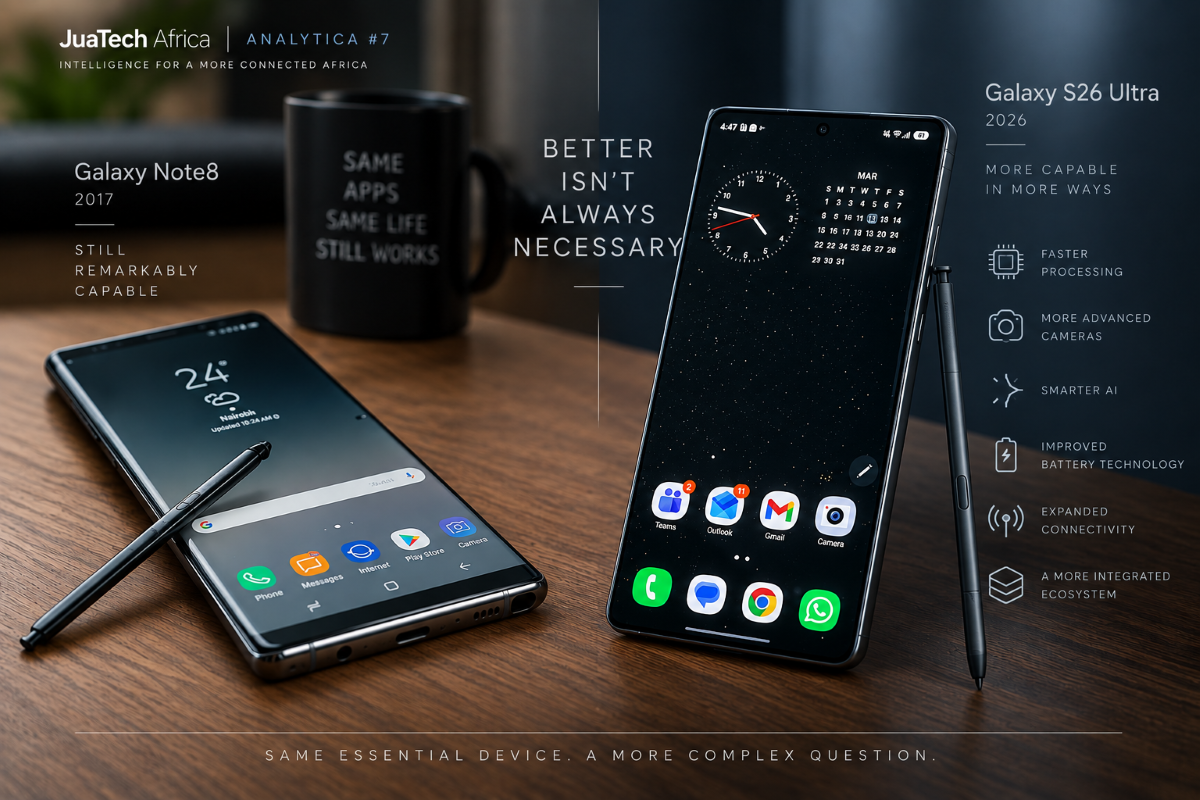
Smartphones continue to gain better cameras, faster processors, smarter AI and denser batteries. Yet replacement cycles are stretching. Has the industry entered an era where technological progress no longer drives new phone purchases?
About Analytica
Analytica is JuaTech Africa’s long-form intelligence and analysis series, examining the forces shaping technology markets, consumer behaviour and Africa’s digital future.

This is Analytica Report #7. In The Smartphone Upgrade Problem, we investigate why smartphones continue to improve while consumers increasingly find fewer compelling reasons to upgrade. The report examines technological maturity, diminishing returns, affordability, and the changing meaning of smartphone value.
You do not need to have read the previous reports. This analysis stands on its own while contributing to JuaTech Africa’s continuing examination of mobile technology and its wider implications.
I. The Phone in Your Pocket Is Probably Better Than You Think
A peculiar moment increasingly accompanies the launch of a new smartphone. You watch the presentation as the manufacturer reveals a brighter display, a faster processor, upgraded cameras, improved battery technology and another generation of artificial intelligence features. The numbers rise, the benchmarks improve and the specification sheet fills with evidence that this is a better device than the one before it. Yet when the presentation ends, you may look at the phone already in your hand and arrive at a surprisingly difficult question: Do I really need to replace this?
That question would have been harder to ask a decade ago. A smartphone that is two or three years old can still be remarkably capable. It can handle demanding applications, mobile banking and work, stream high-resolution video, navigate unfamiliar places, connect to fast mobile networks, take excellent photographs and run games that once required dedicated hardware. If its battery remains healthy and its software is still supported, an older flagship can keep doing almost everything its owner expects long after its successor has appeared in a shop window.
There are, of course, legitimate reasons to replace an ageing phone. Batteries deteriorate, displays and charging ports wear out, storage can become restrictive, software support eventually ends, and newer devices can deliver meaningful improvements in cameras, endurance, connectivity, or performance. But these reasons are becoming increasingly specific. A new model arriving on the market no longer automatically makes the previous model feel obsolete. The successor must show why its improvements matter enough to justify the cost and disruption of changing devices.
That marks a significant departure from the earlier smartphone era. The transition from feature phones to smartphones fundamentally changed mobile computing. Touchscreens transformed interaction, mobile broadband expanded what a connected handset could do outside the home or office, and app stores turned the phone into a software platform that could continuously acquire new functions. Later advances in cameras, biometric authentication, high-refresh-rate displays and mobile processors continued to make each generation feel materially different from the one before it. For years, the smartphone industry conditioned consumers to associate technological progress with a visible reason to upgrade.
Today, that relationship is more complicated. Manufacturers continue to release increasingly capable devices, but the difference between what a new phone can technically accomplish and what an existing phone already does sufficiently well is becoming harder to perceive. A substantially faster processor does not necessarily make messaging or email feel dramatically different. A higher-resolution camera does not automatically produce proportionally better photographs. Another collection of AI features may be technically impressive without changing how its owner actually uses the device. The technology can improve considerably while the experience improves only marginally.
That distinction sits at the center of the modern smartphone market. The industry has not stopped innovating, but consumers are becoming more demanding about what counts as an upgrade. As replacement cycles stretch and smartphones remain useful longer, the burden on each new generation grows. It must compete not only with rival products, but with the device already sitting in the customer’s pocket.
The more interesting question, therefore, is not whether smartphone innovation has slowed. It is why technological progress is becoming harder to translate into a compelling reason to upgrade. To understand that shift, we first need to examine the upgrade cycle itself: how long consumers are keeping their phones, why that period has expanded, and what it reveals about the changing relationship between technological progress and consumer demand.
II. The Upgrade Cycle Has Changed
For years, the smartphone business depended on a relatively predictable rhythm. Consumers bought a device, used it for a couple of years, and eventually replaced it with a newer model that promised enough additional performance, camera capability, battery life or connectivity to make the next purchase feel worthwhile. That rhythm became embedded in the industry’s economics. Manufacturers planned product cycles around it, operators used contracts and financing to accelerate upgrades, and consumers learned to think of two or three years as a natural point when a phone reached the end of its useful life. That assumption is becoming harder to sustain.
The four-year smartphone is moving closer to reality
The evidence is now difficult to dismiss. Counterpoint Research recorded a global smartphone replacement cycle of 43.4 months in 2023, its highest level on record, followed by a modest improvement to 43.0 months in 2024. Its forecast expects the cycle to gradually shorten to 40.4 months by 2029, but that still leaves the market operating at a considerably longer replacement interval than the annual or two-year upgrade culture that once defined the category. Counterpoint attributes the unusually long cycle to factors including inflation, geopolitical disruption and increasingly incremental device upgrades.
This does not mean consumers have collectively decided to keep every smartphone for four years. Enthusiasts, professionals and consumers with demanding workloads will continue to upgrade earlier, while others will replace devices when batteries deteriorate, software support ends or physical damage makes continued ownership impractical. What matters is the shift in the centre of gravity. The smartphone industry can no longer assume that the arrival of a new generation will, by itself, give millions of existing users a strong enough reason to buy again.
Higher prices are only part of the story
Cost is clearly making that decision harder. In 2026, rising memory prices have created a significant new pressure on smartphone manufacturers. Counterpoint reported that smartphone memory prices had risen more than 300% year over year in the second quarter, with memory costs surpassing processor costs across smartphone segments. The resulting pressure is particularly severe in entry-level and mid-range devices, where manufacturers have less room to absorb higher component costs.
But explaining longer replacement cycles entirely through inflation would be too convenient. If price were the whole problem, lower prices and easier financing should restore the old replacement rhythm. Instead, another factor has become increasingly important: the phone itself has become harder to outgrow.
Modern smartphones are simply more capable and more durable as computing products. A device that was considered high-end several years ago may still have sufficient processing power, camera quality, connectivity and software capability for its owner’s everyday needs. The consequence is subtle but commercially significant. Consumers no longer necessarily have to wait for their current phone to become inadequate. They can keep using it while deciding whether the improvements in its successor are worth paying for.
From time-driven replacement to value-driven replacement
This changes the nature of the purchase decision. The question used to be largely chronological: How long have I had this phone, and what has replaced it? Increasingly, it is economic and experiential: What will the new phone allow me to do that this one cannot?
That distinction is crucial. A new smartphone will almost always be objectively better than its predecessor. It may have a faster processor, a more sophisticated camera system, a brighter display or more capable AI hardware. But objective superiority does not automatically create subjective value. If the improvement does not materially change the owner’s experience, the incentive to replace the existing device weakens.
This is the deeper change taking place in the smartphone market. The industry is no longer competing only to produce a better phone. It is competing to produce a meaningfully better experience. As devices become more capable and replacement cycles lengthen, the burden placed on each new generation increases. Manufacturers can keep improving specifications, but consumers are becoming more selective about which improvements are worth their money.
The smartphone upgrade cycle, in other words, is becoming less about when a consumer should replace a phone and more about why. And that leads to a more consequential question: what happens to innovation when the improvements required to justify an upgrade become progressively harder to see?
III. The Smartphone Has Entered Its Mature Phase
The lengthening smartphone upgrade cycle becomes easier to understand when you view the smartphone not simply as a product, but as a technology category entering maturity. Young technologies tend to advance through conspicuous breakthroughs. They solve problems consumers can immediately recognise and, in doing so, redefine what the product itself can be. Mature technologies behave differently. Once the fundamental problems have largely been solved, innovation shifts toward optimisation, efficiency, integration and refinement. Progress can remain substantial, but its effects become less dramatic in everyday use. The smartphone is increasingly operating in this latter phase, where the challenge is no longer to make the device capable, but to make the next generation meaningfully better than an already highly capable predecessor.
When each generation changed the product
The transition from feature phones to smartphones illustrates what technological breakthrough looks like. It was not simply a better version of the same product. The touchscreen displaced physical keys as the primary interface, mobile operating systems turned the handset into a computing platform, broadband connectivity expanded its usefulness beyond voice and messaging, and app stores allowed users to continually extend its capabilities. The value of the transition was obvious because it changed what a phone fundamentally was and what people could do with it.
Several subsequent developments produced similarly visible leaps. The transition from LCD to OLED brought deeper blacks, higher contrast and greater design flexibility, while OLED has since moved from a premium differentiator toward a mainstream smartphone display technology. The shift from 3G to 4G dramatically expanded the practicality of mobile broadband, enabling richer applications, video streaming and increasingly cloud-dependent services. The move from single-camera phones to multi-camera systems, meanwhile, gave smartphones dedicated focal lengths and computational photography capabilities that transformed mobile imaging. These were technological advances, but they were also changes consumers could readily experience. The product behaved differently because the underlying technology had crossed an important threshold.
That kind of breakthrough becomes harder to repeat once a category has solved many of its most obvious problems. A modern smartphone is already fast enough for most mainstream workloads, connected enough for almost any ordinary mobile service, sophisticated enough to produce excellent photographs and capable enough to function as a primary computing device for millions of people. The next generation therefore begins from a much higher baseline. It is improving an already successful solution rather than replacing an inadequate one.
The problem of diminishing visible returns
This is where the distinction between technological progress and perceived improvement becomes important. Consider display refresh rates. Moving from 60Hz to 120Hz produced an immediately noticeable improvement in scrolling, animation and interface responsiveness. Moving from 120Hz to 144Hz can still have legitimate benefits, particularly for specialised gaming applications, but the difference is considerably less consequential for the average smartphone user. The engineering has not become less real; the visible benefit has become harder to distinguish.
The same principle applies to other specifications, although each needs to be judged on its actual implementation rather than its headline number. A move from a basic single-camera system to a sophisticated multi-camera and computational-imaging platform fundamentally expanded what mobile photography could achieve. Increasing resolution from 50MP to 200MP, however, does not automatically produce a proportionate improvement in photographic quality. Sensor size, optics, pixel-binning, processing, stabilisation and software can matter as much as the number printed on the specification sheet.
Processor manufacturing provides an even clearer example. A transition to a more advanced semiconductor process such as 2nm can deliver meaningful gains in transistor density, performance and power efficiency. Those are major engineering achievements. But consumers do not buy transistor density; they buy the consequences of it. The benefit becomes meaningful when greater efficiency extends battery life, sustained performance improves, on-device AI becomes practical, or entirely new capabilities become possible. The smaller manufacturing node is therefore an enabler of consumer value rather than the value itself.
The same logic explains why increasing memory from 12GB to 16GB does not necessarily transform the experience for every user. Additional memory can be valuable for demanding workloads, heavy multitasking and future software requirements, but a consumer whose daily routine consists primarily of messaging, browsing, photography, streaming and ordinary applications may experience little immediate difference. The specification has advanced, yet the tasks being performed have not changed.
This is the phenomenon of diminishing visible returns. It does not mean that every new generation is less innovative than the one before it. It means that as the technological baseline rises, increasingly sophisticated engineering can produce improvements that are more difficult to perceive without specialised use, measurement or sustained comparison.
Innovation did not disappear. The obvious problems did.
This is why declaring that smartphone manufacturers have simply “run out of ideas” misses the more interesting story. The industry continues to solve difficult engineering problems in artificial intelligence, imaging, battery efficiency, thermal management, connectivity and semiconductor design. The difference is that many of these advances operate beneath the surface. They improve what the smartphone can do, how efficiently it can do it, and what future capabilities it can support, without necessarily changing the owner’s behavior overnight.
The smartphone has therefore entered an unusual stage of technological maturity. Its engineering frontier continues to move, but the consumer’s everyday experience does not necessarily move with it at the same pace. Earlier breakthroughs expanded the boundaries of the category; many current innovations refine what already exists, making it faster, more efficient, more intelligent, and more reliable.
That distinction matters because it helps explain the paradox established earlier. A smartphone can keep getting better technologically while becoming harder to replace. The problem facing manufacturers is not simply to invent something new. It is to turn that innovation into a sufficiently meaningful improvement in everyday life that consumers can see, feel and justify.
And this is where the story becomes more interesting. If innovation hasn’t stopped but has instead moved beneath the surface, where are today’s most consequential smartphone advances taking place, and which of them have the potential to change the upgrade equation?
IV. Innovation Did Not Stop. The Problems Changed
If the smartphone has entered technological maturity, it is tempting to conclude that innovation has slowed. The evidence points to a more interesting explanation. The industry has not stopped solving difficult problems; it has changed the kinds of problems it is trying to solve. Earlier generations focused on making smartphones fundamentally more capable. How could they become faster? How could displays become sharper and more responsive? How could cameras produce better photographs? How could mobile networks deliver more data? Those questions produced advances that were immediately visible because they changed the basic experience of using a phone. The harder questions now sit deeper in the technology stack: how can more computing be performed without consuming more power, how can artificial intelligence run locally rather than constantly depending on the cloud, how can batteries store more energy without making devices larger, and how can increasingly complex systems remain cool, efficient and reliable inside a device that still has to fit in a pocket?
The race has moved beneath the surface
The modern smartphone is becoming less a collection of isolated components and more an integrated computing system. The processor is no longer simply responsible for executing applications. It contains specialised hardware for graphics, image processing, machine learning and increasingly complex AI workloads. Qualcomm’s Snapdragon 8 Elite Gen 5, for example, combines its CPU and GPU with a dedicated Hexagon NPU and a sensing hub designed for on-device AI, while the company reports improvements in both processing performance and power efficiency over the previous generation. The significance is not simply that a new chip is faster. It is that the smartphone is acquiring the computational infrastructure required to understand speech, images, context and user behaviour locally and increasingly to act on that information.
That represents a fundamental change in the processor’s role. Earlier generations largely competed on how quickly they could execute instructions. Increasingly, smartphone silicon is being designed around what kinds of intelligence it can execute efficiently. On-device AI can reduce dependence on remote servers, improve responsiveness and allow some personal data to remain on the device. Qualcomm’s current mobile platforms, for instance, are explicitly being positioned around generative and agentic AI running at the edge rather than treating the smartphone simply as a terminal for cloud computing. The technical achievement is considerable, even if the consumer benefit may initially appear as a faster image edit, a more useful assistant, better transcription or an application that quietly performs a task that previously required several steps.
The same shift is visible in mobile imaging. The camera race has moved well beyond the simple question of how many megapixels a sensor contains. Modern smartphone photography depends on the interaction between sensors, optics, image signal processors, neural processing, computational photography and increasingly generative techniques. The phone can combine multiple exposures, recognise scenes, separate subjects from backgrounds, correct noise and dynamic range, and process an image according to an understanding of what it believes the scene contains. The important innovation is therefore no longer only the camera module itself. It is the computational system surrounding it.
Battery technology is becoming a computing problem
Power presents an even more fundamental constraint. More capable processors, brighter displays, faster connectivity and continuous AI processing all demand energy. The industry cannot indefinitely solve that problem by simply increasing battery capacity because smartphones must remain thin, light and thermally manageable. Battery innovation therefore becomes an enabling technology for almost every other area of smartphone progress.
Recent silicon-carbon battery developments illustrate this shift. At MWC 2026, HONOR demonstrated a silicon-carbon battery with 32% silicon content and energy density above 900Wh/L, while its Magic V6 uses a 6,660mAh silicon-carbon battery with up to 921Wh/L energy density in a foldable device. These are not merely bigger batteries. Higher energy density allows manufacturers to pursue greater capacity without accepting the same increase in physical volume, potentially giving demanding devices more endurance while preserving thinness.
This is precisely the kind of innovation that can disappear from the consumer’s field of view. A better battery chemistry does not announce itself with a new interface. Its success may be experienced simply as a phone that lasts longer, charges faster or manages demanding workloads without becoming uncomfortably large. Yet without improvements in energy storage and power efficiency, many of the industry’s other ambitions become more difficult to realise.
The smartphone is becoming part of a larger network
Connectivity is undergoing a similar transformation. The old mobile-network question was largely about improving terrestrial coverage and increasing data speeds. Those remain important, but the boundary of mobile connectivity is now expanding beyond the cellular tower. Direct-to-device satellite technology is being developed to allow compatible smartphones to communicate with satellites when terrestrial networks are unavailable, extending connectivity into remote areas and providing another layer of resilience during network outages and disasters. The GSMA describes direct-to-device connectivity as a complement to terrestrial networks rather than a replacement for them, with potential applications ranging from emergency communications to connectivity in sparsely populated areas.
The significance is easy to miss because satellite connectivity may spend most of its life doing nothing. A user in a well-covered city may never need it. But the underlying innovation changes the boundary of what a mobile phone can be: a device that previously depended entirely on terrestrial infrastructure can increasingly maintain a communication path beyond it. The recent development of direct-to-device systems using standard smartphones demonstrates that the frontier of mobile connectivity is no longer confined to improving the tower network alone.
This is the pattern running through modern smartphone innovation. Computing is becoming more specialised, batteries are becoming denser, cameras are becoming more computational, connectivity is becoming more resilient and devices are becoming increasingly capable of understanding context. Foldables are pursuing a different kind of innovation by changing the physical relationship between screen size and portability, while thermal engineering, materials science and power management quietly determine whether these capabilities can coexist in a device that remains practical to carry.
None of this looks as revolutionary as the first smartphone. That is partly because the innovation is solving constraints rather than introducing entirely unfamiliar categories of behaviour. The breakthrough is often hidden inside the experience. A processor becomes more efficient so that an AI model can run locally. A battery becomes denser so that a thinner device can last longer. Computational photography improves so that a small sensor can produce results once associated with much larger cameras. Satellite connectivity extends the network beyond the tower. The user sees the outcome; the engineering that made it possible remains largely invisible.
This changes the meaning of innovation in the smartphone era. The industry is no longer asking only how to make the phone do more. It is increasingly asking how to make the phone do more within the same physical, thermal, energy and connectivity constraints.
That is a much harder engineering problem, and it may be the reason the industry can appear stagnant while continuing to advance at remarkable speed. Smartphone innovation has not disappeared. It has become less visible because the frontier has moved from adding obvious capabilities to removing the constraints that prevent existing and emerging capabilities from working better.
The question now is whether consumers will recognise that progress as valuable enough to change their behaviour. Because the industry can solve an extraordinarily difficult engineering problem and still fail to create an upgrade worth paying for. That gap between technical possibility and consumer value is where the next stage of the smartphone story begins.
V. Why Specifications Stop Feeling Like Innovation
The smartphone industry has become exceptionally good at measuring progress. Every new generation arrives with numbers that can be compared directly with the previous one: more megapixels, more RAM, faster processors, brighter displays, higher charging wattages and increasingly advanced semiconductor processes. These figures provide manufacturers, reviewers and consumers with a convenient language for describing technical change. They also create an impression of continuous acceleration. If the number is higher, the assumption is that the technology must have advanced meaningfully. Yet a specification tells us what a component is capable of achieving; it does not, by itself, tell us what the owner will experience.
That distinction becomes increasingly important as the smartphone category matures. When a technology is still developing rapidly, improvements in specifications often correspond to dramatic changes in capability. A faster mobile connection can transform what can be done online. A substantially more capable processor can make entirely new applications possible. A better display can change how content is consumed. But once a device already performs these functions competently, the relationship between a higher specification and a better experience becomes less direct. The technology can continue advancing while the improvement perceived by the user becomes progressively smaller.
The number is not the experience
Smartphone cameras provide perhaps the clearest example. A 200MP sensor can capture considerably more image data than a 50MP sensor, and that additional resolution can be useful for cropping, detailed imaging and certain computational techniques. But megapixel count is only one component of a modern imaging system. Sensor size, lens quality, optical stabilisation, pixel-binning, dynamic range, image signal processing and computational photography all influence the photograph that eventually reaches the screen. A carefully engineered 50MP system can therefore produce more useful results than a poorly implemented 200MP system, particularly in difficult lighting. The larger number represents additional technical capability, but the photograph is the actual consumer experience.
Memory follows the same principle. More RAM can allow a smartphone to keep more applications active, support heavier multitasking and provide additional headroom as software becomes more demanding. Those benefits are real, particularly for power users, creators and people who routinely work with demanding applications. But once a device has enough memory to handle an individual’s normal workload comfortably, additional capacity can become difficult to notice. A consumer whose routine consists largely of messaging, browsing, photography, streaming and ordinary productivity may experience little practical difference between 12GB and 16GB if both configurations already perform those tasks without significant limitation. The specification has improved, but the user’s needs may not have changed.
Processor performance exposes the same gap from another direction. Modern flagship processors can deliver substantial gains in CPU and GPU performance, power efficiency and artificial intelligence processing. Those improvements are important because they provide the computational headroom required for more sophisticated software, gaming, image processing and on-device AI. Yet consumers rarely experience processor performance as a benchmark score. They experience it through application responsiveness, rendering, image processing, gaming stability, thermal behaviour and battery endurance. Once those everyday interactions are already fast enough, another large increase in theoretical performance can produce a much smaller change in perceived usefulness.
Charging technology demonstrates why the headline number can also be misleading. A smartphone supporting 100W charging is not automatically more convenient than one supporting 67W or 45W. Actual charging performance depends on battery capacity, charging curves, thermal management, charger compatibility and how long the device can sustain its maximum input. More importantly, the relevant consumer question is not simply how many watts the charger can deliver. It is how quickly the device can recover enough energy to remain useful, how consistently it can do so and how well the battery retains its capacity over years of ownership. Peak wattage is therefore a technical characteristic; convenience is the outcome the consumer actually values.
These examples do not make higher specifications irrelevant. They demonstrate why specifications must be interpreted rather than merely counted. A component can become substantially more capable without producing an equally substantial improvement in everyday use. As the technological baseline rises, the industry has to work harder to translate technical gains into benefits that consumers can actually perceive.
Specification progress versus experiential progress
This distinction gives us a useful framework for understanding the modern smartphone: specification progress is not necessarily experiential progress. Specification progress occurs when a measurable technical attribute improves. The processor becomes faster, the camera gains resolution, the display reaches a higher brightness level, the battery accepts more charging power or the device carries more memory. These are legitimate forms of technological advancement and may involve years of research, engineering and investment.
Experiential progress occurs at a different level. It happens when those technical improvements produce a meaningful difference in what the user can accomplish, how effectively they can accomplish it or how the device fits into their life. Consumers do not ultimately purchase transistor density, megapixel counts or charging wattage for their own sake. They purchase the capabilities and outcomes those technologies make possible. The distinction becomes increasingly important when the underlying technology advances faster than the user’s practical needs.
There are clear instances where specification and experience move together. The transition from 60Hz to 120Hz displays is one example because the increase in refresh rate produces a readily perceptible difference in scrolling, animation and interaction. The evolution from basic single-camera systems to sophisticated multi-camera platforms with computational photography produced another meaningful change because smartphones became substantially more capable photographic tools. In both cases, the technical advancement crossed the threshold into something the user could readily see or feel.
The relationship becomes weaker when the starting point is already highly capable. Increasing camera resolution may provide greater flexibility without fundamentally changing ordinary photography. Additional RAM may create headroom without altering the behaviour of everyday applications. A faster processor may enable increasingly demanding workloads while leaving familiar tasks feeling almost identical. Higher charging power may reduce charging time without materially changing a user’s routine if the existing system was already sufficiently fast. In each case, the specification has moved forward, but the experience may move only slightly.
The important point is not that these improvements are useless. It is that the relationship between technical advancement and consumer benefit is no longer linear. The first major improvement can solve a visible problem; subsequent improvements may optimise a solution that is already good enough. That is precisely where specification inflation can begin to feel like innovation without necessarily functioning as one from the consumer’s perspective.
From specification to outcome
A more useful way to evaluate smartphone progress is therefore to follow the entire chain from specification to outcome. Consider a camera sensor. A larger sensor can capture more light; more captured light can give the imaging system better information; stronger processing can turn that information into improved dynamic range, lower noise or more reliable low-light photography. Those improvements become genuinely valuable when they help a creator produce better work, allow a professional to document something important or simply enable an ordinary user to capture photographs that an older device would have struggled to produce. The value emerges from what the technology enables, not from the specification in isolation.
The same chain applies to processing power. A more capable processor can make sophisticated AI models practical on the device. Local AI can potentially make certain tasks faster, more private and less dependent on cloud connectivity. Those capabilities become meaningful when they save time, improve accessibility, simplify work or allow users to perform tasks that previously required multiple applications or a more powerful computer. In that situation, additional processing power has successfully travelled from specification to capability, from capability to experience and ultimately to outcome.
When that chain breaks, the upgrade proposition weakens. A consumer can acknowledge that a new phone is technically superior while struggling to identify what has materially improved in daily life. This helps explain an important paradox in the mature smartphone market: specification sheets can become increasingly impressive at precisely the moment consumers become less impressed by them. The industry continues improving the inputs, while consumers increasingly judge the results.
This is why the modern smartphone buyer is asking a more demanding question than simply whether the next device is better. Almost every new flagship will be better by some measurable technical definition. The more consequential question is whether that additional capability changes the user’s experience enough to justify the financial cost of replacing a device that already works well.
Specification progress tells us that the technology has advanced. Experiential progress tells us whether that advancement matters.
That distinction may be one of the most important ways to understand the modern upgrade problem. As the smartphone becomes more technically sophisticated, the burden shifts from producing bigger numbers to producing meaningful outcomes. The next generation cannot merely be more capable on paper. It has to make that additional capability matter in the life of the person holding it.
VI. The New Upgrade Triggers
If specifications are becoming less effective at creating urgency, the next question is unavoidable: what would actually make someone replace a phone that still works well? The answer cannot simply be another faster processor, a larger camera sensor or a higher charging number. A genuine upgrade trigger has to cross a more demanding threshold. It must either introduce a capability the existing device cannot provide, solve a problem the owner increasingly feels, or change the way the device is used. This is the standard against which the next generation of smartphone innovation should be judged. The issue is no longer whether manufacturers can make a better phone. They clearly can. The issue is whether they can make one that is meaningfully different from the phone already in the consumer’s hand.
AI must change behaviour, not simply add features
Artificial intelligence is perhaps the industry’s most heavily promoted candidate for the next upgrade cycle, but promotion and consumer adoption are not the same thing. Smartphone manufacturers can add generative editing, transcription, summarisation, translation, assistants and other AI functions to a device, yet none of these automatically gives an owner a compelling reason to replace a functioning phone. For AI to become a genuine upgrade trigger, it must move beyond being another feature category and begin changing how people use the device.
That could happen when AI becomes capable of executing useful multi-step tasks across applications, understanding context rather than isolated commands, processing sensitive information locally, or substantially reducing the amount of manual work required to accomplish common tasks. A smartphone that can understand what its owner is trying to accomplish and take meaningful action on their behalf would represent a more significant change than a phone that simply offers another collection of AI buttons.
The market is not there yet. NIQ’s 2026 smartphone analysis identifies on-device AI and ecosystem integration as potential sources of differentiation, but reports that only 9% of consumers were buying smartphones specifically for AI-driven performance improvements. That is an important signal. AI has considerable upgrade potential, but consumers have not yet demonstrated that they regard it as an essential reason to replace an existing device. The industry therefore still has to prove that smartphone AI can become behaviour-changing technology rather than another layer of marketing language.
Battery breakthroughs could solve a problem everyone understands
Battery technology has a different advantage: it addresses a constraint that virtually every smartphone owner understands. More capable processors, brighter displays, faster connectivity and continuous AI processing all increase energy demands, while consumers still expect devices to remain thin, light and portable. The industry cannot solve every new demand simply by making batteries physically larger. Greater energy density, improved charging behaviour and better power management are therefore becoming foundational to almost every other area of smartphone development.
Silicon-carbon batteries illustrate why this matters. HONOR’s recent devices demonstrate how manufacturers are using silicon-carbon chemistry to push battery capacity and energy density higher without relying solely on greater physical volume. Its Magic V6, for example, combines a 6,660mAh battery with reported energy density of up to 921Wh/L. The important point is not the number itself. Greater energy density creates engineering headroom: manufacturers can pursue more endurance, thinner designs or more demanding workloads without accepting the same physical penalties.
A battery breakthrough therefore has the potential to become a powerful upgrade trigger because its benefit can accumulate throughout the entire day. If a new phone can deliver substantially longer endurance while remaining portable, it addresses a recurring problem rather than introducing a capability the owner may never use. That is a much stronger proposition than simply increasing charging wattage on a specification sheet.
The camera must produce results, not just bigger numbers
Imaging remains one of the smartphone’s most important areas of differentiation, but the next meaningful camera breakthrough is unlikely to come from megapixel inflation alone. The more interesting frontier lies in the relationship between optics, sensors, image processing and artificial intelligence. Smartphone cameras are increasingly computational systems capable of combining multiple sources of information to produce an image that would be difficult to obtain from the individual hardware components alone.
The opportunity is to make the physical limitations of a small mobile camera matter less. Better computational photography can improve low-light performance, dynamic range, motion capture, zoom and subject recognition without requiring the device to carry the physical dimensions of a dedicated camera. For creators, journalists, professionals and ordinary users, the upgrade becomes meaningful when the new system reliably captures photographs or video that the previous phone could not.
This is the difference between a camera specification and a camera breakthrough. A 200MP sensor may be impressive, but if the resulting images do not materially improve the owner’s ability to capture, create or communicate, the upgrade proposition remains weak. The winning camera technology will be the one that makes the user say, “I could not have done this as well with my old phone.”
New form factors can change the relationship with the device
Foldables occupy a particularly important position because they challenge the physical assumptions of the conventional smartphone rather than simply refining them. A slab phone can become faster, brighter and more efficient, but its fundamental relationship between screen size and physical footprint remains largely unchanged. A foldable can alter that equation by giving users a larger working area without requiring them to carry a permanently larger device.
That distinction makes foldables one of the clearest examples of experiential innovation in the current market. A book-style foldable can provide a more expansive environment for multitasking, document work, media consumption and productivity while retaining a more compact footprint when closed. The technology still faces meaningful obstacles, including price, durability, thickness and software optimisation, but those limitations do not erase the underlying proposition. The device actually behaves differently because its physical form is different.
This is why foldables matter to the broader innovation debate even if they remain a relatively small segment. They demonstrate that one of the strongest ways to make a mature smartphone feel new is to change the relationship between the person and the hardware itself.
Connectivity can expand where the smartphone works
Connectivity represents another potential upgrade trigger because it can expand the physical boundaries of the smartphone. Direct-to-device satellite technology is beginning to extend communication beyond conventional terrestrial mobile networks, allowing compatible devices to maintain connectivity in places where cellular infrastructure is unavailable or unreliable. The GSMA describes direct-to-device satellite services as a complement to terrestrial networks, with potential applications including emergency communications and connectivity in remote or sparsely populated areas.
For a consumer who spends most of their time in a well-covered urban environment, satellite connectivity may remain a useful insurance policy rather than a reason to upgrade. For someone who travels extensively, works in remote locations or operates in areas with limited terrestrial coverage, however, it can represent a fundamentally different capability. The technology becomes commercially meaningful when it solves a problem that the existing phone cannot solve.
The smartphone may become more valuable as the ecosystem grows
The final potential trigger may not come from the smartphone in isolation at all. The device is increasingly becoming a control point for a wider technology ecosystem involving watches, earbuds, computers, vehicles, smart-home equipment and cloud services. As these relationships become more sophisticated, the value of a new phone could increasingly depend on how intelligently it coordinates the technologies surrounding its owner.
This is potentially more consequential than another isolated hardware upgrade. Imagine a smartphone that can maintain context across devices, move work seamlessly between a phone and computer, coordinate with a vehicle, interpret information from wearable sensors and use local AI to personalise those interactions while maintaining appropriate privacy controls. The individual hardware components may not look revolutionary in isolation, but the combined experience could be substantially different from that of an older device.
The same principle governs all six potential triggers. AI, battery technology, imaging, form factors, connectivity and ecosystem integration are not automatically reasons to upgrade simply because manufacturers introduce them. Their value depends on whether they cross the boundary between technical capability and meaningful consumer outcome.
That is ultimately the test the smartphone industry now faces. A genuine upgrade trigger expands what the consumer can do, how effectively they can do it, or where they can do it. A weak upgrade trigger merely improves a capability that was already sufficient.
The next smartphone therefore does not need to be dramatically better at everything. It needs to be meaningfully different at something that matters.
And that distinction leads to the larger commercial problem facing the industry. If consumers can increasingly keep their existing phones for three, four or even more years, manufacturers cannot depend on annual specification improvements to create demand indefinitely. They have to create new forms of value while persuading consumers that those forms of value are worth paying for.
VII. The Economics of Making People Upgrade
The slowdown in smartphone replacement is not merely a change in consumer behaviour. It creates a structural problem for an industry whose economics have historically depended on persuading people to buy new hardware repeatedly. When consumers replaced phones every two years, manufacturers could generate substantial demand by making each generation sufficiently faster, more capable or desirable than the previous one. As ownership periods extend toward four years, that model becomes harder to sustain. Manufacturers may continue producing better products, but they are selling into a market where the previous product remains useful for considerably longer.
That creates pressure across the entire smartphone value chain. Manufacturers must recover substantial investment in semiconductor design, displays, cameras, batteries, artificial intelligence and software while operating in increasingly mature markets where unit growth is harder to achieve. Component costs and development complexity can add further pressure to margins, particularly as manufacturers compete to deliver flagship-level technology across increasingly crowded price segments. Counterpoint’s research points to replacement cycles remaining extended, while NIQ describes a telecommunications market in which revenue can continue growing even when device unit demand is under pressure. The implication is significant: the industry’s future growth cannot depend entirely on selling a greater number of physical smartphones.
This helps explain the continuing push toward premiumisation. When volume becomes harder to expand, increasing the value captured from each customer becomes commercially attractive. Flagship processors, sophisticated camera systems, premium displays, foldable designs and advanced materials allow manufacturers to create higher-value products even when overall unit growth is constrained. Premiumisation, however, has a natural limit. Consumers will not spend more simply because manufacturers need higher margins. The additional price has to correspond to an improvement that feels sufficiently valuable to justify the expenditure, particularly when a three-year-old flagship may still perform most everyday tasks extremely well.
The industry has therefore developed mechanisms designed to reduce the financial friction associated with upgrading. Trade-in programmes can turn an existing smartphone into purchasing power, reducing the effective cost of a replacement. Financing and instalment plans distribute the expense over a longer period, while carrier incentives can reduce the upfront barrier further. These mechanisms matter because the decision to upgrade is not determined by technology alone. A consumer can recognise that a new device is better and still decide that replacing a functioning phone is financially unnecessary. Making the transaction easier can therefore stimulate demand without changing the underlying technology.
A more consequential shift is occurring around the smartphone itself. Manufacturers increasingly want the handset to function as the centre of a broader ecosystem involving watches, earbuds, tablets, computers, vehicles, cloud storage and software services. This changes the economics of the customer relationship because the manufacturer is no longer dependent exclusively on earning its return from another handset sale. A customer who keeps a smartphone for four years can still generate value through accessories, services, subscriptions and engagement with the wider ecosystem. The longer ownership cycle can therefore become commercially sustainable if the relationship with the customer becomes broader than the device itself.
Ecosystem integration can also create a subtler reason to upgrade. When devices work together more intelligently, the value of the smartphone increasingly depends on its ability to coordinate the technologies surrounding its owner. A new handset that provides substantially better integration with a computer, vehicle, wearable device or AI service may offer a benefit that cannot be captured by comparing processor speeds or camera resolutions alone. The upgrade becomes less about owning the newest piece of hardware and more about gaining access to a more capable technological environment.
None of these strategies, however, removes the industry’s fundamental requirement for genuine differentiation. Financing can make an expensive phone easier to purchase, and a trade-in can reduce its effective cost, but neither creates demand if the product itself offers little meaningful improvement. Ecosystems can increase retention and services can generate recurring revenue, but they cannot indefinitely compensate for weak hardware innovation or an upgrade proposition that consumers do not value. Commercial mechanisms can lower the barrier to purchase; they cannot manufacture the desire to cross it.
The economics therefore point back to the central argument of this analysis. A longer replacement cycle forces manufacturers to become more sophisticated about both value creation and value capture. They need products capable of generating genuine reasons to upgrade, commercial systems that make those upgrades financially accessible, and ecosystems that continue producing value between hardware purchases. The annual smartphone launch can no longer be treated as an automatic demand-generation event.
This is a more difficult environment for manufacturers, but it may ultimately produce a more rational technology market. Consumers have greater incentive to retain devices that remain capable, compare meaningful improvements rather than headline specifications, consider total ownership cost and demand longer software support. Manufacturers, meanwhile, have greater incentive to build products and services that remain valuable throughout a longer relationship with the customer.
The smartphone business is therefore moving away from a simple cycle of buy, replace and repeat toward a more complex model in which hardware, software, services, financing, trade-ins and ecosystems all contribute to the economics of ownership. Yet the fundamental commercial challenge remains unchanged: the manufacturer must eventually give the consumer a reason to spend again.
The difference is that, in a mature smartphone market, “new” is no longer a sufficient reason. The upgrade has to be demonstrably worth it.
VIII. The African Upgrade Equation
The global smartphone story becomes more complicated when it reaches Africa because the economics of upgrading are not identical to those of mature Western markets. For a significant number of African consumers, replacing a functioning smartphone is not simply a question of whether the next model is technologically superior. It is a financial decision involving the purchase price, expected lifespan, resale value, repairability, software support, battery condition and the practical usefulness of whatever has improved. The question is therefore not simply whether a new phone is better. It is whether the improvement is worth the additional expenditure.
This creates a different upgrade equation. A consumer considering a new smartphone may compare a current-generation mid-range device against a previous-generation flagship, a refurbished premium handset against a new budget model, or a new device against simply keeping the phone already in their possession. These alternatives complicate the manufacturer’s upgrade proposition because technological progress does not automatically translate into purchasing preference. A two-year-old flagship with a strong camera system, capable processor, premium display and remaining software support can represent considerably greater value than a newer device whose principal advantages exist on a specification sheet.
The growing role of refurbished and previous-generation smartphones makes this particularly important. A consumer does not necessarily have to move forward one generation at a time. They can move sideways into another brand, backwards into a previous flagship, or into the secondary market where depreciation creates access to hardware that was previously beyond their budget. In this environment, the question becomes less about owning the newest smartphone and more about maximising capability per shilling.
Financing changes the calculation but does not eliminate it. Instalment payments can make a high-value smartphone accessible to consumers who cannot comfortably absorb the full purchase price at once, but the total cost of ownership remains relevant. A device that appears affordable through monthly payments may become less attractive when the consumer considers the full repayment cost, accessories, repairs and the opportunity cost of replacing a phone that still functions adequately. For the same reason, durability and software support become economic considerations rather than merely technical specifications. A device that remains secure, functional and supported for several additional years can deliver considerably greater value than one that becomes difficult to maintain soon after purchase.
Battery health has a similar economic significance. A smartphone with a degraded battery may remain perfectly functional but deliver a substantially different ownership experience. Conversely, a well-maintained device with strong battery health can remain useful long after its successor has arrived. This makes battery longevity an increasingly important part of the used-device and refurbished market, where the physical condition of the handset directly affects its value and resale potential.
The African smartphone market also has to contend with grey-market economics. Unofficial imports can sometimes offer consumers access to devices at prices below those available through formal distribution, but the apparent saving can come with uncertainty around warranty coverage, software support, after-sales service, network compatibility and the provenance of the device. Price alone therefore does not provide a complete measure of value. The real comparison is between the total cost and expected utility of ownership.
This is where the mature smartphone market can actually benefit African consumers. Longer device lifespans, stronger software support, healthier secondary markets and more meaningful innovation give buyers greater freedom to wait. Consumers can demand more from manufacturers because they have more alternatives: keep the existing phone, buy a previous-generation flagship, purchase refurbished, finance a newer model or wait for a genuinely consequential technological improvement.
The most important question is therefore not whether the next smartphone is technologically better. It almost certainly will be. The more useful question for the African consumer is what level of improvement justifies the cost of upgrading?
That is the African upgrade equation: additional expenditure must produce additional utility. When the improvement is merely incremental, keeping the existing device may be the rational decision. When a new technology materially improves productivity, endurance, imaging, connectivity or the way the device fits into everyday life, the calculation changes.
For JuaTech Africa, that distinction matters. The role is not simply to report which smartphone has the newest technology. It is to help readers understand when that technology is actually worth paying for.
IX. So What Should Consumers Actually Upgrade For?
If the smartphone industry is moving into an era of longer ownership and diminishing visible returns, consumers need a better way to decide when an upgrade is actually justified. The answer should not be found in the launch calendar or in the number attached to a processor, camera or charging system. A sensible upgrade decision begins with the device already in the user’s possession and asks a more practical question: what can the new phone do materially better that matters to me?
The first consideration is capability. An upgrade makes sense when the new device enables something the existing phone cannot perform adequately. That could mean running demanding software, handling professional workloads, supporting advanced AI features, enabling better gaming performance or providing access to capabilities that genuinely expand what the user can accomplish. A faster specification matters when it crosses that threshold of usefulness.
Reliability and longevity can be equally important. A phone approaching the end of its software-support period, developing hardware problems or becoming increasingly unreliable may justify replacement even if its performance remains adequate. A newer device with substantially longer software support, stronger durability or better repair prospects can represent a meaningful improvement in ownership value. In this context, upgrading is not necessarily about obtaining more technology. It can be about securing a more dependable technology platform for the years ahead.
Battery endurance and camera performance deserve separate consideration because they affect everyday use so directly. A significant improvement in battery life can change how frequently a user has to charge the device, while a genuinely superior camera can matter to creators, professionals and anyone who relies heavily on mobile photography or video. The test, however, is whether the improvement is large enough to be noticed in normal use. A larger battery or higher-resolution sensor is not automatically a better experience.
The same principle applies to productivity and connectivity. A new smartphone may justify its cost if it meaningfully improves multitasking, document work, communication, mobile broadband or access to networks that the previous device cannot use effectively. Satellite connectivity, for example, becomes relevant when a user’s circumstances make coverage beyond terrestrial networks valuable. Similarly, a larger foldable display may be worthwhile for someone whose work benefits from additional screen space but unnecessary for someone whose smartphone use is primarily communication and entertainment.
Finally, form factor and software longevity can create reasons to upgrade that specifications alone cannot capture. Moving from a conventional smartphone to a foldable can fundamentally change how the device is used, while significantly longer software support can extend the useful life of a new purchase and improve its long-term economics. These are not merely numerical improvements. They change the relationship between the device and its owner.
The opposite test is equally important. A consumer should be cautious when the principal justification for replacement is simply that the new model is newer, has a slightly faster processor, carries more memory, adds megapixels or offers a specification that sounds impressive but does not address a real limitation.
The most rational upgrade decision can therefore be expressed simply: replace a smartphone when the improvement is material, relevant and valuable enough to justify the cost of leaving the existing device behind.
This is more demanding than following the annual product cycle, but it is also more useful. Technology should improve people’s capabilities, not simply their specification sheets. For consumers, that means buying when technology creates meaningful value and waiting when it does not.
X. The Next Smartphone Upgrade Cycle
The next meaningful smartphone upgrade cycle is unlikely to be defined simply by a faster processor, a brighter display and a camera with more megapixels. Those improvements will continue because the industry will continue refining silicon, displays, imaging systems and battery technology. But refinement alone is unlikely to restore the sense of urgency that characterised earlier generations. The next major cycle will have to make the smartphone feel different not merely because its components are better, but because its relationship with the user’s digital life has changed.
Artificial intelligence is likely to be central to that transition, although its importance will depend on whether it moves beyond isolated features and becomes genuinely useful. A capable personal AI could change how people search for information, communicate, organise work, interact with applications and manage increasingly complex digital tasks. The significance would not come simply from putting an AI model inside a phone. It would come from the device understanding context and acting meaningfully on behalf of its owner. That would change the function of the smartphone rather than simply expanding its specification sheet.
The same principle extends beyond AI. Wearables can provide continuous information about activity and health, smart glasses could move some forms of computing away from the phone’s screen, satellite networks can extend connectivity beyond terrestrial infrastructure, and foldable displays can change the relationship between portability and screen size. Advances in battery technology can also make increasingly demanding computing possible without proportionally increasing the physical size of the device. Each development addresses a different limitation, but together they point toward a broader transformation in what the smartphone can be.
The important shift is from the smartphone as a standalone product to the smartphone as a personal computing hub. Its value increasingly comes from coordinating the devices, services and information surrounding its owner. A phone may communicate with a watch, transfer work to a computer, interact with a vehicle, interpret information from sensors and connect to AI services while maintaining continuity across different environments. In this model, the hardware remains important, but its greatest value comes from the capabilities it enables beyond the handset itself.
That could also change how manufacturers compete. Intelligence, interoperability, privacy, battery efficiency, ecosystem depth and the quality of experiences created across multiple devices may become more important differentiators than another incremental specification increase. The winning device may not necessarily be the one with the most impressive individual components. It may be the one that makes the surrounding technological environment feel more coherent, responsive and useful.
There is, however, a distinction between technological possibility and market reality. AI could remain largely cosmetic, smart glasses could remain niche, satellite connectivity may matter primarily to particular users, and foldables could continue to face barriers around price and durability. The industry’s challenge is therefore not merely to invent new technologies, but to turn them into reliable, accessible and sufficiently valuable experiences.
That is why the next smartphone cycle may look less dramatic on a specification sheet while being more significant in practice. The most consequential innovations may be distributed across the processor, battery, operating system, network, accessories and services rather than concentrated in one headline component.
The smartphone’s future may not depend on making the device dramatically better at being a smartphone. It may depend on making the smartphone better at connecting the person to everything else. If that transition succeeds, the next upgrade cycle will be defined less by the phone as an isolated product and more by the computing environment it enables.
XI. Better Isn’t Enough
Something about the modern smartphone launch is revealing. The technology on stage can be extraordinarily sophisticated, yet the person watching may still look at the phone already in their hand and see little reason to change it. That is not necessarily evidence of an industry that has run out of ideas. It may be evidence of an industry that has become exceptionally good at solving problems that consumers no longer experience as urgent.
The smartphone has crossed an important threshold. Its fundamental capabilities are now sufficiently mature that improvement alone does not guarantee significance. A faster processor can be technically superior without transforming everyday computing. A more advanced camera can produce better results without changing what most people photograph. More memory, faster charging, and brighter displays can all represent genuine engineering progress while delivering increasingly modest changes in perceived value.
That does not make the innovation meaningless. It changes the standard by which we judge innovation.
As smartphones become more capable, durable and expensive to develop, the industry has to demonstrate not simply that the next generation is better, but why that difference matters. Consumers are becoming more willing to keep capable devices, compare alternatives and wait for improvements that justify the cost. In Africa, where the economics of ownership can make the decision even more consequential, that calculation matters even more.
The smartphone industry, then, has not stopped innovating. It has reached the point where innovation must increasingly justify itself.
The next important advances may happen beneath the specification sheet, across software, silicon, batteries, networks, AI and connected devices. Their significance will ultimately depend on whether they produce experiences that consumers can feel and capabilities they genuinely value.
The next great smartphone will not necessarily be the one with the most impressive specification sheet. It will be the one that gives consumers a sufficiently compelling reason to stop looking at the phone they already own and asking whether they really need to upgrade.
About Analytica
Analytica is JuaTech Africa’s long-form intelligence and analysis series, examining the forces shaping Africa’s technology markets, consumer behaviour and digital future.
It goes beyond the immediate technology story to examine what is changing beneath the surface, why it matters, and what the implications could be for consumers, businesses, technology companies and the wider African ecosystem. Each edition starts with a question worth investigating and follows the evidence rather than the prevailing narrative.
Why Smartphone Innovation Feels Slower continues that work. It follows earlier Analytica investigations into smartphone value, market behaviour, technological maturity and the changing relationship between consumers and the devices they use. Together, these analyses form a growing body of JuaTech Africa research into one of the most consequential technology categories in Africa.
The question is not simply whether smartphones are getting better. It is whether technological progress is still producing enough meaningful value to change behaviour. That distinction sits at the heart of this analysis and will continue to inform how JuaTech Africa examines the mobile technology market.
Keep the conversation going
An analysis should not end with the last paragraph. The market will continue to move, manufacturers will continue to innovate, and consumers will continue to decide whether the next device is worth the cost.
What would make you upgrade your smartphone today? A genuinely better camera? Longer battery life? On-device AI that actually changes how you work? Satellite connectivity? A new form factor? Or has your current phone simply become good enough?
Join the conversation with JuaTech Africa across our social platforms and WhatsApp. Share your perspective, challenge the argument and follow the developments that will shape the next stage of the smartphone market.
For a deeper and more regular view of the signals behind Africa’s technology markets, subscribe to the JuaTech Africa Intelligence Brief. It extends the conversation beyond individual stories, bringing together developments, analysis and market intelligence worth paying attention to.
Read Analytica. Follow the conversation. Stay ahead of what changes next