

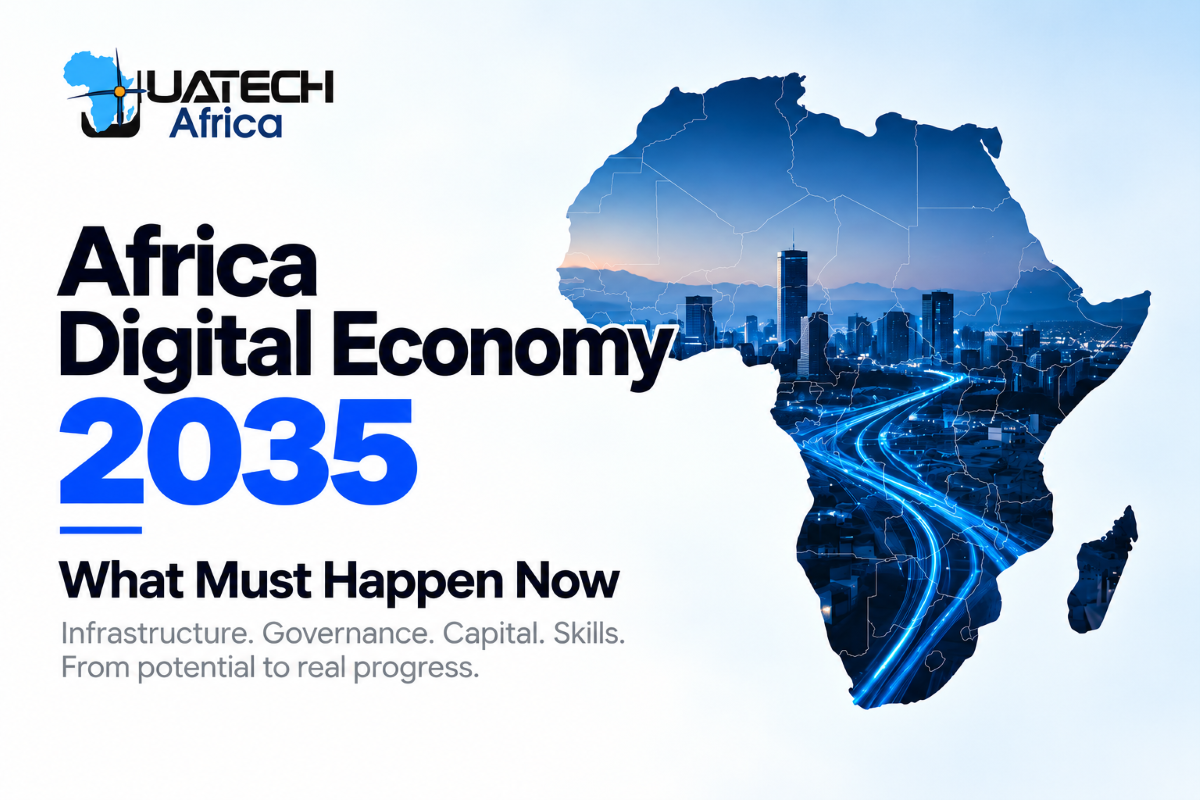
Africa’s digital economy could reach $300 billion by 2035. But infrastructure, governance, capital and human capital will determine whether that projection becomes reality.
Africa Digital Economy 2035: What Must Happen Now
Africa’s digital economy is entering a period in which the scale of the opportunity is increasingly being measured in hundreds of billions of dollars. In 2026, Public First, commissioned by Meta, estimated that Sub-Saharan Africa’s digital economy could more than double from $130 billion today to $300 billion by 2035. The projection reflects continued expansion in digital businesses, infrastructure and technology adoption across the region. It is a significant opportunity, but it is also conditional. Reaching that scale depends on whether the ecosystem develops the capacity to support it.

The African Development Bank’s December 2025 analysis adds another major figure, but measures something different. It estimates that inclusive development and deployment of artificial intelligence could generate up to $1 trillion in additional GDP for Africa by 2035, close to one-third of the continent’s current economic output. This is not a projection that Africa’s digital economy will be worth $1 trillion. It estimates the additional economic output AI could generate if adoption translates into productivity gains. One figure measures the potential scale of the digital economy; the other measures AI’s potential contribution to economic output.
Both point to the same underlying opportunity. Yet neither explains whether Africa can build the systems required to capture it. A digital economy does not expand because a projection says it will. It expands when connectivity is affordable and reliable, electricity and computing capacity can support demand, businesses can access capital, regulation provides sufficient certainty for investment, and people have the skills to build and operate increasingly complex digital systems. The projection describes the destination. The ecosystem determines whether the road exists.
That question matters even more in a difficult macroeconomic environment. On 8 April 2026, the World Bank projected Sub-Saharan Africa’s growth at 4.1% for 2026 and inflation at 4.8%, while warning that high public debt, rising debt-service costs and constrained external financing were limiting governments’ capacity to fund development priorities. This does not invalidate the digital opportunity. It makes execution more important. Africa must build the infrastructure, institutions, companies and capabilities of a more sophisticated digital economy while competing for capital under tighter financial conditions.
This creates a distinction that will shape the next decade: digital adoption is not the same as digital capacity. Africa can add connected users, devices, digital transactions and online services without necessarily developing the computing capacity, intellectual property, financial architecture and technical workforce required to capture a proportionate share of the value created. The continent can become a much larger market for digital products while remaining dependent on infrastructure, platforms, capital and technologies developed elsewhere.
The central question for Africa’s digital economy in 2035 is therefore not simply how large the market could become. It is what must be true for that scale to become economically and technologically sustainable. JuaTech Africa’s African Tech Ecosystem coverage examines that question by looking beneath the projections at the systems connecting infrastructure to capital, regulation to investment, skills to productivity, and technology adoption to economic value.
Four structural conditions sit at the centre of that test: infrastructure, governance, capital and human capital.
Where Things Actually Stand
2026 marks a shift in Africa’s digital transformation from strategy formation toward execution. For much of the past decade, governments focused on broadband plans, digital transformation frameworks, data policies, digital identity and emerging technology strategies. The African Union’s Digital Transformation Strategy for Africa 2020–2030 provided the continental framework, followed by the Continental Artificial Intelligence Strategy, endorsed in July 2024. Kenya’s National AI Strategy 2025–2030 is part of the same transition, setting priorities around infrastructure, data, skills, research and innovation, and governance. The policy architecture is becoming more substantial. The harder question is whether it is translating into functioning systems.
That distinction is fundamental. A strategy expresses intent. An ecosystem is evidence of execution. A digital identity framework matters when people can use it across services. An AI strategy matters when businesses can access the power, connectivity, data, computing capacity, capital and talent required to build and deploy AI. The same principle applies to mobile networks, fintech, cloud computing, data centres and digital commerce. These are not isolated technology markets. They are interconnected layers whose performance increasingly depends on one another.
For Africa’s digital economy to reach the scale being projected for 2035, the test is therefore no longer simply whether governments have the right ambitions. It is whether the continent can build, finance, govern and staff the systems required to turn those ambitions into productive economic capacity. That is where the ecosystem will be won or lost.
Four structural conditions sit at the centre of that test: infrastructure, governance, capital and human capital.
Pillar One: Infrastructure Is Still the Floor, Not the Ceiling
Infrastructure is the physical layer on which Africa’s digital economy depends, yet the gap between the continent’s population and its computing capacity remains substantial. The Africa Data Centres Association’s 2026 report estimates that Africa holds just 0.6% of global data-centre capacity, despite representing roughly one-fifth of the world’s population. Operational capacity stands at about 360 MW, with another 238 MW under construction and 656 MW planned. McKinsey estimates that demand across Africa’s five largest data-centre markets could rise from roughly 0.4 GW to 1.5–2.2 GW by 2030, implying billions of dollars in additional investment.
Connectivity is expanding, but bandwidth alone does not create digital capacity. Systems such as 2Africa, designed to provide up to 180 Tbps of subsea capacity, are increasing the continent’s international connectivity and lowering a critical bottleneck for cloud services, digital commerce and data-intensive applications. The next constraint is increasingly inland: fibre networks, reliable electricity, data centres and affordable access must develop alongside subsea capacity. The Africa Data Centres Association now identifies power availability as the principal constraint on data-centre expansion, overtaking connectivity.
That makes energy infrastructure inseparable from the digital-economy strategy. AI workloads intensify the requirement because high-performance computing demands substantial electricity and cooling. A data centre therefore cannot be treated simply as a technology investment. Its commercial viability depends on the reliability and cost of the power system, connectivity, land, financing and the availability of customers capable of absorbing its capacity. This is where Africa’s infrastructure challenge becomes an ecosystem challenge: building one layer without the others can leave expensive capacity underutilised.
The financing gap is equally material. The African Development Bank estimates that Africa requires $130–170 billion annually for infrastructure, with a financing shortfall of $68–108 billion a year. That requirement covers infrastructure broadly, not digital infrastructure alone, but it illustrates the capital competition facing digital projects. Energy, transport, water and telecommunications are competing for investment within the same constrained environment.
The implication for 2035 is straightforward. Africa does not merely need more fiber, data centers or subsea cables. It needs an integrated infrastructure stack in which connectivity, power, computing capacity and financing reinforce one another. Infrastructure should therefore be judged not by what is announced, but by what becomes operational, reliable, affordable and economically productive. That is the floor on which every other pillar of Africa’s digital economy must stand.
Pillar Two: Governance Has to Outgrow the Strategy Document
Africa has made meaningful progress in building digital and AI policy frameworks. The harder phase is now beginning: turning strategy into enforceable rules, capable institutions and predictable markets. Kenya’s National AI Strategy 2025–2030, for example, establishes priorities around infrastructure, data, skills, research and innovation, and governance. At the continental level, the African Union’s 2024 Continental AI Strategy calls for harmonized national approaches, stronger legal frameworks and a five-year implementation program. In May 2025, an AU high-level policy dialogue went further, calling for regular AI risk assessments, reviews of existing laws, stronger safeguards for privacy and personal data, and a continental AI governance mechanism.
The commercial significance is straightforward. Investors and technology companies do not operate on strategy documents. They operate within rules governing data, taxation, digital trade, cybersecurity, intellectual property, competition and emerging technologies. Governance becomes an economic asset when it creates predictability. A regulator that can interpret rules consistently, resolve disputes and enforce them gives businesses greater confidence to invest. A policy framework without the institutional capacity to implement it does considerably less.
The cross-border problem is even more consequential. Africa’s digital economy cannot reach continental scale if data, payments, digital identities and digital services encounter incompatible rules at every border. The AfCFTA Digital Trade Protocol seeks to address this problem precisely through harmonized rules, common standards, interoperability and a common legal framework for digital trade. In 2025, the AU also issued guidelines for integrating data provisions into digital-trade protocols, with the explicit objective of strengthening coherent data governance across African markets.
This is why governance should be measured differently by 2035. The question is no longer how many strategies governments have published. It is whether those strategies produce predictable regulation, capable enforcement, and interoperable markets. Smart Africa’s expansion to 42 member states by March 2026 shows that continental coordination is advancing, but it still must translate into national implementation and commercially usable systems.
What must happen: regulators need technical personnel, sustainable budgets and measurable implementation mandates. Governments need to align national rules where fragmentation directly raises the cost of digital business, particularly around data, digital trade, cybersecurity and AI. The AU can establish continental direction, but national institutions ultimately determine whether those rules work in practice.
For investors, this is not administrative detail. Regulatory capacity is part of market infrastructure. Countries that can provide clear rules, credible enforcement and interoperable digital systems will be better positioned to attract capital, scale technology companies and capture more value from the digital economy. Those that cannot risk turning policy ambition into another layer of friction.
Pillar Three: Capital Formation Is the Binding Constraint
Africa’s central financing problem is not simply a shortage of capital. It is converting capital into productive, long-duration investment. The African Development Bank estimates that the continent requires $130–170 billion annually for infrastructure, leaving a financing gap of $68–108 billion a year. Yet Africa has domestic financial resources. The OECD estimates that African institutional investors hold approximately $1.1 trillion in assets, including about $455 billion in pension funds. The AfDB puts the broader pool of domestic savings and assets across banks, pension funds, insurers and sovereign wealth funds at more than $4 trillion. The paradox is clear: substantial pools of African capital exist alongside enormous unmet investment needs.
Technology financing shows the same imbalance at a different scale. Partech recorded $4.1 billion in African technology funding in 2025, up 25% from 2024, with debt accounting for a record $1.64 billion. Yet funding remains highly concentrated. Kenya, South Africa, Egypt and Nigeria captured the majority of capital, while early-stage financing remained under pressure. The market is recovering, but recovery is not the same as depth. Africa needs capital that can finance infrastructure, growth-stage companies and productive assets over long time horizons, not only capital that follows the most investable markets and strongest existing businesses.
This matters because the other three pillars require sustained financing. Data centres need power and fibre before they can generate returns. Regulators need technical capacity and institutional budgets. Skills systems require investment long after a training programme is announced. External development finance remains important, but a digital economy built predominantly around foreign capital remains exposed to exchange-rate movements, global interest rates and changes in investor risk appetite. The strategic objective should therefore be capital formation, not simply capital attraction.
That means making more domestic institutional capital investable in productive assets while improving project preparation, risk-sharing, local capital markets and bankable infrastructure pipelines. It does not mean forcing pension funds into unsuitable projects. It means creating investment structures in which institutional investors can price risk, earn appropriate returns and invest at scale. The AfDB has explicitly identified domestic savings and institutional capital as a major opportunity for financing Africa’s transformation.
The test for 2035 is therefore not how much foreign capital Africa can attract. It is whether Africa can mobilise, intermediate and recycle more of its own capital into productive capacity. If the continent succeeds, infrastructure, technology companies and human capital can compound together. If it does not, every other pillar remains vulnerable to financing cycles determined elsewhere. Africa’s digital economy will ultimately be shaped not only by how much capital enters the continent, but by how much productive capital the continent learns to create and deploy itself.
Pillar Four: The Skills Gap Is Wider Than the Optimism Admits
Africa’s demographic growth is often presented as its greatest digital-economy advantage. Every year, 10–12 million young Africans enter the workforce, while only about three million formal jobs are created. The opportunity is enormous, but demographics become an economic asset only when people possess the skills that productive employers need. The World Bank has found that only 11% of Africa’s tertiary education graduates have formal digital training, while more than 230 million jobs across Sub-Saharan Africa are expected to require digital skills by 2030. The gap is therefore not simply about creating more jobs. It is about building a workforce capable of filling them.
The pressure is becoming more specialised as digital infrastructure expands. The World Economic Forum’s Global Cybersecurity Outlook 2026 found that 63% of organisations in Sub-Saharan Africa reported lacking the critical people and skills needed to meet their cybersecurity objectives. That is a particularly important signal because cybersecurity capability must grow alongside connectivity, cloud adoption, digital payments and AI. A continent that digitises faster than it develops the people capable of securing those systems creates a structural vulnerability inside its own digital expansion.
AI makes the skills equation more complicated. The WEF’s Future of Jobs Report 2025 found that 77% of surveyed employers globally expect to upskill workers in response to AI, while 41% expect to reduce their workforce as automation changes the tasks people perform. The same report identifies AI and big data, networks and cybersecurity, technological literacy, analytical thinking and other human capabilities among the skills gaining importance. The implication for Africa is significant: AI literacy alone will not be enough. Workers need the judgement to use these systems, evaluate their outputs and understand when they are wrong.
The response cannot remain dependent on short-term training programmes. Digital capability has to move deeper into schools, universities, vocational education and workplace training, with curricula connected to actual labour-market demand. Africa also needs stronger pathways from education into employment, including apprenticeships, industry certification and practical experience. Otherwise AI may raise the productivity ceiling for already-skilled workers while removing some of the entry-level tasks through which inexperienced workers traditionally gained experience.
The test for 2035 is therefore not whether Africa has a young population. It is whether that population can become a productive digital workforce. The demographic dividend will not arrive automatically. It has to be built through education, skills, jobs and continuous reskilling. Africa’s greatest digital asset is not the size of its future workforce. It is the capability that workforce develops.
The Position
Africa’s digital opportunity is real. But the outcome will depend less on the ambition of the projections than on the strength of the systems built underneath them. Infrastructure provides capacity. Governance provides predictability. Capital provides scale. Human capital provides capability. None is sufficient alone. Their economic value emerges when they reinforce one another.
Africa does not lack digital ambition. It has continental strategies, national AI frameworks, expanding fiber and subsea networks, growing data-center markets, technology companies and substantial pools of domestic savings. The harder task is converting these assets into productive, scalable and locally durable capacity. A cable is not an ecosystem. A strategy is not implementation. A funding round is not capital formation. A young population is not automatically a digital workforce.
That is why the $300 billion digital-economy projection for 2035 should be treated as an opportunity to be earned, not an outcome already secured. Its credibility will be built progressively through infrastructure that becomes operational, regulation that becomes enforceable, capital that becomes productive and skills that become economically valuable.
For investors, the opportunity is to identify where those conditions are converging. For governments, it is to build the environment in which productive investment can compound. For African companies, it is to shift from consuming imported technology to building, owning, and exporting digital capability.
And for JuaTech Africa, the question worth tracking is not simply what Africa announces, but what it builds; not simply what is projected, but what the underlying system can support; and ultimately, whether today’s digital ambition survives contact with 2035.
Continue the Ecosystem Intelligence
Africa’s digital economy will not be shaped by one technology, one company or one policy decision. It will emerge from the interaction between infrastructure, capital, regulation, companies, platforms and the people building and using them. That is why this analysis is part of JuaTech Africa’s broader Ecosystem Intelligence coverage.
If this article helped you understand what must happen for Africa’s digital economy to reach its 2035 potential, the next question is where those conditions are already changing.
Explore our continuing coverage of the African Tech Ecosystem for analysis of the companies, technologies, infrastructure projects, investment flows, policies and market shifts shaping that transition. Follow the links below to move from the macro picture into the specific systems and players behind it.
Go deeper
- African Tech Ecosystem: Follow the companies, platforms, infrastructure and technologies shaping Africa’s digital economy.
- Market Intelligence: Understand the numbers behind market growth, investment, adoption and competition.
- Analytica: Read deeper investigations into the structural forces reshaping technology and its economics.
- Tech Decoded: Build the technical context behind the technologies changing African markets.
- JuaTech Africa Newsletter: Receive our most important analysis, intelligence and market developments directly in your inbox.
- JuaTech Africa WhatsApp: Get selected intelligence and important developments directly on WhatsApp.
Have a view? Add to the intelligence.
What do you think will determine whether Africa reaches its $300 billion digital-economy potential by 2035? Infrastructure? Capital? Regulation? Skills? Or something this analysis has missed? Share your perspective with JuaTech Africa. The strongest observations, experiences and market intelligence from our readers help us understand what is happening beyond the headlines.
[Join the Newsletter] [Join JuaTech Africa on WhatsApp]
Sources & Methodology
This analysis draws on publicly available research, institutional data, policy documents and industry reports available as of September 2026. JuaTech Africa distinguishes between reported data, institutional projections and its own analytical interpretation. Projections are presented as conditional scenarios rather than guaranteed outcomes, and figures from different sources are not treated as directly interchangeable where they measure different aspects of Africa’s digital economy. Where older institutional estimates remain relevant, their original publication period is retained rather than presented as a new 2026 estimate.
Sources
1. Public First, commissioned by Meta | 2026
Meta & SSA: Accelerating Digital Transformation
Used for the $130 billion to $300 billion Sub-Saharan African digital-economy projection and analysis of connectivity, digital infrastructure and the economic value associated with expanded digital adoption.
2. African Development Bank | December 2025
Africa’s AI Productivity Gain: Pathways to Labour Efficiency, Economic Growth and Inclusive Transformation
Used for the estimate that inclusive AI development and deployment could generate up to $1 trillion in additional GDP by 2035. The figure is treated as a potential economic impact under specified conditions, not as a forecast of the size of Africa’s digital economy.
3. World Bank | 8 April 2026
Sub-Saharan Africa’s Growth Holds, But Downside Risks Mount
Used for the 4.1% 2026 growth projection and analysis of debt-service pressures, financial conditions, fiscal constraints and structural risks affecting the region’s development capacity.
4. African Union | 2020
Digital Transformation Strategy for Africa 2020–2030
Used as the continental policy foundation for the discussion of Africa’s digital transformation agenda and the shift from strategy development toward implementation.
5. African Union | 2024
Continental Artificial Intelligence Strategy
Used for the continental AI policy framework and its priorities around infrastructure, data, skills, research, investment, governance and responsible AI development.
6. Government of Kenya, Ministry of Information, Communications and the Digital Economy | 2025
Kenya Artificial Intelligence Strategy 2025–2030 and Implementation Roadmap
Used for Kenya’s national AI priorities and the discussion of implementation capacity, institutional coordination and policy execution.
7. African Union / AfCFTA
Protocol on Digital Trade under the African Continental Free Trade Area
Used for the discussion of harmonised rules, common standards and interoperability required to support continental digital trade.
8. African Union | 2025
African Guidelines on Integrating Data Provisions in Digital Trade Protocols
Used for the discussion of data-governance harmonisation and cross-border digital trade.
9. Smart Africa | 2026
Smart Africa Alliance Membership and Institutional Updates
Used for the discussion of continental digital cooperation and the scale of Smart Africa’s participating member states.
10. Africa Data Centres Association | February 2026
Data Centres in Africa 2026: The Economic Report
Used for Africa’s 0.6% share of global data-centre capacity, reported data-centre capacity and the infrastructure and power constraints affecting further expansion.
11. African Development Bank / Infrastructure Consortium for Africa
Africa Infrastructure Financing Estimates
Used for the established estimate that Africa requires approximately $130–170 billion annually for infrastructure, with an estimated $68–108 billion annual financing gap. These figures pre-date 2026 and are presented as an established structural estimate rather than a new 2026 calculation.
12. McKinsey & Company | 2024
The rise of AI and the data centre opportunity in Africa
Used for the analysis of African data-centre demand, including projections of approximately 1.5–2.2 GW of demand by 2030 from a base of roughly 0.4 GW, and the associated infrastructure investment requirement.
13. OECD | 2025
Africa Capital Markets Report 2025
Used for the analysis of African institutional capital markets, including approximately $455 billion in pension-fund assets and approximately $320 billion held by insurance companies, alongside the structural constraints affecting institutional investment.
14. African Development Bank | 2026
African domestic savings and investment analysis
Used for the broader discussion of Africa’s domestic savings and asset base and the challenge of converting available domestic capital into productive long-term investment.
15. Partech | January 2026
2025 Africa Tech Venture Capital Report
Used for the $4.1 billion in combined African technology equity and debt financing recorded in 2025, the reported year-on-year growth and the changing role of debt in African technology financing.
16. World Bank / IFC
Demand for Digital Skills in Sub-Saharan Africa
Used for the analysis of digital-skills demand and the estimate that more than 230 million jobs in the region will require digital skills by 2030.
17. World Economic Forum | 2025–2026
Future of Jobs Report 2025 and Global Cybersecurity Outlook 2026
Used for the analysis of AI-driven workforce transformation, employer expectations around upskilling and workforce reduction, and cybersecurity skills capacity in Sub-Saharan Africa.
How JuaTech Africa Uses These Sources
The sources above provide the evidence base for this analysis. JuaTech Africa contributes by interpreting and synthesizing those findings into a broader assessment of Africa’s digital ecosystem.
The article distinguishes between three forms of evidence:
Reported data: measurements and findings published by the cited institution.
Institutional projections: estimates, forecasts or scenarios produced by research organizations, governments and development institutions.
JuaTech Africa analysis: interpretation, synthesis and conclusions drawn from the available evidence.
This distinction is deliberate. A projection is not presented as a fact, an institutional estimate is not presented as a JuaTech Africa forecast, and analytical conclusions represent JuaTech Africa’s interpretation of the evidence.