

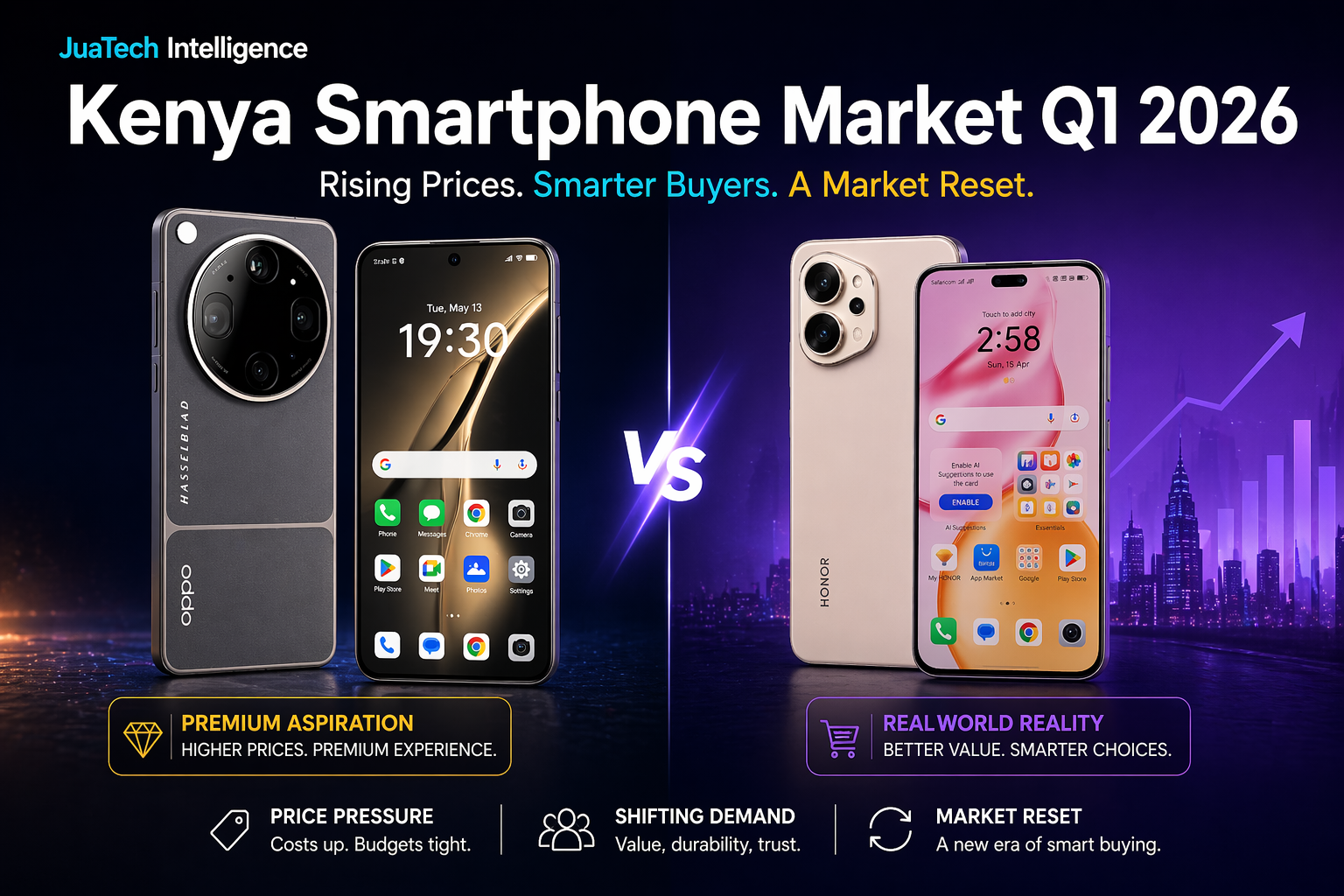
A deep market intelligence breakdown of how rising costs, supply constraints, and changing consumer behavior are reshaping Kenya’s smartphone industry.
Executive Summary

The Kenyan smartphone market in Q1 2026 is defined by pressure, adaptation, and selective demand. Rising production costs, currency depreciation, and supply constraints have pushed device prices upward across all segments, while consumer purchasing power has remained constrained. As a result, demand remains active but increasingly cautious, with buyers prioritizing value, reliability, and long-term usability over rapid upgrades.
Market dynamics show a clear structural shift. Unit movement has slowed, but average selling prices have increased, sustaining overall market value. Consumer behavior has evolved toward more deliberate decision-making, with extended upgrade cycles and heightened sensitivity to pricing and perceived value.
Key insights shaping the market:
- Demand remains present but highly price-sensitive and delayed
- The mid-range segment (KES 20,000 to 40,000) defines competition and revenue
- Brand perception increasingly outweighs marginal differences in specifications
This is not a decline in market activity. It is a transition toward a more disciplined, value-driven ecosystem where pricing, availability, and trust determine outcomes.
Why Smartphones Are Getting More Expensive in Kenya
Smartphone pricing in Kenya in Q1 2026 is being driven by a convergence of global cost pressures and local economic realities, creating sustained upward movement across all price segments. At the production level, manufacturers are facing higher input costs, particularly in memory (DRAM and NAND), advanced chipsets, and device assembly. These increases are not marginal. Industry estimates indicate bill-of-material costs have risen by 15 to 25% year-on-year, forcing brands to adjust pricing across their portfolios.
At the same time, currency pressure is amplifying these increases locally. The Kenyan Shilling’s continued weakness against the US Dollar means that import costs have risen significantly, even where global pricing has remained stable. Distributors are now pricing in exchange rate volatility, and retailers are passing these costs directly to consumers, further stretching affordability.
Logistics and supply chain disruptions compound the situation. Higher fuel costs, increased shipping insurance, and longer transit times are raising the landed cost of every device entering the country. For an import-dependent market like Kenya, these pressures are structural and unavoidable.
The impact is clearly visible in retail pricing. Devices that retailed at KES 28,000 to 30,000 in 2024 now sit at KES 34,000 to 40,000, while entry-level smartphones have shifted from below KES 15,000 to KES 18,000 to 22,000. This is not a temporary spike. It reflects a structural reset in how smartphones are priced and accessed in Kenya.
Get the Full Kenya Smartphone Market Intelligence Report (Q1 2026)
Market Reality: Demand Is Strong but Cautious
The Kenyan smartphone market in Q1 2026 reflects a clear shift from the pricing pressures outlined earlier. While demand remains present, the pace of transactions has slowed across key segments as rising costs begin to influence purchasing behavior. Retail channels are reporting reduced unit movement, particularly in entry-level and lower mid-range devices, where price sensitivity is highest, and affordability constraints are most visible.
At the same time, average selling prices (ASP) are increasing across the market. Fewer devices are being sold at higher price points, allowing the overall market value to remain relatively stable despite softer volumes. This indicates a structural change in how revenue is generated, with greater reliance on higher-value transactions rather than mass-market volume.
Consumer behavior has also evolved in response. Buyers are more deliberate, spending more time comparing devices, evaluating trade-offs, and prioritizing long-term usability over short-term features. Impulse purchases have declined, replaced by more calculated decisions shaped by constrained budgets and a stronger focus on value.
The Mid-Range War (KES 20K–40K)
The KES 20,000 to 40,000 segment is the most competitive and commercially decisive part of Kenya’s smartphone market. It captures the widest base of buyers while carrying the highest expectations around performance, reliability, and long-term value. In Q1 2026, competition in this segment is no longer defined by specifications alone, but by how effectively brands align price, experience, and trust within increasingly constrained budgets.
Samsung
Samsung’s strategy in the mid-range is built on trust, software consistency, and long-term usability. Its Galaxy A-series devices are positioned as stable, reliable, and supported over time, which allows the brand to sustain slightly higher pricing within the segment. It wins by reducing perceived risk, appealing to buyers who prioritize durability, updates, and a consistent user experience over aggressive hardware positioning.
Transsion (Tecno, Infinix, Itel)
Transsion competes through price-to-spec optimization and deep market accessibility. Its devices maximize visible value, combining large batteries, high-refresh displays, and high-resolution cameras at competitive price points. Backed by strong distribution, it maintains consistent availability across channels. It wins by aligning closely with real purchasing power and delivering immediate, tangible value at scale.
Xiaomi
Xiaomi positions itself on performance efficiency and technical credibility. Its devices target informed buyers who evaluate smartphones based on chipset capability, display quality, and overall performance balance. Pricing is aggressive relative to hardware, often undercutting competitors within the same band. It wins by appealing to comparison-driven consumers seeking the strongest performance per shilling.
This is just one layer of the market shift.
The full report breaks down what is driving these changes and what they mean for pricing, positioning, and strategy.
👉 https://juatechafrica.com/product/kenya-smartphone-market-report-q1-2026/
The Affordability Crisis
The Kenyan smartphone market in Q1 2026 is defined by a widening gap between device prices and consumer incomes. As outlined earlier, smartphones are moving into higher price bands, but purchasing power has not kept pace. A mid-range device priced between KES 30,000 and 40,000 now represents a significant financial commitment for most buyers, shifting the purchase from convenience to calculated investment.
This challenge is compounded by limited access to structured financing. Unlike more mature markets where installment plans are widely available, most consumers in Kenya must pay upfront. This restricts access to higher-value devices and delays upgrade decisions, even where demand exists.
As a result, upgrade cycles are extending. Many users are now holding onto devices for 3 to 5 years, prioritizing durability and long-term usability over frequent replacements.
Consumer response to these pressures is clear and measurable:
- Delaying smartphone upgrades until absolutely necessary
- Prioritizing battery life, durability, and reliability over new features
- Increasing reliance on refurbished and grey market devices
- Becoming highly sensitive to pricing, discounts, and promotions
This is not a decline in demand. It is a recalibration of how and when consumers can afford to participate in the market.
Supply Chain & Availability Shift
The Kenyan smartphone market in Q1 2026 is no longer defined only by pricing, but increasingly by access. Supply chain pressures are reshaping how and when devices reach the market, creating a disconnect between global launches and local availability. Many smartphones are announced internationally, yet arrive in Kenya weeks or even months later, reducing momentum and limiting early demand capture.
This delay is driven by allocation priorities. Manufacturers are directing initial inventory to higher-margin markets in Asia, Europe, and North America, where pricing stability and purchasing power are stronger. As a result, Kenya operates as a secondary allocation market, receiving stock after primary regions have been served.
Even when devices reach the market, availability is inconsistent. Retail channels are experiencing rapid sell-through followed by extended restocking gaps, particularly in high-demand mid-range models. This creates uncertainty for both retailers and consumers, often forcing purchase decisions based on what is available rather than what is preferred.
Availability is now a competitive advantage. Brands that maintain a consistent supply across key price segments are gaining visibility, trust, and ultimately, market share.
The Rise of the Grey Market
The Kenyan smartphone market in Q1 2026 is increasingly defined by a dual-channel reality. As pricing pressure intensifies and availability remains inconsistent, the grey market has evolved from a peripheral alternative into a functional extension of how devices are accessed. Consumers are not shifting channels out of preference, but out of necessity shaped by cost and timing.
Official Market
The official channel is structured around pricing integrity, warranty coverage, and after-sales support. Devices move through authorized distributors and retailers, backed by manufacturer service networks that provide reliability and long-term assurance. However, this structure carries layered costs, including import duties, currency adjustments, logistics, and channel margins. These factors collectively elevate retail pricing, particularly in the mid-range and premium segments, where affordability is already under pressure.
Grey Market
The grey market operates through parallel imports, offering genuine devices at lower prices by bypassing parts of the formal distribution chain. Price differences typically range between KES 3,000 and 6,000, creating a clear and immediate financial incentive. For many consumers, the appeal is twofold: reduced upfront cost and faster access to devices that may be delayed or unavailable through official retail channels.
The trade-off lies in post-purchase certainty. Warranty coverage can be limited, after-sales support may be inconsistent, and product verification is not always guaranteed.
This shift is structural, not temporary. It reflects a market adjusting to gaps in pricing, availability, and speed within the formal ecosystem.
Get the Full Kenya Smartphone Market Intelligence Report (Q1 2026)
Technology Reality Check (AI, Chipsets, Cameras)
In Q1 2026, smartphone positioning in Kenya is heavily influenced by how technology is marketed, but the gap between advertised capability and real-world experience remains significant. Across the mid-range segment in particular, features such as AI enhancements, high-performance chipsets, and high-resolution cameras are used to differentiate devices, yet their practical impact is often more limited than presented.
Artificial intelligence has become a central theme in product messaging, with claims around smarter photography, better battery optimization, and enhanced performance. In reality, most implementations remain incremental. They improve specific functions such as scene detection or background processing, but do not fundamentally change how users interact with their devices on a daily basis.
A similar gap exists with chipset performance. Benchmark scores and processor branding are widely used to signal superiority, yet for most users, everyday tasks such as messaging, streaming, and browsing show minimal difference across devices. Long-term consistency, thermal management, and software optimization matter more than peak performance metrics.
Camera systems reflect the same pattern. Higher megapixel counts create a perception of better quality, but real output depends on sensor quality, image processing, and software tuning rather than resolution alone.
| Marketed | Reality |
| AI-powered features | Mostly incremental improvements |
| High benchmark scores | Limited impact on daily use |
| 100MP+ cameras | Image quality depends on processing, not resolution |
This gap reinforces a critical shift. Specifications may drive attention, but real-world experience determines value.
Consumer Behavior & Awareness Gap
The Kenyan smartphone market in Q1 2026 is not limited by access to information, but by the ability to interpret it. Consumers are exposed to an increasing volume of content across social platforms, retail environments, and online reviews. However, this abundance has created an imbalance where information is available, but understanding remains limited.
Short-form platforms such as TikTok and Instagram Reels play a significant role in shaping perception. They drive awareness quickly and visually highlight features, but often lack depth and context. At the point of purchase, retail influence becomes decisive, where recommendations are shaped by stock availability and sales priorities rather than purely by user needs.
This environment reinforces a pattern of misinterpretation. Specifications such as megapixel count, processor names, and AI branding are often treated as direct indicators of quality, even when they do not reflect real-world performance. As a result, purchase decisions appear informed but are not always aligned with actual usage requirements.
The biggest issue is not price—it is understanding value.
This gap between information and interpretation continues to shape satisfaction, upgrade decisions, and long-term trust in the market.
Brand Perception vs Market Reality
In Kenya’s smartphone market, perception is not a secondary factor. It is a primary decision filter. As prices rise and product specifications become harder to interpret, consumers increasingly rely on brand associations to simplify choices and reduce risk.
Samsung is positioned around trust and reliability. Its devices are widely perceived as stable, well-supported, and durable. This perception allows Samsung to maintain pricing power, particularly in the mid-range, where buyers are making more deliberate, long-term decisions. Consumers choose Samsung not necessarily for the strongest specifications, but for confidence in consistent performance and support.
Transsion, through Tecno, Infinix, and Itel, is defined by accessibility and affordability. Its strength lies in aligning closely with local purchasing power while maintaining strong distribution. Consumers choose Transsion because it offers immediate value and availability, making it the most practical option for a large portion of the market.
Xiaomi occupies the space of performance and technical value. It appeals to more informed buyers who prioritize chipset capability and overall efficiency within a given price range. Consumers choose Xiaomi when they are actively comparing options and seeking the best performance per shilling.
Brand choice in Kenya is not just about preference. It is about reducing uncertainty in a complex market.
What’s Actually Selling in Kenya (Q1 2026)
Sales performance in Q1 2026 reflects a market driven by pricing discipline, availability, and perceived value rather than raw innovation. The devices leading in sales are not the most advanced, but those that align closely with how Kenyans buy, use, and justify their smartphones.
The Samsung Galaxy A56 leads through consistency, combining reliability, software stability, and strong brand trust, making it a safe long-term choice. The Infinix Note 60 Series continues to drive volume by delivering visible value at competitive pricing, appealing to a broad, price-conscious audience. The Samsung Galaxy A36 5G offers a strong, accessible upgrade path, thanks to its familiarity and balanced positioning.
The Redmi Note 15 Series attracts more informed buyers seeking performance efficiency within a defined budget. At the entry level, the Tecno Spark Series remains critical, enabling access for first-time users and highly price-sensitive segments.
These devices succeed because they reflect the realities of the market, where value, trust, and availability define what sells.
Market Outlook (2026–2028)
The Kenyan smartphone market is entering a phase defined by precision rather than expansion. The structural pressures outlined across pricing, supply, and consumer behavior will continue to shape how the market evolves over the next two to three years.
- Premium influence will expand beyond volume:
High-end devices will remain low in unit share but will increasingly shape expectations across all segments. Design, software experience, and ecosystem value introduced at the top will continue to cascade into the mid-range.
- Mid-range pressure will intensify:
The KES 20,000 to 40,000 segment will remain the core battleground, with tighter pricing bands, higher expectations, and reduced margin flexibility for brands competing on value.
- AI will become standard, not a differentiator:
Artificial intelligence features will be embedded across devices, but their presence alone will no longer drive purchasing decisions. Practical application and real-world usefulness will determine relevance.
- Pricing pressure will persist:
Global production costs, currency dynamics, and supply constraints will continue to sustain higher price levels, limiting any meaningful return to previous affordability thresholds.
The market will reward brands that align pricing, availability, and real-world value with the realities of consumer demand.
Strategic Conclusion: The New Rules of Kenya’s Smartphone Market
The Kenyan smartphone market in Q1 2026 is no longer defined by rapid growth or aggressive expansion. It is shaped by pressure across pricing, supply, and consumer decision-making. Buyers are more cautious, brands are more constrained, and competition is increasingly concentrated in fewer, more critical segments.
Across the market, a consistent pattern has emerged. Devices that succeed are not those with the most advanced specifications, but those that deliver clear, practical value within real financial limits. At the same time, availability and brand perception have become as important as pricing in influencing purchase decisions.
This shift marks a transition toward a more disciplined and selective market environment, where execution matters more than positioning alone.
This market will be won by those who align price, value, availability, and trust.
Make Smarter Smartphone Decisions in 2026
Explore in-depth reviews, practical buying guides, and real-world comparisons on JuaTech Africa. Cut through the noise, understand how devices actually perform, and choose a smartphone that aligns with your needs, budget, and long-term value.
Get the Full Report
If you want a complete understanding of where the Kenya smartphone market is headed and how to act on it, access the full intelligence report.
This goes beyond surface trends to explain what is driving demand, where value is shifting, and what it means for your decisions.
Get the Full Kenya Smartphone Market Intelligence Report (Q1 2026)