

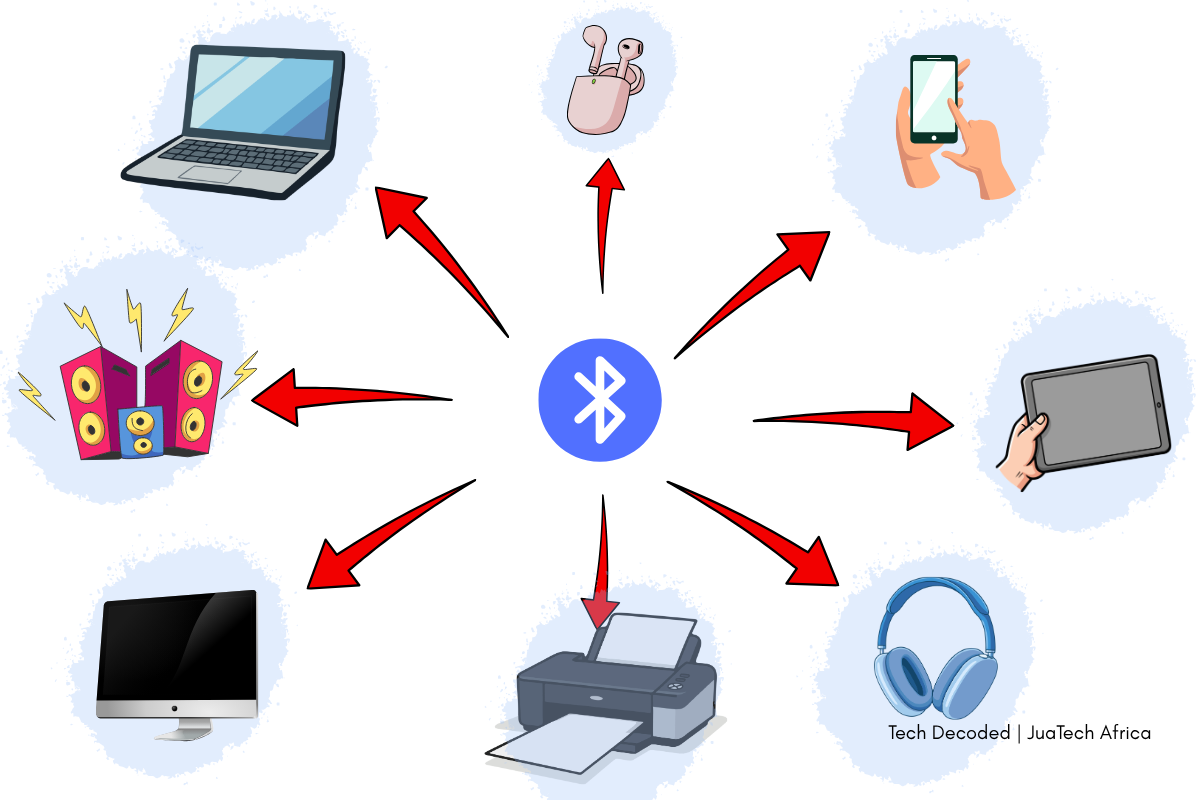
Bluetooth sits at the center of how your devices communicate. It powers your earbuds, smartwatch, car audio, keyboard, and a growing number of smart home devices. Yet most users only see a version number and move on.
That version number matters.

If you use a modern phone like the Samsung Galaxy S25 Ultra or premium earbuds like the Apple AirPods Pro (2nd generation), your daily experience is shaped by Bluetooth 5 and later. Understanding the differences between Bluetooth 4, 5, and 6 helps you choose better devices, fix common issues, and avoid paying for features you will not benefit from.
This is a focused, practical breakdown built for real use.
What is Bluetooth?
Bluetooth is a short-range wireless standard that connects devices and allows them to exchange data using low-power radio signals. Its design priorities are simple: reliability, low energy use, and ease of pairing.
In practical terms, Bluetooth enables:
- Wireless audio streaming
- Device control such as keyboards and gamepads
- Data syncing for wearables
- Smart device communication in homes and cars
The version your device uses determines how well these tasks are handled.
How Bluetooth Works
Bluetooth creates a secure, low-power link between two or more devices. One device broadcasts a signal, another discovers it, and after pairing, they exchange data in small packets over a shared frequency band.
Two concepts define the experience:
- Classic Bluetooth for continuous data like audio
- Bluetooth Low Energy (BLE) for low-power tasks like fitness tracking
Modern versions combine both efficiently, balancing performance and battery life without user intervention.
Bluetooth Key Terms Explained (Complete Glossary)
Bluetooth is often explained through version numbers, but the real understanding comes from the terms behind how it works. Concepts like codecs, latency, profiles, and low energy are what actually determine your experience, from audio quality to connection stability and battery life.
This glossary breaks down the most important Bluetooth terms in clear, practical language. It is designed to help you move beyond basic usage and understand what is happening when you connect devices, troubleshoot issues, or choose between products.
If you have ever wondered why some earbuds sound better, why connections drop, or what features like LE Audio and aptX actually do, this section gives you the answers in a way that is easy to follow and useful in real-world decisions.
| Term | Meaning | Why It Matters |
| Bluetooth | A short-range wireless technology for connecting devices | Powers wireless audio, wearables, and device communication |
| Bluetooth Version (4, 5, 6) | The generation of Bluetooth technology | Determines speed, range, efficiency, and features |
| BLE (Bluetooth Low Energy) | A power-efficient version of Bluetooth | Enables long battery life in wearables and IoT devices |
| Classic Bluetooth | Standard Bluetooth used for continuous data like audio | Used in headphones, speakers, and car systems |
| Pairing | The process of connecting two Bluetooth devices | First step to establish a secure connection |
| Range | Maximum distance between connected devices | Affects signal strength and connection stability |
| Latency | Delay between sending and receiving data | Critical for gaming, video calls, and audio sync |
| Bandwidth | Amount of data transmitted per second | Impacts audio quality and transfer speed |
| Throughput | Actual usable data transfer rate | Determines real-world performance |
| Codec | Audio compression format used over Bluetooth | Directly affects sound quality and efficiency |
| SBC | Default Bluetooth audio codec | Universal but lower quality compared to newer codecs |
| AAC | Advanced Audio Codec used by Apple devices | Better quality than SBC, optimized for iPhones |
| aptX | Qualcomm audio codec for improved sound | Lower latency and better quality on supported devices |
| aptX HD | Enhanced version of aptX | Higher resolution audio support |
| aptX Adaptive | Dynamic codec that adjusts based on conditions | Balances quality, latency, and stability |
| LDAC | High-resolution audio codec by Sony | Delivers near wired-quality audio |
| LE Audio | New Bluetooth audio standard (5.2+) | Improves efficiency and enables new features |
| LC3 Codec | New codec used in LE Audio | Better sound quality at lower bitrates |
| Dual Audio | Ability to connect two audio devices simultaneously | Useful for sharing audio with another user |
| Multipoint | Connect one device to multiple sources | Switch between phone and laptop seamlessly |
| Broadcast Audio | Send audio to multiple devices at once | Enables public audio sharing and group listening |
| Channel Sounding | Bluetooth 6 feature for precise distance measurement | Enables accurate tracking and positioning |
| Direction Finding | Ability to detect signal direction (Bluetooth 5.1) | Improves location tracking and navigation |
| RSSI (Signal Strength) | Measures strength of Bluetooth signal | Affects connection stability and range |
| Interference | Signal disruption from other devices or networks | Causes dropouts and unstable connections |
| Frequency Band | Bluetooth operates at 2.4 GHz | Shared with Wi-Fi, leading to possible interference |
| Pairing Mode | State where device is discoverable | Required to connect new devices |
| Discoverability | Ability for devices to be found by others | Important during setup |
| Profiles | Predefined Bluetooth use cases (e.g., audio, file transfer) | Determines what a connection can do |
| A2DP | Audio streaming profile | Enables music playback over Bluetooth |
| HFP (Hands-Free Profile) | Used for calls and voice communication | Powers Bluetooth calling in cars and headsets |
| AVRCP | Remote control profile | Allows play, pause, skip functions |
| HID | Human Interface Device profile | Used for keyboards, mice, controllers |
| GATT | Protocol for BLE communication | Used in wearables and health devices |
| L2CAP | Data transport protocol | Handles data transmission between devices |
| PHY | Physical layer defining speed and range | Affects performance characteristics |
| Advertising (BLE) | Broadcasting small packets of data | Used in beacons and tracking devices |
| Beacon | Bluetooth device that transmits signals for location | Used in retail, navigation, and tracking |
| Mesh Networking | Devices connected in a network topology | Used in smart home systems |
| Connection Interval | Frequency of communication between devices | Impacts power consumption and responsiveness |
| Packet | Unit of data transmitted over Bluetooth | Smaller packets improve efficiency |
| Encryption | Security mechanism for data transmission | Protects against unauthorized access |
| Authentication | Verifies identity of connected devices | Prevents spoofing and attacks |
| Firmware | Software controlling Bluetooth hardware | Updates can improve performance and features |
| Backward Compatibility | Ability to connect with older versions | Ensures broad device compatibility |
| Multi-Link Operation (future integration) | Simultaneous connections across channels | Improves stability and speed in advanced use |
| IoT (Internet of Things) | Network of connected smart devices | Bluetooth is a key enabler for IoT ecosystems |
Bluetooth 4: Efficiency First
Bluetooth 4 introduced Bluetooth Low Energy, enabling always-connected devices. This is what enabled the rise of fitness bands, smartwatches, and IoT sensors. Devices could stay connected for days or weeks without draining battery.
What you get with Bluetooth 4:
- Excellent battery efficiency
- Stable connections for basic use
- Limited range and slower data speeds
Where it falls short today:
- Weaker performance in crowded environments
- Less stable audio for modern wireless earbuds
- Limited support for advanced audio features
Verdict: Reliable for simple devices, but no longer ideal for premium audio or high-demand use.
Bluetooth 5: The Real Upgrade
Bluetooth 5 transformed the user experience by improving the three things that matter most: range, speed, and stability.
Core improvements:
- Up to four times the range
- Up to twice the data speed
- Stronger, more reliable connections
This translates directly into fewer dropouts, better performance through walls, and more consistent audio in real environments.
Key upgrades within Bluetooth 5:
Bluetooth 5.1
Introduced direction finding, enabling devices to detect signal direction. This improves location-based features and tracking accuracy.
Bluetooth 5.2
Introduced LE Audio, one of the most important upgrades in years.
LE Audio enables:
- Higher quality sound at lower power
- Better synchronization between earbuds
- Audio sharing to multiple devices
Bluetooth 5.3
Focused on efficiency and interference management, improving stability in crowded wireless environments.
Verdict: Bluetooth 5.2 and above is the current sweet spot. It delivers the best balance of performance, efficiency, and real-world reliability.
Bluetooth 6: Precision and Responsiveness
Bluetooth 6 shifts focus from general connectivity to precision and control. The defining feature is Channel Sounding, which enables highly accurate distance measurement between devices.
What this means in practice:
- Precise item tracking beyond simple proximity
- Improved indoor navigation
- Smarter automation based on exact device location
Bluetooth 6 also improves latency handling, making connections more responsive. This matters for gaming, voice assistants, and real-time interactions.
Verdict: Bluetooth 6 is forward-looking. Its benefits will become clearer as more devices adopt it.
Bluetooth 4 vs 5 vs 6: What Actually Changes
| Feature | Bluetooth 4 | Bluetooth 5 | Bluetooth 6 |
| Range | Short | Significantly longer | Optimized with precision |
| Speed | Basic | Faster | More efficient |
| Audio | Standard | LE Audio support | Improved stability |
| Power Use | Low | Lower | Optimized further |
| Tracking | Limited | Improved | Highly accurate |
What Version Should You Care About?
This depends on how you use your devices.
For wireless earbuds and headphones:
Bluetooth 5.2 or higher is essential. It ensures stable connections, better battery life, and support for modern audio features.
For wearables:
Bluetooth 5 improves sync speed and reliability compared to Bluetooth 4.
For gaming and low-latency use:
Newer versions reduce delay and improve responsiveness.
For smart ecosystems and tracking:
Bluetooth 6 introduces capabilities that will define next-generation experiences.
What Most People Get Wrong
The Bluetooth version alone does not guarantee performance.
Your experience depends on:
- The version on both devices
- Audio codecs and hardware quality
- Environmental interference
If one device uses Bluetooth 4 and the other uses Bluetooth 5, the connection defaults to the lower standard.
For best results, ensure both your phone and accessories support the same modern version.
FAQs on Bluetooth
- Does Bluetooth version affect sound quality?
Not directly. Sound quality depends on codecs and hardware. However, Bluetooth 5.2 enables LE Audio, which improves efficiency and consistency, especially for true wireless earbuds.
- Is Bluetooth 5 worth upgrading to from Bluetooth 4?
Yes. The improvement in range, stability, and reliability is noticeable in daily use, especially with wireless audio.
- Do I need Bluetooth 6 today?
No. Bluetooth 5.2 or 5.3 is sufficient for most users. Bluetooth 6 will matter more as supporting devices become common.
- Why do my earbuds disconnect sometimes?
Common causes include interference, distance, and older Bluetooth versions. Newer versions reduce these issues but cannot eliminate them entirely.
- Is Bluetooth safe to use?
Yes. Bluetooth uses encryption and secure pairing protocols. Risks are minimal when using trusted devices.
- Does Bluetooth drain battery quickly?
No. Modern Bluetooth, especially BLE, is designed for low power consumption. Impact on battery life is minimal.
- Can newer Bluetooth connect to older devices?
Yes. Bluetooth is backward compatible. Performance will match the older device.
- What is the best Bluetooth version for buying in 2026?
Bluetooth 5.2 or higher is the recommended baseline for new devices.
Final Take
Bluetooth has evolved from a simple cable replacement into a critical layer of modern connectivity.
- Bluetooth 4 made low-power devices viable.
- Bluetooth 5 refined performance and reliability.
- Bluetooth 6 introduces precision and smarter interactions.
For most users today, the decision is straightforward:
Choose devices with Bluetooth 5.2 or newer. It delivers the best real-world experience across audio, connectivity, and efficiency.
Anything below that is functional, but no longer future-ready.