

5G Is Not Just Faster Internet
5G is not just faster internet. It is the infrastructure powering the next phase of the digital economy.
For decades, mobile networks have evolved in generations, each unlocking new capabilities. 4G enabled streaming, social media, and the app economy. 5G goes further. It introduces a new class of connectivity that supports real-time systems, intelligent automation, and massive device ecosystems.

If you are searching for what 5G is and how it works, the answer goes beyond speed. 5G is a complete redesign of wireless communication, built to connect people, machines, and industries at scale.
What is 5G? A Clear Technical Definition
5G is the fifth-generation wireless network standard developed under global frameworks such as the 3rd Generation Partnership Project and guided by bodies like the International Telecommunication Union.
It is designed to deliver three foundational capabilities:
- Ultra-fast speeds reaching multi-gigabit per second performance
- Ultra-low latency as low as 1 millisecond under ideal conditions
- Massive connectivity supporting up to 1 million devices per square kilometer
Unlike 4G, which primarily improved mobile internet for human users, 5G is built for multi-layered communication systems. This includes smartphones, connected vehicles, industrial machines, healthcare systems, and smart cities.
This is why 5G is widely considered a general-purpose technology with economy-wide impact.
How 5G Works: The Three Core Use Cases
To fully understand how 5G works, it is essential to break it down into its three primary service categories.
Enhanced Mobile Broadband (eMBB)
Enhanced Mobile Broadband focuses on delivering significantly higher data speeds and improved network capacity.
This enables:
- 4K and 8K video streaming
- Faster downloads and uploads
- Cloud gaming with minimal lag
- Seamless augmented and virtual reality experiences
For everyday users, this is the most visible benefit of 5G. It directly improves how content is consumed and shared.
Ultra-Reliable Low Latency Communication (URLLC)
URLLC focuses on response speed and reliability. Latency in 5G can drop to near real-time levels, enabling:
- Autonomous vehicles that react instantly to road conditions
- Remote medical procedures with precision control
- Industrial automation in smart factories
- Real-time monitoring of critical infrastructure
This is where 5G shifts from convenience to mission-critical infrastructure.
Massive Machine-Type Communication (mMTC)
Massive Machine-Type Communication enables the connection of large numbers of devices within a single network.
Applications include:
- Smart homes with connected devices
- Smart cities with intelligent traffic systems
- Precision agriculture using sensors and analytics
- Environmental monitoring systems
This is the backbone of the Internet of Things, where devices communicate continuously without human intervention.
The Core Technologies Behind 5G
5G works because of several key technological innovations that improve how wireless networks transmit data.
Spectrum: The Foundation of 5G Networks
5G operates across three main frequency bands:
Low-Band Spectrum: Provides wide coverage and strong indoor penetration, but speeds are similar to 4G.
Mid-Band Spectrum: Offers a balance between speed and coverage. This is the most widely deployed 5G band globally and across Africa.
High-Band Spectrum (mmWave): Delivers extremely high speeds, often exceeding 1 to 3 Gbps in dense environments. However, it has a limited range and struggles with physical obstacles.
The real-world performance of 5G depends heavily on which spectrum is deployed.
Small Cells: Dense Network Infrastructure: 5G networks rely on small cells, which are compact base stations deployed closer to users.
Key advantages:
- Higher data capacity
- Reduced network congestion
- Improved speed and reliability
This approach, known as network densification, is essential for maintaining performance in urban environments.
Massive MIMO: Increasing Capacity and Efficiency
Massive MIMO uses multiple antennas to send and receive data simultaneously.
It enables:
- More users to connect at once
- Higher network efficiency
- Better performance in crowded areas
This is critical for cities, events, and high-traffic locations.
Beamforming: Targeted Signal Delivery
Beamforming enables 5G networks to send signals directly to a user’s device rather than broadcasting in all directions.
Benefits include:
- Stronger signal quality
- Reduced interference
- Faster and more stable connections
This improves both speed and reliability.
Network Slicing: Custom Networks for Different Needs
Network slicing allows operators to divide a single physical network into multiple virtual networks.
Each slice can be optimized for:
- High-speed streaming
- Low-latency critical applications
- Low-power IoT devices
This creates a flexible and efficient network architecture.
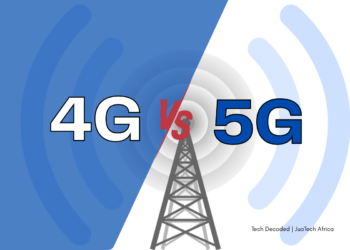
5G vs 4G: Key Differences Explained
| Feature | 4G LTE | 5G |
| Speed | Up to 100 Mbps | Up to 10 Gbps |
| Latency | 30 to 50 ms | 1 to 10 ms |
| Device Density | 100,000/km² | 1,000,000+/km² |
| Network Design | General-purpose | Use-case optimized |
| Reliability | Moderate | Ultra-high |
The difference between 4G and 5G is not just performance. It is a shift toward intelligent, adaptive networks.
Real-World Applications of 5G Technology
5G is already transforming industries:
Smart Cities: Improved traffic management, energy efficiency, and public safety systems.
Healthcare: Telemedicine, remote diagnostics, and advanced medical procedures.
Agriculture: Precision farming using sensors, drones, and real-time data.
Transportation: Connected vehicles and intelligent logistics systems.
Media and Entertainment: Cloud gaming, live streaming, and immersive digital experiences.
5G in Africa: Opportunities and Challenges
5G deployment across Africa presents both strong potential and clear constraints.
Opportunities
- Accelerated digital transformation
- Growth in fintech and digital services
- Smarter agriculture and urban development
- Improved connectivity for businesses and creators
Challenges
- High infrastructure costs
- Limited spectrum availability
- Uneven rural coverage
- Cost of 5G-enabled devices
Most networks in Africa currently rely on mid-band 5G, which provides a balance between performance and coverage.
Why 5G Matters for Businesses and Creators
5G is not just a telecom upgrade. It is a business enabler.
For platforms like JuaTech Africa and digital businesses:
- Faster content delivery improves user experience
- Low latency enables real-time services
- IoT integration creates new business models
- Scalable infrastructure supports innovation
Understanding 5G gives businesses a competitive advantage in a digital-first economy.
Frequently Asked Questions About 5G
- What is 5G and how does it work?
5G is the fifth-generation mobile network standard designed to deliver faster speeds, lower latency, and the ability to connect significantly more devices than previous generations. It works by combining advanced technologies such as high-frequency spectrum, small cell infrastructure, massive MIMO antennas, beamforming, and network slicing. These systems operate together to improve how data is transmitted, making communication faster, more reliable, and more efficient across both consumer and industrial use cases.
- Is 5G faster than 4G LTE?
Yes, 5G is significantly faster than 4G LTE, but actual speeds depend on the type of 5G network deployed. Low-band 5G offers speeds similar to 4G with better coverage, while mid-band 5G delivers noticeably faster performance suitable for most users. High-band 5G, also known as mmWave, can achieve speeds above 1 Gbps in ideal conditions. Beyond speed, 5G also improves network responsiveness and capacity, which enhances the overall user experience even in congested environments.
- Why is 5G considered a major technological advancement?
5G is considered a major advancement because it shifts mobile networks from being primarily communication tools to becoming platforms for real-time, intelligent systems. It enables new technologies such as autonomous vehicles, smart cities, remote healthcare, and industrial automation. Unlike previous generations, 5G supports both human and machine communication at scale, making it a foundational technology for the digital economy.4.
- What is latency in 5G, and why does it matter?
Latency refers to the time it takes for data to travel between devices. In 5G networks, latency can drop to 1-10 milliseconds, compared to 30-50 milliseconds in 4G. This reduction is critical for applications that require instant response, such as online gaming, real-time video communication, autonomous systems, and remote medical procedures. Lower latency improves both performance and reliability in time-sensitive environments.
- Is 5G available in Kenya and across Africa?
5G is already available in Kenya, primarily in major urban centers, with rollout led by providers such as Safaricom. Across Africa, deployment is expanding but remains concentrated in cities due to infrastructure costs and spectrum availability. Most networks in the region use mid-band spectrum, which provides a practical balance between speed and coverage. Rural expansion is expected to improve over time as investment increases.
- Do you need a 5G phone to use 5G?
Yes, accessing 5G requires a 5G-compatible smartphone, a compatible SIM or eSIM, and coverage in a 5G area. Devices that are not 5G-enabled will automatically connect to 4G or lower network standards. As more affordable 5G devices enter the market, adoption is expected to grow rapidly.
- Does 5G consume more battery on smartphones?
Early 5G smartphones experienced higher battery consumption due to less efficient chipsets and network management. However, modern devices are equipped with optimized processors and intelligent network switching that balance performance and power usage. Battery impact now depends more on usage patterns, signal strength, and network conditions than on 5G alone.
- Is 5G safe for human health?
Yes, 5G is considered safe based on current scientific evidence. It operates in accordance with international safety guidelines established by organizations such as the World Health Organization and the International Commission on Non-Ionizing Radiation Protection. 5G uses non-ionizing radiation, which does not have enough energy to damage DNA or human cells. Regulatory bodies continue to monitor and evaluate their safety as deployment expands.
- Why does 5G sometimes feel slow or inconsistent?
5G performance can vary depending on several factors, including the type of spectrum used, distance from network infrastructure, physical obstacles, and network congestion. In many regions, users are connected to low- or mid-band 5G, which does not deliver the extreme speeds of high-band mmWave networks. As infrastructure improves and more spectrum becomes available, consistency and performance will continue to improve.
- What is the difference between 5G and WiFi?
5G and WiFi serve different purposes. 5G is a wide-area cellular network designed for mobility and large-scale coverage, while WiFi is a local network used within homes, offices, and public spaces. 5G provides broader coverage and seamless connectivity across locations, while WiFi typically offers faster speeds within a limited range. Both technologies complement each other and are often used together.
- Will 5G replace fiber internet?
5G will not replace fiber internet. Instead, both technologies work together. Fiber provides the high-capacity backbone that supports 5G networks, while 5G delivers wireless access to users. In many cases, 5G base stations rely on fiber connections to maintain high performance. Fiber remains essential for stable, high-speed data transmission at scale.
- What are the main benefits of 5G technology?
The key benefits of 5G include faster data speeds, lower latency, higher network capacity, and the ability to support a massive number of connected devices. These capabilities enable new applications such as smart cities, connected healthcare systems, intelligent transportation, and advanced digital services. For businesses and creators, 5G also improves content delivery, real-time interaction, and scalability.
- Is upgrading to 5G worth it right now?
Upgrading to 5G depends on your location and usage needs. If you live in an area with strong 5G coverage and rely on data-intensive applications such as streaming, gaming, or content creation, the benefits are clear. If coverage is limited, the immediate impact may be smaller. However, choosing a 5G-enabled device is a practical step for future readiness as networks continue to expand.
- What is the future of 5G technology?
5G is still evolving, with ongoing improvements in network infrastructure, spectrum usage, and device capabilities. Future developments include wider deployment of standalone 5G networks, deeper integration with artificial intelligence, and advancements in edge computing. Looking ahead, research into next-generation technologies such as 6G is already underway, aiming to enhance speed, intelligence, and connectivity further.
The Infrastructure Defining the Future
5G is a foundational technology that will shape how industries operate, how cities function, and how people interact with the digital world.
It enables real-time communication, intelligent automation, and large-scale connectivity in ways that were previously not possible.
While deployment is still evolving, the long-term impact of 5G is clear. It will define the next decade of innovation, economic growth, and technological advancement.
For readers of Tech Decoded by JuaTech Africa, understanding 5G is essential. It is the foundation upon which the future of connectivity is being built.