
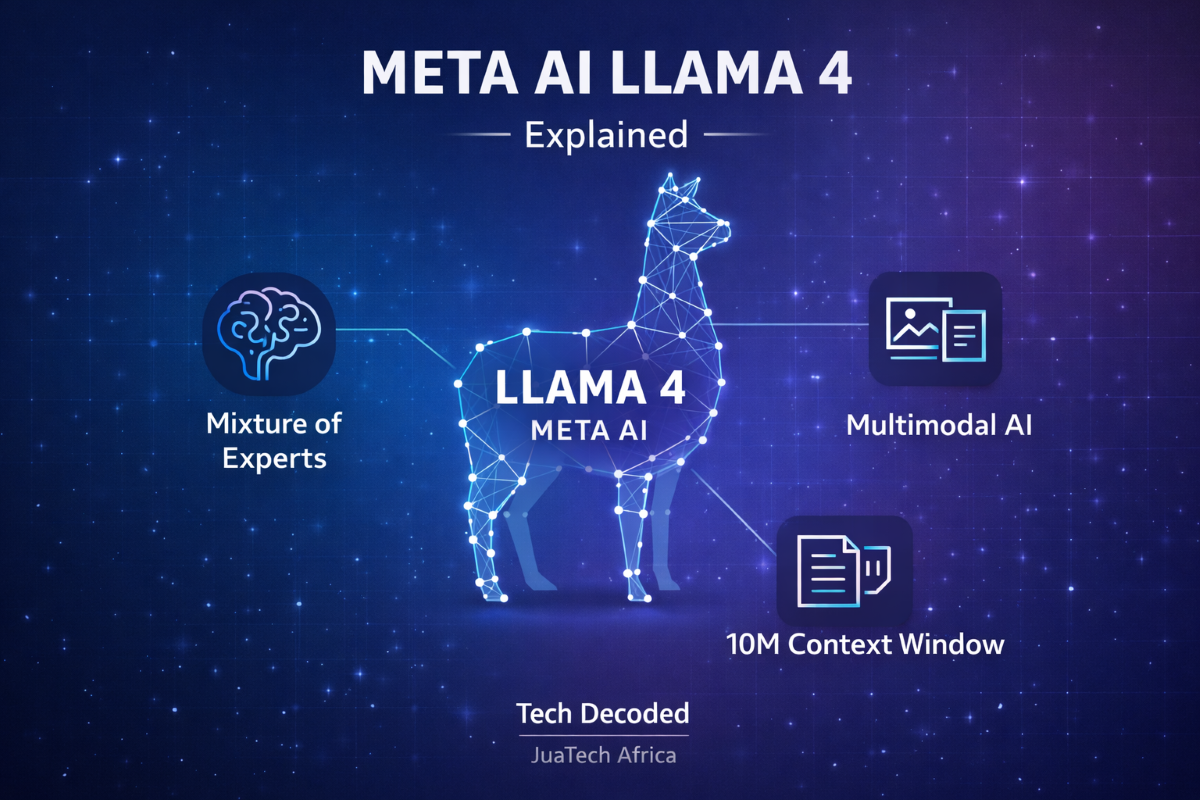
If Google’s Gemini is the “Research Scientist” of the AI world, Meta AI is the “Social Connector.” Built on the open-source Llama (Large Language Model Meta AI) architecture, Meta’s AI strategy is unique: it doesn’t want to be a destination; it wants to be the fabric of the apps you already use – WhatsApp, Instagram, and Facebook.
For the African user, Meta AI is often the first point of contact with Generative AI. But beneath the “Imagine” prompts and chat summaries lies a sophisticated engine designed for speed and local accessibility.

Check on AI & Emerging Technology Master Guide to access all Apps and platform explainers
1. The Llama Engine: Open-Source Power
The backbone of Meta AI is Llama 4 (as of 2026). Unlike proprietary models, Meta’s “Open Weights” approach has allowed the global developer community to optimize Llama for specific hardware.
Tech Decoded Insight: Because Llama is open, it has been “quantized” (shrunk) more effectively than almost any other model. This is why you see Llama 4 Nano running smoothly on mid-range smartphones in Kenya that might struggle with the heavier requirements of Gemini.
2. On-Device vs. Social Cloud: The Hybrid Model
Meta uses a clever hybrid approach to balance speed and power:
- The Social Cloud: When you ask Meta AI in a WhatsApp group to “Plan a trip to Diani,” it uses a larger Llama model in the cloud to pull real-time data from partnerships with major news and travel outlets.
- Llama 4 Nano (On-Device): For 2026, Meta has integrated “Zero-Latency” AI for basic tasks. This handles message drafting and local photo editing directly on your NPU, ensuring that your data stays private and your battery isn’t drained by constant server pings.
- Tech Decoded: “Zero-Latency” WhatsApp Business
One of the most significant updates for 2026 is the integration of Llama 4 Nano into WhatsApp Business.
- The 2 AM Factor: Small businesses in Nairobi can now use on-device AI to handle customer queries instantly at any hour without needing an active, high-speed data connection for every single interaction.
- Quantization Magic: Meta uses 4-bit and sub-4-bit quantization to fit powerful reasoning into the 6GB or 8GB of RAM found in popular mid-range devices from Tecno and Infinix.
4. Multilingual Mastery: Beyond English
Meta’s NLLB (No Language Left Behind) initiative has been folded into Meta AI, giving it a distinct advantage in the African market.
- Idiomatic Accuracy: In 2026 benchmarks, Meta AI consistently outperforms competitors in identifying local idioms and low-resource languages (including Swahili and regional dialects). It doesn’t just translate; it localizes context, making it the preferred tool for real-time chat translation.
5. The “Privacy Trade-Off” & Ad Targeting
As part of our JuaTech Intelligence mission, we must address the “Privacy Caveat.”
- Data Usage: While your personal WhatsApp messages remain end-to-end encrypted, your interactions with Meta AI (the questions you ask and images you generate) are used by Meta to train their models and, as of late 2025, to personalize ad targeting across Facebook and Instagram.
- The JuaTech Advice: Use Meta AI for creativity, social planning, and quick info. For sensitive legal or financial “Deep Research,” we recommend sticking to private, on-device models.
6. JuaTech Verdict: The “Social Intelligence” Check
When evaluating Meta AI on your next device, look for:
- NPU Compatibility: Even though Meta is efficient, an NPU-optimized chip (like the Dimensity 8000 series or Snapdragon 7-series) makes “Imagine” image generation feel instantaneous.
- App Integration: Ensure your Meta apps are updated to the 2026 “Vibes” and “Manus” (AI Agent) versions to get the full multimodal experience.