

Deep Industry Analysis | Flagship Strategy
Last Updated: January 2026
Performance benchmarks, pricing changes, regional availability, and ecosystem implications are continuously updated as the market evolves.

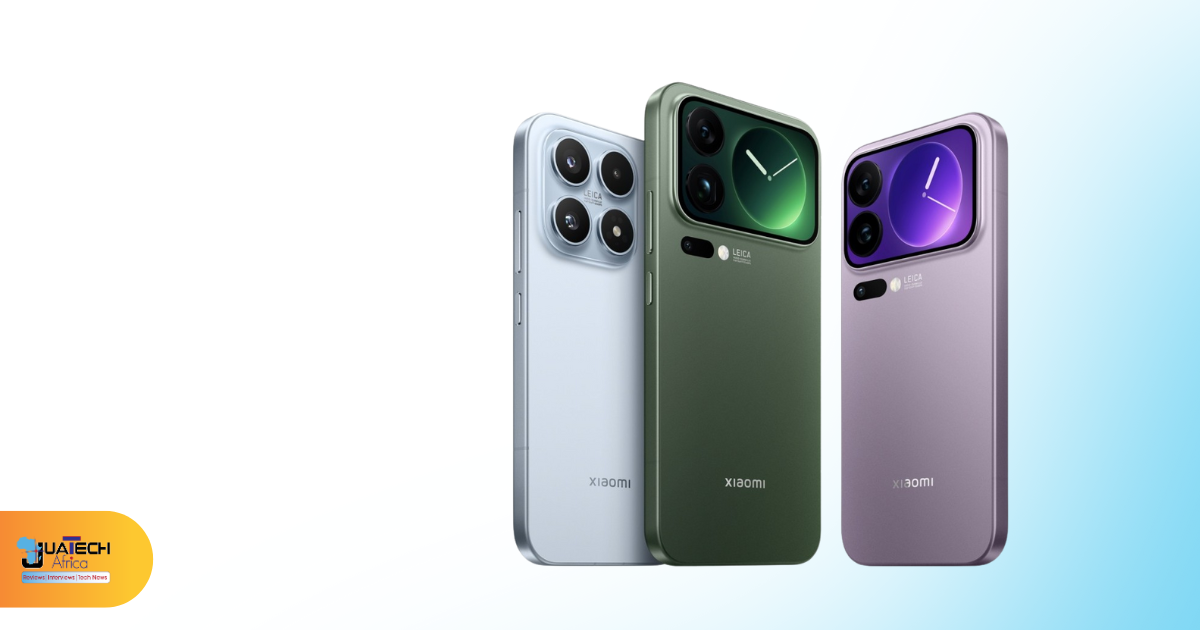
On 25 September 2025, Xiaomi introduced the Xiaomi 17 Series—base, Pro, and Pro Max—becoming the first smartphones to ship commercially with Qualcomm’s Snapdragon 8 Elite Gen 5. On specification alone, the headline numbers are dramatic: a 7,000mAh battery on the standard model, a 6.3-inch LTPO OLED with a claimed peak brightness of 3,500 nits, and pricing that deliberately undercuts traditional flagship norms, starting at approximately US$630 in China.
But the Xiaomi 17 Series is not important because of what it launches with. It is important because of where it lands in the global power structure of smartphones—particularly in Africa.
Kenya’s smartphone penetration has now crossed 80%. Mobile subscriptions exceed 71 million. Mobile money, digital identity, and platform services are no longer peripheral—they are infrastructure. In this environment, a flagship device is not a luxury object; it is a productivity engine, a financial gateway, and a long-term ecosystem decision.
Xiaomi’s strategic bet is clear: deliver elite silicon, oversized endurance, and aggressive pricing at a moment when Samsung, Apple, and Google are raising premiums faster than real-world value. Whether the Xiaomi 17 Series resets the flagship tier—or merely pressures it—requires deeper comparison, not spec admiration.
Key Features & Specs That Matter: Comparative Analysis
Performance Architecture: Snapdragon 8 Elite Gen 5
The Xiaomi 17 Series debuts Qualcomm’s Snapdragon 8 Elite Gen 5 (SM8850-AC), a 3nm flagship SoC engineered for sustained performance under load. Its octa-core setup features:
- 2x 4.6 GHz Oryon V3 Phoenix L cores for peak tasks
- 6x 3.62 GHz Oryon V3 Phoenix M cores for efficiency
- Adreno 840 GPU for high-fidelity rendering and gaming
- On-device NPU for accelerated AI tasks, including real-time image processing and voice recognition.
Pound for pound, the Snapdragon 8 Elite Gen 5 is a significant improvement over the already established prowess and processing power of the 8 Elite Gen 4. The nearest chip that can match the indomitable 8 Gen 5 capabilities is the Dimensity 9500, yet to be launched on any device. We have covered this comprehensively in our previous article. Read here.
This matters in African markets where thermal throttling, app multitasking, and gaming performance are often deal-breakers. The Elite Gen 5’s architecture promises not just speed, but stamina—a critical differentiator in hot climates and high-use scenarios.
Battery & Charging: 7,000mAh + Xiaomi Surge Fast Charging
Xiaomi equips the base 17 model with a 7,000 mAh Si/C Li-Ion battery, paired with:
- 100W wired charging via Xiaomi Surge P1 chip
- 50W wireless charging with Surge G1 support
- L-shaped high-silicon cell design for better energy density and thermal control.
The Xiaomi 17 Pro model comes equipped with:
- Si/C Li-Ion 6300mAh battery
- 100W wired, PD3.0, QC3+, 100W PPS and 50W wireless charging options.
- 22.5W reverse wireless.
You may ask: Why does the base model of the series have a larger battery compared to the Pro model? The Xiaomi 17 base model features a larger battery, as fast-charging batteries like those in the Pro model typically require smaller capacities for thermal and structural efficiency.
The crème de la crème and crown jewel of the Xiaomi 17 Series is the magnificent Xiaomi 17 Ultra. It features:
- Si/C Li-Ion 7500 mAh battery
- 100W wired, PD3.0, QC3+, 100W PPS charging
- 50W wireless charging
- 22.5W reverse wireless options
No current flagship rivals the battery capacity and charging speeds Xiaomi boldly delivers in its latest lineup. This isn’t just engineering — it’s a declaration of intent. More than that, it’s a strategic leap. In markets like Kenya, where power reliability fluctuates and users demand uncompromising endurance, this battery setup isn’t merely generous — it’s transformational. It empowers creators, commuters, and professionals to go full throttle from dawn to dusk, without the anxiety of mid-day depletion.
Display & Brightness: LTPO OLED with 3,500 Nits
Xiaomi 17 Pro Max |Autdoor and Sunlight Supremacy
Let’s work with its elite model, the crème de la crème of the Xiaomi 17 Series. In the Xiaomi 17 Pro Max, display engineering isn’t about chasing vibrancy for showroom demos — it’s about commanding visibility in the real world. With a staggering peak brightness of 3,500 nits, Xiaomi doesn’t just lead the pack — it redefines what flagship clarity should look like.
Powered by M10 luminescence technology, layered with Dragon Crystal Glass, and optimized for 82.1 cd/A luminous efficiency, this panel is built for equatorial realities — not just studio lighting. Whether you’re navigating Nairobi’s midday glare or filming content in open terrain, Xiaomi’s display remains legible, vibrant, and power-conscious.
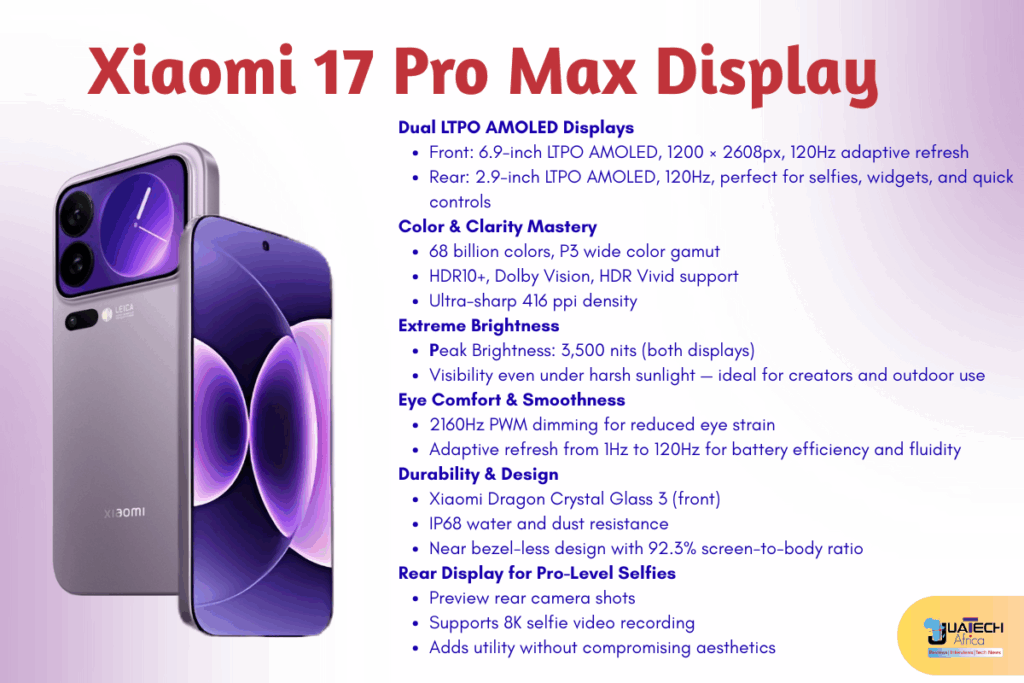
Xiaomi 17 Pro Max Display Highlights:
- Panel: 6.9-inch LTPO AMOLED, 1–120Hz adaptive refresh
- Brightness: 3,500 nits peak — industry-leading
- Eye Comfort: 2160Hz PWM dimming for reduced eye strain
- Color & HDR: HDR10+, Dolby Vision, 68 billion colors
- Efficiency: Independent RGB pixel stack for 26% lower power draw
This is Xiaomi’s message to people who work outdoors, mobile-first creators, and commuters: you’ll see clearly — even at noon in Nairobi, Kitengela, or Abuja.
How does it match rival brands’ elite models? Read our article on Best Flagship Models for Kenya in 2025.
1. Pixel 10 Pro XL: Software-Driven Clarity
Google’s Pixel 10 Pro XL introduces its Super Actua OLED — a panel tuned for AI-enhanced clarity and contextual adaptation. It’s bright, yes, but its real strength lies in software synergy rather than raw luminance.
- Panel: 6.8-inch LTPO OLED, 1–120Hz
- Brightness: 3,300 nits peak
- Color & HDR: HDR10+, 24-bit depth
- Protection: Gorilla Glass Victus 2
Pixel’s display adjusts tone and brightness based on ambient conditions and user behavior. But when it comes to unfiltered daylight legibility, Xiaomi still holds the crown.
2. Samsung Galaxy S25 Ultra: Color-Rich Refinement
Samsung’s S25 Ultra continues its legacy with a Dynamic AMOLED 2X panel — renowned for cinematic color and deep contrast. But in 2025, its brightness ceiling remains conservative.
- Panel: 6.8-inch LTPO AMOLED 2X, 1–120Hz
- Brightness: 2600 nits peak brightness
- Color & HDR: HDR10+, ProScaler tech
- Protection: Gorilla Glass Victus 2
Samsung offers polish and ecosystem harmony. But in African markets where sunlight is unforgiving, Xiaomi’s extra 1,600 nits make a tangible difference — especially for mobile-first professionals and creators.
3. iPhone 17 Pro Max: Balanced Brilliance
Apple’s iPhone 17 Pro Max delivers a Super Retina XDR OLED — precise, predictable, and deeply integrated with iOS. It’s a masterclass in balance, but not in brightness supremacy.
- Panel: 6.7-inch LTPO OLED, ProMotion 1–120Hz
- Brightness: 1600 (typ) – 3,000 nits peak (outdoor)
- Color & HDR: HDR10, Dolby Vision, True Tone
- Protection: Ceramic Shield 2
Apple’s True Tone adapts to ambient light, offering a comfortable viewing experience. But Xiaomi’s higher brightness and pixel-level efficiency give it the edge in outdoor-first use cases.
Strategic Summary: What Xiaomi Is Really Saying
Xiaomi’s 17 Pro Max isn’t just brighter — it’s built for clarity under pressure. In markets like Kenya, this translates to:
- Uncompromised legibility in direct sunlight
- Battery synergy through LTPO and pixel-level efficiency
- Eye comfort via high-frequency PWM dimming
- Durability with Dragon Crystal Glass protection
- Visual fidelity that supports HDR workflows and content creation
Where others optimize for cinematic polish or software harmony, Xiaomi is optimizing for real-world usability — and that’s a strategic leap. In a flagship space dominated by legacy brands, Xiaomi isn’t asking to be admired. It’s asking to be understood. And when it comes to display clarity, brightness, and efficiency — especially in equatorial markets — the Xiaomi 17 Pro Max doesn’t just compete. It leads.
Camera System: Leica-Tuned Triple 50MP Stack
Xiaomi’s imaging partnership with Leica continues with a triple 50MP setup. The camera setup is similar across all the devices in Xiaomi’s 17 Series model. For an insightful look at what Xiaomi offers, let’s focus on the Pro Max model and its closest competitors.
Xiaomi 17 Pro Max: Leica-Tuned Precision
Xiaomi’s imaging system is co-engineered with Leica — and it shows. The triple 50MP setup is designed for optical purity, manual control, and cinematic realism.
- Main: 50MP, f/1.7, 1/1.28″, dual pixel PDAF, OIS
- Telephoto: 50MP, f/2.6, 115mm periscope, 5x optical zoom, OIS
- Ultra-wide: 50MP, f/2.4, 17mm, 102˚ field of view
- Front: 50MP, f/2.2, 21mm wide, PDAF, 4K HDR10+
- Video: 8K@30fps, 4K@120fps, 10-bit LOG, Dolby Vision, gyro-EIS
This is a creator’s suite — not just a camera. Leica’s tuning delivers natural skin tones, rich contrast, and low-light reliability. The 50MP front camera alone is a bold statement: Xiaomi sees creators as protagonists, not afterthoughts.
iPhone 17 Pro Max: Computational Mastery
Apple’s camera system is built around consistency and polish, powered by its Fusion Engine and deep integration with iOS.
- Main: 48MP, f/1.6, sensor-shift OIS
- Telephoto: 48MP, f/2.8, 100mm tetraprism, 4x optical zoom
- Ultra-wide: 48MP, f/2.2, 120˚ field of view
- Front: 18MP, f/1.9, OIS, 4K Dolby Vision
- Video: 4K@120fps, ProRes RAW, Apple Log 2, Spatial video
Apple excels in computational photography — Smart HDR, Deep Fusion, and Photonic Engine deliver polished results with minimal effort. It’s ideal for users who want reliable output without manual tweaking.
Pixel 10 Pro XL: AI-Driven Storytelling
Google’s Pixel 10 Pro XL is a software-first imaging powerhouse, tuned for contextual adaptation and AI enhancement.
- Main: 50MP, f/1.7, 1/1.31″, dual pixel PDAF, OIS
- Telephoto: 48MP, f/2.8, 113mm, 5x optical zoom, OIS
- Ultra-wide: 48MP, f/1.7, 123˚, autofocus
- Front: 42MP, f/2.2, 17mm ultra-wide, PDAF
- Video: 8K@30fps (cloud-enhanced), 4K@60fps, 10-bit HDR, gyro-EIS
Pixel’s strength lies in contextual intelligence — Real Tone, Magic Editor, and Night Sight deliver emotionally resonant images with minimal friction. It’s a storyteller’s companion, especially for social-first creators.
Strategic Comparison on Cameras: What Sets Xiaomi Apart
| Feature | Xiaomi 17 Pro Max | iPhone 17 Pro Max | Pixel 10 Pro XL |
| Main Sensor | 50MP, Leica-tuned, f/1.7 | 48MP, Fusion, f/1.6 | 50MP, AI-tuned, f/1.7 |
| Telephoto Zoom | 5x optical, 115mm periscope | 4x optical, 100mm tetraprism | 5x optical, 113mm |
| Ultrawide Field of View | 102˚, 17mm | 120˚, 13mm | 123˚, 17mm |
| Front Camera | 50MP, 4K HDR10+ | 18MP, 4K Dolby Vision | 42MP, 4K HDR |
| Video Capabilities | 8K, 4K@120fps, LOG, Dolby Vision | 4K@120fps, ProRes, Spatial, Dolby | 8K (cloud), 4K@60fps, HDR |
| Imaging Philosophy | Leica optics, manual realism | Fusion AI, computational polish | AI-driven, contextual storytelling |
Why Xiaomi Deserves a Serious Look
In the Kenyan and generally African markets, where mobile cameras power journalism, marketing, and storytelling, Xiaomi’s 17 Pro Max offers:
- Optical depth for pro-grade control
- Leica realism for natural color and contrast
- High-resolution front camera for creator-first framing
- 8K and LOG formats for post-production workflows
- Reliable low-light performance for events and nightlife
It’s not just a camera. It’s a mobile production suite — tuned for creators, built for storytellers, and engineered for trust.
Memory & Storage: UFS 4.1 with Up to 16GB RAM
Xiaomi 17 Series Memory & Storage Configurations
| Model | RAM Type | RAM Options | Storage Type | Storage Options | microSD Slot | Key Benefits |
| Xiaomi 17 | LPDDR5X | 12GB / 16GB | UFS 4.1 | 256GB / 512GB | No | Fast app switching, smooth multitasking |
| Xiaomi 17 Pro | LPDDR5X | 12GB / 16GB | UFS 4.1 | 256GB / 512GB | No | High-speed media access, gaming fluidity |
| Xiaomi 17 Pro Max | LPDDR5X | 16GB | UFS 4.1 | 512GB | No | Creator-grade performance, pro workflows |
Why This Matters for Kenyan and African Users
UFS 4.1 Storage
Offers up to 4,000 MB/s read speeds — ideal for video editing, file transfers, and app loading. This is especially valuable for creators, marketers, and business owners managing large media files or cloud workflows. With the increased use of smartphones for content creation, this is ideal for professionals seeking to boost productivity and optimize commercial opportunities.
LPDDR5X RAM
Delivers faster data access and lower power consumption. Whether you’re running WhatsApp Business, Canva, CapCut, or multiple browser tabs, this RAM keeps things running smoothly and responsively.
No microSD slot? No problem
With up to 512GB of internal storage, users can store thousands of photos, videos, and documents without the need for external cards — reducing the risk of corruption or slow access.
Multitasking Muscle
16GB RAM enables seamless switching between apps, background processes, and real-time editing — perfect for mobile-first professionals and content creators.
Future-Proofing
These specs aren’t just fast — they’re built to last. As apps get heavier and workflows more demanding, Xiaomi’s memory architecture ensures longevity and relevance.
Why These Specs Matter in African Markets
In East Africa, premium isn’t defined by spec sheet inflation — outcomes define it:
- Performance under load: for creators, gamers, and multitaskers
- Battery life under pressure: for commuters and power-conscious users
- Daylight legibility: for outdoor workers and mobile-first professionals
- Reliable imaging: for content creators, SMEs, and storytellers
- Fast, durable storage: for business continuity and media workflows
The Xiaomi 17 Series doesn’t just tick boxes — it solves problems. And that’s what makes it premium.
A Comparative snapshot: Flagship Face-off
While the Xiaomi 17 Pro and Pro Max grab headlines with Leica optics and Magic Back Display, the Xiaomi 17 base model delivers core flagship power at a more accessible price point—without compromising on performance. But how does it compare to rival brands’ base models? Perhaps this reveals more about things to come or a deeper, underlying point of concern that could shape decisions, perceptions, and even sales by the end of Q4 2025.
Flagship Base Model Comparison: Xiaomi vs Apple vs Samsung vs Pixel
| Feature | Xiaomi 17 | iPhone 17 | Samsung Galaxy S25 | Google Pixel 10 |
| Display | 6.3-inch LTPO AMOLED, 120Hz, HDR10+, Dolby Vision, 3500 nits peak | 6.3-inch Super Retina XDR OLED, 120Hz, HDR10, 3000 nits peak | 6.2-inch Dynamic LTPO AMOLED 2X, 120Hz, HDR10+, 2600 nits peak | 6.3-inch OLED, 120Hz, HDR10+, 3000 nits peak |
| Chipset | Snapdragon 8 Elite Gen 5 (3nm) | Apple A19 Bionic (3nm) | Snapdragon 8 Elite (3nm) / Exynos 2500 (region-dependent) | Google Tensor G5 (3nm) |
| Storage | 256GB 12GB RAM, 512GB 12GB RAM, 512GB 16GB RAM | 256GB 8GB RAM, 512GB 8GB RAM | 128GB 12GB RAM, 256GB 12GB RAM, 512GB 12GB RAM | 128GB 12GB RAM, 256GB 12GB RAM |
| Camera Setup | Triple 50MP: wide + telephoto + ultra-wide (Leica tuned) | Dual 48MP Fusion: wide + ultra-wide + 2x telephoto (optical zoom) | Triple: 50MP wide + 10MP telephoto (3x zoom) + 12MP ultra-wide | Triple: 48MP wide + 10.8MP telephoto (5x zoom) + 13MP ultra-wide |
| Battery Capacity | 7000mAh Si-C, 100W wired, 50W wireless | ~3692mAh, 25W wired, 15W MagSafe wireless | 4000mAh, 25W wired, 15W wireless | 4970mAh, 30W wired, 15W wireless |
| Software | HyperOS 3 (Android 16 base) | iOS 26 | One UI 7 (Android 15 base) | Android 16, Pixel-exclusive AI features |
| Build & Durability | Dragon Crystal Glass, aluminum frame, IP68 | Ceramic Shield 2, aluminum frame, IP68 | Gorilla Glass Victus 2, Armor Aluminum, IP68 | Gorilla Glass Victus 2, aluminum frame, IP68 |
| Kenya Pricing (Est.) | KES 72,000–82,000 (12GB+256GB) | KES 135,000+ (256GB) | KES 120,000+ (128GB) | KES 115,000+ (128GB) |
Editorial Verdict: Xiaomi’s Calculated Disruption in Kenya’s Flagship Arena
The Xiaomi 17 Series doesn’t just enter Kenya’s premium smartphone market—it challenges the very foundation of the market. While previous models felt like marketing warm-ups, the 17 Series represents a bold and strategic reset. At a time when flagship dominance hinges on brand prestige and inflated pricing, Xiaomi delivers top-tier specs—on its base model —Snapdragon 8 Elite Gen 5, 7000mAh battery, 100W charging, Leica optics—at nearly half the cost of Apple’s iPhone 17 or Samsung’s Galaxy S25.
This isn’t a spec stunt. It’s a value revolution.
- Battery supremacy: Xiaomi’s 7000mAh cell dwarfs Apple’s 3692mAh and Samsung’s 4000mAh, offering unmatched endurance for mobile-first users.
- Charging speed: With 100W wired and 50W wireless charging, Xiaomi redefines convenience for creators and entrepreneurs.
- Camera realism: While Apple and Pixel lean on computational photography, Xiaomi’s Leica partnership delivers optical clarity and versatility for real-world storytelling.
- Display brilliance: A 6.3-inch AMOLED panel peaking at 3500 nits makes Xiaomi the brightest contender—literally.
In a market where perception often trumps practicality, Xiaomi invites Kenyan and African buyers to reconsider what premium means. It doesn’t mimic the Big 3—it recalibrates the conversation. For tech enthusiasts, creators, and performance-driven users, the Xiaomi 17 base model isn’t a compromise—it’s a benchmark.
JuaTech Africa’s stance is clear: Xiaomi isn’t just competing; it’s winning. It’s leading a flagship rethink. Kenya and Africa are ready.
Price vs Performance: The Real Battleground in Kenya
Xiaomi’s 17 Series enters Kenya with a base model priced at CNY 4,499, translating to KES 74,000–77,000 before taxes. Even with VAT (16%) and import duties (~10–15%), retail pricing could range between KES 85,000 and KES 95,000—still KES 40,000–60,000 below the iPhone 17 (KES 135,000–165,000) and the Pixel 10 (KES 108,000–114,000).
Yet Xiaomi isn’t just cheaper—it’s better equipped. A 7000 mAh battery, Snapdragon 8 Elite Gen 5, Leica 50MP triple cameras, and 100W wired + 50W wireless charging offer unmatched endurance and speed. Apple and Google deliver polished ecosystems, but Xiaomi delivers raw, sustained performance at a lower price.
If Xiaomi localizes its supply and leverages Kenya’s mobile money and device financing systems, it can lower upfront barriers and democratize access to flagship devices. The value equation is straightforward: more power, more battery, more camera—less money.
This isn’t a competition. It’s a challenge to the entire premium narrative.
Africa & Kenya — Enabling Terrain and Associated Risks
Kenya and Africa aren’t just receptive to Xiaomi’s 17 Series—they’re primed for it. With over 71 million mobile subscriptions and smartphone penetration exceeding 80%, Kenya offers a mature, high-volume market where flagship adoption is no longer aspirational—it’s practical.
Mobile money and financing—via M-Pesa, carrier installments, and fintech loans—expand the addressable market. If Xiaomi secures strong partnerships with telcos and retailers, it can lower upfront barriers and rapidly scale adoption.
African users demand real-world performance: gaming, content creation, multitasking, and all-day battery life. Xiaomi’s 7000 mAh battery, Snapdragon 8 Elite Gen 5, and Leica optics directly map to these needs.
However, success hinges on execution:
- After-sales support: Without local service centers, parts availability, and repair confidence, even great specs won’t stick.
- Tax and import friction: Duties and markups can inflate prices by 20–40%, threatening Xiaomi’s margin advantage.
- Brand loyalty and ecosystem lock-in: Apple and Samsung retain users through resale value, software familiarity, and ecosystem stickiness.
If Xiaomi nails pricing, distribution, and service, the 17 Series could trigger a flagship upgrade wave, compress competitor margins, and redefine what premium means across Africa. This isn’t just a launch—it’s a market reset.
JuaTech Africa’s Editorial Verdict
Xiaomi hasn’t just launched a phone—it’s launched a strategic threat. The Xiaomi 17 Series combines elite silicon, a massive 7000 mAh battery, Leica optics, and aggressive pricing that undercuts both the iPhone 17 and Pixel 10 Series by up to KES 60,000. Apple still leads in ecosystem loyalty; Pixel pushes AI and imaging depth. But Xiaomi delivers raw, sustained value per shilling—engineered for Africa’s demanding, mobile-first users.
Kenya’s terrain is well-suited: it boasts over 71 million mobile subscriptions, an 80% smartphone penetration rate, and widespread mobile financing options through M-Pesa and carrier partnerships. If Xiaomi executes on pricing transparency, after-sales support, and urban–semi-urban availability, the 17 Series won’t just compete—it will lead. This is a market reset. Flagship power is no longer exclusive, and the narrative is shifting from “brand premium” to “performance premium.”
For Kenyan tech enthusiasts, the question is no longer “can it compete with iPhone or Pixel?” but “can they compete with Xiaomi 17?” The benchmark has moved—and JuaTech Africa will track every step.