

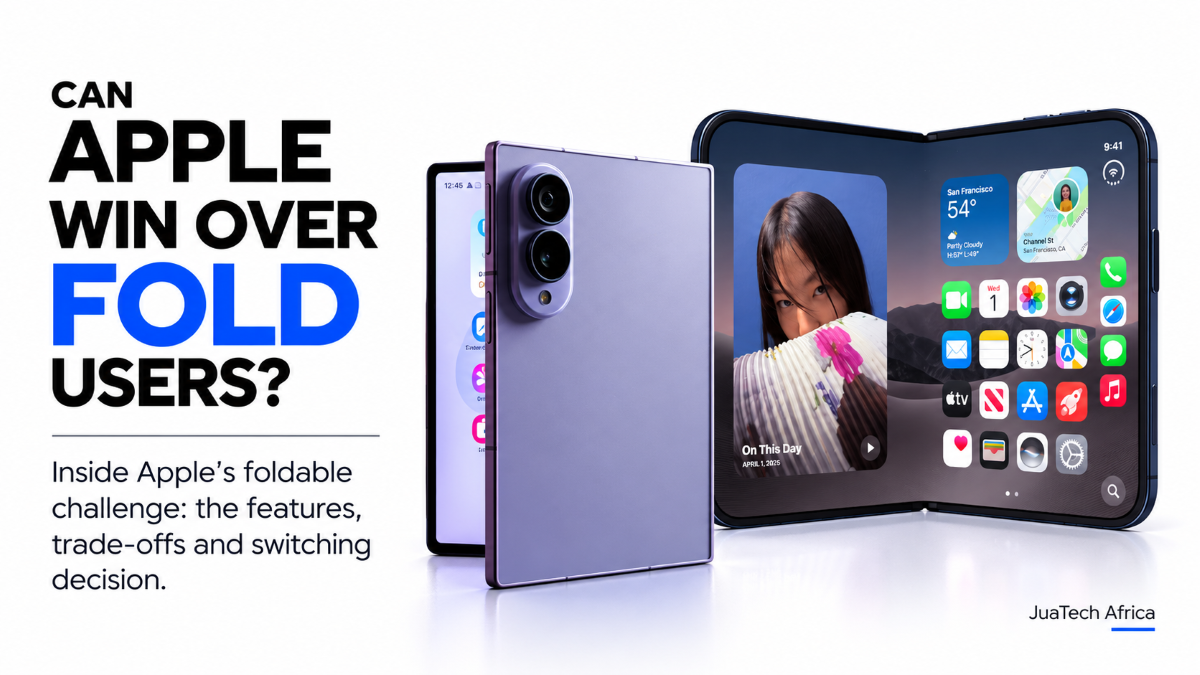
Apple’s first foldable iPhone enters a market shaped by Samsung, Motorola and Xiaomi. We examine the Duo’s premium proposition, Apple’s competitive strategy, the trade-offs existing foldable users face, and what Kenyan buyers should consider before switching.
A Samsung Galaxy Z Fold owner considering the iPhone Duo faces a difficult question: what could Apple’s first foldable offer that an established premium foldable does not? After investing in a device built for multitasking, productivity, and entertainment, switching platforms demands more than curiosity about a new form factor. It demands a compelling reason.

Apple enters a market shaped by years of competition. Samsung’s Galaxy Z Fold series has evolved through multiple generations, while OPPO’s Find N series, vivo’s X Fold series, HONOR’s Magic V line, and Google’s Pixel Fold family have advanced different approaches to book-style foldables. Motorola’s Razr range and Xiaomi’s foldable devices further demonstrate the category’s diversity. Apple is entering an established market, not creating one.
That distinction raises the central question: does Apple need to build the best foldable smartphone, or the foldable that makes the most sense to an iPhone customer? The answer depends on more than brand loyalty or specifications. Software, productivity, cameras, durability, ecosystem integration, and price all matter.
This analysis examines the iPhone Duo’s proposition, its competitive position, the case for switching, and the trade-offs buyers must weigh. For Kenyan consumers, local availability, warranty coverage, repair options, and ownership costs also matter. The question is whether Apple’s entry offers a genuinely compelling reason to reconsider the premium foldable market.
Apple’s Foldable Moment: Entering a Market It Did Not Create
The foldable smartphone has moved beyond experimentation
Foldable smartphones have moved from expensive experiments to a recognized premium category, but they haven’t displaced conventional smartphones. Their appeal is straightforward: a device that folds into a pocketable phone can open into a larger canvas for reading, multitasking, video and work. The challenge is making that versatility worth the additional cost, thickness and mechanical complexity.
Market figures show both momentum and restraint. Counterpoint Research expects cumulative global foldable shipments to exceed 100 million units by the end of 2026, counting devices shipped since the category emerged in 2019. Yet it estimates that foldables still account for only about 2% of the overall smartphone market. IDC separately forecasts 22.9 million foldable shipments in 2026, up 12.6% year on year. These figures measure different things: one is a cumulative milestone, while the other estimates shipments in a single year. Together, they indicate a growing but still small category.
Why Apple’s entry matters
Samsung’s Galaxy Z Fold and Z Flip lines have helped establish book-style and clamshell designs, while Huawei, Motorola, HONOR, OPPO, vivo, Xiaomi and Google have developed competing products. Apple is therefore entering a category whose engineering and user-experience challenges rivals have already explored.
Its potential advantage lies in the iPhone brand’s reach, its established customer base, control over hardware and software, and the services surrounding its devices. These strengths could persuade iPhone owners who have considered foldables too unfamiliar or impractical to reconsider. Apple’s entry may also encourage developers to invest more heavily in large-screen iOS experiences, strengthening the category beyond hardware alone.
Counterpoint forecasts that Apple could capture 25% of foldable shipments in 2026. That is a projection, not realized market share or evidence of sustained adoption, and it reflects expectations for a limited sales window.
The more consequential test is whether the iPhone Duo expands demand beyond existing Apple customers and gives current foldable users a credible reason to switch. Brand power can generate attention; sustained utility must convert it into demand.
The iPhone Duo: What Apple Is Actually Bringing to the Table
A foldable design built around the iPhone experience
The iPhone Duo adopts a book-style design, with a 5.4-inch outer display for conventional phone use and a 7.6-inch inner display when opened. Apple says the inner screen is 50% larger than the iPhone 18 Pro Max display, while the outer panel provides 90% of the iPhone 18 Pro’s screen area. Its Grade 5 titanium frame and nano-textured inner display are intended to combine structural strength with reduced glare and crease visibility. These specifications establish the design proposition, but not one-handed comfort, readability or how noticeable the crease will be in everyday use.
Display, cameras, performance and battery
Both displays support ProMotion, Always-On functionality and up to 3,000 nits of peak outdoor brightness, according to Apple. The rear camera system combines a 48-megapixel Fusion Main camera with a 48-megapixel Fusion Ultra Wide camera. The main camera also offers integrated optical-quality 2x zoom. This versatile dual-camera setup may not suit buyers who rely on dedicated telephoto hardware, so they should compare it carefully with competing flagship foldables.
The A20 Pro chip, custom vapor chamber, and dual-battery architecture support demanding workloads across the larger display. Apple rates video playback at up to 31 hours using the inner screen, 44 hours using the outer screen, and 24 hours when both displays are used equally. These are manufacturer estimates under specified conditions, not guarantees of mixed-use battery life.
Apple iPhone Duo Key Specifications
| Specification | Apple iPhone Duo |
| Form factor | Book-style foldable smartphone |
| Build | Titanium frame; Ceramic Shield 2 front; Ceramic Shield back |
| Outer display | 5.4-inch Super Retina XDR OLED |
| Inner display | 7.6-inch folding Super Retina XDR OLED with nano-texture finish |
| Display features | ProMotion up to 120Hz, Always-On, HDR, up to 3,000 nits peak outdoor brightness |
| Resolution | Outer: 1398 × 2034 pixels; inner: 1878 × 2670 pixels |
| Dimensions, folded | 84.1 × 117.8 × 11.3mm |
| Dimensions, unfolded | 164.6 × 117.8 × 5.2mm |
| Weight | 254g |
| Processor | Apple A20 Pro, 6-core CPU, 7-core GPU and dual 16-core Neural Engine |
| Operating system | iOS 27 |
| Rear cameras | 48MP Fusion Main with sensor-shift optical image stabilization; 48MP Fusion Ultra Wide |
| Zoom | 2× optical-quality telephoto; up to 10× digital zoom |
| Front cameras | 12MP outer camera; under-display inner FaceTime camera |
| Video recording | Up to 4K Dolby Vision at 120fps on the main camera |
| Battery | Dual built-in rechargeable lithium-ion batteries |
| Battery life | Up to 24 hours typical use; video playback up to 44 hours on the outer display or 31 hours on the inner display |
| Charging | USB-C fast charging; MagSafe and Qi2 wireless charging up to 25W |
| Storage options | 256GB, 512GB, 1TB and 2TB |
| Biometrics | Touch ID |
| Water and dust resistance | IP68, rated to a maximum depth of 6 meters for up to 30 minutes under laboratory conditions |
| SIM | Dual eSIM; no physical SIM card slot |
| Connectivity and ports | USB-C with USB 3 data transfer up to 10Gb/s; DisplayPort support |
| Additional features | Apple Intelligence, Siri AI, Split View multitasking and planned Apple Pencil (USB-C) support |
The A20 Pro: Processing Power Behind the Fold
The A20 Pro underpins the iPhone Duo’s promise: making a foldable feel like an iPhone, not simply a larger screen. Apple says its 2-nanometre chip combines a six-core CPU, a seven-core GPU with hardware-accelerated ray tracing, and a dual 16-core Neural Engine. Compared with the A19 Pro, Apple claims up to 20% CPU gains, up to 40% GPU gains, and 50% more memory bandwidth. The Neural Engine offers twice the compute power for on-device AI.
In daily use, this architecture keeps app launches, photo processing, demanding games, AI features, and side-by-side multitasking responsive across both displays. A dedicated display engine manages both screens, while a vapor chamber helps dissipate heat and sustain performance under load. Peak speed tells part of the story: a foldable must remain responsive when its display, processor, and battery work hard together. Independent testing will show how closely performance matches Apple’s claims.
What the specifications do not tell us
Software may prove as important as hardware. iOS 27 introduces Split View, letting two apps run side by side, along with interface adaptations for the open display. Apple says selected third-party apps, including Netflix, Zoom and Slack, are already optimized. Broader app support and implementation quality will determine whether the larger canvas becomes a practical workspace or simply a larger viewing surface. Apple plans to add Apple Pencil support later in the year, rather than at launch.
Apple also lists IP68 water and dust resistance and describes a reinforced folding display, but this rating does not make the flexible panel immune to damage. As pre-orders begin and retail availability approaches, independent testing is still needed for sustained battery performance, thermal behavior, hinge longevity, inner-screen wear, and camera quality in difficult conditions. Until long-term evidence emerges, assess the Duo’s engineering as design decisions and manufacturer claims, not proof that it eliminates foldable compromises.
Apple’s Real Proposition: A Foldable That Remains an iPhone
Apple’s entry into the foldable market matters not just because of the hardware, but because it brings an experience to a category already served by established competitors. The iPhone Duo’s proposition rests on a central question: can Apple make a foldable compelling enough to justify its premium without asking existing iPhone users to compromise the experience they already value?
Familiarity as a competitive advantage
For existing Apple customers, switching to the iPhone Duo could be less disruptive than moving to a foldable from another manufacturer. Their familiarity with iOS, iCloud, iMessage, FaceTime, Apple services, and connected devices offers a practical advantage. Photos, files, messages, subscriptions, and established workflows can stay within the same ecosystem, reducing the friction that often comes with a platform change.
That continuity matters to professionals and other users who rely on their smartphones for work and personal communication. A foldable can introduce a larger screen without necessarily requiring a new digital environment. However, the strength of this advantage depends on what users already own and how deeply they rely on Apple’s services. For someone invested in Samsung’s Galaxy ecosystem, the same switch could mean abandoning equally familiar software, services, and device integrations.
Familiarity therefore lowers the barrier to adoption for some customers, but it does not automatically make the Duo superior. Apple still has to demonstrate that its foldable form factor improves everyday use enough to justify the purchase.
Software adaptation is the real test
The larger internal display creates opportunities for multitasking, reading, document review, and working across applications. Yet screen size alone does not guarantee a better experience. The practical value depends on how well iOS adapts to the expanded display, whether apps use the space intelligently, and how naturally users can move between the outer and inner screens.
Side-by-side apps, responsive layouts, and smooth display transitions matter most. If these capabilities feel intuitive, the Duo could become more useful for users who research, communicate, and create content on their phones. If applications simply stretch to fill the screen, the extra display area may offer less benefit than its size suggests.
Compatibility also matters. Users need their essential applications to behave consistently across both displays, without disruptive layout changes or limitations that undermine productivity. The quality of software adaptation, rather than the novelty of unfolding a phone, will determine how useful the device becomes over time.
Premium positioning beyond specifications
Apple’s premium proposition also depends on the relationship between design, hardware, software, and brand perception. A carefully integrated experience can justify a higher price when it reduces friction and delivers benefits users notice repeatedly. But brand recognition and ecosystem loyalty cannot substitute for meaningful improvements.
The decisive test is differentiation. If the iPhone Duo offers a more coherent, useful, and dependable foldable experience for its intended audience, Apple could attract buyers who have previously resisted the category. If its advantages amount mainly to familiar branding and access to iOS on a larger screen, established foldables may remain more compelling for users who prioritize multitasking flexibility, hardware value, or features specific to their preferred platform.
Apple’s opportunity, then, is not simply to make a folding iPhone. It is to make folding meaningfully improve what an iPhone can do.
The Foldable Battlefield: Samsung, Motorola, Xiaomi and OPPO
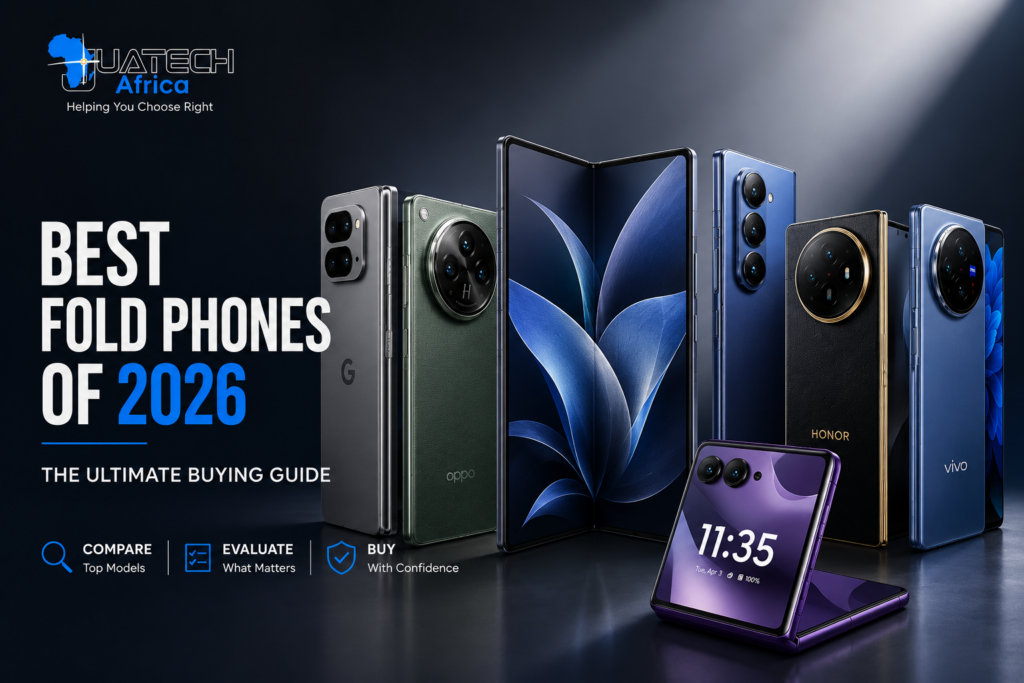
The iPhone Duo enters a market where competitors have already developed distinct approaches to foldable phones. Samsung emphasizes multitasking, Motorola combines a large display with stylus support, Xiaomi pushes hardware innovation, and OPPO positions its Find N6 as a productivity tool. The meaningful comparison is how these devices translate their specifications into productivity, imaging, portability, and long-term ownership value.
Samsung Galaxy Z Fold8: The Established Challenger
Samsung’s Galaxy Z Fold8 is the Duo’s most direct rival. Its 8.0-inch inner display exceeds Apple’s 7.6-inch panel, while its 215g weight makes it 39g lighter than the Duo’s 254g. Samsung specifies a Snapdragon 8 Elite Gen 5 for Galaxy processor, a 4,800mAh battery, and up to 26 hours of video playback. Its dual 50MP rear cameras provide wide and ultra-wide coverage, supported by software features designed for photography and multitasking.
Samsung’s strongest advantage is its established foldable workflow. One UI supports multi-window arrangements, flexible app layouts, and Galaxy AI features. Apple’s counter is iOS integration, the A20 Pro chip, and continuity across its existing devices. The Duo’s multitasking experience must demonstrate comparable practical value for demanding workloads. Samsung’s US starting price is $1,899.99, below the Duo’s stated $1,999 entry price, although neither figure establishes the final Kenyan retail cost. Phoneplace Kenya lists the Samsung at KES 197,000 to KES 205,000, subject to market changes.
Apple iPhone Duo vs Samsung Galaxy Z Fold8: Key Specifications Compared
The following table comprehensively compares the iPhone Duo with the standard Galaxy Z Fold8
| Specification | Apple iPhone Duo | Samsung Galaxy Z Fold8 |
| Operating system | iOS | Android with One UI |
| Processor | Apple A20 Pro | Qualcomm Snapdragon 8 Elite Gen 5 (3nm) for Galaxy |
| Inner display | 7.6-inch folding OLED, 120Hz | 7.6-inch folding display, 120Hz |
| Outer display | 5.4-inch OLED, 120Hz | 5.5-inch cover display |
| Inner display resolution | 1878 × 2670 pixels, 430 ppi | 2448 x 1848 pixels, 404 ppi |
| Folded thickness | 11.3mm | 9.7mm |
| Unfolded thickness | 5.2mm | 4.5mm |
| Weight | 254g | 201g |
| Build and display protection | Titanium design, Ceramic Shield 2 front, Ceramic Shield back | Foldable design with anti-reflection main display |
| Rear cameras | Dual 48MP system: main and ultrawide | Dual 50MP system: wide and ultrawide |
| Optical zoom | 2× optical-quality telephoto; no dedicated telephoto camera | Up to 10× digital zoom; no dedicated telephoto camera on the standard model |
| Video recording | Up to 4K Dolby Vision at 60fps | 8K@30fps, 4K@30/60/120fps, 1080p@30/60/120/240fps, gyro-EIS, OIS |
| Front cameras | 12MP outer camera and under-display inner camera | Dual 10MP front wide and ultrawide cameras, according to Samsung’s product information |
| Battery capacity | – | 4,800mAh |
| Manufacturer-claimed video playback | Up to 44 hours on the outer display or 31 hours on the inner display | Up to 26 hours |
| Wired charging | Up to 50% in around 20 minutes with a compatible 60W-or-higher USB-C adapter | 45W wired, QC2.0, 63% in 30 min |
| Wireless charging | MagSafe and Qi2, up to 25W | 20W wireless, 4.5W reverse wireless |
| Storage options | 256GB, 512GB, 1TB and 2TB | 256GB, 512GB and 1TB |
| RAM | 12GB on 256GB, 512GB, ITB; 16GB on 2TB Models | 12GB on 256GB and 512GB models; 16GB on the 1TB model |
| Water and dust resistance | IP68, rated for up to 6m of water for 30 minutes under specified laboratory conditions | IP48 dust and water resistant (dust > 1mm; immersible up to 1.5m for 30 min) |
| Biometric security | Touch ID fingerprint sensor (side-mounted) | Fingerprint recognition (side-mounted) |
| SIM support | Dual eSIM; no physical SIM card | SIM configuration varies by market and model · eSIM + eSIM (8 or more, max 2 at a time) – Global · eSIM + eSIM (China) |
| US launch price, 256GB | $1,999 | $1,899.99 |
| US launch price, 512GB | $2,199 | $2,099.99 |
| US launch price, 1TB | $2,599 | $2,499.99 |
| US launch price, 2TB | $3,199 | Not offered |
| Kenyan price and availability | Confirm local availability, retail price, eSIM support and warranty before buying | Available at select retail shops. |
Motorola Razr Fold: A Bigger Canvas for Work
Motorola’s Razr Fold is a book-style foldable, unlike the compact clamshell Razr phones. It pairs an 8.1-inch inner display with the Snapdragon 8 Gen 5 platform, a 6,000mAh battery, and support for running three apps simultaneously. Its 50MP main and ultra-wide cameras offer a versatile shooting setup, while the optional Moto Pen Ultra enables sketching, handwriting, and annotating documents. These features make the Motorola Razr Fold an alternative for users who want a large-screen Android workspace without carrying a tablet.
The Duo instead appeals to users who value Apple’s integration with devices such as Mac, Apple Watch, and AirPods. Apple Pencil USB-C support is listed for the Duo, so the distinction is not simply whether a stylus is available. Buyers should compare accessory costs, application support, and the practical usefulness of each device’s handwriting and multitasking tools.
Xiaomi 18 Fold: Ambitious Hardware, Limited Reach
Xiaomi’s 18 Fold takes a hardware-led approach, pairing a 7.58-inch inner display with a 5.38-inch outer screen, the company’s XRing O3 chipset, and a 6,000mAh battery. Its Leica-branded camera system combines a 200MP main sensor with 50MP periscope telephoto and ultra-wide cameras. Support for 67W wired and 50W wireless charging further strengthens its specification sheet.
However, the phone is positioned for the Chinese market, making global availability a key consideration for Kenyan buyers. Buyers must weigh its hardware promise against software localization, network compatibility, and access to warranty support and repairs. Strong specifications offer little practical value if buyers can’t get reliable local support.
OPPO Find N6: The Productivity Challenger
The OPPO Find N6 makes a strong case for professionals and creators. Its 8.12-inch inner display is larger than the Duo’s, yet its 225g body is 29g lighter. The Snapdragon 8 Elite Gen 5, 6,000mAh battery, and 80W wired charging support demanding workloads. Its Hasselblad camera system adds a 200MP main sensor, 50MP periscope telephoto, and 50MP ultra-wide camera.
The optional OPPO AI Pen, combined with Free-Flow Window multitasking, supports handwriting, annotation, drawing, and AI-assisted conversion of sketches into diagrams. This gives OPPO an explicitly productivity-focused proposition. Although the Duo also supports Apple Pencil USB-C, buyers should assess how deeply each platform integrates stylus input with its applications and workflows. For research, note-taking, and visual work, the Find N6 deserves serious consideration.
Where the iPhone Duo Can Differentiate Itself
The comparison reveals different priorities rather than a universal winner. Samsung offers an established multitasking environment, Motorola and OPPO emphasize stylus-assisted productivity, and Xiaomi pairs ambitious hardware with questions about international availability. The Duo’s proposition must stand on the quality of its overall experience, not simply its Apple branding.
For Kenyan buyers, that experience is only part of the decision. Local availability, warranty coverage, repair options, eSIM compatibility, and replacement-part costs can determine whether an expensive foldable remains practical over several years. Buyers should also consider how well each device supports their existing applications, accessories, and daily workflows.
At $1,999, the Duo occupies a premium position, with correspondingly high expectations. Brand affinity may influence purchasing decisions, but the commercial test is whether the device delivers enough practical benefit to justify its price against alternatives. Independent testing, software performance, and long-term ownership experience will ultimately determine whether Apple’s approach gives Duo a compelling reason to beat its rivals.
The Switching Question: Should Galaxy Fold Users Move to iPhone Duo?
A Galaxy Z Fold owner shouldn’t switch to the iPhone Duo just because Apple has entered the foldable market. At $1,999, the Duo is a major purchase and a platform change. The decision should turn on whether iOS, Apple’s ecosystem, and the Duo’s capabilities improve how you work, communicate, and create enough to justify the cost.
Multitasking and productivity
The Duo’s 7.6-inch inner display supports Split View, letting you run two apps side by side, switch apps quickly, and open two windows of the same app, such as Safari. Apple Pencil USB-C support adds another productivity option. Samsung’s Galaxy Z Fold8, however, already offers established multi-window workflows through One UI. The question is not which phone can display two apps; it is whether your essential apps work well together, files move easily between them, and tasks can be completed without friction. If your routine depends on Samsung-specific tools, Android file access or professional applications, test those workflows before switching.
Cameras, battery life and everyday reliability
Apple rates the Duo for up to 24 hours of typical use, with video playback of up to 31 hours on the inner display and 44 hours on the outer display. These are manufacturer estimates, not predictions of a working day involving mobile data, calls, navigation, photography, and multitasking. Megapixel counts alone cannot establish camera superiority either. Independent testing still needs to assess mixed-use battery life, low-light photography, sustained performance, hinge wear, and inner-screen durability. If reliability matters more than being an early adopter, waiting for long-term evidence is the rational choice.
Ecosystem switching costs
Apple’s Move to iOS tool transfers supported content, including contacts, messages, photos, videos, calendars, and WhatsApp content. However, you may need to transfer music, books, and PDFs manually, and you may need to download or replace some apps. Before switching, review cloud storage, password management, subscriptions, messaging habits, smart-home devices, and wearable compatibility. A Galaxy Watch or a workflow built around Samsung Notes may not transfer neatly. Migration is possible, but the real cost includes the time you spend rebuilding familiar systems and habits, not just moving data.
The cost of switching
Calculate the Duo’s $1,999 US starting price, subtract the realistic resale value of your Fold, then add replacement accessories, app purchases, subscriptions, migration, and local acquisition costs. The Duo uses eSIM only, so Kenyan buyers should confirm carrier compatibility before purchasing. Repair exposure also matters: The Verge reports US out-of-warranty estimates of $999 for inner-display damage and $1,499 for other damage. These are substantial potential costs, not predictions of what every repair will cost. Confirm local service availability, warranty terms, and insurance coverage before committing.
Who should switch, and who should stay?
Consider switching if you already rely on Apple services, want continuity across Apple devices, and have confirmed that Duo supports your essential workflows. Do consider staying if Android flexibility, Samsung-specific productivity tools, existing app arrangements, or your current accessories are central to daily use. Wait for more evidence if your decision depends on long-term durability, repair costs, sustained battery performance, or demanding professional workflows that independent testing has not yet evaluated.
JuaTech Africa’s Take:
The Duo may be the right foldable for a Galaxy owner who actively wants Apple’s ecosystem. It is not automatically an upgrade. At this price, switch for a demonstrable improvement in your own experience, not novelty, prestige, or the assumption that a newer entrant must be better.
The key commercial distinction here is that the iPhone Duo’s US price is confirmed, but Kenya’s landed ownership cost isn’t a single fixed number. Some Kenyan sellers have listed the 256GB model at KES 350,000+, while others are running pre-order arrangements without publishing a confirmed price. That difference is useful to readers: it demonstrates why buyers should distinguish a dated seller quotation from official Apple pricing.
Is the iPhone Duo Worth Its Premium Price?
The US price is only the starting point
Apple’s iPhone Duo starts at US$1,999 for 256GB, rising to $2,199 for 512GB, $2,599 for 1TB, and $3,199 for 2TB. These are official US prices, not Kenyan retail prices. Kenya is not among the initial launch markets, so local buyers must account for importation, seller margins, taxes, and availability. Converting dollars to shillings provides a reference, not what a buyer will necessarily pay.
The Kenyan ownership equation
As of 17 October 2026, no authoritative seller has an established price of the iPhone Duo. We will run with the $1999 price, before taxes, importation, and margins are factored in. Running mostly on pre-order, pricing will be rolled out once Apple Kenya, Phoneplace Kenya, FoneXpress, Ropem and others officially update prices across the various variants.
Buyers should verify the current quotation, storage configuration, stock status, and delivery date before paying. Prices remain speculative, with many factors shaping the final retail price. Still, the KES 400,000 average price range makes sense, indicating the iPhone Duo as a premium device.
The purchase price is only part of the equation. The Duo uses eSIM exclusively, so Kenyan buyers should confirm activation with their carrier before ordering. Warranty coverage deserves equal attention: Apple’s terms allow it to restrict iPhone service to the country where the device was originally sold. Ask the seller who handles warranty claims, where repairs are performed, and whether replacement parts are accessible. Budget for compatible accessories and consider the device’s eventual resale value, too.
Paying for capability versus paying for prestige
The Duo’s premium buys a foldable iPhone experience, a large inner display, Apple’s A20 Pro chip, and integration with the company’s software and services. For users who will regularly multitask, read, create or work across the expanded screen, those capabilities may justify the expense. Existing Apple customers may also value ecosystem continuity and the prestige associated with owning a distinctive flagship.
However, buyers should compare that proposition against competing foldables offering larger displays, stylus-based productivity or more versatile camera hardware, as well as conventional flagship phones that may deliver better value for everyday use. The Duo’s long-term durability, repair costs and real-world performance also warrant scrutiny.
JuaTech Africa’s Take:
At more than KES 350,000* in several published local listings, the iPhone Duo is a considered luxury purchase, not a default recommendation. Buy it if its foldable experience and Apple ecosystem solve meaningful needs, and the total cost of ownership is affordable. If prestige is the principal attraction, recognize that you are paying for the experience and association as much as for practical capability.
The Wider Strategic Question: What Apple’s Entry Changes
Can Apple expand the category?
Apple’s entry gives foldable smartphones access to a substantial audience of premium iPhone customers who may have resisted Android alternatives. The opportunity is not simply to win customers from Samsung or OPPO, but to persuade conventional iPhone users that a folding display offers enough practical value to change how they use a smartphone.
Early demand is encouraging. On 16 October 2026, the Financial Times reported that Apple sold out the iPhone Duo on its website within hours of pre-orders opening, with delivery estimates extending into January. However, supply constraints complicate interpretation: long delivery times can reflect strong demand, limited initial production, or both. They do not establish how many customers will ultimately buy the device or how many are switching from competing foldables.
Counterpoint Research’s September forecast projected Apple would capture 25% of global foldable shipments in 2026, behind Samsung at 38%. These remain forecasts, not final market shares. Foldables account for only about 2% of the overall smartphone market, leaving substantial room for expansion if the category can demonstrate lasting utility.
What the competition must prove next
The next phase will test whether manufacturers can turn premium hardware into reliable everyday tools. Software maturity, app optimization, multitasking, battery endurance, portability, repairability, and pricing will shape the category’s appeal. Apple may raise expectations for hardware-software integration, while Samsung and Chinese manufacturers will be incentivized to strengthen their productivity experiences and differentiate their designs.
These are competitive pressures, not guaranteed outcomes. The evidence that matters will be sustained sales, repeat purchasing, customer satisfaction, and improvements that users can actually feel.
What this means for the smartphone market
Apple’s entry could intensify competition at the premium end and reinforce the importance of ecosystem loyalty in purchasing decisions. It may also encourage consumers to evaluate smartphones by the experiences they enable rather than specifications alone.
For JuaTech Africa, the strategic question is whether Apple’s arrival expands the market or primarily redistributes premium buyers among manufacturers. The real measure of impact will not be launch excitement or waiting lists, but sustained adoption, demonstrable consumer value and a stronger foldable category.
What Kenyan Buyers Need to Establish Before Purchasing
Availability, eSIM and after-sales support
Buying the iPhone Duo in Kenya requires more than finding a retailer advertising it. Since Kenya is not among Apple’s initial launch markets, buyers should establish whether a unit is physically available, its country of origin and the expected delivery timeline before paying. An online listing does not necessarily guarantee immediate availability.
The Duo is eSIM-only, with no physical SIM card slot. Safaricom and Airtel Kenya offer eSIM services, making local connectivity a practical option for customers using either network. Buyers should still confirm that their specific device model is compatible and establish the activation requirements with their preferred operator before purchasing an imported unit.
As Apple’s global rollout progresses, another question deserves attention: will the company consider a physical SIM variant for markets where eSIM adoption, carrier support or consumer preferences differ? Apple has offered different SIM configurations across regional iPhone lineups before, although there is no confirmed indication that the Duo will receive a physical SIM version. Greater flexibility could broaden its appeal in markets with different connectivity needs. Whether Apple considers such a change necessary will depend on regional demand, carrier readiness and its wider product strategy.
Warranty, repair and total ownership cost
After-sales support is a more immediate concern for Kenyan buyers. Apple’s warranty terms allow it to restrict iPhone service to the country where a device was originally sold. Consequently, an imported Duo may not enjoy the same practical service options as a device purchased in a market where Apple provides direct support.
Before paying, establish whether the seller’s warranty is manufacturer-backed or retailer-provided, what it covers and who handles claims. Ask whether qualified technicians and replacement parts are accessible in Kenya, particularly for the folding display and hinge. Find out how repairs are handled if parts must be imported, how long servicing could take and who bears the associated costs.
Seller credibility also matters. Confirm the device’s condition, regional model, network-unlocked status and warranty eligibility. Obtain a valid receipt, written warranty terms, and a clear return policy. If the phone is advertised as available, ask the retailer to confirm that the unit is physically in stock rather than awaiting importation.
The purchase price is only one part of the ownership equation. Factor in applicable taxes, accessories, insurance, potential repair expenses, and expected resale value. Foldable-screen damage can expose owners to substantial costs, so buyers should investigate repair options before committing rather than after a problem arises.
JuaTech Africa’s Take:
The iPhone Duo could be an attractive premium device for Kenyan buyers, but its value depends on more than the hardware. Verify availability, eSIM compatibility, warranty coverage, and repair arrangements before paying. At this price, dependable after-sales support is part of the product’s value, not an optional extra.
FAQs About the iPhone Duo
How much does the iPhone Duo cost in Kenya?
Apple’s official US starting price is $1,999 for the 256GB model. In Kenya, several dealers and sellers list it at KES 350,000+. There is no confirmed substantial price, yet. Because prices vary across the local market, buyers should confirm the final price, taxes, stock, and delivery terms directly with the seller before paying, even on pre-order. By mid-November, we should have clear local prices based on storage variants, maybe eSIM, SIM provisions.
What makes the iPhone Duo outstanding enough to justify its premium price?
The iPhone Duo combines a foldable 7.6-inch inner display, Apple’s A20 Pro processor, iOS integration, and access to the Apple ecosystem in one device. For professionals and creators, the appeal lies in combining smartphone portability with a larger workspace. However, these features alone do not prove superior value. The premium is justified only if the foldable experience, productivity benefits, and ecosystem integration meaningfully improve how you work and use your device.
Is the iPhone Duo better than the Samsung Galaxy Z Fold 8?
Neither device is universally better. The Duo appeals to users who want a foldable iPhone and Apple’s ecosystem, while Samsung offers an established Android foldable experience, an 8-inch inner display, and a lighter 215g design. The better choice depends on your preferred operating system, productivity needs, camera priorities, and existing devices.
Should Galaxy Fold users switch to the iPhone Duo?
Switch if iOS integration and Apple’s services offer meaningful benefits for your daily work. Before changing platforms, consider app compatibility, multitasking habits, accessories, data migration, and the cost of replacing your current device. Galaxy Fold owners who are satisfied with Samsung’s productivity tools have no compelling reason to switch just because Apple has entered the foldable market.
Does the iPhone Duo support physical SIM cards in Kenya?
No. Apple specifies dual eSIM support worldwide, with no physical SIM card slot. Safaricom and Airtel Kenya offer eSIM services, but confirm device compatibility and activation requirements with your chosen operator before purchasing an imported unit.
Is the iPhone Duo worth buying?
The Duo is worth considering if you want a foldable iPhone, will regularly use its larger inner display, and can comfortably afford its purchase and ownership costs. Existing Apple users have the clearest reason to consider it. Buyers concerned about long-term durability, repair costs, or first-generation uncertainty should wait for independent testing and stronger evidence of long-term ownership.
Conclusion: Is the iPhone Duo Worth Switching For?
Apple’s entry into the foldable market gives premium smartphone buyers another compelling option, but it does not automatically make the iPhone Duo the best foldable for everyone. Its strongest proposition is the combination of a folding display, familiar iOS, and Apple’s connected ecosystem. Whether that combination justifies the premium depends on the practical benefits it delivers.
For existing iPhone users, the Duo offers a natural route into foldable smartphones without leaving Apple’s ecosystem. For Samsung Galaxy Z Fold owners, switching requires more than Apple’s arrival alone. Multitasking, software preferences, camera performance, ownership costs and long-term reliability should guide the decision. In Kenya, confirmed availability, eSIM compatibility, warranty coverage, and access to repairs also matter.
The verdict is straightforward: the Duo deserves serious consideration, but it is not an automatic upgrade. Its long-term durability and sustained real-world performance still require independent evaluation. Choose the foldable that best supports how you work, create, and live, rather than buying on brand appeal alone.
JuaTech Africa examines the technology, competition, and market forces behind the products. Our goal is to help you make better-informed decisions, not simply follow the next launch.
Continue Exploring the Foldable and Premium Smartphone Market
These JuaTech Africa guides and analyses offer further insight into the devices, ecosystems, and buying decisions shaping the premium smartphone market.
- Best Fold Phones of 2026: The Complete Buying Guide: Compare leading foldables and identify the form factor that best suits your needs.
- Samsung Galaxy Z Fold8 Review: Is This the Most Complete Foldable Smartphone Yet?: Explore Samsung’s approach to foldable design, productivity and premium smartphone ownership.
- Apple Ecosystem for Productivity: Understand how Apple’s connected devices and services can support work, creativity and productivity.
- iPhone 18 Pro Max and the Premium Smartphone Race: Examine Apple’s position in the wider competition for premium smartphone buyers.
Stay Informed with JuaTech Africa
The smartphone market moves quickly. New launches, pricing changes, software developments and competitive shifts can change the value of a purchase long after release.
Join the JuaTech Africa newsletter for curated smartphone intelligence, market analysis, product insights and developments that matter.
Prefer WhatsApp? Join our WhatsApp audience for convenient access to our latest coverage and selected insights.