

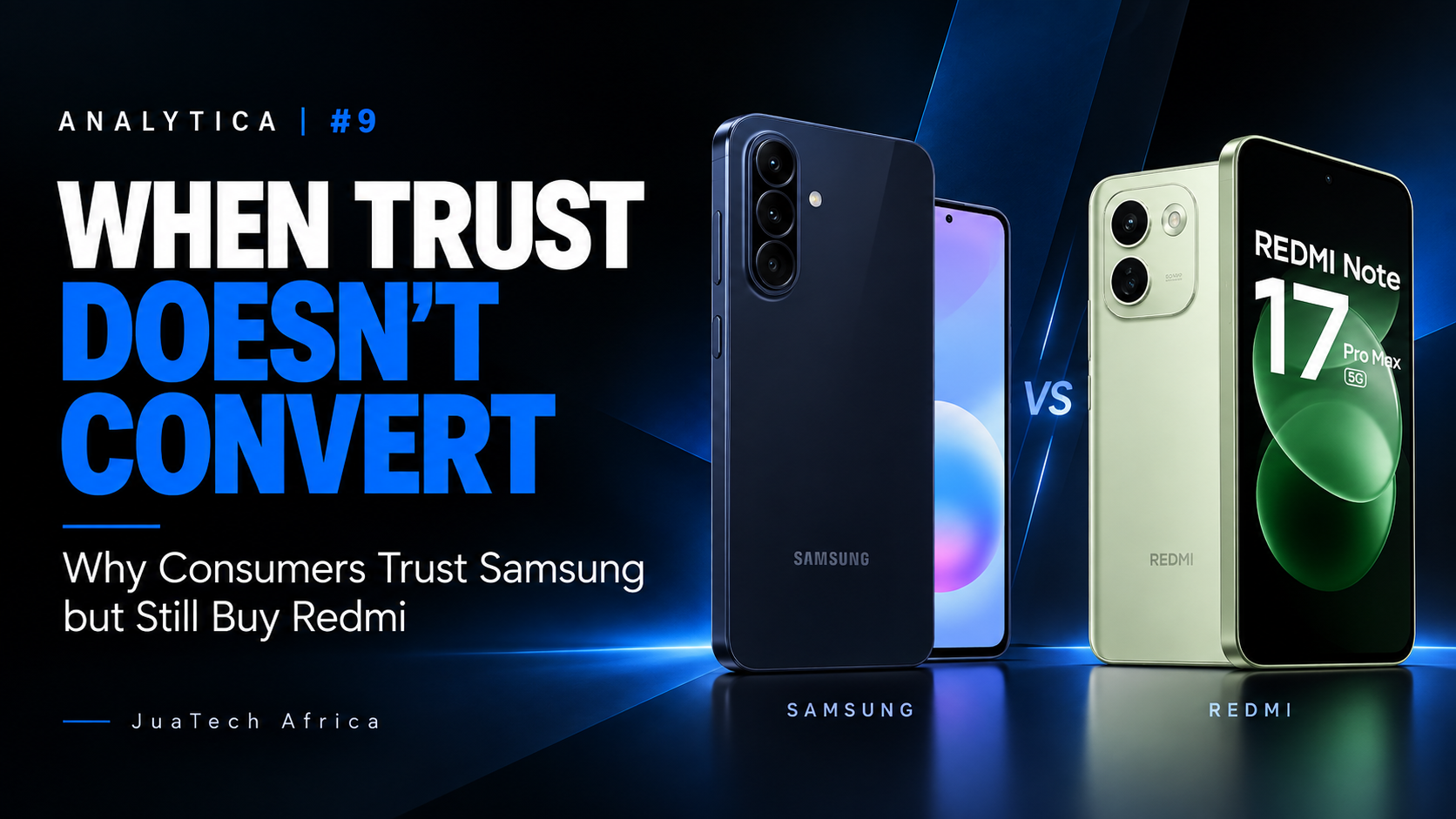
Trust builds preference. Price, perceived value, motivation and economic reality can still determine the purchase.
Analytica is JuaTech Africa’s long-form market intelligence and analysis series, examining the forces shaping mobile technology, the businesses competing within it, and the consumers whose decisions ultimately determine how markets evolve. Each edition moves beyond products, launches, and headlines to examine how technology, economics, business strategy, market structure, and consumer behavior interact. The objective is not simply to document what happened, but to understand why it happened, what it reveals about the market and what it means for organizations and decision-makers operating within it. Analytica treats evidence, context, and interpretation as distinct but connected elements, bringing together market signals and deeper analysis to challenge assumptions and develop useful perspectives on Africa’s technology economy. This edition applies that approach to one of the most revealing tensions in smartphone competition: the gap between what consumers believe about brands and what they ultimately buy.

The Consumer Who Trusts Samsung but Buys Redmi
Consider a consumer who regards Samsung as a dependable smartphone brand but ultimately purchases Redmi. This apparent contradiction challenges a familiar assumption about brand loyalty: that positive perceptions naturally lead to purchase and that purchase demonstrates loyalty. Consumer behavior is rarely that linear. A person can recognize a brand, become familiar with its products, develop confidence in its ability to deliver, and prefer it over alternatives, yet choose another device when it’s time to buy. The consumer may trust Samsung’s quality but find Redmi’s combination of specifications and price more compelling for their immediate needs. They may prioritize camera capability, battery life, storage, or performance; respond to a promotion or financing option; or conclude that paying more for the trusted brand does not add enough value for that purchase.
This is where the distinction between brand trust and brand loyalty becomes fundamental. Awareness means recognizing a brand; familiarity reflects exposure and understanding; trust concerns confidence in the brand’s expected delivery; preference reflects relative inclination; purchase intention describes what a consumer expects to buy; and purchase behavior records what they actually purchase. Loyalty extends beyond a single transaction into continued preference, repeat purchasing or commitment. These stages can reinforce one another, but none guarantees the next. A trusted brand can therefore earn consideration without securing the sale, while a single purchase cannot by itself establish durable loyalty. This distinction is central to understanding smartphone brand switching and the broader relationship between consumer perception and purchasing behaviour.
The economic context makes the relationship even more important. Omdia reported that African smartphone shipments fell 7% year on year in the second quarter of 2026, while shipments of devices priced below $100 fell 34%. Kenya’s shipments fell 15%, while the African average selling price rose $41 year on year to $202. Omdia linked the contraction to rising device prices, memory costs and affordability pressure. The figures don’t tell us what consumers trust or prefer, but they set the conditions under which those preferences convert, or fail to convert, into purchases.
The affordability constraint matters most in Sub-Saharan Africa. GSMA reported that, by the end of 2025, an entry-level internet-enabled handset cost the poorest 20% of people in the region the equivalent of 76% of their average monthly income. In such an environment, a smartphone decision cannot be reduced to brand reputation. A consumer can recognize one brand’s quality or reliability yet choose another because the required financial sacrifice does not seem justified by the added value.
Samsung and Redmi provide a useful lens because they represent different approaches to creating value within the same broad smartphone market. Samsung has built substantial brand equity across smartphones and consumer electronics, while Redmi has built a strong value-oriented proposition within Xiaomi’s wider portfolio through a combination of price, specifications, and functionality. The purpose of examining them is not to establish which brand is superior. It is to understand how different propositions compete when a consumer must reconcile trust, aspiration, need, affordability and expected utility.
The consumer therefore does not make a brand purchase decision in isolation. They evaluate a proposition against a specific need, a financial ceiling, competing alternatives, and the circumstances surrounding the transaction. Price can change consideration. Product capability can alter perceived value. Availability can determine what is actually accessible. Financing can change affordability, while retailer influence can introduce information or alternatives that were not part of the original decision. As a result, a consumer can switch devices without rejecting a brand, or buy a competing brand without abandoning a long-standing preference. What appears to be a simple act of brand switching can reflect a much more complex negotiation between motivation, purchasing power, perceived value, risk and choice.
The central paradox of this edition of Analytica is therefore not simply why someone might trust Samsung and buy Redmi. It is what happens between preference and purchase, and which forces determine the outcome when brand equity encounters economic reality and competing value propositions. A brand can earn the consumer’s trust without necessarily earning the transaction. To understand that gap, we must first examine whether trust and loyalty are actually the same thing.
Trust Is Not Loyalty
The relationship between a consumer and a smartphone brand is more complicated than the language of brand loyalty suggests. Trust matters because it reduces uncertainty. It gives consumers confidence that a brand can deliver a product, experience or level of performance they consider acceptable. But trust is not the same as preference, and preference is not the same as loyalty. A consumer can trust a brand without choosing it, prefer it without buying it, buy it without becoming loyal to it, and switch from it without completely rejecting it. Understanding these distinctions is essential to understanding what happens between a brand’s position in the consumer’s mind and its position in the consumer’s shopping basket.
The Consumer Relationship Is a Sequence, Not a Single State
The journey begins with brand awareness, when the consumer recognises that a brand exists, and develops through brand familiarity, as repeated exposure, ownership, advertising, retail interaction and recommendations give the consumer a clearer understanding of what the brand represents. Brand trust develops when the consumer becomes confident that the brand will deliver what it promises or what experience has taught them to expect. Brand preference goes further, reflecting a relative inclination toward one brand over competing alternatives. Purchase intention captures what the consumer expects or says they are likely to buy, while purchase behaviour records what they actually purchase. Brand loyalty extends beyond the individual transaction into continued preference, repeat purchasing and commitment.
These stages can reinforce one another, but none guarantees the next. Awareness does not guarantee familiarity. Familiarity does not guarantee trust. Trust does not guarantee preference. Preference does not guarantee purchase intention, and purchase intention does not guarantee purchase behaviour. Even repeat purchasing does not automatically prove deep loyalty. A consumer may repeatedly choose the same brand because they are satisfied and committed, but they may also remain with it because alternatives appear less attractive, switching is inconvenient, or existing habits make the familiar choice easier.
This distinction matters because consumer relationships can change without producing a clean break. A consumer may retain confidence in a brand while purchasing elsewhere for a particular need. Equally, a consumer may purchase the same brand repeatedly without developing the kind of commitment that would prevent them from considering alternatives. A transaction provides evidence of what happened at one point in time. It does not, by itself, explain the relationship behind it.
Trust Creates Confidence. Value Determines the Trade-Off. The critical question, therefore, is not whether trust matters. It does. The more important question is what happens when trust encounters competing value.
Smartphone consumer research shows that value extends beyond price. Functional, emotional, and social benefits can influence how consumers evaluate brands, while consumer-brand identification and confidence in the retail relationship can strengthen commitment. These findings point to an important distinction: consumers do not evaluate a trusted brand in isolation. They evaluate what they believe the brand offers against what competing brands offer and what they are willing to give up to get it.
This provides a more useful interpretation of the Samsung-Redmi paradox. A consumer may trust Samsung because previous experience, reputation or brand signals reduce perceived risk. Yet the same consumer may judge Redmi to offer greater value for the particular amount of money available. That decision does not necessarily reject Samsung’s credibility. It may reflect a different assessment of what each proposition delivers for the immediate purchase.
The same principle applies to preference. A consumer can prefer Samsung overall while choosing Redmi for a specific purchase. The product category may remain the same, but the circumstances can change the decision. The relevant question becomes less about which brand the consumer likes most and more about which proposition makes the most sense under the conditions of the purchase.
Switching Does Not Always Mean Rejection
Brand switching introduces another layer of complexity. It is tempting to interpret movement from Samsung to Redmi, or from any established brand to another, as evidence that the original brand has lost the consumer. Research suggests a more nuanced interpretation. Consumers can move between brands because of dissatisfaction, stronger alternatives, changing needs, price pressure, social influence, variety seeking or the practical costs and benefits associated with staying.
This creates an important analytical distinction: a switch is an observable behaviour, not an explanation. The transactbehaviorion tells us that the consumer chose differently. It does not tell us whether they abandoned their previous preference, responded to a temporary circumstance or discovered that another proposition better suited their needs.
The same caution applies to market share. Market share tells us where transactions occurred. It does not, by itself, tell us why consumers made those choices, how strongly they felt about the brand, whether they considered alternatives orr whether they will repeat the decision. Purchase intention requires similar caution. What consumers say they intend to do can inform analysis, but actual purchase behavior remains stronger evidence of what happened at the point of transaction.
Where Trust Meets Its Limit
The relationship between trust and purchase therefore reaches its limit when another consideration becomes more decisive at the point of choice. Price may outweigh the reassurance provided by brand familiarity. Perceived value may make an alternative more compelling. Product fit may become more important than general brand preference. Availability, financing, retailer influence or changing consumer needs can alter the decision before the transaction takes place.
The strategic implication is that brands are not competing only to become trusted. They are competing to make that trust commercially consequential when the consumconsumers areer is ready to act. Trust can earn consideration and reduce perceived risk, but loyalty develops through the broader relationship between the consumer and the brand across ownership, ,experience and subsequent purchase decisions.
That takes the analysis beyond brand psychology and toward purchase economics. If trust can secure a place in the consumer’s consideration set without securing the transaction, what exactly is the consumer trying to maximize when choosing a smartphone?
Inside the Smartphone Purchase
A smartphone purchase rarely begins with a brand. It begins with a need, a constraint or a change in circumstances. The consumer may need a faster device, a better camera, more storage or a battery that survives a full working day. They may have a broken phone, received a promotion, experienced a change in income or reached the point where the existing device no longer meets their requirements. The brand enters the decision, but it competes with the practical problem the consumer is trying to solve.
This matters because smartphone purchasing is a multi-dimensional decision. Research in Kenya shows that product features, pricing strategies, and promotion can significantly influence smartphone purchase preferences, while GSMA research identifies affordability, disposable income, device features, financing, availability, social influences, and individual preferences as factors shaping smartphone adoption in Africa. These findings do not mean every consumer weighs the variables equally. They show that purchase decisions cannot be reduced to a single motivation, such as price or brand.
Functional Motivations: What Must the Device Do?
Functional motivations concern the job the smartphone must perform. Performance matters when consumers need applications to run smoothly, multitask, game, or process demanding workloads. Camera capability matters when photography, video, social content or professional communication becomes central to usage. Battery life matters because a device that cannot last through the user’s routine creates friction. Storage, software experience, and durability influence how useful the device remains over time.
These factors matter most when consumers compare devices in a similar price range. A buyer may not care about a chipset in isolation, but may care whether the phone still feels fast two years later. They may not seek a particular camera sensor, but they may want dependable photos in difficult conditions. Functional value is therefore not simply a list of specifications. It is the consumer’s assessment of whether those specifications solve a meaningful problem.
Economic Motivations: What Can the Consumer Justify?
Economic motivation introduces the constraint that every other benefit must confront. Price establishes the immediate financial sacrifice, but affordability depends on income, purchasing power, financing, promotions and competing obligations. GSMA research on smartphone adoption identifies disposable income, device cost, financing and distribution as important factors affecting ownership. In Kenya, GSMA research similarly identifies affordability and willingness to allocate financial resources to smartphones as central drivers, alongside demand for long battery life, storage, speed and durability.
This is where perceived value becomes more useful than price alone. A KSh 30,000 smartphone is not automatically expensive or affordable. Its value depends on what the consumer receives, how long they expect to use it, what alternatives cost and whether its benefits justify the expenditure. Total cost of ownership extends the calculation beyond acquisition to durability, repairs, software support, battery replacement, resale and the cost of replacing the device sooner than expected. The consumer is asking not only, “What does this phone cost?” but “What will it cost me, and what will it return over the period I expect to own it?”
Emotional Motivations: What Does the Purchase Make the Consumer Feel?
Smartphones also carry psychological value that specifications and price cannot fully capture. Consumers may seek confidence in their purchase, reassurance that they have avoided a poor decision, or satisfaction from owning a device that reflects their aspirations. Attachment can develop through previous ownership and positive experiences, while risk avoidance can favour brands with established reputations, familiar software environments or stronger perceived support.
These motivations help explain why consumers sometimes pay more than the minimum required to meet functional needs. A premium can represent reassurance, identity, status or anticipated longevity rather than additional specifications alone. Smartphone research has found that emotional and social consumption values can contribute to brand commitment and reduce switching behaviour, demonstrating that the relationship between a device and its owner extends beyond functional utility.
Social Motivations: Who Else Is in the Decision?
The smartphone is also a social object. Friends, family, colleagues, influencers, online communities and workplace expectations can shape what consumers notice, consider and eventually buy. Social influence can operate through recommendations or through perceptions of what people in a particular environment use. A consumer may want a device because it is familiar within their peer group, because colleagues use a particular ecosystem, or because ownership communicates status.
Situational Motivations: Why Now?
Even strong brand preferences can be overridden by circumstances. A broken phone creates urgency. A promotion changes the economics. Limited stock can remove an option from consideration. A change in income can expand or contract the feasible budget. Financing can transform a large upfront payment into a manageable periodic commitment. Availability matters because consumers cannot purchase a proposition they cannot access through a trusted channel when they need it.
This makes smartphone purchasing dynamic rather than static. The same consumer can make different decisions at different times because the need, budget, alternatives and context have changed. What looks like inconsistent brand behaviour may therefore be a rational response to changing circumstances.
The Consumer Decision Stack
These motivations can be brought together through a simple decision stack:

This is not a rigid psychological law. It is an analytical framework for understanding how multiple forces converge around a transaction.Need establishes the problem the consumer wants solved. Budget defines the financial boundary. Options determine what the consumer can realistically choose from, including products available through retailers, financing channels and secondary markets. Perceived value compares expected benefits with the sacrifice required. Risk introduces uncertainty around quality, reliability, support and the possibility of making the wrong choice. Context captures situational forces, from urgency and promotions to social influence and availability. Purchase is the observable outcome.
Brand trust can influence several points in this stack. It can increase consideration, reduce perceived risk and strengthen confidence in a purchase, but it does not control the entire decision. A trusted brand can lose when its price exceeds the consumer’s budget, when another device offers greater perceived value, when a preferred configuration is unavailable or when a situational need makes another proposition more appropriate.
The consumer, therefore, is not simply choosing between Samsung and Redmi. The consumer is solving for a combination of utility, affordability, confidence and circumstance. The brand that understands only preference sees a customer. The brand that understands the decision stack sees the forces that determine whether preference becomes purchase.
That brings us to the next question: if consumers make decisions through this combination of needs, constraints, and perceived value, how much is a trusted brand actually worth when the consumer has to pay for it?
The Price of Trust
If brand trust can influence consideration, reduce perceived risk and strengthen preference, it should have some economic value. The difficult question is how much. Consumers do not experience brand equity as an abstract marketing asset. They encounter it when comparing prices, evaluating alternatives and deciding whether the additional amount demanded by one brand is justified. This makes willingness to pay one of the clearest tests of whether brand trust has translated into commercial value. A consumer may trust Samsung, for example, but trust alone does not establish that they will pay KSh 10,000, KSh 20,000 or more for a Samsung device instead of a Redmi offering a different combination of price and capability.
The Premium Must Be Earned
A price premium represents the amount consumers are willing to pay above an alternative because they perceive additional value in the proposition. That value can come from perceived quality, reliability, design, software support, ecosystem integration, service, durability, resale value or the confidence associated with an established brand. Academic research on customer-based brand equity treats perceived quality, perceived value for cost and willingness to pay a price premium as distinct but connected dimensions of brand value. The implication is important: brand equity can create pricing power, but pricing power depends on value perceived by the consumer.
Smartphone research provides evidence that consumers can attach monetary value to brand equity. A 2026 study of 200 university students in Ghana used a discrete choice experiment to measure trade-offs between smartphone brand, price, storage, battery and camera quality. The study found that brand and camera quality were among the most influential drivers of choice and estimated positive willingness-to-pay premiums for Samsung and iPhone within that sample. The finding should not be generalised to all African consumers, but it is significant because it measures the monetary trade-off directly rather than simply asking whether consumers like or trust a brand.
What Is the Consumer Actually Paying For?
The premium becomes commercially meaningful only when the consumer can identify what they receive in exchange for paying more. Perceived quality is one component. A consumer may believe that a more expensive device will provide better reliability, performance or longevity. Risk reduction is another. A familiar brand can make an expensive purchase feel safer because the consumer has greater confidence in its products, software, service network or resale prospects. Ecosystem value can also matter when the smartphone connects with watches, tablets, computers, services or other devices already owned.
Service and longevity extend the calculation further. If a device receives longer software support, remains useful for more years, has accessible repair options or retains greater resale value, its initial price may represent only one part of its economic proposition. The consumer is effectively comparing total ownership value, not simply the amount displayed on the retail shelf. Conversely, if the premium product does not deliver benefits that matter to that particular buyer, the additional price becomes difficult to justify regardless of the strength of the brand.
This is why perceived value is more useful than price when analysing the Samsung-Redmi relationship. The relevant question is not whether Samsung costs more. The relevant question is what Samsung gives the consumer that makes the additional expenditure worthwhile. If the answer is stronger software support, greater durability, better service, stronger resale, ecosystem benefits or lower perceived risk, those benefits become part of the premium proposition. If the consumer does not value them sufficiently, the premium loses economic force.
Trust Can Become Willingness to Pay
Brand trust can nevertheless influence the willingness to pay because confidence has economic consequences. A 2026 study of 371 Vietnamese consumers examining technology gadgets found that brand image and brand trust were among the strongest predictors of willingness to pay premium prices. The research does not establish the same relationship in every market, but it reinforces the mechanism under examination here: trust can move beyond perception and affect the amount consumers consider justified.
Samsung-specific research provides another indication of this relationship. A study of Samsung smartphone owners in Malang Raya, Indonesia, found positive relationships between brand experience, brand loyalty, brand love and willingness to pay a premium price. Again, the sample and market limit how broadly the finding can be applied, but the direction is relevant: accumulated experience and relationship strength can contribute to a consumer’s willingness to accept a higher price.
The critical point, however, is that willingness to pay is not willingness to overpay. Consumers still compare alternatives. A trusted brand can command a premium only while the perceived incremental benefits remain greater than, or sufficiently close to, the additional sacrifice. As the price gap widens, the brand must justify more value. If Redmi offers adequate performance, camera capability, battery life and storage at substantially less money, the consumer may conclude that Samsung’s additional benefits do not justify the difference for their particular use case.
The Price of Trust Has a Ceiling
This creates a practical ceiling for brand equity. Trust can reduce uncertainty, strengthen confidence and support a premium, but it does not give a brand unlimited pricing power. The consumer continuously recalculates the exchange between price paid and value received. Economic pressure can lower willingness to pay, while stronger product differentiation, better service or greater longevity can raise it.
The strategic question for Samsung, Redmi and every other smartphone brand is therefore not simply whether consumers trust them. It is whether that trust produces enough incremental perceived value to influence what consumers are willing to sacrifice. How much is brand trust actually worth? It is worth only as much as the consumer believes the additional value justifies paying for it.
Samsung vs Redmi: Two Different Value Propositions
Samsung and Redmi make this report’s central paradox easier to see because they compete for overlapping smartphone consumers while creating value in materially different ways. The distinction is not simply that Samsung occupies higher price positions while Redmi is associated with affordability. Both brands operate across multiple price points, use technology as a differentiator, have developed broader ecosystems, and compete for consumers who increasingly weigh what they receive against what they must pay. The more useful distinction is how each brand converts its assets into a consumer proposition. Samsung has built value around brand equity, product breadth, technology, software, ecosystem continuity, and perceived assurance. Redmi has historically placed greater emphasis on specification density, functionality, aggressive value positioning, and accessibility within Xiaomi’s broader technology ecosystem.
Samsung: Building Value Through Brand Architecture
Samsung’s smartphone proposition begins with an unusually broad portfolio architecture. The company explicitly describes its strategy as creating regional portfolios that span mass-market through premium devices, allowing it to respond to different market conditions while maintaining a common Galaxy identity. Its premium portfolio adds differentiated technologies including advanced displays, imaging, AI capabilities and foldable form factors. This architecture gives Samsung something strategically valuable: continuity across price segments. A consumer may enter through a lower-priced Galaxy device while still encountering the same brand universe represented by the S and Z series.
That creates brand equity beyond any individual handset. The flagship does not only generate premium revenue; it helps establish what the Galaxy brand represents in the consumer’s mind. Technology leadership, design language, software experience and premium positioning can therefore influence perceptions of products further down the portfolio. Samsung’s value proposition becomes partly cumulative: each product operates within a larger system of associations built through years of market presence, marketing and ownership experience.
Samsung increasingly extends that proposition beyond hardware. Galaxy AI, One UI and the wider Galaxy ecosystem connect smartphones with tablets, watches, earbuds and other devices, while Samsung explicitly promotes interoperability across these products. This creates a form of ecosystem value that is difficult to capture in a conventional specification comparison. A consumer who already owns several Galaxy products may value continuity, shared services and cross-device functionality in ways that are not visible on a smartphone specification sheet.
Software and service therefore become part of the premium equation. A consumer may not consciously calculate the monetary value of software support, security, ecosystem integration or service availability before purchasing, but these factors can reduce perceived risk and increase confidence in ownership. The brand is effectively asking the consumer to pay not only for the physical device, but for a broader ownership proposition.
This helps explain why Samsung’s strategy cannot be reduced to premiumisation. Its ability to maintain products across price bands gives it room to premiumise the brand while still participating in mass-market demand. Omdia’s second-quarter 2026 data illustrates the importance of this breadth. Samsung’s African shipments increased 15% year on year to 3.9 million units, giving it 22% of the regional market, even as the overall market contracted 7%. Omdia specifically linked Samsung’s performance to the market’s movement toward higher price bands and its ability to maintain inventory for volume products including the Galaxy A07 and A17.
The implication is significant. Samsung’s brand equity is not operating separately from its distribution and portfolio strategy. Trust becomes commercially useful when consumers can find an appropriate Galaxy device at the moment of purchase. Brand, product architecture, availability and channel therefore reinforce one another.
Redmi: Making Perceived Value Highly Visible
Redmi constructs value through a different emphasis. Xiaomi describes its mission around building products at “honest prices,” while its Redmi portfolio has traditionally made hardware capability and price highly visible parts of the proposition. This does not mean Redmi simply sells inexpensive smartphones. Its strategic logic is to make the relationship between what the consumer receives and what the consumer pays unusually prominent.
Feature density can communicate that relationship. Battery capacity, charging speed, display refresh rate, storage, camera specifications and processor capability are tangible attributes that consumers can compare quickly. A buyer may struggle to quantify the future economic value of ecosystem integration, but they can readily see that one phone offers more storage or a larger battery for a lower price. Specifications therefore become part of Redmi’s communication architecture, translating technical capability into an immediately understandable value proposition.
The strategy has evolved beyond hardware. Xiaomi operates a wider ecosystem through HyperOS and its connected-device platform, with its current “Human × Car × Home” strategy linking smartphones, smart-home products and other connected experiences. Redmi therefore provides an entry point into an increasingly integrated Xiaomi environment rather than functioning solely as an isolated low-cost handset brand.
This evolution matters because it changes the nature of the value proposition. If Redmi were competing only on price and specifications, its relationship with the consumer would be vulnerable whenever competitors matched those specifications at similar prices. Ecosystem, software, service and ownership experience can create additional reasons to remain with the brand. Xiaomi’s current Redmi products already communicate longer software experiences and Xiaomi interconnectivity, demonstrating that the proposition is moving beyond the traditional specification-versus-price equation.
Yet the economic proposition remains central. That becomes particularly important in Africa, where affordability is under pressure. Omdia reported that Xiaomi’s African shipments fell 30% year on year in the second quarter of 2026, even as the company explored financing partnerships to broaden access to higher-value devices. The lesson is not that Redmi’s value proposition has failed. It is that value positioning itself must adapt when the cost base, consumer purchasing power and price architecture of the market change.
Different Mechanisms, Same Consumer Calculation
The contrast between Samsung and Redmi becomes clearer when the propositions are placed against the same consumer decision.
| Dimension | Samsung | Redmi |
| Positioning | Broad Galaxy proposition with strong premium and mass-market architecture | Value-oriented proposition with increasing reach into higher-value segments |
| Price | Uses portfolio breadth to span price bands and sustain premium positioning | Makes price-to-capability relationships highly visible |
| Product | Differentiation through technology, design, software and flagship innovation | Differentiation through feature density, specifications and practical capability |
| Brand | Long-established equity and perceived assurance | Value association supported by Xiaomi’s wider brand ecosystem |
| Ecosystem | Galaxy phones, tablets, watches, Buds and services | Xiaomi HyperOS and broader connected-device ecosystem |
| Distribution | Broad portfolio and established channel presence | Accessibility and value-oriented channel proposition |
| Consumer motivation | Confidence, aspiration, continuity, technology and ownership assurance | Functional value, specification density, affordability and capability |
However, the table should not be mistaken for a winner’s scorecard. It shows that the same consumer can respond to different forms of value depending on the problem they are trying to solve.
A consumer buying Samsung may place greater weight on perceived reliability, software experience, ecosystem continuity, service, longevity or the reassurance of an established brand. Another consumer may place greater weight on getting more storage, battery capacity, display capability or processing performance within a fixed budget. The same consumer can even make both calculations at different points in the ownership cycle.
This is where the Samsung-Redmi case becomes more revealing than a conventional brand comparison. Samsung’s challenge is not simply to remain trusted. It must make its incremental value sufficiently tangible to justify the premium attached to its proposition. Redmi’s challenge is not simply to remain affordable. It must convert specification-led value into an ownership proposition strong enough to sustain satisfaction, trust and loyalty after the initial purchase.
Neither proposition therefore operates on price alone. Samsung competes on confidence multiplied by a broader ownership architecture. Redmi competes on visible capability multiplied by perceived value and accessibility. Both are attempting to answer the same fundamental consumer question from different directions: What am I getting for what I am giving up?
That question is ultimately more important than the brands themselves. The consumer does not encounter two corporate strategies in the abstract. They encounter two propositions at a specific price, for a specific need, under specific economic and situational conditions. Brand equity, product strategy, ecosystem, distribution and pricing only become commercially meaningful when they survive that final comparison.
The Samsung-Redmi case therefore reveals a broader principle for smartphone competition: brands do not create value simply by being trusted, nor do they create value simply by offering more specifications. They create value when the consumer can perceive, justify and access a proposition that solves the problem at hand. The transaction occurs when that perceived value becomes stronger than the sacrifice required to obtain it.
That takes the investigation to the next layer. If two brands can construct compelling but different value propositions, what happens when the market itself changes the consumer’s ability to pay for them?
When the Market Changes, Consumers Change
A smartphone market does not change only when fewer or more devices are sold. It changes when the economic conditions surrounding the purchase change. Prices, component costs, inventory, financing, currency movements and replacement cycles can alter what consumers consider affordable, what they regard as good value and how long they are prepared to wait before replacing a device. The consumer therefore does not make the same decision in a different market. The decision equation itself can change.
Africa’s smartphone market in 2026 illustrates this distinction. Omdia reported that smartphone shipments across Africa fell 7% year on year in 2Q26 to 17.8 million units. The decline was much sharper in the sub-$100 segment, where shipments fell 34%. Yet the average selling price across the market increased by $41 year on year to $202. These three movements should not be collapsed into one conclusion. Fewer units were shipped, the market’s average price increased, and the lowest-priced segment contracted disproportionately. Market volume and market value were therefore moving differently.
The distinction becomes more important when market value is separated from consumer demand. A higher average selling price can reflect consumers moving into more expensive devices, but it can also reflect manufacturers passing higher component costs through the supply chain. Omdia reports that memory now represents nearly 60% of the bill of materials for smartphones below $400 and more than 64% for devices below $99. Rising memory costs, alongside currency and supply-chain pressures, are making some entry-level devices harder to manufacture profitably. The resulting price increase does not necessarily mean consumers suddenly demanded more expensive smartphones. It can mean the cost of satisfying an existing need has risen.
This is where consumer affordability becomes distinct from demand. Omdia described underlying African smartphone demand as structurally strong in 1Q26, supported by connectivity needs, digital services, and a young, mobile-first population, even as affordability pressures weakened market conditions. GSMA’s 2025 research similarly identifies handset affordability as the largest barrier to mobile internet adoption in low- and middle-income markets. By the end of 2025, an entry-level internet-enabled handset represented 76% of average monthly income for the poorest 20% of people in Sub-Saharan Africa. Demand for connectivity can therefore remain strong even as the ability to buy a new smartphone declines.
That tension changes the consumer decision equation. When a device becomes more expensive relative to income, the consumer has more options than simply buying or walking away. They can extend the replacement cycle, repair the existing phone, purchase a lower-priced model, consider a refurbished device, use financing or wait for a promotion. Each response changes the meaning of brand preference. A consumer may continue to trust Samsung but postpone buying a Samsung device. Another may prefer a particular Redmi model but choose a different device because it is available at the required price. The underlying preference has not necessarily disappeared. The economic conditions have changed its ability to become a transaction.
The market is also changing the competitive environment through inventory and availability. Omdia reported that African smartphone growth in 1Q26 was partly supported by inventory frontloading, while 2Q26 saw a significant contraction. This matters because what a consumer can actually find in a retail channel is part of the purchase decision. A trusted brand cannot convert consideration into a sale if the model is unavailable, delayed or priced beyond the consumer’s budget. Distribution therefore sits between brand preference and purchase behaviour, linking market conditions to the final transaction.
Financing can alter that relationship by changing the timing of affordability. Omdia notes that vendors are increasingly using financing and channel partnerships as rising prices make upfront payments harder to absorb. Financing does not necessarily make a smartphone cheaper; it changes how the consumer experiences its cost. A device that fails an upfront budget test may pass a monthly-payment test. This can preserve demand for higher-value devices while simultaneously changing the basis on which consumers compare brands.
Kenya shows why market-level movements must be interpreted carefully. Omdia recorded a 15% year-on-year decline in Kenyan smartphone shipments in 2Q26. At the same time, Samsung’s African shipments increased 15% to 3.9 million units and its market share rose to 22%, while Xiaomi’s shipments fell 30% to 1.9 million and its share declined to 11%. These movements do not prove that consumers became more loyal to Samsung or less loyal to Xiaomi. Shipment share measures transactions and channel movement. It does not directly measure brand trust, preference or loyalty.
The market is consequently becoming more segmented. Premiumisation can increase the value of the smartphone market while affordability pressure intensifies at the lower end. A consumer with sufficient purchasing power may trade up, while another extends a device’s life because the same price increase has a very different effect on household finances. The market can therefore move toward higher average selling prices without every consumer becoming more willing or able to spend.
This is the central implication for brand trust and brand loyalty. Trust remains an asset, but its commercial expression depends on the market conditions surrounding the purchase. When affordability tightens, the consumer may place greater weight on price, financing, durability, battery life, storage, repairability and total ownership value. Brand trust still reduces uncertainty, but it may no longer outweigh the financial sacrifice required to act on that trust.
Market change therefore does not automatically change what consumers believe about brands. It changes the constraints under which those beliefs compete with other priorities. Consumers do not necessarily abandon trusted brands when economic conditions deteriorate. They recalculate what they can justify, when they should buy and what combination of price and utility represents acceptable value. That is where loyalty encounters its harder test: not whether the consumer still trusts the brand, but whether that trust survives when acting on it becomes economically difficult.
Loyalty Under Economic Pressure
Economic pressure does not necessarily erase brand loyalty. It can change how loyalty is expressed. A consumer who cannot comfortably afford the device associated with a preferred brand does not automatically stop trusting that brand, just as purchasing another device does not necessarily represent complete rejection. Under financial pressure, consumers can preserve the relationship while changing the timing, price point, ownership model or condition of the device they buy.
Loyalty Can Survive a Delayed Purchase
The distinction matters because purchase frequency is not the same as loyalty. A consumer may continue to prefer Samsung while extending the life of an existing Galaxy device because the replacement price has moved beyond their budget. Another may move from a premium model to a lower-priced device. A third may wait for a promotion or use financing rather than abandon the brand.
Omdia’s 1Q26 data illustrates the pressure behind these decisions. Kenya’s smartphone shipments fell 16% year on year as rising retail prices pushed consumers to extend replacement cycles, while the broader African market still showed structurally strong underlying demand for smartphones and digital connectivity. The market was therefore not simply losing consumers. Some consumers were changing when they purchased and how much they were prepared to spend.
This distinction is important for understanding smartphone brand loyalty. If a consumer delays a purchase for six months, the absence of a transaction during that period does not prove that brand loyalty has disappeared. The consumer may still return to the same brand when purchasing power improves or when a financing option makes the preferred device accessible.
Financing Changes the Path to Ownership
Financing makes the relationship between affordability and loyalty even more complex. Instead of forcing the consumer to choose between a preferred device and an unaffordable upfront payment, financing changes the structure of the decision. The relevant question becomes whether the consumer can manage the periodic payment.
This mechanism is already visible in Kenya. Safaricom’s Lipa Mdogo Mdogo smartphone financing programme allows customers to acquire devices through instalments as low as KSh20 per day, and GSMA reports that more than 1.3 million customers had been supported through the programme. The significance extends beyond the financing product itself. It demonstrates how mobile money, telecommunications and device distribution can become part of the consumer’s route to smartphone ownership.
For consumer buying behaviour, this matters because affordability is no longer determined only by the sticker price. Financing can preserve access to a preferred brand, enable a higher-value purchase or allow a consumer to remain within an ecosystem that would otherwise be financially inaccessible. Omdia likewise identifies device financing as an increasingly important affordability strategy as higher smartphone prices make upfront payments harder to absorb across Africa.
The Secondary Market Can Preserve Brand Relationships
Economic pressure also creates another path: consumers can change the condition of the device without necessarily changing the brand.
Kenya provides a particularly useful illustration. GSMA documents M-KOPA’s Second Life Smartphones programme, through which pre-owned devices, including Nokia and Samsung models, are refurbished and resold. Its refurbishment facility has a weekly processing capacity of 1,500–2,000 devices, while refurbished phones can be offered at discounts of 30% or more from current retail prices. One example cited by GSMA is a two-year-old device offered at roughly half its original cost.
The broader African secondary market reinforces the point. Counterpoint reported that Africa’s pre-owned smartphone market grew 6% year on year in the first half of 2025, with financial constraints and perceptions of reliability and device lifespan contributing to demand. Samsung recorded 4% growth in the region’s refurbished market during the period.
This creates an important distinction in brand switching. A consumer who moves from a new Samsung to a refurbished Samsung has changed the economics of ownership without necessarily changing the brand relationship. A consumer who repairs an existing device has extended the relationship through longevity. A consumer who temporarily buys another brand because of price or availability may also return later.
Economic pressure can therefore produce loyalty without immediate purchase, switching without rejection and purchase without deep loyalty. The transaction captures one moment; loyalty describes a relationship that can extend beyond that moment.
This is why Africa cannot be treated as one homogeneous smartphone market. Omdia’s 1Q26 data showed South Africa growing 17%, supported by replacement demand and higher-value purchases, while Kenya declined 16%. Nigeria grew 8%, with demand concentrated partly in the $200–299 range. Different purchasing-power conditions, market maturity and financing environments create different expressions of consumer behaviour.
The central question is therefore not simply whether economic pressure weakens brand trust and brand loyalty. It is what consumers are willing to change before they are willing to abandon a brand. They may change timing, financing method, product tier, device condition or ownership duration while preserving the underlying relationship. That distinction becomes critical when examining the wider commercial system around the consumer, because brands do not compete alone. Retailers, distributors, financing providers and secondary markets all influence whether loyalty ultimately becomes a purchase.
The Brand Battle Does Not End With the Consumer
A consumer may enter the smartphone market with a brand preference already formed, but the final purchase does not happen in a vacuum. Between the manufacturer’s proposition and the consumer’s decision sits a commercial system of distributors, retailers, salespeople, financing providers and inventory managers. Each participant can affect what the consumer sees, what is available, what it costs and how the alternatives are presented.
This makes the smartphone purchase a channel-mediated decision. The consumer may prefer one brand, but the transaction depends partly on whether that brand is available through the right retailer, at the right price, with the right configuration and financing option.
Distribution Determines What Can Be Bought
The importance of this system is particularly pronounced in Africa. Omdia has reported that offline retail channels account for more than 95% of smartphone sales in most African markets, making physical distribution a critical part of the competitive landscape. In markets where consumers still rely heavily on physical stores, the distance between brand preference and purchase can be remarkably short: what is on the shelf, what the retailer has in stock and what the salesperson recommends can materially influence the final choice.
Inventory therefore becomes more than an operational concern. It becomes part of consumer behaviour. A consumer cannot purchase a preferred model that is unavailable, while a retailer has an incentive to sell the inventory that is already in the channel. Omdia’s 1Q26 analysis noted that African smartphone growth was supported partly by inventory frontloading, while its 2Q26 analysis highlighted disciplined inventory management as one factor supporting Samsung’s performance as the market shifted toward higher price bands.
This creates an important distinction between brand demand and channel availability. A device can generate strong interest but still lose a transaction if the consumer encounters another model that is immediately available. Conversely, a heavily stocked device can gain sales because it is visible, accessible and ready to purchase. Availability does not necessarily create brand loyalty, but it can determine which brand gets the opportunity to convert consideration into a transaction.
The same logic applies to pricing and promotions. A manufacturer establishes positioning, but retailers and distributors operate within competitive local conditions. Temporary discounts, bundled accessories, trade-in offers, operator packages or other promotions can change the perceived value of a device at the point of sale. The consumer may therefore arrive with one reference price and leave with a different calculation of value.
The Point of Sale Can Reframe the Decision
The salesperson occupies an especially important position because the point of sale is where competing propositions become tangible. Consumers may know Samsung, Redmi, TECNO, Infinix or HONOR before entering a store, but they may not have evaluated every model within their budget. A salesperson can introduce an alternative, explain a specification, highlight a promotion, recommend a configuration or redirect attention toward a device that better fits the immediate transaction.
This does not mean salespeople determine consumer decisions. Rather, they become part of the information environment in which those decisions are made. Their influence can be particularly significant when smartphone specifications are difficult to compare or when consumers rely on recommendations to reduce purchase uncertainty.
Financing extends this influence further. Omdia identifies financing and channel partnerships as increasingly important as rising component costs push smartphone prices upward. Vendors are increasingly using financing not simply as a payment facility but as a route to make higher-value devices accessible without relying entirely on price reductions.
The commercial implication is significant. The consumer’s question can shift from “Which phone do I want?” to “Which phone can I obtain, at this price, through this payment arrangement, from this retailer, today?” That is a materially different decision.
The manufacturer therefore competes through more than product and brand. It competes through distribution depth, inventory availability, retail relationships, channel incentives, financing and point-of-sale execution. Omdia’s 2026 analysis explicitly identifies established financing ecosystems, operator partnerships, localized manufacturing and extensive last-mile distribution as increasingly important capabilities as affordability pressures intensify.
This also explains why a consumer can appear to “switch” brands without having fundamentally changed their preferences. The original brand may have lost not because its reputation deteriorated, but because another proposition became more accessible, more visible, better financed or more strongly recommended at the moment of purchase.
The brand battle therefore does not end when the consumer forms an opinion. It continues through the channel that converts that opinion into a transaction. Brand trust creates consideration, but the channel determines how effectively that consideration can reach the point of sale. The next question is what happens when consumers do switch, and whether every switch should actually be interpreted as rejection.
Why Consumers Switch Without Necessarily Rejecting a Brand
Buying another smartphone brand is one of the clearest visible signs of switching, but it is not necessarily proof that a consumer has rejected the previous brand. A transaction records what the consumer bought at a particular moment. Loyalty describes a broader relationship involving satisfaction, trust, commitment, familiarity, habit and expectations about future purchases. The two can diverge.
Research into smartphone brand switching supports this distinction. The push-pull-mooring framework explains switching through competing forces: dissatisfaction or regret can push consumers away, attractive alternatives and social influence can pull them toward another brand, while switching costs and emotional commitment can restrain the move. Variety seeking can also encourage consumers to experiment with alternatives. Switching, therefore, does not automatically mean that trust has disappeared.
Switching Has Different Meanings
Permanent switching occurs when the consumer meaningfully abandons the previous brand and establishes another as the new reference point for future purchases. Repeated dissatisfaction, declining perceived value or a consistently more attractive alternative can contribute to this outcome.
Temporary switching is different. A consumer may purchase another brand because the preferred device is unavailable, too expensive at that moment or poorly matched to an immediate requirement. The alternative solves the present problem without necessarily replacing the original brand in the consumer’s long-term consideration set.
Situational switching occurs when circumstances surrounding the purchase alter the decision. A broken phone, urgent replacement, promotion, income change, financing opportunity or retailer recommendation can change what the consumer buys without fundamentally changing how they perceive the original brand.
Portfolio switching occurs when consumers move between brands or product lines according to different needs. A consumer may use Samsung for one device, Redmi for another or consider different brands across price points. The purchase then reflects a portfolio of preferences rather than exclusive allegiance to one brand.
These distinctions matter because smartphone brand switching is not binary. A consumer can move between brands while retaining familiarity, trust or future purchase intention toward the previous one.
What Makes Consumers Stay or Leave?
Satisfaction matters because repeated poor experiences can create the push that makes alternatives more attractive. Yet satisfaction alone does not explain loyalty. Inertia and cognitive lock-in can keep consumers with a familiar brand because they already understand the interface, own compatible accessories, use established services or perceive the effort and uncertainty of changing as greater than the expected benefit.
Switching costs extend beyond money. Changing smartphone ecosystems can involve learning a new interface, transferring data, replacing accessories and adapting to different services. These costs can restrain switching even when another brand appears attractive.
Emotional commitment and brand community can strengthen the relationship further. Consumers who identify with a brand or participate in its community may require a stronger reason to leave. Conversely, not every switch results from dissatisfaction. Variety seeking can motivate experimentation with a new camera system, design, operating system or feature set. A consumer can therefore try another brand without rejecting the original one.
The Transaction Is Not the Relationship
This distinction is critical when interpreting market data. If a Samsung customer buys a Redmi because of price, that transaction shows that Redmi won the immediate purchase. It does not, by itself, establish that the customer has stopped trusting Samsung. If the consumer later returns to Samsung, the earlier purchase may represent temporary or situational switching rather than permanent abandonment.
The reverse is also possible. A consumer can repeatedly buy a brand because it is available, competitively priced or heavily promoted without developing deep emotional commitment. Repeated purchase can therefore exist without strong loyalty, just as a single competing purchase can occur without genuine rejection.
For brands, this means market share should not be treated as a direct measure of loyalty. Market share captures transactions; loyalty describes the relationship behind those transactions. A decline in purchases can reflect weakening loyalty, but it can also result from price, availability, financing, product cycles or changing circumstances.
The more useful question is therefore not simply whether the consumer switched, but why the switch occurred and what happened to the relationship with the original brand. That distinction moves the analysis beyond the transaction and toward the larger strategic question: what are smartphone brands actually competing for when trust, value, economics, context and alternatives all influence the purchase?
What Smartphone Brands Are Really Competing For
Samsung and Redmi provide a useful case study, but the underlying competition is much larger. Apple, OnePlus, OPPO, Xiaomi, realme, HONOR, Motorola, TECNO and Infinix all compete within overlapping parts of the smartphone market, yet they do not attempt to create value in exactly the same way. Some compete through trust and status, others through affordability and specification density, while others use innovation, ecosystem, distribution or aggressive pricing to change what consumers consider worth paying for.
The result is a market in which market share is an outcome, not the entire competitive objective. Brands are competing for something deeper: the consumer’s perception of what constitutes a worthwhile smartphone.
The Competition Is Over Perceived Value
Apple demonstrates the power of brand, status, ecosystem and perceived quality at the premium end. Samsung combines brand trust with portfolio breadth, ecosystem integration and presence across multiple price bands. OnePlus has historically connected performance and enthusiast appeal with a value proposition, while OPPO has used camera technology, design and increasingly broad portfolio positioning to compete across segments.
Xiaomi and realme have built strong associations between specifications and price, while HONOR has increasingly pushed into higher-value segments by combining design, technology and premium positioning. Motorola competes through brand recognition, differentiated designs and a broad Android portfolio. TECNO and Infinix have built substantial African relevance by combining affordability, feature density, aggressive product cycles and extensive distribution.
These approaches are different, but the consumer ultimately evaluates them through a common question: what am I receiving in exchange for what I must give up? The sacrifice may be money, but it can also involve compromising on camera capability, software support, status, performance, availability or ecosystem benefits.
Current African market data illustrates why this competition is becoming more complex. In 2Q26, Africa’s smartphone shipments declined 7% year on year, while the sub-$100 segment fell 34%. Yet Samsung’s shipments increased 15%, while HONOR grew 13%. Xiaomi declined 30% and OPPO declined 25%. TRANSSION, whose portfolio includes TECNO and Infinix, declined 14%. These movements show different exposure to price bands, supply conditions and purchasing-power pressures. They do not, by themselves, establish changes in brand loyalty.
Different Brands, Different Sources of Advantage
The competitive battlefield therefore extends beyond product specifications. Trust reduces perceived risk. Affordability expands accessibility. Value determines whether specifications and benefits justify the price. Status can make a premium device desirable beyond its functional utility. Innovation gives brands reasons to command attention and potentially sustain a premium.
Then there is the infrastructure surrounding the product. Ecosystem can increase retention by making multiple devices and services work together. Availability and distribution determine whether consumer interest can become a transaction. Pricing power determines how much of the brand’s perceived value can be converted into revenue without destroying demand. Customer retention determines whether the relationship survives beyond one purchase.
The current market environment makes these advantages more consequential. Omdia reports that rising memory costs are forcing vendors to rethink pricing, product portfolios and channel strategies. Vendors with greater exposure to entry-level and mid-range products face greater pressure because their margins are thinner and consumers are more price sensitive. At the same time, financing and trade-ins are becoming more important mechanisms for supporting demand as prices rise.
This helps explain why competitive strategy cannot be reduced to winning a specification comparison. A brand can offer more RAM, a larger battery or a faster charging system and still lose the purchase if the consumer values software longevity, resale value, ecosystem continuity or perceived reliability more highly. Conversely, a brand can charge less without winning if the consumer interprets the lower price as a compromise in quality or status.
The competitive objective is therefore to shape the reference point against which consumers evaluate alternatives. Apple can make ecosystem and status part of the value equation. Samsung can make reliability, portfolio depth, and ecosystem continuity part of it. Xiaomi and realme can make specification-to-price ratios central to it. TECNO and Infinix can make feature accessibility and distribution central to it. HONOR, OPPO, Motorola and OnePlus can construct their own combinations around particular segments and consumer motivations.
This is why market share alone tells an incomplete story. Two brands can sell similar numbers of smartphones while creating very different levels of trust, willingness to pay, retention or customer lifetime value. A brand can also gain share through availability or aggressive promotions without necessarily strengthening long-term loyalty.
Smartphone brands are therefore competing for more than units. They are competing for the consumer’s definition of value, the right to occupy consideration, the ability to justify a price and the relationship that remains after the transaction.
The strategic question is no longer simply who sells the most smartphones. It is who can make its proposition feel most justified when the consumer compares alternatives under real economic and situational constraints. That is the point at which brand perception must become purchase behaviour, creating the central problem for the next stage of the analysis: the Brand-to-Purchase Gap.
The Brand-to-Purchase Gap
The investigation began with a simple contradiction: how can a consumer trust one smartphone brand and still purchase another? The answer is that the relationship between a brand and a purchase is not direct. A brand can shape what the consumer knows, believes and prefers, but the final decision is made within a much wider set of economic, functional and personal circumstances. The space between what the consumer thinks about a brand and what the consumer ultimately does is what JuaTech calls the Brand-to-Purchase Gap.
The journey begins with the brand
Brand influence develops over time. Awareness makes the brand known. Familiarity gives the consumer repeated exposure and a clearer understanding of what the brand represents. Trust develops when the consumer becomes confident that the brand can deliver. That confidence can become preference, and preference can eventually place the brand among the serious options considered for a purchase.
i) The Brand

This progression explains why brand building matters, but it also establishes an important boundary. Consideration is not purchase. A consumer can consider Samsung without buying Samsung. They can prefer Samsung and still purchase Redmi. They can trust Apple while deciding that an iPhone does not fit their present budget. The brand has earned a place in the decision, but it has not yet secured the transaction.
The gap is where the market enters
Once a brand enters the consideration set, the consumer’s preference encounters the realities of the purchase. Price, need, perceived value, income, identity, availability, risk, financing and competing alternatives can all strengthen, weaken or redirect the original preference.
ii) The Purchase Gap
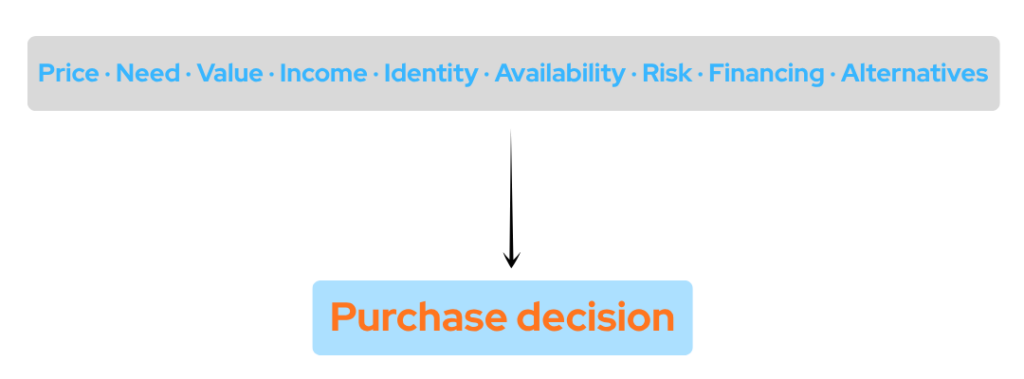
These forces do not carry equal weight in every situation. Someone replacing a broken phone may prioritise availability and immediate affordability. A professional may place greater weight on performance, reliability and longevity. A consumer with limited purchasing power may prefer a particular brand but choose another because financing makes the alternative accessible. Another consumer may place greater value on design, status or ecosystem continuity.
The same consumer can therefore make different smartphone choices at different moments without necessarily becoming inconsistent or disloyal. The preference can remain while the circumstances surrounding the purchase change.
Purchase is a moment, not the whole relationship
The purchase is where brand perception meets economic reality. A Samsung-preferring consumer who buys Redmi because of price may have changed products without abandoning Samsung. Another consumer may buy Redmi, have a poor ownership experience and return to Samsung. A third may discover that Redmi consistently provides better value for their needs and gradually change their long-term preference.
The transaction is therefore an event. Loyalty is a relationship that develops across events.
What happens after the transaction matters because ownership creates new evidence. Performance, reliability, software, battery life, camera quality, durability and service either confirm or challenge what the consumer expected from the brand. That experience influences satisfaction and, eventually, the next decision.
iii) The Post-purchase Loop

A positive experience can strengthen trust, encourage another purchase, and deepen brand attachment. A disappointing experience can create dissatisfaction and make alternatives more attractive. Yet even then, price, availability, promotions, financing, changing needs, and switching costs can influence what happens next.
Loyalty sits beyond the transaction
Loyalty should not be treated as the automatic result of repeated purchases. A consumer may repeatedly buy a brand because it is available, familiar or competitively priced without developing deep commitment. Equally, a single competing purchase may be temporary, situational or driven by a specific need rather than genuine rejection.
Loyalty is better understood as a durable relationship expressed through sustained preference, trust, commitment, repeat purchasing, advocacy and resistance to competing alternatives. It can survive an individual transaction and, under economic pressure, can even survive a temporary change in what the consumer buys.
This gives the Brand-to-Purchase Gap its value as a JuaTech analytical framework. It provides a way to examine smartphone consumer behaviour across brands, price segments, markets and ownership models without treating perception, purchase and loyalty as interchangeable measures.
Market share tells us what was sold. Purchase intention tells us what consumers say they may do. A transaction tells us what happened at a particular moment. The framework asks the more useful question: what happened between the consumer’s perception of the brand and the decision at the point of purchase? That is where price, need, value, purchasing power, identity, availability, risk, financing, and alternatives enter the analysis.
The central insight is therefore straightforward: brands can shape perception, earn consideration and build trust, but they do not control the purchase. Between the brand and the transaction sits the consumer’s reality. That space is the Brand-to-Purchase Gap.
What This Means for Brands, Retailers and Marketers
The Brand-to-Purchase Gap has consequences across the smartphone value chain. A manufacturer can build a trusted brand and a competitive product, but the outcome still depends on pricing, portfolio structure, distribution, retail execution and the consumer’s circumstances at the moment of purchase. The commercial lesson is straightforward: creating preference and converting preference are related activities, but they are not the same activity.
Manufacturers: Make the Premium Defensible
Manufacturers must ensure that the price they ask is supported by value the consumer can actually perceive. Brand equity can create willingness to pay, but the premium still has to be justified through product capability, reliability, software support, longevity, ecosystem benefits, service or other ownership advantages.
Portfolio architecture becomes equally important. A manufacturer needs products that address different purchasing capacities without making the range so fragmented that consumers cannot understand the value difference between models. Retention should also extend beyond annual upgrades. Financing, trade-ins, repairs, refurbished devices and lower-priced products can provide pathways for consumers to remain within a brand ecosystem when purchasing power changes.
Marketers: Stop Treating Consideration as Conversion
Marketing must distinguish the stages of the consumer relationship. Awareness establishes recognition. Trust strengthens confidence. Consideration puts the brand into the purchase conversation. Conversion records the transaction. Loyalty describes what happens across transactions and over time.
These are different outcomes and should be measured differently. High awareness does not demonstrate purchase intent. Purchase intent does not guarantee conversion. A successful transaction does not automatically establish loyalty.
The practical implication is that marketers need to connect brand metrics with behavioural evidence. Understanding why consumers consider a brand, why they choose it, why they reject it and what brings them back provides more commercial intelligence than measuring exposure alone.
Retailers: Influence the Final Decision
Retailers operate at the point where the consumers’ preferences meet available choices. Price thresholds, inventory, promotions, recommendations, and financing can all change the calculation. The retailer therefore has a role in translating product specifications into consumer value. A customer may enter looking for a particular brand but leave with another because the alternative offers a better price, is immediately available, comes with a promotion, or is recommended as a better fit for the customer’s needs. Understanding consumer motivation is therefore commercially valuable. The objective is not simply to sell what is in stock, but to understand what the customer is actually trying to solve.
Distributors: Convert Demand Into Availability
Distributors occupy a less visible but critical position between manufacturer strategy and retail execution. Inventory levels, geographic coverage, pricing discipline and channel relationships determine whether consumer demand can become an actual transaction.
Stock-outs can destroy conversion even when brand consideration is strong. Excess inventory can trigger discounting and weaken price positioning. Distribution is therefore not merely logistics. It shapes availability, pricing and the consumer’s opportunity to act on a preference.
JuaTech: Intelligence Across the Gap
For JuaTech Africa, the Brand-to-Purchase Gap provides a practical foundation for a broader intelligence proposition. Market intelligence explains what is happening across shipments, segments, prices, and channels. Consumer intelligence explains why consumers buy, delay, switch, trade down or remain loyal. Competitive intelligence examines how brands construct and defend their value propositions. Pricing intelligence examines the relationship between price, perceived value, affordability and purchase behavior.
These disciplines become more powerful when connected. A market-share movement becomes more meaningful when it can be examined alongside pricing, inventory, consumer motivations and competitive positioning.
That is the commercial opportunity in the framework. JuaTech does not need to stop at reporting what happened in the smartphone market. Its deeper value lies in explaining why it happened, what changed in the consumer decision equation, and where brands are gaining or losing value between consideration and purchase.
The Brand May Win the Mind. The Consumer Controls the Transaction.
The Samsung–Redmi paradox appears simple on the surface. A consumer can trust Samsung, recognise its quality, prefer its products and still purchase a Redmi smartphone. At first glance, that behaviour can look inconsistent. If trust creates preference, why does preference not always produce the purchase? The investigation shows that the apparent contradiction disappears once the distance between brand perception and purchasing behaviour is examined.
Consumers do not buy brands in isolation. They buy products within particular economic and personal circumstances. A consumer may trust Samsung because of its reputation, product experience, ecosystem, software support or perceived reliability. But when the purchase becomes immediate, that trust competes with price, need, perceived value, income, availability, financing, risk and competing alternatives.
A Redmi device may therefore become the more appropriate choice for a particular purchase without meaning that Samsung has lost the consumer’s trust. The consumer may judge that the additional amount required for Samsung does not provide enough additional value for the problem they need to solve. Another consumer may reach the opposite conclusion and decide that Samsung’s additional perceived value justifies the premium.
This is the Brand-to-Purchase Gap. The brand can influence awareness, familiarity, trust, preference and consideration, but the transaction occurs only after those perceptions encounter the realities of the consumer’s decision.
That distinction also changes how brand loyalty should be understood. A single purchase does not establish loyalty, just as a single switch does not necessarily destroy it. Consumers can delay purchases, trade down, use financing, repair an existing device, buy refurbished hardware or temporarily choose another brand while retaining a longer-term preference. Loyalty can therefore survive a change in transaction behaviour.
The broader African smartphone market makes this relationship particularly important. The continent contains markets at different stages of smartphone adoption, different levels of purchasing power and different combinations of first-time buyers and replacement demand. Consumers therefore encounter the same global smartphone brands under very different economic circumstances. A proposition that converts effectively in one market or consumer segment may face a different value equation elsewhere.
This makes modern smartphone competition more complex than a contest between specifications, advertising and brand recognition. Brands compete to establish trust, justify prices, create perceived value, secure availability, build ecosystems, reduce purchase risk and retain consumers after the transaction. Retailers, distributors, financing providers and secondary markets also influence whether a consumer can act on an existing preference.
The commercial consequence is that market share alone cannot explain the consumer relationship. Sales reveal what happened in a transaction. They do not always reveal what the consumer believed, what alternatives were considered, what constraint shaped the decision or whether the relationship with the previous brand has actually ended.
The Samsung–Redmi paradox therefore reveals something larger about smartphone consumer behaviour. Trust matters, but trust operates within an economic and competitive environment. Brand loyalty matters, but loyalty does not remove price, need, purchasing power or circumstance from the decision. Perceived value connects these forces by determining whether what the consumer expects to receive feels sufficient to justify what they must give up.
The fundamental insight is therefore simple: the brand may shape what the consumer believes. The consumer’s economic reality, motivations and perception of value determine what happens at the transaction.
The brand may win the mind. The consumer controls the transaction.
Methodology & Sources
Methodology
This Analytica investigation combines market intelligence, consumer research, academic literature and company information to examine the relationship between brand trust, perceived value, consumer choice and smartphone purchase behaviour.
The analysis draws primarily on African smartphone market data from Omdia, including shipment trends, vendor performance, average selling prices, price-segment movements, affordability pressures, inventory conditions, financing and channel dynamics. GSMA research provides additional context on smartphone affordability, mobile internet adoption, financing, distribution and secondary-device markets across Africa and Sub-Saharan Africa. Counterpoint Research is used to examine developments in Africa’s pre-owned and refurbished smartphone market.
Consumer behaviour is examined through academic research covering smartphone purchase preferences, brand equity, willingness to pay, brand switching and consumer decision-making. The research base includes studies from Kenya, Ghana, Vietnam and Indonesia. Where individual studies use specific samples, markets or methodologies, their findings are treated as evidence within those contexts rather than as representative of all African consumers.
Company information from Samsung and Xiaomi is used to describe publicly stated product, portfolio, ecosystem and positioning strategies. Such material is treated as evidence of company positioning, not independent evidence that consumers necessarily perceive or value those propositions in the same way.
The Brand-to-Purchase Gap is JuaTech Africa’s analytical framework developed through this investigation. It synthesises the evidence into a model that distinguishes brand awareness, familiarity, trust, preference and consideration from the economic, functional and situational factors that influence the final purchase. The framework is an analytical interpretation developed by JuaTech Africa and is not presented as a framework independently established by any single external study.
Throughout the investigation, market data is distinguished from consumer perception and behaviour. Shipment data is not treated as a direct measure of loyalty. Market share is not treated as a direct measure of brand trust. Purchase intention is distinguished from actual purchase behaviour, while a single transaction or brand switch is not treated as conclusive evidence of a long-term relationship.
The analysis therefore combines three layers: evidence establishes what is observable, research provides explanations for consumer and market behaviour, and JuaTech interpretation connects those findings into a broader analytical perspective.
Sources
1. Market Intelligence
Omdia. Smartphone Market Update 2Q26: Africa. 2026.
Primary source for 2Q26 African smartphone shipments, vendor performance, market share, average selling prices and price-segment developments.
Omdia. Africa’s smartphone shipments grew 3% in 1Q26 but 2026 outlook falls 28% amid affordability pressures. May 2026.
Source for 1Q26 African market performance, including Kenya, South Africa and Nigeria, replacement-cycle pressure, inventory frontloading and affordability conditions.
Omdia. Offline dominance in smartphone retail: Africa’s resilient backbone.
Source for the role of offline retail and the finding that offline channels contribute more than 95% of smartphone sales in most African markets.
Counterpoint Research. From Saturation to Surge: The Global Pre-owned Smartphone Landscape in Transition. October 2025.
Source for Africa’s 6% year-on-year growth in the pre-owned smartphone market in H1 2025 and Samsung’s 4% growth in the region’s refurbished market.
2. Africa, Affordability and Smartphone Adoption
GSMA Intelligence. Accelerating Smartphone Adoption in Africa. 2025.
Source for smartphone affordability, purchasing power, financing, distribution, adoption barriers, consumer behaviour and secondary-device markets across Africa.
GSMA. Improving handset affordability in low- and middle-income countries.
Source for the relationship between handset affordability, income and mobile internet adoption.
GSMA. M-KOPA: Applying the Pay-As-You-Go Model to Smartphones in Africa.
Source for the role of device financing and pay-as-you-go models in expanding smartphone access.
Safaricom. Customer Obsession / Lipa Mdogo Mdogo. 2024.
Source for Safaricom’s smartphone financing programme and reported customer reach.
3. Consumer Behaviour and Smartphone Choice
Kenyatta University. Marketing Strategies and Purchase Preference among Consumers of Smartphones in Nairobi City County, Kenya.
Source for evidence concerning product features, pricing, promotion, distribution and consumer smartphone purchase preferences in Nairobi.
Kenyatta University. Consumer Perception and Purchase Intention of Mobile Phones at Selected Retail Outlets in Nairobi City County, Kenya.
Source for research examining consumer perception, perceived quality, utility, price and purchase intention in Nairobi.
Osafo, S. K., Afriyie Frimpong, E. Y., & Kwofie, C. Brand equity and smartphone choice among Ghanaian university students. Scientific African, 32, e03304, 2026. DOI: 10.1016/j.sciaf.2026.e03304.
The study uses a discrete choice experiment involving 200 Ghanaian university students and examines trade-offs among brand, price, storage, battery capacity and camera quality. It finds brand and camera quality to be important drivers of choice and estimates willingness-to-pay premiums for selected premium brands within the study sample.
Ngo, T. T. A., An, G. K., Dang, N. Y., Doan, T. T., & Nguyen, V. M. H. The psychological impact of social media marketing on consumer willingness to pay for tech gadgets: A study on brand perception and decision-making. Acta Psychologica, 262, 106130, 2026. DOI: 10.1016/j.actpsy.2025.106130.
The study surveyed 371 Vietnamese consumers and used Partial Least Squares Structural Equation Modelling to examine brand perception, brand trust and willingness to pay premium prices for technology products.
Sari, T. R. L., Handayanto, E., & Sa’diyah, C. The Influence of Brand Experience, Brand Loyalty, and Brand Love on the Willingness to Pay a Premium Price among Samsung Smartphone Customers in Malang Raya. Jamanika, 4(3), 2024.
Source for the relationship between brand experience, loyalty, brand love and willingness to pay a premium price among Samsung smartphone customers in the Malang Raya market.
4. Brand Switching and Consumer Choice
Liao, J., Li, M., Wei, H., & Tong, Z. Antecedents of smartphone brand switching: a push-pull-mooring framework. Asia Pacific Journal of Marketing and Logistics, 33(7), 1596–1614, 2021. DOI: 10.1108/APJML-06-2020-0397.
The study uses online questionnaires, structural equation modelling and netnography to examine smartphone brand switching. It identifies regret as a push factor; subjective norms and alternative attractiveness as pull factors; and switching costs, emotional commitment and brand community engagement as mooring factors, while variety seeking increases switching intention.
N’da, K., Ge, J., Ren, S. J. F., & Wang, J. What matters for international consumers’ choice preferences for smartphones: Evidence from a cross-border ecommerce platform. PLOS ONE, 18(5), e0285551, 2023.
Source for analysis of smartphone choice preferences using transaction data from a cross-border e-commerce platform.
5. Brand and Company Positioning
Samsung. Why Galaxy. Samsung Africa.
Source for Samsung’s publicly stated Galaxy ecosystem, device integration and product proposition.
Xiaomi. About Xiaomi. Xiaomi Africa.
Source for Xiaomi’s publicly stated ecosystem strategy, product philosophy and broader Human × Car × Home positioning.
Interpretation of Evidence
The sources above are used according to their evidentiary role. Market intelligence establishes market conditions and observable commercial outcomes. Academic and consumer research provides evidence concerning motivations, perceptions, preferences and behavioural mechanisms. Company sources establish how brands describe their own propositions. JuaTech Africa’s analysis interprets the interaction among these elements.
No individual source is treated as sufficient to explain the entire consumer decision. In particular, market share and shipment data are not interpreted as direct measures of loyalty, consumer surveys are not treated as equivalent to observed purchasing behaviour, and findings from individual country or consumer samples are not automatically generalised across Africa.
The Brand-to-Purchase Gap is therefore presented as an analytical synthesis: a way of understanding what happens between a brand’s position in the consumer’s mind and the transaction that ultimately takes place.
Continue Exploring Analytica
When Trust Doesn’t Convert is part of Analytica, JuaTech Africa’s long-form market intelligence and analysis series examining the forces shaping mobile technology, businesses and consumers across Africa.
If this investigation changed how you think about smartphone purchasing, continue with the previous Analytica investigations:
Why Smartphone Innovation Feels Slower
Why does smartphone innovation feel increasingly incremental, and what does that reveal about the industry’s next phase?
The Rise of the Secondary Smartphone Market in Kenya
How are refurbished, used and secondary devices changing the economics of smartphone ownership in Kenya?
The Smartphone Longevity Era
Why are consumers keeping smartphones longer, and how is longer device ownership changing the market?
Stay connected to JuaTech Africa. Subscribe to the JuaTech Africa Newsletter for new intelligence, analysis, and market perspectives delivered directly to your inbox. You can also follow the JuaTech Africa WhatsApp Channel for new publications, intelligence briefs, and important developments as they happen.
Explore the Analytica series
Subscribe to the JuaTech Africa Newsletter
Follow JuaTech Africa on WhatsApp