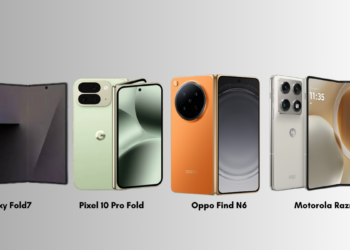


MediaTek, Qualcomm and Samsung are taking smartphone silicon into a new era of performance, efficiency and AI. But beyond the 2nm headlines, what will actually change for the phones we use?
The smartphone industry has entered a new silicon race, and this time the battleground is the 2nm smartphone processor. MediaTek’s Dimensity 9600 Pro, Qualcomm’s Snapdragon 8 Elite Gen 6 and Snapdragon 8 Elite Extreme Gen 6, and Samsung’s Exynos 2600 are bringing 2nm-class semiconductor technology into the flagship smartphone conversation. Their arrival marks another significant step in the race to deliver more computing power without proportionally increasing the power, heat and physical constraints that have always defined smartphones.

But what does 2nm actually mean for you? For most smartphone users, the process node printed in a processor specification means very little on its own. What matters is what manufacturers can do with the technology: make phones faster and more responsive, extend battery endurance, control heat under demanding workloads, process AI directly on the device, improve computational photography and sustain more demanding gaming experiences. That is where the 2nm smartphone chip becomes more than a semiconductor milestone.
MediaTek, Qualcomm and Samsung are therefore competing over something much bigger than a smaller transistor. They are competing over how much useful computing power the next generation of smartphones can deliver. The question is not simply who has the most advanced 2nm chip, but what 2nm will actually change in the phone you use.
What Is 2nm, Really?
The term 2nm refers to a new generation of semiconductor manufacturing technology. It does not mean every transistor in a 2nm smartphone processor is literally 2 nanometres in size. Process-node names have evolved into broad indicators of manufacturing advances that can enable greater transistor density, improved efficiency and higher performance within a similar physical footprint.
Why does that matter for smartphones? A phone has finite limits. Its battery can supply only so much power, its chassis can dissipate only so much heat, and its processor has limited physical space. Moving from 3nm toward 2nm gives chip designers an opportunity to pack more computing capability into that constrained environment while improving how efficiently the silicon uses power.
That is why performance per watt is more important than the “2nm” label itself. A processor that produces impressive peak performance but consumes excessive power or generates too much heat does not automatically create a better smartphone experience. The real promise of 2nm is the ability to deliver more useful computing within the same power and thermal envelope.
For the user, that could eventually mean faster performance, longer battery endurance, more capable on-device AI, better graphics and increasingly sophisticated image processing. The 2nm race, therefore, is ultimately a race to do more with less.
Three Chipmakers, Three Bets on the Future
The 2nm smartphone processor race brings three very different strategies into focus. MediaTek, Qualcomm and Samsung are not simply shrinking their flagship chips. They are deciding where the next gains in mobile computing should come from. The Dimensity 9600 Pro, Snapdragon 8 Elite Gen 6 family and Exynos 2600 therefore represent three competing approaches to the same problem: how to deliver more computing power without overwhelming the smartphone’s limits of power, heat and physical size.
More importantly, these processors are no longer abstract semiconductor announcements. The first 2nm smartphones are now appearing, while others are being prepared for launch. That gives us an opportunity to connect the silicon to the hardware it is designed to power and understand what each chipmaker is actually trying to achieve.
MediaTek: Make Efficiency a Weapon
The Dimensity 9600 Pro is MediaTek’s clearest statement yet that flagship silicon is no longer merely about chasing peak performance. Its 2nm platform combines an all-big-core CPU design, advanced AI processing, LPDDR6 memory support and UFS 5.0 storage. MediaTek claims significant generational gains in both performance and power efficiency, including up to 61% lower multi-core power consumption.
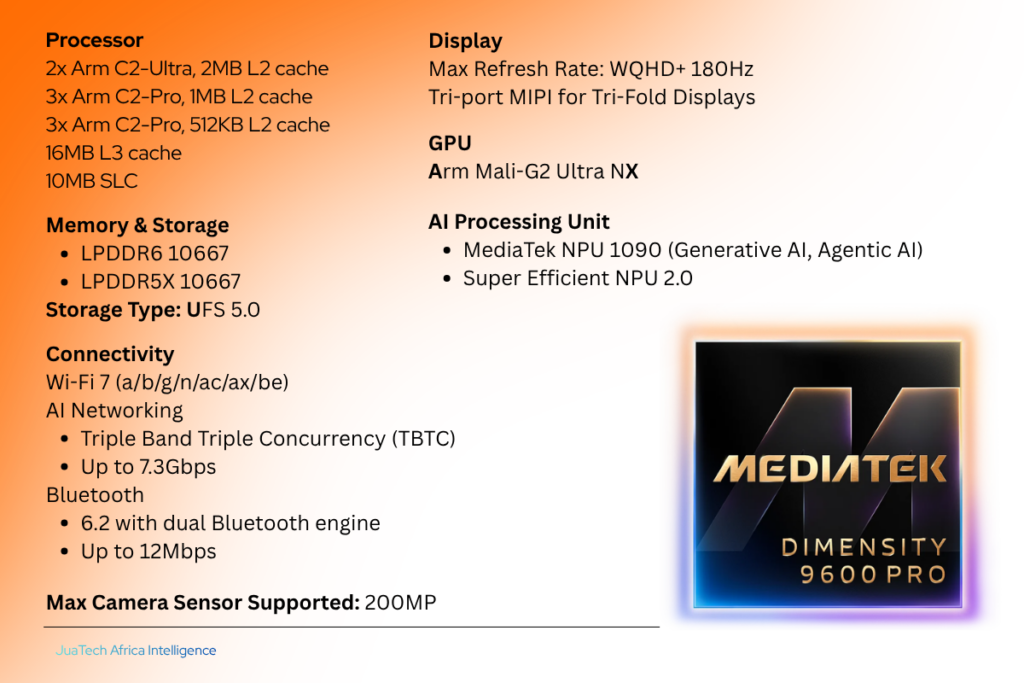
The strategy is already visible in hardware. Vivo X500 Pro Max is powered by the Dimensity 9600 Pro and pairs the processor with an aggressively specified camera system, an 8,000mAh battery and advanced 4K 240fps video capabilities. OPPO has also announced the Find X10 Pro Max as one of the first smartphones to feature the Dimensity 9600 Pro, with an international launch planned.
These devices illustrate an important part of MediaTek’s strategy. The company is not simply trying to produce a faster processor. It is creating additional computational headroom for high-end photography, AI processing, gaming and sustained workloads, while attempting to reduce the power cost of delivering that performance.
The strategic play is therefore clear: MediaTek is turning efficiency into flagship leverage.
Qualcomm: Raise the Ceiling, Widen the Platform
Qualcomm is approaching the new generation differently. Instead of one flagship platform, it has introduced two: the Snapdragon 8 Elite Extreme Gen 6 and the Snapdragon 8 Elite Gen 6.
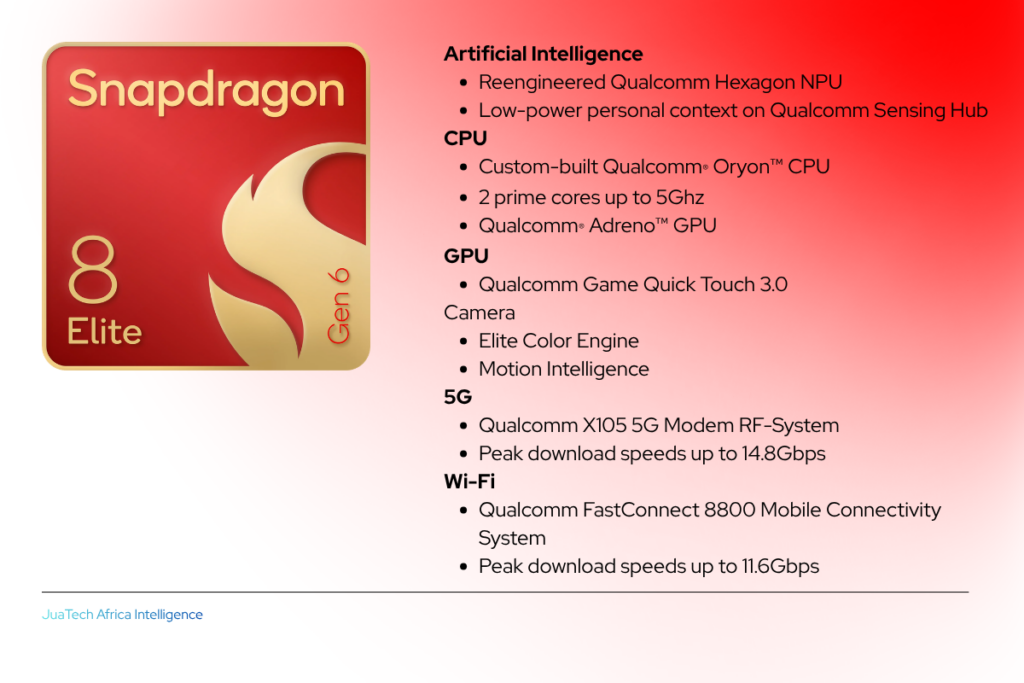
The Extreme platform represents Qualcomm’s highest-performance configuration, while the standard Snapdragon 8 Elite Gen 6 extends many of the same AI, gaming, imaging and connectivity capabilities into a broader premium tier. Both are built on a 2nm process and use Qualcomm’s custom Oryon CPU, rearchitected Adreno GPU and Hexagon NPU. The Oryon CPU reaches 5GHz, giving Qualcomm the highest headline CPU clock among the four platforms examined in this article.
The hardware ecosystem is already taking shape. Motorola has unveiled the motorola signature 27, which uses the Snapdragon 8 Elite Extreme Gen 6 and is positioned as the company’s new ultra-premium flagship. Qualcomm has also identified HONOR, iQOO, OnePlus, OPPO, REDMI, RedMagic, vivo and Xiaomi among the manufacturers preparing smartphones based on the new Snapdragon platforms.
That distinction matters. Snapdragon 8 Elite Gen 6 & Snapdragon 8 Elite Extreme Gen 6 are not simply two names for the same chip. Qualcomm is creating a two-tier flagship silicon strategy. The Extreme platform pushes the performance ceiling, while the standard platform gives manufacturers a way to bring much of Qualcomm’s new AI, graphics and connectivity architecture to a wider range of top-tier devices.
Qualcomm’s strategy is therefore broader than producing the fastest processor. It is attempting to expand the Snapdragon platform around a new generation of AI-heavy, graphics-intensive and increasingly intelligent smartphones.
Samsung: Turn 2nm GAA Into a System Advantage
The Exynos 2600 takes a different route. Built using Samsung’s 2nm GAA process, it combines a new-generation CPU, NPU and Xclipse 960 GPU with claimed gains in computing, AI and ray-tracing performance over the previous generation.
Its CPU architecture is also distinctive. The Exynos 2600 uses a 10-core 1+3+6 configuration, consisting of one C1-Ultra core, three higher-performance C1-Pro cores and six efficiency-focused C1-Pro cores. Samsung’s published specifications place those groups at 3.8GHz, 3.25GHz and 2.75GHz respectively.
Unlike the newly announced Snapdragon platforms, the Exynos 2600 is already directly tied to Samsung’s current flagship hardware. Galaxy S26 and Galaxy S26+ use the Exynos 2600 in markets where Samsung specifies the processor, with Samsung positioning the chip as a foundation for CPU, GPU, NPU, camera and energy-efficiency improvements. Already, the Exynos 2500 (3nm) on the Galaxy S26 FE shows promise that Samsung are not messing around
That makes the Galaxy S26 family particularly useful to this discussion. Samsung controls the semiconductor manufacturing process, chip design, smartphone hardware and much of the software environment. It can therefore tune the Exynos 2600 around the Galaxy experience rather than treating the SoC as an isolated component.
Samsung’s real differentiator, therefore, is structural. It operates across semiconductor manufacturing, chip design and smartphones, giving it an opportunity to connect its 2nm GAA process directly to Exynos and Galaxy hardware.
Three Strategies, One Silicon Transition
The smartphones make those strategies tangible. Vivo X500 Pro Max and OPPO Find X10 Pro Max show where MediaTek’s Dimensity 9600 Pro is being deployed: high-end devices where camera processing, AI, gaming and sustained efficiency are central to the proposition.
The motorola signature 27 demonstrates Qualcomm’s Extreme Gen 6 strategy in hardware, while the company’s broader list of launch partners shows how the two Snapdragon 8 Elite Gen 6 platforms are being positioned as a premium ecosystem rather than a single-device proposition.
The Galaxy S26 and S26+ show Samsung taking its 2nm silicon directly into its own flagship hardware and software environment.
Three companies, therefore, are pursuing three different forms of advantage: MediaTek is weaponising efficiency, Qualcomm is expanding the performance frontier across two flagship tiers, and Samsung is attempting to turn manufacturing integration into a system-level advantage. The 2nm battle is no longer just happening inside semiconductor fabs. It is now appearing in the smartphones consumers hold in their hands.
2nm Smartphone Silicon: The Technical Reference
The four flagship platforms entering the 2nm smartphone era take distinctly different approaches to CPU design, graphics, AI and power efficiency. This reference brings the most important technical differences into one place, with particular attention to the architecture and clock speeds that shape how each platform is designed to perform.
| Technical specification | MediaTek Dimensity 9600 Pro | Snapdragon 8 Elite Gen 6 | Snapdragon 8 Elite Extreme Gen 6 | Samsung Exynos 2600 |
| Process technology | 2nm | 2nm | 2nm | 2nm GAA |
| CPU architecture | Arm C2-Ultra + C2-Pro | Qualcomm Oryon | Qualcomm Oryon | Arm C1-Ultra + C1-Pro |
| CPU architecture generation | Arm C2 | Custom 64-bit Oryon | Custom 64-bit Oryon | Armv9.3 |
| CPU cores | 8-core | 8-core | 8-core | 10-core |
| CPU configuration | 2 + 3 + 3 | 2 + 6 | 2 + 6 | 1 + 3 + 6 |
| CPU core arrangement | 2 × C2-Ultra + 3 × C2-Pro + 3 × C2-Pro | 2 × Prime + 6 × Performance | 2 × Prime + 6 × Performance | 1 × C1-Ultra + 3 × high-performance C1-Pro + 6 × efficiency-focused C1-Pro |
| Highest CPU clock | 4.55GHz | 5.0GHz | 5.0GHz | 3.8GHz |
| Other CPU clocks | 3 × C2-Pro @ 4.35GHz; 3 × C2-Pro @ 3.1GHz | 6 × Performance @ 4.0GHz | 6 × Performance @ 4.0GHz | 3 × C1-Pro @ 3.25GHz; 6 × C1-Pro @ 2.75GHz |
| CPU cache | 16MB L3 + 10MB SLC; 2MB/1MB/512KB L2 by core group | 16MB Oryon Flex Cache | 16MB Oryon Flex Cache | Samsung does not publish an equivalent cache breakdown |
| GPU | Arm Mali-G2 Ultra NX | Qualcomm Adreno | Qualcomm Adreno with Matrix Cores | Samsung Xclipse 960 |
| GPU architecture / features | Ray tracing + Neural Graphics | Hardware-accelerated ray tracing | Adreno Neural Fusion + Matrix Cores + ray tracing | Ray tracing + Exynos Neural Super Sampling |
| AI processor | NPU 1090 + Super Efficient NPU 2.0 | Qualcomm Hexagon NPU + Sensing Hub | Qualcomm Hexagon NPU + Sensing Hub | Dedicated NPU / AI Engine |
| AI emphasis | Agentic AI, generative AI, models up to 30B parameters | Agentic AI + on-device learning | Agentic AI + larger on-device models | Generative AI + on-device processing |
| Memory support | LPDDR6 10667 / LPDDR5X 10667 | LPDDR5X / LPDDR6* | LPDDR5X / LPDDR6* | LPDDR5X |
| Storage support | UFS 5.0 | UFS 5.0* | UFS 5.0* | UFS 4.1 |
| Maximum camera support | 200MP | Up to 320MP* | Up to 320MP | Up to 320MP |
| Video capability | Up to 8K60; 4K120; 4K240 slow motion | Up to 8K30* | Up to 8K60; 4K240 | Up to 8K |
| Gaming emphasis | Ray tracing + Neural Graphics | Adreno gaming + hardware ray tracing | Neural Fusion + AI graphics + ray tracing | Xclipse 960 + ray tracing + ENSS |
| 5G modem | Integrated 5G | Qualcomm X105 Modem-RF | Qualcomm X105 Modem-RF | Samsung 5G modem platform |
| Peak 5G download | Platform dependent | 14.8Gbps | 14.8Gbps | Platform dependent |
| Wi-Fi | Wi-Fi 7 | FastConnect 8800, Wi-Fi 8 | FastConnect 8800, Wi-Fi 8 | Wi-Fi platform dependent |
| Bluetooth | 6.2 | Bluetooth 6 | Bluetooth 6 | Platform dependent |
| Distinctive architectural approach | All-big-core CPU + dual-NPU architecture | 5GHz Oryon + balanced flagship platform | 5GHz Oryon + enhanced graphics and AI architecture | 2nm GAA + 10-core heterogeneous CPU |
How to Read the Numbers
The table immediately reveals one of the most interesting characteristics of this 2nm generation: the highest clock speed does not belong to the chip with the highest core count. Qualcomm reaches 5.0GHz on its Oryon prime cores, MediaTek reaches 4.55GHz on its C2-Ultra cores, while Samsung’s Exynos 2600 peaks at 3.8GHz. At the same time, Samsung uses ten CPU cores, compared with eight on both MediaTek and Qualcomm platforms.
Those numbers are useful, but they are not a performance ranking. The processors use different architectures, core designs, cache structures and power-management strategies. They also divide work differently between CPU, GPU and NPU. MediaTek takes an all-big-core 2+3+3 approach, Qualcomm uses a 2+6 Oryon configuration, while Samsung employs a 1+3+6 design that replaces the traditional little-core cluster with six efficiency-focused middle cores.
That distinction is important because a CPU does not spend its life running at its maximum clock. The real smartphone experience depends on how effectively a processor moves between performance states, how much work it can complete per clock cycle, how efficiently it uses power and how long the phone can sustain that workload before heat becomes a constraint. The numbers tell us what these chips are built to do. The architecture tells us how they intend to do it.
The Real 2nm Battle Isn’t About Clock Speed
The easiest way to misunderstand the 2nm smartphone processor race is to reduce it to clock speed and benchmark scores. A 4.55GHz CPU may establish a formidable performance ceiling, but a smartphone cannot operate at its ceiling indefinitely. It has a finite battery, a finite thermal envelope and a finite amount of space in which to dissipate heat. The more important question is therefore what a processor can sustain after the initial burst of performance.
This is where performance per watt becomes the real measure of progress. MediaTek reports both higher CPU performance and substantially lower power consumption on the Dimensity 9600 Pro, while Qualcomm’s Snapdragon 8 Elite Gen 6 and Extreme Gen 6 similarly emphasise efficiency alongside CPU and GPU gains. Samsung is making the same argument with the Exynos 2600, linking its 2nm GAA process and architectural changes to power efficiency across CPU, GPU and AI workloads.
The implications extend beyond the CPU. A capable GPU must sustain demanding graphics without exhausting the phone’s thermal budget. An NPU must execute increasingly complex AI workloads locally without turning continuous intelligence into continuous battery drain. And the entire system has to coordinate these workloads rather than allowing one component’s peak performance to undermine the device’s efficiency elsewhere.
That changes the definition of a powerful smartphone processor. Peak performance tells us how hard the chip can run. Performance per watt tells us how much useful work it can deliver before the phone’s physical limits intervene. The significance of 2nm, ultimately, lies in expanding that usable performance envelope.
So, What Will You Actually Notice?
The value of a 2nm smartphone processor is ultimately decided outside the semiconductor laboratory. It has to translate into a better device. That transition is already beginning as the Dimensity 9600 Pro, Snapdragon 8 Elite Gen 6 family and Exynos 2600 move into real flagship hardware. The important question is therefore no longer simply what 2nm can do in theory, but what users can actually expect to experience in phones built around it.
Battery: Will 2nm Make Phones Last Longer?
Potentially, but 2nm does not automatically mean longer battery life. Greater transistor efficiency gives chip designers more computing capability within a given power budget, allowing the same workload to consume less energy or more demanding workloads to run without a proportional increase in consumption. The Dimensity 9600 Pro, for example, is being deployed in flagship hardware where manufacturers can combine its efficiency with large batteries and aggressive performance targets. The final endurance still depends on the display, modem, battery capacity, software and overall system tuning.
Performance: Will Your Phone Actually Feel Faster?
Yes, but peak benchmark scores are only part of the story. The more meaningful improvement may be how long a phone can maintain high performance. A faster CPU can accelerate demanding applications, multitasking and AI workloads, while greater efficiency can reduce the power cost of sustaining that performance. In practice, the difference between generations may appear less as a dramatic burst of speed and more as consistent responsiveness when the workload becomes heavy.
Heat: Will Phones Run Cooler?
Better efficiency can create additional thermal headroom, but it does not guarantee a cool phone. A processor still operates inside a tightly constrained chassis. During extended gaming, video processing or AI workloads, the ability to move heat away from the silicon becomes critical. If 2nm allows more useful work before thermal limits intervene, the benefit is not merely lower temperature; it is less performance lost to throttling.
AI: Will AI Finally Become More Useful?
This may be the most consequential change. More capable NPUs and AI engines allow smartphones to process increasingly sophisticated workloads locally, including generative AI, image enhancement, voice processing and other functions that previously depended more heavily on cloud computing. The 2nm generation gives manufacturers more computational headroom to make these features practical without turning every AI interaction into a battery drain. What users actually experience, however, will depend on the models and software deployed by each phone maker.
Cameras and Gaming: What Changes?
Cameras can benefit from stronger ISP and NPU capabilities by processing more image and video information in real time, enabling increasingly sophisticated computational photography. Gaming benefits from stronger GPUs and improved efficiency, particularly when demanding workloads continue for long periods. The real gain is therefore not simply a higher frame-rate or faster image-processing claim, but the possibility of sustained high performance without exhausting the phone’s thermal and power budget.
That is the consumer significance of 2nm. It is not simply about making the next smartphone faster. It is about giving that smartphone more usable computing capacity within the same fundamental limits of battery, heat and size.
Here’s the Catch: 2nm Doesn’t Automatically Make a Better Phone
There is a temptation to treat 2nm as a shortcut to a better smartphone. It is not. The processor is the engine of the device, but the engine does not determine the entire driving experience. A flagship 2nm smartphone chip can deliver extraordinary capability and still be held back by poor thermal management, an inefficient display, limited battery capacity or software that fails to use the available hardware effectively.
The real smartphone experience is the product of a system: SoC, cooling, battery, RAM, storage, display, modem, software and OEM optimisation working together. This is particularly important when evaluating claims around performance and efficiency. A manufacturer’s processor-level improvement does not automatically translate into the same percentage improvement in battery life, gaming endurance or everyday responsiveness.
The reverse is also true. A well-engineered smartphone can extract remarkable performance and efficiency from a previous-generation process through intelligent power management, effective cooling and tightly integrated software.
That distinction matters because 2nm creates an opportunity; it does not guarantee an outcome. The winners of this transition will ultimately be determined not only by who produces the most advanced silicon, but by who turns that silicon into the most effective complete smartphone.
Does This Mean You Should Wait for a 2nm Phone?
The arrival of 2nm smartphone processors does not make today’s flagship phones obsolete. Current 3nm and 4nm platforms already deliver substantial CPU and GPU performance, advanced AI processing, sophisticated cameras and high-end gaming. The 2nm generation represents another step in efficiency and computing headroom, not a dividing line between capable and incapable smartphones.
For someone considering a new phone, the more useful question is what the device needs to deliver today versus what the 2nm generation is likely to improve over time. Early 2nm smartphones will occupy the premium end of the market, where manufacturers can justify the cost of new silicon and build around its capabilities. As semiconductor production matures, those advances should progressively reach more devices and price segments.
The other reason to avoid judging the transition too quickly is that the chip is only the starting point. Actual battery endurance, sustained performance, thermal behaviour, gaming and on-device AI require testing inside finished products. The first generation establishes what 2nm can deliver; subsequent generations will show how effectively manufacturers can turn that capability into everyday value.
So the real question is not whether you should automatically wait for 2nm. It is whether the additional performance, efficiency and AI capability of a particular 2nm phone justify its position when compared with the complete experience available today.
What 2nm Means for the Smartphone Industry
The significance of the 2nm smartphone processor race extends well beyond MediaTek, Qualcomm and Samsung. It signals a shift in what manufacturers will compete over as conventional smartphone performance becomes increasingly mature. CPU speed will remain important, but performance per watt, on-device AI, graphics, imaging and sustained computing are becoming equally important measures of a mobile platform’s value.
AI is particularly significant. As more processing moves from the cloud onto the device, the smartphone needs silicon capable of handling increasingly complex workloads without exhausting its battery or thermal headroom. That makes semiconductor efficiency a strategic advantage rather than simply an engineering achievement. It also gives chipmakers greater influence over the direction of smartphone design, from cooling systems and battery requirements to camera architectures and the physical limits of future devices.
For manufacturers, the next challenge is therefore converting semiconductor advances into products consumers can justify buying. That becomes especially important in Africa, where premium technology eventually has to cross a difficult bridge from flagship innovation to affordable mass-market hardware. The important question for the African smartphone market is not simply when 2nm arrives, but how quickly its benefits begin filtering into the devices ordinary consumers can realistically access.
That is where the 2nm race becomes a market story.
Three Chipmakers, Three Bets on the Future
The 2nm smartphone processor race brings three distinct strategies into focus. MediaTek, Qualcomm and Samsung are not simply shrinking their flagship chips. They are deciding how the additional efficiency and computing headroom of 2nm should be used.
The easiest way to understand the transition is to look at what came before. 3nm already transformed flagship smartphone silicon, enabling higher CPU and GPU performance, stronger on-device AI and better power efficiency without proportionally increasing the size of phones or their batteries. The 2nm generation now attempts to push that balance further.
MediaTek: Make Efficiency a Weapon
The Dimensity 9600 Pro builds on MediaTek’s All Big Core strategy, moving from the 3nm Dimensity 9500 to a 2nm 2+3+3 architecture using C2-Ultra and C2-Pro cores. Its top core reaches 4.55GHz, while MediaTek claims up to 61% lower multi-core power consumption than its predecessor. The chip is already finding its way into premium hardware, including the OPPO Find X10 Pro Max, where its efficiency can be paired with a large battery, advanced imaging and sustained AI workloads.
Qualcomm: Raise the Ceiling
Qualcomm takes a more aggressive performance route. The Snapdragon 8 Elite Gen 6 and 8 Elite Extreme Gen 6 bring its Oryon CPU architecture to 2nm, with peak CPU clocks reaching 5GHz. The Extreme version pushes the performance ceiling, while the standard platform extends the architecture across a broader flagship tier. The motorola signature 27 provides an early example of the Extreme platform in premium hardware, while Qualcomm has named several other major Android manufacturers preparing devices around the new silicon.
Samsung: Make the Process Part of the Product
The Exynos 2600 moves Samsung from 3nm GAA to 2nm GAA, with a distinctive 10-core 1+3+6 CPU configuration. It reaches 3.8GHz on its C1-Ultra core and is already deployed in the Galaxy S26 and S26+ in markets where Samsung specifies Exynos. Because Samsung controls semiconductor manufacturing, processor design and Galaxy hardware, it can tune the silicon as part of a broader system rather than treating it as an isolated component.
Three companies, therefore, are making three different bets. MediaTek is weaponising efficiency, Qualcomm is pushing the performance frontier, and Samsung is attempting to turn manufacturing integration into a system-level advantage.
What 3nm established, 2nm now seeks to extend: more useful computing within the same fundamental limits of battery, heat and physical size. The first 2nm phones are premium products, but their importance extends beyond today’s flagships. As the technology matures, its efficiency and computing gains should progressively filter into broader smartphone categories. The 2nm transition is therefore not simply about a smaller process node. It is about deciding what to do with the additional headroom that node creates.
Stay Ahead of the Silicon Shift
The 2nm era is only beginning. As this technology moves from premium flagships into more accessible smartphones, it will reshape performance, battery life, AI, cameras and the economics of mobile technology.
At JuaTech Africa, we are following that shift beyond the specifications. Explore our Analytica, Industry Intelligence and Kenya Smartphone Market reports for deeper analysis of the technologies and market forces shaping Africa’s next smartphone cycle. If you want the signal before it becomes another headline, join the JuaTech Africa WhatsApp Intelligence Circle for focused technology and market updates. You can also subscribe to our newsletter for new intelligence, reports and analysis delivered directly to you. Don’t just keep up with technology. Understand where it is going