

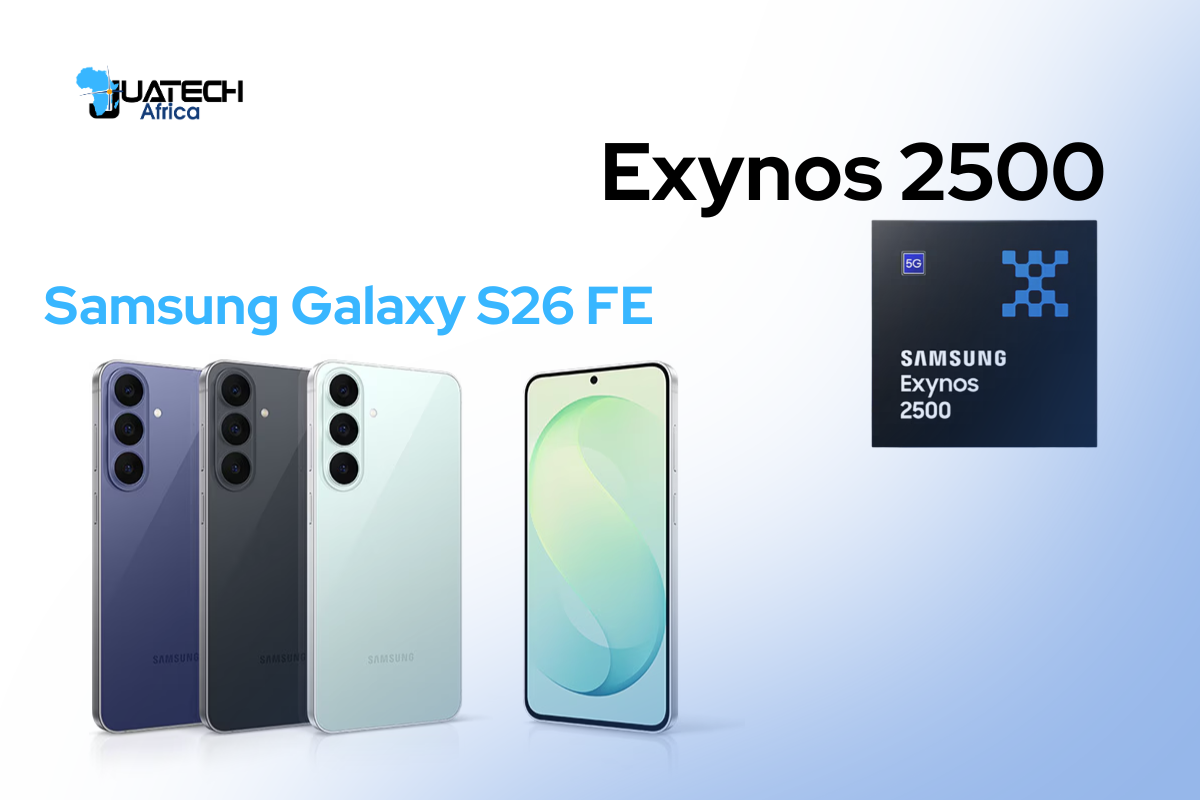
Samsung’s 3nm Exynos 2500 brings a new CPU architecture, Xclipse 950 graphics and a 59-TOPS NPU to the Galaxy S26 FE. But beyond the specifications, its real significance lies in what it reveals about Samsung’s evolving approach to performance, AI, efficiency and the Galaxy experience.
For years, Samsung’s Exynos processors have occupied an unusual position in the smartphone industry. One of the world’s largest technology companies designs them, yet much of the public conversation has been reduced to a familiar comparison: Exynos versus Snapdragon. That debate is understandable, but it can obscure the more consequential story. Exynos represents Samsung’s attempt to control one of the most important layers of the smartphone, from computing and graphics to artificial intelligence, imaging and power efficiency. The Exynos 2500 is a useful point at which to examine how far that ambition has progressed, particularly now that Samsung has put the chip into the Galaxy S26 FE.

Exynos 2500: How Far Has Samsung Come?
The Exynos 2500 is not simply another processor upgrade. Built on Samsung’s 3nm Gate-All-Around process, it combines a deca-core CPU based on Arm’s latest architecture with the fourth-generation Xclipse 950 GPU, a dedicated NPU for AI workloads, an advanced image signal processor, and an integrated 5G modem. Samsung says the NPU can deliver up to 59 trillion operations per second, a 39% improvement over its predecessor, while the processor’s power-efficient architecture and packaging are designed to improve performance without letting the added computing capability overwhelm a smartphone’s thermal and battery constraints.
Those specifications become clearer when you view the Exynos 2500 as a system-on-chip rather than simply a CPU. A modern smartphone distributes work across several specialized processing units. The CPU handles general computing, the GPU handles graphics, the NPU accelerates neural-network workloads, and the image signal processor helps turn raw camera data into the photographs and video users ultimately see. The modem manages cellular connectivity, while the chip’s power-management architecture must keep all these workloads within the limited energy and thermal envelope of a pocket-sized device. Samsung’s Exynos 2500 is therefore designed to coordinate an increasingly complex collection of computing tasks within a single mobile platform.
That matters because processor capability only becomes valuable when it changes what the user can actually do. A faster CPU should translate into responsive multitasking rather than merely a higher benchmark score. The Xclipse 950 GPU, built around AMD’s RDNA 3 architecture and supporting hardware-accelerated ray tracing, should matter when demanding games require sustained graphics performance. Samsung’s image-processing capabilities should matter when computational photography improves difficult shots or enables more sophisticated video processing. The NPU should matter when it can run AI functions efficiently on the device. The real measure of Exynos, therefore, is not the specification itself but the experience that Samsung can build around it.
The AI Test Is More Important Than the TOPS Number
This is where the Exynos 2500 becomes particularly relevant to the smartphone industry’s direction. Samsung has designed the chip for on-device AI and says its NPU can process up to 59 TOPS. The company also highlights support for ExecuTorch, which lets developers deploy PyTorch-based models directly on Exynos-powered devices, and describes the 2500 as a foundation for a hybrid AI approach in which on-device and cloud processing can work together.
The distinction between AI capability and AI usefulness is important here. A TOPS figure describes the NPU’s theoretical processing capacity, but it doesn’t tell us whether a person will actually experience a better AI-enabled smartphone. That depends on the models used, software optimization, memory, power consumption, thermal management, and whether Samsung or third-party developers use the hardware effectively. An NPU can be extremely capable and still have limited practical impact if the software does not exploit it properly. Conversely, well-integrated on-device AI can make complex tasks feel almost instantaneous because the underlying processing becomes invisible to the user.
The Galaxy S26 FE provides Samsung with an opportunity to demonstrate that integration. The device pairs the Exynos 2500 with One UI 9 and Samsung’s latest Galaxy AI experiences, plus a 6.7-inch Dynamic AMOLED 2X display with a 120Hz refresh rate, a 4,900mAh battery, and a triple-camera system led by a 50MP main sensor with optical image stabilization and a 3x optical telephoto camera. Samsung is also committing the S26 FE to up to seven generations of OS upgrades and seven years of security updates, giving the device a much longer software horizon than the traditional smartphone replacement cycle.
That combination is significant because it gives the Exynos 2500 a job beyond delivering raw performance. It must support the camera system, sustain display and gaming workloads, manage power consumption, and provide the computational foundation for AI features that Samsung increasingly uses to differentiate the Galaxy experience. The S26 FE is therefore a useful test of whether Samsung can turn its semiconductor engineering into a broader product advantage.
Why Samsung Still Cares About Its Own Silicon
The strategic appeal of Exynos becomes clearer when you consider the processor alongside the rest of Samsung’s technology stack. Samsung has expertise across semiconductor design and manufacturing, memory, displays, cameras, mobile hardware and software. Owning the mobile SoC gives the company greater influence over how these components interact, potentially allowing tighter optimisation between the processor, imaging system, AI workloads, power management and One UI. That does not automatically make Samsung’s approach superior to Qualcomm’s or MediaTek’s, but it gives Samsung a degree of control that is strategically valuable as smartphones become more dependent on specialised computing.
The Galaxy S26 FE is particularly interesting because the FE line extends this technology beyond Samsung’s highest-priced flagship models. Samsung describes the S26 FE as bringing flagship experiences to more consumers, and the device combines the Exynos 2500 with Galaxy AI, advanced cameras, a 120Hz AMOLED display, 5G and long-term software support. In effect, Samsung is taking its own silicon and placing it inside a product designed to make premium Galaxy capabilities accessible to a broader market.
That is why the Exynos 2500 deserves to be examined on its own terms. The question is no longer simply whether Samsung can produce a competitive mobile processor. It is whether the company can use that processor as part of a tightly integrated Galaxy platform in which silicon, AI, imaging, software, connectivity and long-term support reinforce one another. The Galaxy S26 FE offers the latest chance to see whether that ambition is translating from semiconductor engineering into meaningful consumer value, and whether Exynos is becoming more than Samsung’s answer to Snapdragon.
From Exynos 2400 to Exynos 2500: Where Samsung Has Actually Moved Forward
The Exynos 2500 makes more sense when viewed against the Exynos 2400 rather than as an isolated processor. The previous generation already marked an important step for Samsung, bringing a deca-core CPU, AMD RDNA 3-based Xclipse 940 graphics, hardware-accelerated ray tracing, on-device AI processing and an integrated 5G modem. Samsung also moved the Exynos 2400 to a 4nm process with fan-out wafer-level packaging, reflecting a growing emphasis on managing both performance and thermals.
The Exynos 2500 builds on that foundation with a different CPU configuration, a newer Xclipse 950 GPU and a substantially expanded emphasis on neural processing. Its CPU uses a 1+7+2 arrangement built around a Cortex-X925 performance core, while Samsung says the large core delivers up to 15% higher performance than the corresponding Exynos 2400 core. The GPU remains based on AMD’s RDNA 3 architecture, but the Xclipse 950 represents the fourth generation of Samsung’s Xclipse graphics technology and continues the company’s push into hardware-accelerated graphics and ray tracing.
The bigger change, however, may be how Samsung treats AI as a core part of the processor rather than an add-on feature. The Exynos 2500’s NPU is rated at up to 59 TOPS, which Samsung says represents a 39% improvement over the Exynos 2400. It also supports frameworks such as ExecuTorch, giving developers a path to deploy AI models directly on the device.
That progression matters because modern smartphone workloads are becoming increasingly heterogeneous. A camera application may simultaneously depend on the CPU, GPU, ISP and NPU. An AI-assisted editing feature may use neural processing while memory, storage and thermal management determine how quickly the task can be completed. Gaming similarly depends on more than peak CPU performance, with graphics architecture, sustained thermal behavior and power efficiency influencing the experience over longer sessions.
Samsung’s development of Exynos therefore reflects a broader shift in what a smartphone processor represents. It is no longer simply the component that makes applications run quickly. It is becoming the computational foundation through which the phone interprets images, processes AI models, renders graphics, manages connectivity and coordinates increasingly sophisticated software.
59 TOPS Sounds Impressive. But What Does Samsung’s AI Actually Do?
This is where the specifications need to be translated into something more meaningful. A 59-TOPS NPU indicates substantial theoretical neural-processing capability, but TOPS alone does not tell a buyer how useful the phone’s AI will be. The practical outcome depends on the models being run, software optimization, memory bandwidth, thermal limits, power consumption and how much of the workload can actually be processed locally.
The Exynos 2500 is designed to support several of these emerging workloads. Samsung highlights on-device generative AI capabilities, including object removal and background expansion, alongside AI-based image processing. Its ISP also supports camera systems of up to 320 megapixels and 8K video processing.
The practical implication is important. When a Galaxy device can process more of an AI or imaging workload locally, it can potentially reduce dependence on cloud processing and improve responsiveness for supported features. But that does not mean every AI feature automatically becomes faster or better simply because the NPU is more powerful. Samsung still has to integrate the hardware effectively into One UI, Galaxy AI and the applications people actually use.
That distinction is central to understanding Exynos 2500. The silicon creates capability; Samsung’s software determines how much of that capability becomes visible to the user.
The Galaxy S26 FE Is Where Exynos 2500 Faces Its Real Test
The Galaxy S26 FE gives the Exynos 2500 a different significance because it places Samsung’s silicon inside a commercially important Galaxy device rather than leaving the processor as a semiconductor achievement on paper. The phone combines the chip with a 6.7-inch 120Hz Dynamic AMOLED 2X display, a 4,900mAh battery, a 50MP main camera with optical image stabilization and a 3x telephoto camera, alongside Samsung’s current software and Galaxy AI experience.
That combination creates a much more useful test of Exynos. The question is no longer whether Samsung can produce a processor with competitive specifications. The question becomes whether the entire device can convert that processing capability into sustained performance, responsive AI features, effective computational photography, good gaming behavior and sensible power consumption.
This is also why processor comparisons can become misleading when reduced to a single benchmark number. A smartphone is a system. The processor, display, battery, cooling system, memory, cameras, operating system and applications all influence the final experience. A theoretically powerful chipset that cannot sustain its performance under heat or that lacks deep software optimization may deliver a different experience from what its specification sheet suggests.
The S26 FE therefore gives Samsung an opportunity to demonstrate something broader: whether proprietary silicon can become a meaningful part of the Galaxy experience rather than simply another component inside it.
Samsung’s Bigger Bet: Owning More of the Galaxy’s Intelligence
There is a strategic reason Samsung continues to invest in Exynos even when the smartphone market is dominated by powerful competing platforms. Samsung Semiconductor describes Exynos as a highly integrated platform combining computing, graphics, neural processing, imaging, display, security and connectivity functions.
Greater control over these layers gives Samsung more room to coordinate the hardware and software stack. In principle, that can allow the company to tune power management around its own silicon, optimize imaging pipelines around its camera systems, integrate AI acceleration more deeply into Galaxy software and develop device features with greater control over the underlying architecture.
But vertical integration does not automatically produce differentiation. The commercial value appears only when that control results in experiences that users can notice. Samsung therefore has to solve two problems simultaneously: build competitive silicon and make that silicon matter.
The Exynos 2500 matters because it shows Samsung continuing to work on both sides of that equation. It represents progress in CPU architecture, graphics, neural processing, manufacturing, and packaging, while its deployment in the Galaxy S26 FE puts those improvements in consumers’ hands.
And the journey has not stopped there. Samsung’s processor portfolio has already moved on to the Exynos 2600, making the Exynos 2500 less a final destination than a marker in a longer silicon roadmap.
What Exynos 2500 Reveals About Samsung’s Silicon Strategy
The most interesting story surrounding Exynos 2500 is therefore not whether it settles the familiar Exynos-versus-Snapdragon argument. That framing is too narrow for what Samsung is actually building.
The more consequential development is Samsung’s continued attempt to control an increasingly important part of the Galaxy technology stack. CPU performance, graphics, AI acceleration, computational photography, connectivity and power efficiency are converging inside the modern smartphone processor. Owning more of that foundation gives Samsung greater opportunity to determine how those technologies work together.
The Exynos 2500 shows that Samsung has continued to advance that platform across several dimensions. The remaining question is how consistently those advances translate into the products consumers use every day. The Galaxy S26 FE offers one commercial answer, while the arrival of the Exynos 2600 shows Samsung is already working on the next stage.
For Samsung, then, Exynos is no longer simply about having an alternative to Snapdragon. It is part of a longer attempt to shape what happens inside the Galaxy before the user ever touches the screen.
Where Exynos 2500 Fits in the Bigger Picture
The Exynos 2500 is one chapter in a much larger story about Samsung’s silicon strategy and the evolution of smartphone computing. For a deeper look at that journey, our Exynos and Snapdragon analysis examines Samsung’s transition toward AI-driven mobile silicon and what it means for smartphones in Africa.
The story continues with our Exynos 2600 vs Snapdragon 8 Elite Gen 5 analysis, which moves from Samsung’s silicon development to the direct competitive landscape surrounding its latest flagship processor.
And for a wider industry view, our Top 7 Smartphone Chipsets of 2025 analysis places Exynos alongside the other platforms shaping smartphone performance across the market.
Together, these analyses connect the strategy, technology and competitive landscape behind Samsung’s evolving silicon story.