

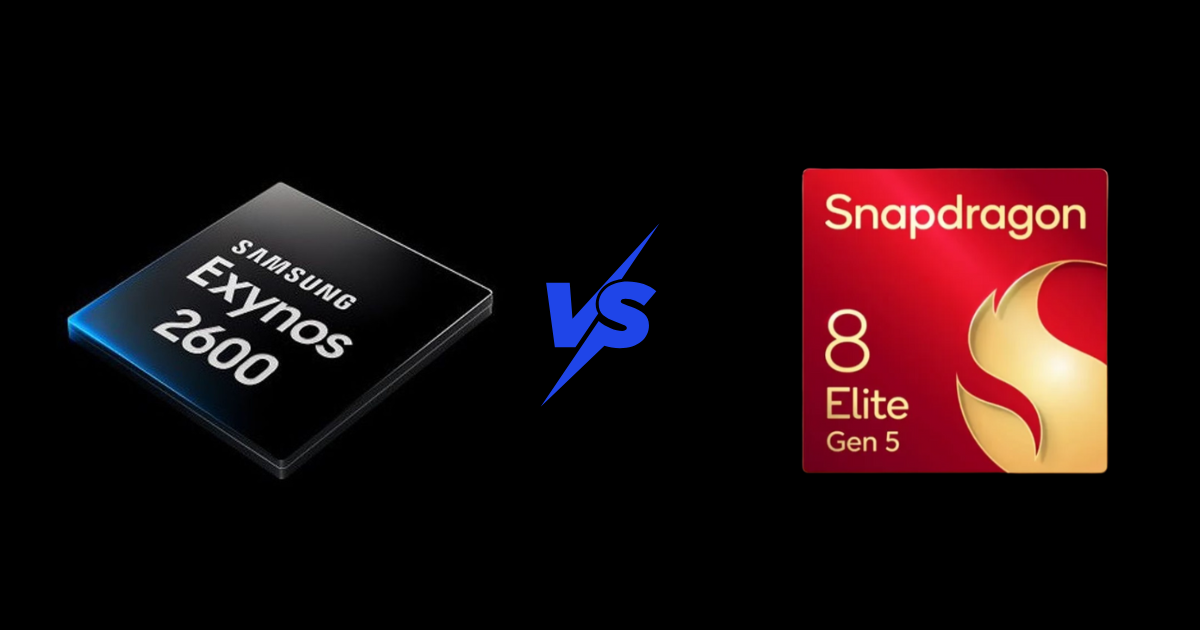
The Processor inside a smartphone determines far more than raw speed. It defines battery life, camera intelligence, AI capability, and how reliably the device performs over the years of use. With the upcoming Galaxy S26 series, Samsung faces a critical decision that will directly shape the real-world experience of millions of users. At the center of that decision are two competing flagship processors: Samsung’s Exynos 2600 and Qualcomm’s Snapdragon 8 Elite Gen 5.
This comparison goes beyond a routine generational upgrade. It reflects a broader shift in the balance of power within the smartphone silicon ecosystem. For years, Qualcomm’s Snapdragon processors have defined the performance standard for flagship Android devices, while Samsung has continued to invest heavily in advancing its Exynos platform to close the gap. The Exynos 2600 represents Samsung’s most ambitious effort yet to deliver a processor that matches or surpasses Qualcomm in performance, efficiency, and AI capabilities.

For buyers in Kenya and across global markets, this distinction has real consequences. The chipset affects gaming performance, multitasking stability, camera processing quality, battery endurance, and long-term software responsiveness. As smartphones increasingly serve as primary computing devices for work, content creation, and communication, processor choice is no longer a technical detail. It is a defining factor in the device’s long-term value. Read our Buyer’s Guide on Smartphones to be well-grounded in the factors that determine your best choice, including the chipset.
This analysis examines the Exynos 2600 and Snapdragon 8 Elite Gen 5 from a real-world perspective, evaluating performance architecture, efficiency, AI capability, and sustained workload behavior to determine which platform delivers the superior flagship smartphone experience as the Galaxy S26 generation approaches.
Why Chipset Choice Matters More Than Ever
The processor is the single most important component inside a modern smartphone. It determines how fast apps open, how efficiently the device manages power, and how reliably it performs over time. While features such as camera hardware and display quality receive more attention, their true performance depends heavily on the chipset powering the device.
Battery life, for example, is directly influenced by processor efficiency. A more efficient chipset allows the smartphone to perform complex tasks while consuming less power, extending daily usage, and preserving long-term battery health. Camera performance is equally dependent on the processor, which handles image processing, HDR rendering, video stabilization, and low-light enhancement.
Artificial intelligence capability has also become closely tied to chipset performance. Modern processors include dedicated neural engines that enable on-device AI features such as real-time translation, intelligent photo processing, voice recognition, and adaptive system optimization. These capabilities improve both the software’s usability and its long-term relevance.
Gaming performance, multitasking stability, and sustained workload handling are also determined by processor architecture and thermal efficiency. A stronger chipset ensures consistent performance under demanding conditions, while weaker processors may slow down over time.
As smartphones increasingly function as primary computing devices, chipset choice is no longer a technical detail. It is a defining factor in performance, efficiency, and long-term device value.
Galaxy S26 Series: Confirmed Direction and Emerging Details
Early industry reports from credible sources such as SamMobile, GSMArena, and PhoneArena indicate that Samsung is preparing a refined Galaxy S26 lineup, expected to include the Galaxy S26 Pro, Galaxy S26 Edge, and Galaxy S26 Ultra. This suggests a potential shift in Samsung’s flagship positioning, with the traditional “Plus” variant likely being replaced by a rebranded Pro model to create clearer differentiation across the lineup.
Several hardware and platform upgrades are also expected as part of this transition. Qi2 wireless charging support is anticipated, enabling more efficient and standardized wireless power delivery aligned with the latest global charging standards. Samsung is also expanding its focus on on-device intelligence, with deeper integration of AI-powered features designed to improve search, productivity, and system responsiveness.
Camera capability remains a central focus, particularly for the Galaxy S26 Ultra. Early leaks point to an advanced quad-camera system, including an upgraded telephoto sensor developed in collaboration with established optical partners. These improvements are aimed at strengthening Samsung’s position in mobile photography, especially in zoom capability, image processing, and low-light performance.
While these hardware and feature upgrades are important, the most consequential change lies deeper within the device. The processor powering the Galaxy S26 series will ultimately determine its performance ceiling, efficiency, AI capability, and long-term usability. This is where the competition between the Exynos 2600 and Snapdragon 8 Elite Gen 5 becomes critical.
Exynos 2600: Samsung’s Most Ambitious Processor Yet
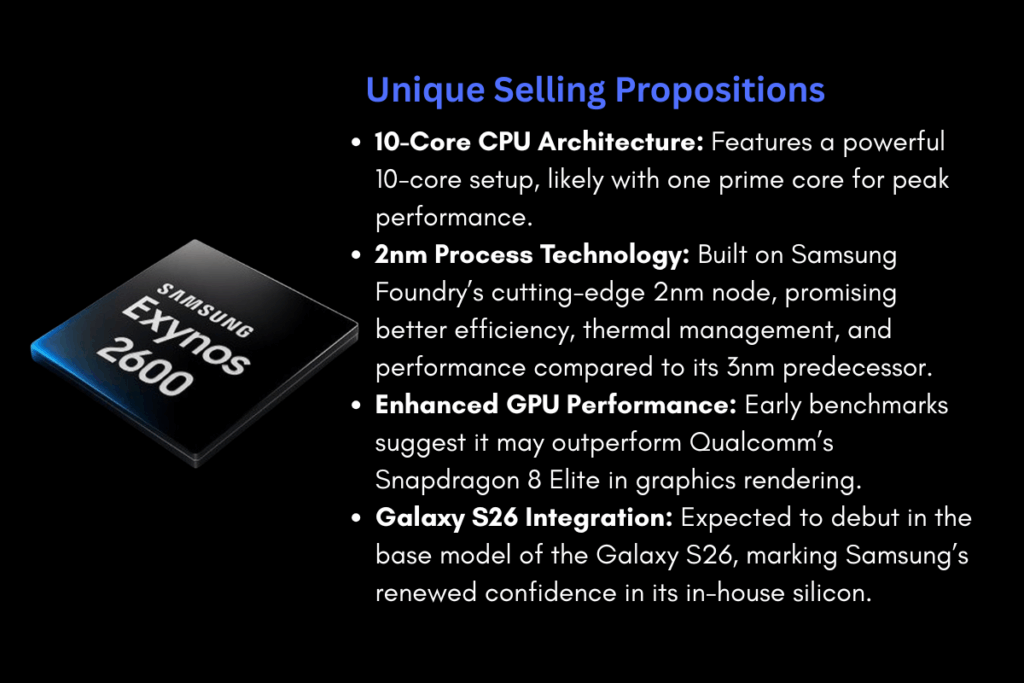
The Exynos 2600 represents Samsung’s most advanced mobile processor to date, built on the company’s next-generation 2nm Gate-All-Around (GAA) manufacturing process. This transition is more than a routine node shrink. It enables higher transistor density, improved performance efficiency, and lower power consumption, which directly translates into faster processing speeds, better battery life, and improved sustained performance under real-world workloads.
Architecturally, the Exynos 2600 integrates Samsung’s latest custom CPU design, paired with the Xclipse GPU based on AMD’s RDNA graphics architecture and an upgraded neural processing unit for on-device AI acceleration. This combination is designed to strengthen key performance areas, including multitasking, gaming stability, computational photography, and AI-assisted system optimization. These improvements target areas where previous Exynos processors struggled to consistently match competing Snapdragon platforms, particularly in sustained performance and thermal efficiency.
AI capability is a central focus of the Exynos 2600 platform. Modern smartphones increasingly rely on dedicated neural engines to power features such as real-time image processing, intelligent battery optimization, voice recognition, and adaptive performance management. The upgraded neural architecture in the Exynos 2600 is designed to accelerate these workloads, enabling faster and more efficient on-device intelligence without relying heavily on cloud processing.
Equally significant is Samsung’s broader deployment strategy. Industry reports suggest the Exynos 2600 is being positioned for wider global use across Samsung’s flagship lineup. If implemented, this would mark a shift toward greater processor parity across regions. For users in Kenya and other international markets, this could translate into more consistent flagship performance, improved efficiency, and stronger long-term reliability across regional device variants.
While independent benchmark validation will ultimately determine its competitive standing, the architectural and manufacturing advancements behind the Exynos 2600 indicate that Samsung is closer than ever to delivering a fully competitive flagship processor. Its success will depend on how effectively these improvements translate into sustained real-world performance, efficiency, and long-term usability.
Snapdragon 8 Elite Gen 5: Performance Benchmark and Platform Maturity
The Xiaomi 17 Series, featuring this chip, is a global hit for its excellent performance.
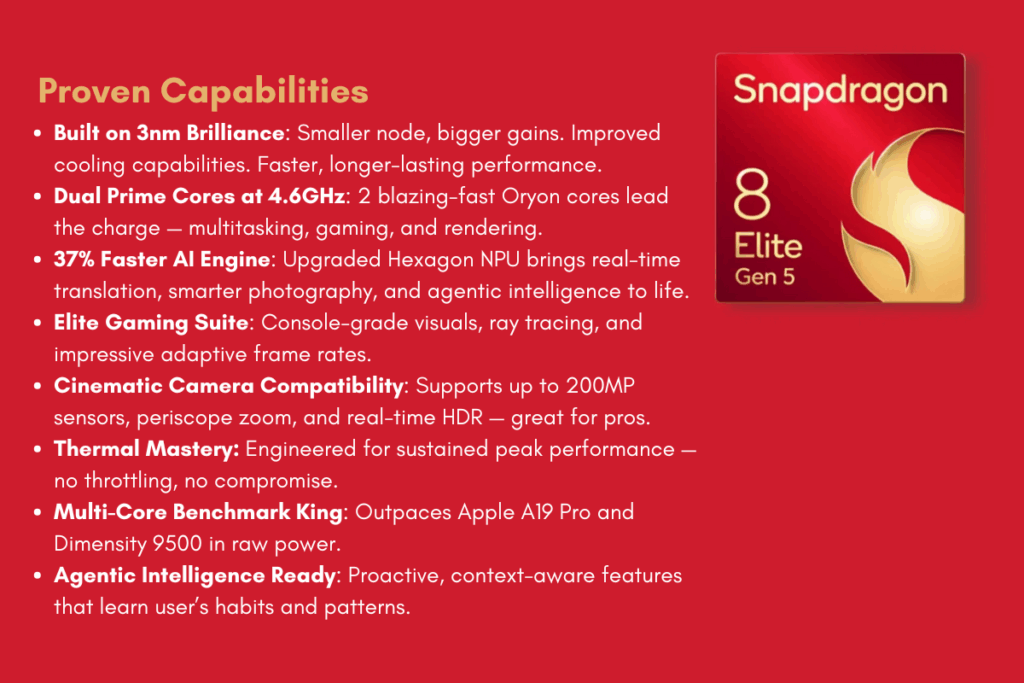
Qualcomm’s Snapdragon 8 Elite Gen 5, built on TSMC’s advanced 3nm (N3E) process, represents one of the most refined and efficient mobile processors currently available. This manufacturing advantage allows the chip to deliver higher performance while consuming less power, resulting in better battery life, improved thermal stability, and sustained performance under demanding workloads.
At the architectural level, the Snapdragon 8 Elite Gen 5 integrates Qualcomm’s custom Oryon CPU cores, next-generation Adreno GPU, and an upgraded Hexagon Neural Processing Unit. This combination enables strong performance across general computing, graphics rendering, and AI acceleration, ensuring the processor can handle intensive workloads such as gaming, video editing, and AI-assisted photography without performance degradation.
Early benchmark results from flagship devices powered by the Snapdragon 8 Elite Gen 5 demonstrate its clear performance leadership:
| Benchmark | Snapdragon 8 Elite Gen 5 Expected Range | What It Means |
|---|---|---|
| AnTuTu v10 | 3,400,000 – 3,800,000+ | Exceptional overall system performance, including CPU, GPU, memory, and storage |
| Geekbench 6 Single-Core | 3,100 – 3,400 | Industry-leading responsiveness and app launch speed |
| Geekbench 6 Multi-Core | 11,500 – 12,500+ | Excellent multitasking, video editing, and sustained heavy workloads |
| 3DMark Wild Life Extreme | 6,000 – 6,800+ | Outstanding graphics performance for gaming and rendering |
| AI Benchmark Score | 3,500+ | Advanced on-device AI acceleration and neural processing capability |
Benchmark data from flagship devices powered by this platform demonstrates its performance leadership. Geekbench 6 multi-core scores typically exceed 11,500 and can reach 12,000 or more, depending on the thermal configuration, reflecting excellent multitasking capability and sustained processing power. AnTuTu v10 scores range between 3.4 million and 3.8 million, placing the Snapdragon 8 Elite Gen 5 among the highest-performing mobile processors currently in production. GPU performance, measured through 3DMark and real-world gaming tests, also shows significant gains, delivering smoother frame rates, improved graphical fidelity, and better stability during extended gaming sessions.
Strong efficiency characteristics complement these performance gains. The TSMC 3nm process enables the processor to maintain high performance while minimizing power consumption, resulting in longer battery life and reduced thermal throttling. Qualcomm’s AI engine further enhances device capability, enabling faster on-device image processing, intelligent system optimization, and more responsive AI-driven features.
Taken together, these capabilities position the Snapdragon 8 Elite Gen 5 as the current performance benchmark for flagship Android smartphones, combining raw speed, efficiency, and long-term reliability in a platform designed to support the next generation of mobile computing.
Exynos 2600 vs Snapdragon 8 Elite Gen 5: Specification and Performance Comparison
Both the Exynos 2600 and Snapdragon 8 Elite Gen 5 represent the most advanced generation of flagship smartphone processors, designed to power premium devices such as the Galaxy S26 series. While both chips are built to deliver top-tier performance, their architecture, efficiency, and real-world behavior differ in ways that directly affect battery life, gaming stability, AI capability, and long-term usability.
The table below summarizes the key differences based on architecture, expected performance characteristics, and platform capabilities.
| Feature | Exynos 2600 | Snapdragon 8 Elite Gen 5 |
|---|---|---|
| Manufacturing Process | Samsung Foundry 3nm (SF3) | TSMC 3nm (N3E) |
| CPU Architecture | Custom Samsung-designed cores with ARM hybrid architecture | Qualcomm Oryon custom CPU cores |
| CPU Performance | Significant improvement over Exynos 2400, strong multi-core performance | Industry-leading single-core and sustained performance |
| GPU | Samsung Xclipse GPU (AMD RDNA-based) | Adreno next-generation GPU |
| GPU Performance | Excellent graphical capability with improved efficiency | Superior sustained gaming performance and stability |
| AI / NPU Capability | Advanced on-device AI processing, improved neural engine | Best-in-class AI acceleration and efficiency |
| Power Efficiency | Improved efficiency compared to previous Exynos generations | Best overall efficiency due to TSMC’s manufacturing advantage |
| Thermal Stability | Improved thermal management, reduced throttling | Superior sustained performance under heavy workloads |
| Camera Processing (ISP) | Advanced image signal processor, strong computational photography | Industry-leading ISP with superior HDR and video processing |
| Gaming Performance | Excellent performance for high-end gaming | Best overall gaming consistency and frame stability |
| Battery Impact | Strong efficiency gains, improved battery longevity | Industry-leading efficiency contributing to longer battery life |
| Expected Device Usage | Galaxy S26 regional variants and Samsung flagship devices | Galaxy S26 global variants and premium Android flagships |
Interpretation: What These Differences Mean in Real-World Use
Both processors deliver flagship-level capability, but their strengths differ in ways that matter for everyday users. The Snapdragon 8 Elite Gen 5 maintains a clear advantage in sustained performance, power efficiency, and overall stability. This translates into smoother gaming, better battery life, and more consistent performance under demanding workloads such as video editing or multitasking.
The Exynos 2600 represents Samsung’s strongest effort yet to close the performance gap. It delivers substantial improvements in efficiency, AI capability, and graphical performance compared to previous Exynos generations. For most users, it provides a fast, responsive experience that reliably handles everyday tasks, content creation, and productivity workflows.
However, based on manufacturing efficiency and processor architecture, Snapdragon continues to set the benchmark for performance consistency and long-term efficiency in flagship Android smartphones.
Why This Comparison Matters for Kenya and African Markets
For buyers in Kenya and across Africa, processor choice has historically had real and measurable consequences. Samsung has often shipped Exynos-powered variants of its flagship devices in many international markets, while Snapdragon variants were reserved for regions such as North America. This created a performance perception gap, as Snapdragon-powered devices frequently demonstrated stronger sustained performance, better efficiency, and more consistent gaming stability.
The Exynos 2600 represents Samsung’s most serious effort to close that gap. Built on a newer-generation manufacturing process and designed with improved efficiency and AI capabilities, it has the potential to deliver a flagship experience that aligns more closely with global performance standards. This matters significantly in mobile-first markets such as Kenya, where smartphones serve as primary tools for business, content creation, communication, and digital productivity.
Improved processor efficiency translates directly into longer battery life, more stable multitasking, and better long-term device reliability. Stronger AI capability enables more advanced camera processing, faster on-device intelligence, and improved overall responsiveness. These are not abstract technical advantages. They directly affect how reliably a device performs over years of daily use.
As flagship smartphones continue to replace traditional computing tools for many users, processor parity across regions becomes increasingly important. The Exynos 2600 signals meaningful progress toward that goal.
Final Verdict: Which Chipset Is Better?
Both the Exynos 2600 and Snapdragon 8 Elite Gen 5 represent the cutting edge of smartphone processor design, and both are capable of delivering flagship-level performance suitable for demanding workloads, gaming, and AI-powered features.
However, based on manufacturing efficiency, architectural maturity, and sustained performance consistency, the Snapdragon 8 Elite Gen 5 is likely to maintain an overall advantage. Its TSMC-built architecture, proven efficiency, and industry-leading performance stability position it as a stronger platform for sustained workloads, gaming, and long-term reliability.
That said, the Exynos 2600 represents a significant leap forward compared to previous Exynos generations. Samsung has narrowed the gap considerably, delivering meaningful improvements in efficiency, AI capability, and overall responsiveness. For most users, the difference in everyday performance may be less noticeable than in previous generations.
Ultimately, both chipsets are capable of powering a premium flagship experience. The Snapdragon 8 Elite Gen 5 currently sets the benchmark for overall performance and efficiency, while the Exynos 2600 demonstrates that Samsung is closer than ever to delivering a truly competitive flagship processor.
For buyers in Kenya and globally, this marks an important shift. A clear performance divide no longer defines processor choice; rather, two increasingly competitive platforms are shaping the future of flagship mobile computing.
Our next article will compare the Dimensity 9500 to the Snapdragon 8 Elite Gen 5.