

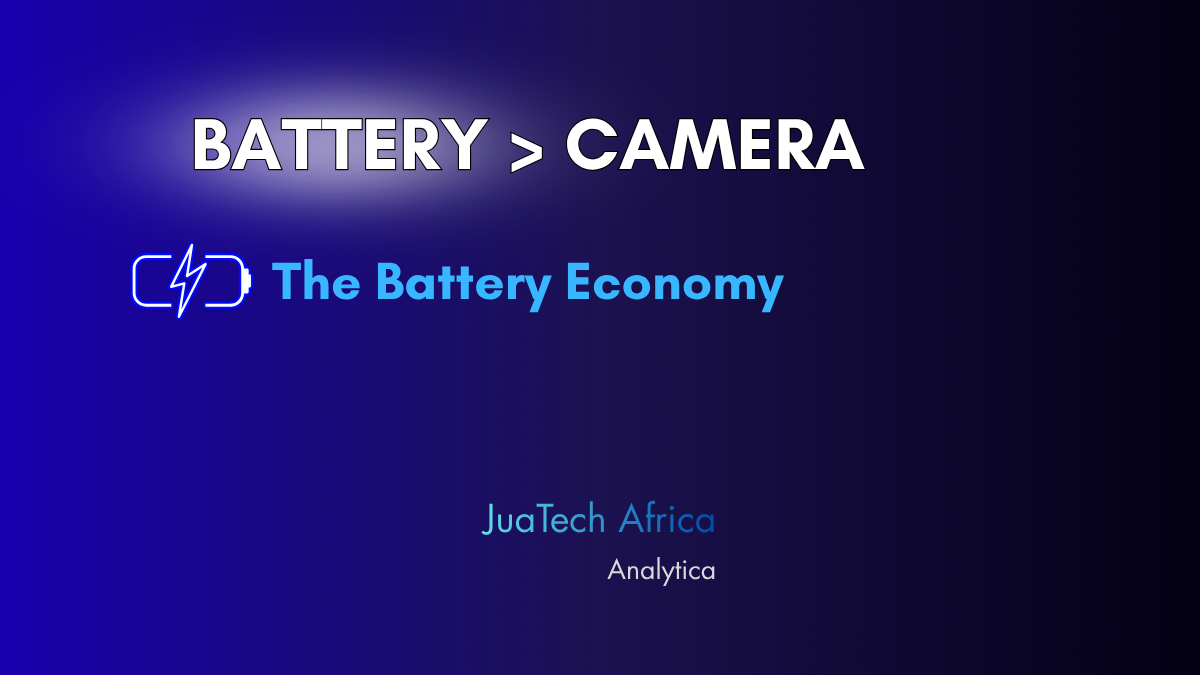
As smartphones become central to work, AI, and daily life, battery capacity and charging speed are overtaking camera performance as the true drivers of value. This Analytica Report examines the shift, the industry divide, and what it means for users—especially in Africa.
Analytica Report #4

Executive Summary
The smartphone market is undergoing a fundamental shift. For over a decade, camera performance defined how devices were marketed and evaluated. Today, that hierarchy is changing. Battery capacity, charging speed, and system efficiency are becoming the primary drivers of real-world value.
This report introduces the concept of the Battery Economy, a framework that explains how modern smartphones are designed, used, and evaluated. It moves beyond specifications to examine how energy is stored, consumed, and replenished throughout daily use.
The analysis highlights a growing divide in the industry. Brands like Samsung Electronics, Apple Inc., and Google prioritize efficiency, optimization, and long-term stability. In contrast, companies such as Xiaomi Corporation, OnePlus, Oppo, Vivo, Tecno, and Infinix are pushing higher battery capacities and faster charging to meet rising usage demands.
This shift is most pronounced in Africa, where smartphones function as primary tools for communication, work, and financial transactions. In such environments, battery performance is not a feature. It is infrastructure.
Looking ahead, the report explores emerging technologies such as silicon-carbon batteries, AI-driven optimization, and advanced charging systems, which signal a move toward smarter, more adaptive energy systems.
The conclusion is clear. Peak features no longer define smartphone value; rather, sustained performance does. Users must move beyond specifications and evaluate devices based on how well they align with real-world usage.
About Analytica | JuaTech Africa Intelligence
Analytica is the flagship research and intelligence arm of JuaTech Africa, focused on decoding the structure, behavior, and evolution of mobile technology markets across Africa. These reports go beyond product reviews to deliver data-driven insights, strategic interpretation, and forward-looking analysis that help consumers, businesses, and industry players make informed decisions.
Each Analytica report addresses a critical question shaping the future of mobile technology in Africa. Previous editions have explored how pricing varies across local markets and why midrange smartphones are increasingly redefining value and performance expectations.
- Analytica Report #1: Smartphone pricing in Kenya and why it defies global models
- Analytica Report #2: Structural gaps that explain why good technology often fails in local markets
- Analytica Report #3: The rise of midrange smartphones and the convergence of performance across tiers
This report builds on that foundation by examining a fundamental shift in how smartphone value is defined, introducing the concept of the Battery Economy and its growing influence on buying decisions.
The Shift No One Is Framing Clearly
For years, the smartphone conversation has been dominated by one central question: how good is the camera? From megapixels to night mode and advanced zoom capabilities, brands have conditioned users to believe that camera performance is the ultimate measure of value. This narrative held strong for nearly a decade, shaping marketing, reviews, and ultimately, buying decisions. However, in 2026, that assumption is no longer as solid as it once was.
A different, more practical question is now taking center stage in the smartphone buying decision: will this phone last the entire day, and how quickly can it recharge when it runs out? This shift is not driven by marketing, but by lived user experience. As usage patterns evolve, consumers are placing increasing importance on smartphone battery life, fast charging, and overall energy reliability. The comparison is no longer just about features, but about the sustainability of use in real-world conditions.
Across Kenya and the broader African market, this shift is even more pronounced. Smartphones have become the primary gateway to digital life, powering communication, mobile payments, remote work, content consumption, and small businesses. Users spend more time on their devices, often in conditions where access to a consistent power source is not guaranteed. In such an environment, battery performance shifts from a convenience to a necessity.
This is where the concept of the Battery Economy becomes relevant. It reflects a new reality in which battery capacity, charging speed, and system efficiency collectively define the true value of a smartphone. While cameras continue to improve, their impact on daily usability is limited compared to the constant demand for power.
The implication is clear. The modern smartphone is no longer judged primarily by how well it captures moments, but by how reliably it sustains them throughout the day.
Then vs Now: The Fall of the Camera Era
The Peak of Camera Innovation (2015–2020)
Between 2015 and 2020, the smartphone industry was defined by rapid, visible progress in camera technology. Brands competed on upgrades users could immediately see and appreciate. The Huawei P20 Pro introduced a triple-camera system with a 40MP primary sensor, 20MP monochrome sensor, and 8MP telephoto lens, enabling 3x optical zoom and significantly improved low-light performance. The Google Pixel 3, with its single 12.2MP sensor, proved that software could outperform hardware through features like Night Sight and HDR+. These were meaningful leaps that changed how people captured photos in everyday situations.
Alongside these breakthroughs, Sony Corporation quietly powered much of the industry through its sensor technology, supplying camera hardware used across flagship smartphones. At the same time, its Xperia lineup, including devices like the Sony Xperia 1 III, adopted a different philosophy, offering professional-grade manual controls, variable telephoto optics, and cinema-focused video tools. This represented the peak of camera-centric innovation, designed not for the average user but for creators who demanded full control over the imaging process. For consumers, this era established a clear, rational buying mindset in which camera performance became the primary measure of smartphone value because the differences were visible, practical, and immediately beneficial.
When Innovation Became Incremental (2021–2023)
From around 2021 onward, the rate of meaningful camera innovation began to slow. Devices like the Samsung Galaxy S21 Ultra pushed hardware boundaries with a 108MP main sensor and dual telephoto lenses offering 3x and 10x optical zoom, while the iPhone 13 Pro refined video with Cinematic Mode and improved stabilization. These were technically advanced systems, but for most users, they did not fundamentally change how smartphones were used daily. The difference between a good photo and a great one became less meaningful in real-world scenarios, especially on platforms where compression reduces visible quality.
Even at the highest level, camera innovation began serving niche users rather than the mass market. Sony’s pro-grade approach continued to push boundaries, but adoption remained limited, reinforcing a broader industry reality. The average user no longer needed more camera capability. They needed something else.
The Shift to Real-World Utility (Battery Takes Over)
At the same time, power demand increased significantly. A typical user now spends between 6 and 8 hours daily on their device, driven by video streaming, social media, mobile gaming, and work-related tasks. Features such as 120Hz displays, 5G connectivity, and background AI processes continuously draw power, placing sustained pressure on battery systems that largely remained within the 4500mAh to 5000mAh range in flagship devices. In markets like Kenya, where smartphones serve as primary tools for communication, payments, and business, this limitation is experienced more directly and more frequently.
This is where the battery life vs camera smartphone buying decision becomes grounded in real-world experience. A user may value advanced zoom or improved video stabilization, but these features are used occasionally. Battery life, on the other hand, affects every interaction throughout the day, from messaging and browsing to streaming and transactions.
The contrast is clear. Cameras have reached a point of sufficiency for most users, while usage continues to expand in both intensity and duration. Even at the highest level of camera innovation, adoption remains niche, reinforcing the reality that most users prioritize reliability over maximum imaging capability.
Cameras improved. Usage exploded.
This marks a structural shift from a feature-driven market to an experience-driven one, where endurance, reliability, and charging speed now play a more decisive role in defining smartphone value.
The Battery Economy Explained: The 4 Pillars of Smartphone Battery Life and Charging Performance
The shift toward the battery life vs camera smartphone buying decision is not driven by a single specification. It reflects a structural change in how smartphones are used and evaluated. Peak features no longer judge the modern device by how it performs at a single point in time, but by how consistently it performs across an entire day of real-world demand. This is the foundation of the Battery Economy.
At its core, the Battery Economy is about continuity. It answers a simple but critical question. Can your device keep up with your life without interruption? In markets like Kenya and across Africa, where smartphones power communication, payments, business, and entertainment, this is not a technical concern. It is a practical one. Battery performance directly determines productivity, reliability, and user confidence.
What defines this system is not a single number, but four interdependent pillars.
Capacity (mAh): The Energy Reserve
Battery capacity, measured in milliamp hours (mAh), defines how much energy a device can store. A 5000mAh battery is now the standard baseline, but the industry is clearly moving beyond it. Devices are increasingly pushing into the 6000mAh to 7000mAh range, with some brands exploring even higher capacities in response to rising power demands.
This is not theoretical. It is already happening in the market. Devices like the Samsung Galaxy M51 demonstrated early that 7000mAh was viable in mainstream smartphones. Gaming-focused devices such as the Asus ROG Phone 7 have adopted 6000mAh dual-cell systems to sustain high performance under load. Within Africa, brands like Tecno and Infinix are aggressively positioning large batteries as core value drivers through series like Pova and Note.
At the same time, the industry is experimenting at the edges. Concepts and emerging devices are pushing toward 7500mAh and beyond, with some niche implementations approaching 8000mAh and even 10,000mAh in extreme cases. While not yet mainstream, these efforts signal a clear direction. The traditional 4000 to 5000mAh range is no longer sufficient for modern usage patterns.
However, capacity alone is not the solution. A 7000mAh device with poor optimization can still underperform a well-tuned 5000mAh device. Larger batteries provide a buffer, not efficiency. They delay the problem, but they do not eliminate it.
What this reveals is a deeper truth. The industry is not increasing battery size as a luxury feature. It is reacting to a widening gap between energy demand and energy supply.
Charging Speed (W): The Recovery System
Charging speed, measured in watts (W), determines how quickly a device can recover from depletion. The evolution here has been aggressive. The industry has moved from 10W and 18W charging to 45W, 67W, and now 100W and beyond.
In controlled conditions, a 67W system can charge a 5000mAh battery to approximately 70% in about 30 minutes. Higher-wattage systems can push even further, though thermal constraints and charging curves often limit sustained peak speeds.
The real value of fast charging is not in reaching 100 percent. It is for reducing downtime. A short 15- to 30-minute charge can restore several hours of usage, which aligns with how people live and work. In African markets, where charging opportunities may be limited or unpredictable, this ability to quickly recover usable power becomes a critical advantage.
Charging speed changes the equation. It shifts battery performance from endurance alone to endurance plus recovery. It gives users flexibility, not just longevity.
Efficiency (Chipset + Software): The Consumption Engine
Efficiency determines how intelligently a smartphone uses its stored energy. It is driven by chipset architecture and refined through software optimization. Modern processors are designed to deliver higher performance per watt, balancing speed with power consumption.
This is where the real hierarchy begins to emerge. A well-optimized 5000mAh device can outperform a poorly optimized 6000mAh or even 7000mAh device in real-world usage. Efficiency reduces unnecessary drain, stabilizes performance under load, and ensures that energy is allocated where it delivers the most value.
Unlike capacity and charging speed, efficiency is not visible on a spec sheet. Yet it is often the deciding factor in whether a device feels reliable or frustrating over time. It is the difference between a phone that lasts all day and one that struggles despite having a larger battery.
Optimization (AI Systems): The Intelligence Layer
The final pillar is optimization, increasingly powered by AI systems. Smartphones now analyze usage patterns, manage background processes, and dynamically adjust power allocation in real time. This includes limiting inactive apps, prioritizing active tasks, and adapting charging behavior to extend battery lifespan.
This transforms battery performance from static to adaptive. Instead of treating all usage equally, the system continuously learns and adjusts to maximize efficiency. As AI capabilities expand, this layer becomes more influential, bridging the gap between hardware potential and real-world performance.
Optimization is what turns a collection of specifications into a coherent experience. Without it, even the best hardware combinations fall short.
The System That Defines Modern Smartphone Value
Together, these four pillars define the Battery Economy as a complete system rather than a single metric. Capacity provides the reserve, charging speed ensures recovery, efficiency controls consumption, and optimization refines performance.
The implications are practical and immediate. A larger battery without efficiency will still drain quickly. Faster charging without thermal control will accelerate degradation. Smarter optimization without sufficient capacity will struggle under sustained demand.
What the industry is revealing, through both mainstream devices and experimental extremes, is a clear direction. Smartphones are becoming more powerful, more connected, and more demanding. Battery systems are evolving not to lead this change, but to keep up with it.
The future of smartphones will not be defined by who has the biggest battery, but by who delivers the most reliable energy experience per day.
This is the reality of the Battery Economy.
Why This Shift Is Happening Now: The Forces Driving the Battery Economy
The rise of the battery life vs camera smartphone buying decision is not a trend. It is a structural shift driven by how smartphones are used today. What has changed is not just technology, but behavior, expectations, and dependence. Smartphones have moved from occasional tools to continuous systems that operate at the center of daily life. This shift is being driven by four powerful forces that are reshaping how battery performance is valued.
On-Device AI and the Rise of Continuous Power Demand
Modern smartphones are no longer passive devices. They are constantly processing information through AI-driven systems that enhance photography, power voice assistants, manage notifications, and optimize performance in real time. Features such as scene detection, live translation, predictive typing, and background app intelligence are always running, even when the user is not actively engaging with them.
This creates a new baseline of power consumption. Unlike earlier smartphone generations, which were event-based, today’s devices operate continuously in the background. The more intelligent the device becomes, the more energy it requires to sustain that intelligence. This introduces a silent but persistent drain that is not visible in spec sheets but is felt in daily use.
Multimedia Consumption and the Explosion of Screen-On Time
The second driver is the scale and intensity of multimedia consumption. Video has become the dominant format of digital interaction, supported by platforms such as YouTube, TikTok, Instagram, and streaming services. Users are spending significantly more time on their screens, often exceeding 6 to 8 hours per day.
This increase is compounded by hardware improvements such as 90Hz and 120Hz displays, which enhance visual smoothness but also increase power consumption. Mobile gaming has also evolved, with graphics-intensive titles placing sustained demand on both the CPU and GPU. These are not short bursts of usage. They are extended sessions that continuously draw power.
The result is a shift from intermittent usage to sustained load, where battery performance is tested over long periods rather than short interactions.
Always-On Connectivity and Background Power Drain
Smartphones are now permanently connected. 4G, 5G, Wi-Fi, Bluetooth, GPS, and cloud synchronization services operate simultaneously, ensuring that devices remain updated and responsive at all times. Messaging apps, email, social platforms, and system services continuously exchange data in the background.
This constant connectivity introduces a new layer of power consumption that did not exist at the same scale in earlier smartphone cycles. Even when idle, devices are active. Background processes, app refresh cycles, and location services contribute to steady battery drain that accumulates throughout the day.
This is a critical shift because it changes how battery life is experienced. It is no longer just about active use. It is also about how efficiently a device manages inactivity.
Mobile-First Economies: Why Battery Matters More in Africa
The most decisive driver is contextual. In Kenya and across Africa, smartphones are not secondary devices. They are the primary gateway to digital life. They power communication, mobile money transactions, remote work, content creation, and small businesses. Can you live without MPESA transactions, which have become the norm of the day in Kenya? WhatsApp has become a baseline for communication in work and social life.
This level of dependence changes expectations. A smartphone is expected to perform reliably throughout the day, even in environments with limited or inconsistent power. Long commutes, extended work hours, and variable access to electricity make battery endurance a practical necessity rather than a convenience.
In this context, battery performance directly affects productivity and income. A device that runs out of power is not just inconvenient; it’s dangerous. It disrupts communication, transactions, and workflow.
These forces are converging to reshape how smartphones are evaluated. Devices are no longer used occasionally. They are used continuously, across multiple demanding functions, in environments that require reliability.
The implication is clear. Battery performance is no longer a supporting feature. It is a foundational requirement.
Smartphones are no longer accessories. They are survival tools.
Making the Numbers Make Sense: Battery Capacity, Charging Speed, and the Reality Behind the Specs
Bigger numbers and faster claims define the modern smartphone market. Battery capacities are rising from 5000 mAh to 6000 mAh, 7000 mAh, and beyond. Charging speeds have moved from 25W to 67W, 100W, and higher. On paper, this suggests progress. In reality, for users in Kenya and across Africa, the more important question is whether these numbers translate into reliable, everyday usability.
Battery Capacity in Context: 5000mAh vs 6000mAh vs 7500mAh and Beyond
Battery capacity, measured in milliamp hours, defines how much energy a device can store. A 5000mAh battery is now the baseline, while newer devices push into 6000mAh and 7000mAh territory. This increase reflects a clear industry response to rising power demand, as outlined earlier, with a shift from camera-centric innovation to sustained, high-load usage.
However, capacity alone does not determine endurance. A 6000mAh battery offers roughly 20% more energy than a 5000mAh unit, and a 7500mAh battery pushes that closer to 50%. Yet in real-world conditions, these gains are often reduced by power-hungry features such as 120Hz displays, 5G connectivity, and continuous background processes.
For many users across Africa, the stakes are higher. In regions with inconsistent electricity access, including parts of Nigeria and rural areas across the continent, charging is not always immediate or convenient. Some users travel significant distances to access charging points, rely on shared infrastructure, or charge devices overnight to ensure availability the next day. In this context, larger battery capacity provides a critical buffer, not just convenience. It provides continuity.
Charging Speed in Practice: 25W vs 67W vs 100W+
Charging speed, measured in watts, determines how quickly a device can recover power. A 25W system may take over an hour to fully charge a 5000mAh battery. A 67W system can reach around 70 percent in approximately 30 minutes, while higher wattage systems promise even faster recovery under controlled conditions.
However, charging performance is not linear. Speeds slow significantly beyond 70-80% due to thermal management and battery protection mechanisms. This means the real value of fast charging lies in short, effective top-ups rather than full charging cycles.
In African markets, this distinction is critical. Where access to electricity may be limited or unpredictable, the ability to get several hours of use from a 15- to 30-minute charge can make a meaningful difference. Charging speed, therefore, is not just about convenience. It is about adaptability to real-world conditions.
Dual-Cell Architecture and Thermal Limits
To support higher charging speeds, many manufacturers use dual-cell battery designs, splitting the battery into two units that charge simultaneously. This allows higher wattage to be distributed more efficiently, reducing localized heat buildup.
Even so, heat remains a fundamental constraint. Faster charging generates more thermal stress, and without effective cooling and power management, this can impact long-term battery health. These trade-offs are rarely emphasized in marketing but are central to real-world performance and device longevity.
The Reality Check: Beyond the Numbers
The key insight, consistent with the broader Battery Economy framework, is that specifications alone do not define experience. Larger batteries do not automatically deliver longer endurance, and faster charging does not guarantee better usability. What matters is how capacity, charging speed, efficiency, and optimization work together as a system.
For users navigating inconsistent power access, long usage hours, and high dependency on mobile devices, this system determines whether a smartphone is reliable or limiting.
Numbers sell. Systems sustain.
This is the distinction that separates marketing claims from meaningful value in the modern smartphone landscape.
The Industry Divide: Two Philosophies of Power
The smartphone industry is not aligned on one path when it comes to battery performance. Instead, it is split between two distinct philosophies that define how brands approach battery life, fast charging, and overall smartphone value. This divide is not about capability. It is about priorities. As established in the Battery Economy framework, the real question is not who can build bigger batteries, but how brands choose to balance capacity, charging speed, efficiency, and long-term reliability.
Efficiency-First Camp: Optimization Over Expansion
- Apple Inc.
- Samsung Electronics
This group has largely stabilized around 4500mAh to 5000mAh battery capacity, even in flagship devices released in 2024 and 2025. Instead of increasing size, they focus on maximizing performance per watt through chipset efficiency, software optimization, and thermal control.
Apple’s iPhones, for example, consistently deliver competitive all-day battery life despite smaller battery sizes, driven by tight hardware and software integration. Samsung maintains a similar approach across its Galaxy S and Fold series, balancing battery size with design, thermals, and long-term durability. Google’s Pixel devices rely heavily on adaptive battery systems and AI-driven power management to extend usage based on behavior.
The philosophy is deliberate. Larger batteries introduce trade-offs such as increased heat, thicker designs, and potential long-term degradation if paired with aggressive charging. For this group, the goal is not to win on specifications, but to deliver predictable, stable, and safe battery performance over time.
Capacity and Charging Camp: Maximum Power, Minimum Downtime
- Xiaomi Corporation
- Oppo
- Vivo
- Tecno
- Infinix
- Honor
- Itel
In contrast, this group is aggressively expanding both battery capacity and charging speed. Devices in this category commonly feature 6000mAh to 7000mAh batteries, with some pushing higher in endurance-focused models. Charging speeds range from 67W to over 100W, supported by dual-cell battery architectures and advanced thermal systems.
This strategy is closely aligned with real-world usage patterns, particularly in markets like Kenya and across Africa, where smartphones are heavily relied upon and access to power can be inconsistent. Brands such as Tecno and Infinix emphasize long-lasting battery performance in series designed for these conditions, while Xiaomi, Oppo, and Vivo push fast charging innovation to minimize downtime.
The value proposition is immediate and tangible. Longer battery life and faster charging translate directly into convenience, reliability, and user confidence in daily use.
The Core Insight: A Philosophy Gap, Not a Technology Gap
At a technical level, both groups operate with access to similar advancements in chipsets, battery materials, and charging systems. The divergence lies in how these technologies are applied.
One camp optimizes for efficiency, control, and long-term stability. The other optimizes for capacity, speed, and immediate usability. Both approaches are valid responses to the same underlying challenge of increasing power demand.
For users, especially in mobile-first economies, the implications are practical. Devices built around capacity and fast charging may offer greater flexibility in environments with limited power access. Efficiency-driven devices may provide more consistent performance over extended periods.
This is not a technology gap. It is a philosophy gap.
Understanding this distinction is essential for making informed decisions in the Battery Economy, where real value is defined not by specifications alone, but by how well a device sustains and adapts to everyday use.
Samsung vs Xiaomi: Who Is Fooling Who?
At the center of the battery conversation sit two brands that represent fundamentally different approaches to smartphone power. On one side is Samsung Electronics, known for consistency, controlled performance, and long-term reliability. On the other is Xiaomi Corporation, pushing the boundaries of battery capacity and charging speed to deliver immediate, high-impact value.
Samsung’s Approach: Efficiency, Balance, and Long-Term Trust
Samsung’s strategy is built on restraint. Across its Galaxy A series and flagship Galaxy S lineup, battery capacity has remained largely within the 4500mAh to 5000mAh range, paired with charging speeds between 25W and 45W.
This is not stagnation. It is positioning.
Samsung prioritizes system efficiency through chipset optimization, display tuning, and thermal control. The goal is to deliver predictable, stable performance throughout the day while preserving battery health over years of use. In line with the Battery Economy framework established earlier, Samsung is optimizing the system, not the headline number.
For the user, the experience is consistent. No surprises. No extremes. Just reliability.
Xiaomi’s Approach: Redefining the Ceiling of Battery Performance
Xiaomi is not playing the same game. It is redefining the limits.
The Xiaomi 17 series is the clearest signal yet. The standard model introduces a ~6300mAh battery; the Pro pushes to ~6300mAh, and the Pro Max reaches 7500mAh, paired with 100W wired charging and 50W wireless charging.
This is not an incremental improvement. It is a step change.
Xiaomi is aggressively expanding both ends of the battery equation:
- Capacity, translating to more stored energy
- Charging speed, which means faster recovery.
The result is a different user promise. Longer endurance and significantly reduced downtime. A 15–20-minute charge can restore hours of usage, aligning with real-world behavior in high-demand environments.
But this approach comes with trade-offs. Larger batteries increase device size and thermal complexity. Ultra-fast charging introduces heat and long-term degradation risks if not tightly controlled. As established earlier, bigger does not automatically mean better, and faster does not automatically mean safer.
The Real Question: Who Is Actually Delivering Value?
This is not a case of one brand being right and the other wrong. It is a divergence in philosophy.
Samsung is optimizing for consistency, efficiency, and long-term stability.
Xiaomi is optimizing for capacity, speed, and immediate usability at scale.
For a user in Kenya or across Africa, where smartphones are used intensively and power access can be inconsistent, both approaches solve real problems. Samsung delivers dependable, all-day performance. Xiaomi delivers extended endurance and rapid recovery when charging opportunities are limited.
One sells stability. The other sells possibility.
The critical insight is this. No one is fooling anyone. The market is being segmented by need. The real decision is not which brand is better, but which philosophy aligns with how the device will actually be used.
Chipsets, AI and the Hidden Battery War
Efficiency Gains: More Performance Per Watt
Modern smartphones are powered by increasingly efficient chipsets from Qualcomm (Snapdragon) and MediaTek (Dimensity). Built on advanced fabrication processes such as 4nm and moving toward 3nm, these chips deliver significantly higher performance while reducing power consumption per task.
On paper, this should improve battery life. A newer chipset can complete tasks faster and return to idle states more efficiently, reducing active power draw. This is why devices today feel faster yet still manage to last through demanding workloads. However, this efficiency gain is only part of the story.
AI Workloads: The Invisible Power Drain
At the same time, smartphones are doing far more in the background than ever before. AI is now embedded across the system, powering photography, voice assistants, real-time translation, predictive typing, and app behavior. These processes are not occasional. They are continuous.
Unlike traditional workloads, AI tasks often run persistently, analyzing data and optimizing performance in real time. This creates a constant baseline load that offsets efficiency gains from modern chipsets. The result is a device that is smarter, more responsive, and more adaptive, but also more demanding on battery resources.
Performance vs Power: The Trade-Off That Defines Modern Smartphones
This creates a fundamental trade-off. As performance increases, so does power demand. High-performance chipsets enable gaming, multitasking, and advanced features, but they also consume more energy under sustained load. Even with improved efficiency, the total energy required continues to rise as usage expands.
This is the hidden battery war. It is not just about how much power a battery holds, but how much power the system continuously demands.
Smarter phones are also more power-hungry.
Understanding this balance is critical. It reinforces a core principle of the Battery Economy. Efficiency alone cannot solve the problem. As smartphones become more capable, battery systems must evolve to support real-world use.
Africa Context: Why Battery Matters More Here
The Battery Economy is not theoretical in Africa. It is practical, immediate, and unavoidable. While global markets debate convenience, in countries like Kenya and Nigeria, battery performance directly determines whether a smartphone can sustain daily life. This is where the shift from camera to battery becomes most visible, because the consequences of failure are real.
Power Inconsistency: The Constraint That Redefines Value
Access to electricity remains uneven across much of the continent. Even in urban centers, outages disrupt routines. In rural areas, reliable power can be limited or entirely unavailable. For many users, charging a phone is not a given. It may involve walking to a nearby center, paying for charging services, or relying on shared and unpredictable access.
This changes the meaning of battery capacity. It is no longer about convenience. It is about survival between charging opportunities. A 6000mAh or 7000mAh device does not just last longer. It extends usability across uncertainty. This is where the push toward higher capacity, discussed earlier, becomes not just relevant but necessary.
Heavy, Continuous Usage: One Device, Multiple Roles
Smartphones in Africa are not used lightly or occasionally. They are used continuously, often across multiple critical functions. A single device supports communication, mobile money transactions, content consumption, navigation, and business operations throughout the day.
This aligns directly with the earlier shift toward sustained workloads. Battery performance is not tested in short bursts. It is tested across hours of continuous demand. The expectation is simple and uncompromising. The device must last.
Mobile-First Reality: The Smartphone as Infrastructure
For many users, the smartphone is not one device among many. It is the primary, and often the only, computing device. It functions as a bank, office, marketplace, and communication hub.
This raises the stakes significantly. Battery performance is no longer a feature to compare. It is infrastructure. If the device runs out of power, access to services, income, and communication is interrupted.
Brands That Understand the Market Reality
- Tecno
- Infinix
- Oppo
- OnePlus
- Vivo
These brands are not just competing on specifications. They are responding to context. Larger batteries, faster charging, and endurance-focused designs reflect a clear understanding of how smartphones are actually used in these markets.
This is why they resonate. They are aligned with reality.
The implication is direct and unavoidable. In Africa, battery performance is not part of the smartphone experience. It defines it.
A phone that cannot last the day is not just inconvenient. It is exclusionary.
Is Bigger Battery Actually Selling?
This is one of the most important questions in the Battery Economy, and the answer is clear. Yes, bigger batteries are selling, but not in the same way across all segments. The real driver is not the number itself. It is what that number enables in daily use.
Mass Market Reality: Utility Drives Decisions
In the midrange and mass market, battery capacity has become a decisive factor in smartphone buying decisions. Devices with 6000 mAh or more and fast charging directly address the realities of heavy use and inconsistent power access. For users in Kenya and across Africa, this is not a preference. It is a requirement.
A larger battery means fewer interruptions, longer usage, and greater confidence throughout the day. When a device supports communication, mobile money, content consumption, and work, battery performance becomes central to its value. Brands like Tecno and Infinix are gaining traction because they align with this need. They are not just selling smartphones. They are selling reliability. Vivo, in response to growing demand for larger batteries, introduced the Y31d with a record 7500 mAh battery. This is a value for need-specific users in the changing African market.
Premium Market Reality: Trust Still Drives Decisions
In the premium segment, the dynamics shift. Battery capacity still matters, but it is not the primary driver of purchase decisions. Users buying high-end devices from Samsung Electronics and Apple Inc. are not chasing the biggest numbers. They are buying into ecosystems, brand reliability, and long-term performance.
These users trust that efficiency, optimization, and system design will deliver consistent battery life, even with smaller capacities. The expectation is not maximum capacity. It is dependable performance across time.
The Real Answer: What Actually Sells
Bigger batteries sell where utility defines value. They win in environments where usage is heavy, charging is uncertain, and reliability is critical. However, in segments where brand trust and ecosystem matter more, battery capacity becomes one part of a larger decision framework.
Utility sells mass. Trust sells premium.
The insight is direct. Bigger batteries are not universally dominant, but they are increasingly essential where real-world usage demands them most.
What Limits Battery Growth? Why Not 15,000mAh Yet?
If bigger batteries solve real problems, why aren’t smartphones already shipping with 10,000 mAh or even 15,000 mAh as standard? The answer is not a lack of technology. It is a set of physical, thermal, design, and regulatory constraints that define what is practical at scale.
Size and Weight: The Physical Constraint
Battery capacity scales with physical size. Increasing from 5000mAh to 8000mAh requires more internal volume, which directly affects device thickness and weight. While this may be acceptable in niche devices such as gaming phones or rugged models, mainstream users still expect slim, lightweight designs that are comfortable to hold and carry.
This creates a trade-off. Every increase in battery size reduces the space available for cameras, cooling systems, and structural components. Beyond a certain point, the device becomes impractical for everyday use.
Heat and Safety: The Invisible Limits
Larger batteries and faster charging systems generate more heat. Combined with high-performance chipsets and sustained workloads, thermal management becomes a critical challenge. Poor heat control does not just affect performance. It affects safety and long-term battery health.
Manufacturers must balance capacity with safe operating temperatures, especially as charging speeds move beyond 67W and 100W. This is why, as discussed earlier, faster does not always mean better. Without proper thermal design, higher capacity and faster charging can introduce risk.
Design Expectations: What Users Will Accept
Smartphones are not just tools. They are personal devices shaped by design expectations. Users expect premium materials, slim profiles, and balanced ergonomics. A 15,000mAh battery may deliver exceptional endurance, but if it results in a bulky, heavy device, it will struggle in mainstream markets.
This is where the industry draws a line between what is technically possible and what is commercially viable.
Regulation and Standards: The Safety Framework
Battery systems are also governed by strict safety regulations regarding transport, certification, and use. Lithium-ion batteries must meet global standards that limit risk during shipping and operation. As capacity increases, compliance becomes more complex, adding another layer of constraint.
The Reality: Where the Market Is Headed
The direction is becoming clear. Extreme capacities, such as 10,000 mAh and beyond, will remain niche, reserved for specialized devices. The mainstream is moving toward a more balanced range, where 6000mAh to 8000mAh, combined with fast charging and efficiency gains, delivers the best trade-off between endurance, usability, and safety.
The future is not the biggest battery. It is the smartest balance.
This is where the Battery Economy is ultimately heading.
Buyer Intelligence: How to Choose Today
The battery life vs camera smartphone buying decision has shifted how users should evaluate smartphones. The biggest mistake today is chasing battery capacity in isolation. A higher mAh rating appears convincing, but, as established throughout this report, it does not guarantee better real-world performance. In the Battery Economy, value is defined by how well a device sustains daily use, not how large the number appears on paper.
Don’t Chase mAh Blindly
Battery capacity is important, but it is not decisive on its own. A 6000mAh or 7000mAh device can still underperform if paired with an inefficient chipset, poor thermal management, or weak software optimization. As seen earlier in the comparison between Samsung Electronics and Xiaomi Corporation, different approaches can deliver similar outcomes depending on how the system is built.
The real question is practical. Does the device last through your actual day, including communication, mobile payments, content consumption, and work? That is the benchmark that matters.
Evaluate the System, Not the Spec
Battery performance results from a system working together. Capacity provides the reserve. The chipset determines efficiency. Charging speed defines recovery. Optimization ensures stability over time.
This aligns directly with the Battery Economy framework established earlier. A balanced 5000mAh device with strong efficiency and controlled charging can outperform a larger battery with poor optimization. This is why numbers alone can mislead. Systems sustain performance.
When evaluating a device, consider how these elements interact, not just how they are marketed.
Match the Device to Your Lifestyle
The final decision is contextual. A heavy user in Kenya or across Africa, managing work, transactions, and extended screen time, may benefit from larger capacity and faster charging to handle unpredictable power access. A moderate user with consistent access to electricity may prioritize efficiency, design, and long-term reliability instead.
The key is alignment. The best smartphone is not the one with the highest specifications. It is the one that fits how the device is actually used.
Choose based on how you live, not what is advertised.
This is the practical application of the Battery Economy.
Foresight: The Future of Battery Tech (2030)
The next phase of the Battery Economy will not be defined by how large batteries become, but by how intelligently energy is created, stored, and delivered. The signals are already visible. What leading brands are building today is not incremental. It is directional.
Silicon-Carbon Batteries: More Power Without More Size
The most immediate shift is toward silicon-carbon battery technology. Brands like Xiaomi Corporation and Honor are already deploying higher-energy-density cells that allow batteries to push beyond 6000mAh and toward 7000mAh and beyond without significantly increasing thickness.
This directly addresses one of the core constraints discussed earlier. Capacity is increasing without compromising form factor. It is not just about bigger batteries. It is about better chemistry.
Fast Charging Evolution: Speed, Safety, and System Control
Charging has become a primary innovation layer. Oppo and OnePlus continue to push high-wattage charging through systems like SuperVOOC, exceeding 100W while improving thermal control and battery protection.
At the same time, Vivo is advancing its BlueVolt battery technology, which focuses not just on speed, but on longevity and stability under high charging loads. BlueVolt integrates optimized battery materials, intelligent charging algorithms, and thermal management to reduce degradation over time, even with repeated fast charging cycles.
This is critical. It signals a shift from chasing peak charging speeds to prioritizing battery health over the device’s lifespan. Whether BlueVolt becomes an industry standard or evolves into broader shared practices, its direction is aligned with where the market is heading.
AI and Energy Intelligence: The Hidden Layer
Battery performance is increasingly defined by intelligence. As established earlier, AI is both increasing background power demand and enabling smarter optimization. Devices now learn usage patterns, limit unnecessary processes, and dynamically allocate energy.
By 2030, this will evolve into predictive energy systems. Smartphones will anticipate usage, adjust power distribution in real time, and integrate seamlessly with surrounding ecosystems such as wearables, vehicles, and smart environments.
What Is Coming Next: Beyond Lithium-Ion
Beyond current advancements, the industry is exploring new frontiers. Solid-state batteries promise higher energy density and improved safety, though they remain in development. Other technologies, including graphene-enhanced batteries and lithium-sulfur chemistry, are being tested to push beyond current limitations in capacity, charging speed, and lifespan.
These are not immediate solutions, but they represent the next phase of battery evolution.
The Direction of the Battery Economy
What companies like Xiaomi, Oppo, Vivo, and OnePlus are building today are early signals of a broader transition. The focus is shifting from raw capacity to balanced systems that combine density, speed, efficiency, and intelligence.
The future is not bigger batteries. It is smarter energy.
This is where the Battery Economy is heading.
Final Verdict: The New Smartphone Value System
The smartphone market has changed, and with it, the way value should be measured. For years, the camera defined the conversation. Today, as this report has established, the center of gravity has shifted. The Battery Economy is not a trend. It is a response to how smartphones are actually used in the real world.
From sustained usage and AI-driven workloads to inconsistent power access and mobile-first economies, the demands placed on smartphones have outgrown traditional priorities. What matters now is not what a device can do at its peak, but how long it can sustain performance without interruption.
The hierarchy is becoming clear.
- Battery life determines how long the device can support real-world usage
- Charging speed defines how quickly it can recover when power runs low
- Performance ensures tasks are handled efficiently without excessive drain
- Display enhances experience but increases power demand
- Camera remains important, but no longer decisive for most users
This is the new value system. It reflects reality, not marketing.
For users, especially in Kenya and across Africa, this shift is even more pronounced. A smartphone is not just a device. It is infrastructure. It supports communication, work, payments, and access to opportunity. When battery performance fails, everything else follows.
The implication is simple. The best smartphone is no longer the one with the best camera or the highest specifications. It is the one that aligns with how it is used, consistently and reliably.
The smartphone of the future is not the one that captures life best, but the one that keeps up with it longest.
What Next? Stay Ahead with JuaTech Africa
You want more?
Join our WhatsApp channel for real-time tech insights that help you make smarter decisions, faster.
Subscribe for deep, no-noise analysis built for users who value clarity over confusion.
Explore more insights designed to help you choose better, spend smarter, and stay ahead.
More Analytica reports are coming, each breaking down the forces shaping how technology is built, priced, and experienced across Africa.
Because in today’s world, the smartest upgrade is not the newest device. It is better judgment.