

The mobile landscape of 2026 has officially moved past the era of “faster is better.” For the Kenyan and broader African tech consumer, a smartphone is now a primary workstation, a creative studio, and a gateway to the new world of on-device intelligence. As we navigate the tech corridors of Nairobi, Lagos, Cairo and Johannesburg, the conversation has shifted. We no longer ask how many megapixels a camera has; we ask about the “brain” inside.
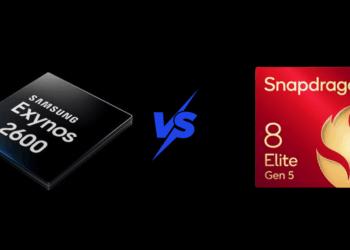
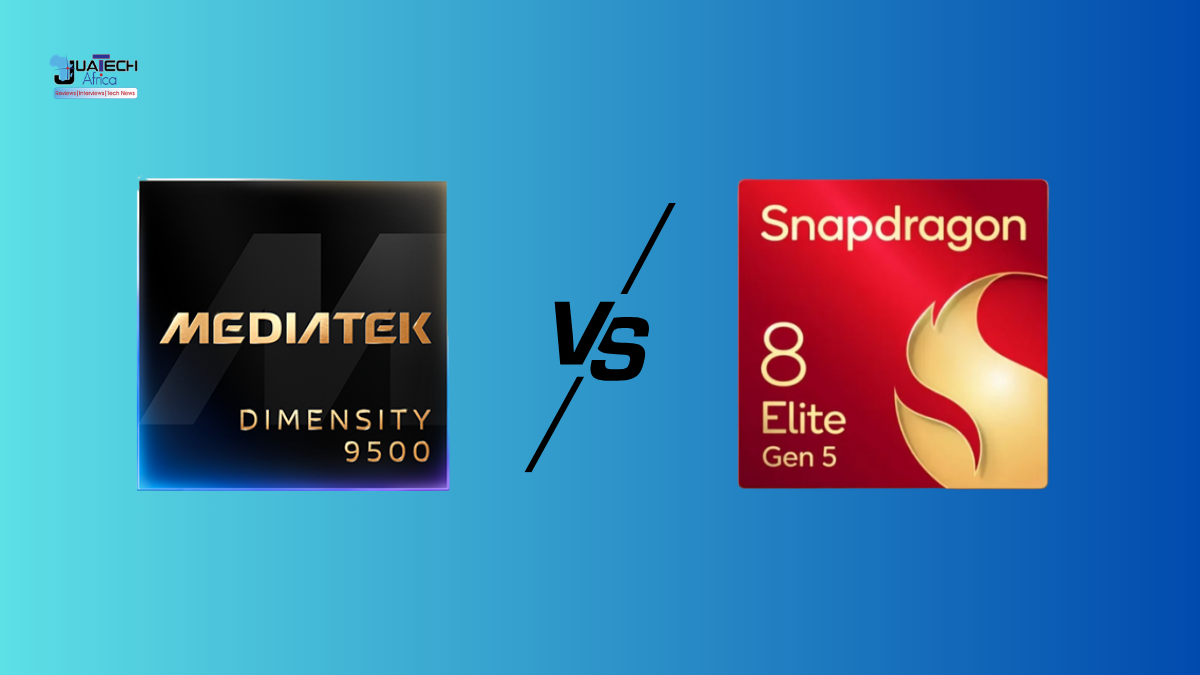
This season, the heavyweights have arrived. On one side, we have the Snapdragon 8 Elite Gen 5, Qualcomm’s most refined custom silicon to date. On the other hand, the MediaTek Dimensity 9500, the champion of “All-Big-Core” architecture, has finally forced the global market to stop calling MediaTek the “budget alternative.”
At JuaTech Africa, we understand your concerns. You worry about battery life during power fluctuations, heat management in our tropical climate, and whether that expensive investment will actually be “smart” a year from now. This is the definitive comparison to help you choose with intent.
The Architecture of Speed: Powering the Daily Hustle
Both chipsets are built on TSMC’s cutting-edge 3-nanometer (3nm) N3P process. Think of this as the density of the engine. By making the components smaller, these chips do more work while sipping less energy. However, how they use that power is where the paths diverge.
Snapdragon 8 Elite Gen 5: The Custom King
Qualcomm has officially matured its custom Oryon v3 CPU. This engine features two “Prime” cores screaming at a massive 4.61 GHz.
- Practicality: In devices like the Samsung Galaxy S26 Ultra, this translates to “Zero-Wait” computing. Whether you are editing a 4K video for social media or running complex data sheets, the phone reacts before your finger leaves the screen.
- User Concerns: High frequency often means high heat. Qualcomm has addressed this with a 35% improvement in power efficiency, but in slim flagship bodies, the device still gets noticeably warm during intensive tasks.
Dimensity 9500: The Multitasking Powerhouse
MediaTek’s “All-Big-Core” design is now in its third generation. By removing tiny “efficiency cores” and using only powerful ones, led by a 4.21 GHz C1-Ultra, the 9500 handles heavy workloads with surprising ease.
- The Practicality: On the Vivo X300 Pro and Oppo Find X9, this chip feels remarkably consistent. It does not “spike” in heat as much as the Snapdragon; it maintains a high level of performance over long hours.
- The User Concern: Many ask if “All-Big-Cores” will drain the battery faster. The reality is the opposite. Because these cores finish tasks faster, they “sleep” sooner, leading to some of the best battery endurance we have seen in 2026.
Table: 2026 Flagship Silicon Comparison – Dimensity 9500 vs. Snapdragon 8 Elite Gen 5
| Feature | Snapdragon 8 Elite Gen 5 | MediaTek Dimensity 9500 |
| Architecture | Custom 3rd Gen Oryon CPU (2+6) | 3rd Gen “All-Big-Core” (1+3+4) |
| Peak Clock Speed | 4.61 GHz (S26 Ultra Special Edition) | 4.21 GHz (C1-Ultra Core) |
| Manufacturing | TSMC 3nm (N3P rocess) | TSMC 3nm (N3P/N3E) |
| Graphics (GPU) | Adreno 840 (Focus: Peak FPS) | Mali-G1 Ultra (Focus: Ray Tracing) |
| AI Processor | Hexagon NPU (Agentic & Personalized) | NPU 990 (Offline 1.58-bit BitNet) |
| ISP (Camera) | 20-bit Spectra Triple AI ISP | 18-bit Imagiq 1190 |
| Max Video | 8K @ 60fps / 4K @ 120fps | 8K @ 60fps / 4K @ 120fps |
| Connectivity | Snapdragon X85 (Best Signal Lock) | UltraSave 4.0 (Best Power Savings) |
| AnTuTu Score | ~4,000,000+ | ~3,700,000+ |
| Local Value | High Resale Value & Brand Prestige | Superior Thermal & Data Efficiency |
Agentic AI: Intelligence That Respects Your Data
In 2026, we have moved past simple chatbots to Agentic AI. This is an assistant that not only answers questions but also performs actions. It summarizes long PDFs for your meeting or automatically filters spam calls in your local dialect.
The Snapdragon 8 Elite Gen 5 introduces the Personal Knowledge Graph. It learns your specific routines locally. If you always use mobile money at a certain time or open your banking app when you arrive at work, the phone pre-loads these apps and secures the connection before you even touch it.
The Dimensity 9500 counters with the NPU 990, which supports 1.58-bit BitNet models.
- Why this matters for Kenyan and larger Africa Users: Most AI needs an internet connection to think. The Dimensity 9500 can run large language models completely offline. For users in areas with expensive data or spotty 5G, a powerful AI that doesn’t “eat” your bundles is a significant win for your wallet.
Gaming and the “Lag” Factor
For the mobile gamer, the GPU (Graphics Processing Unit) is the heart of the experience. However, in the African context, raw power is only half the story. Our climate puts immense pressure on phone thermals; if a chip cannot manage its heat, it “throttles,” leading to the dreaded frame-rate drop mid-match.
The Snapdragon Adreno 840 remains the king of industry optimization. Almost every major title, from Call of Duty: Warzone to Delta Force Mobile, is optimized for Snapdragon first. If you want the highest peak frame rates for competitive e-sports, the Xiaomi 17 Pro/Max is the current benchmark. It pushes the Adreno 840 to its absolute limit, providing a buttery-smooth 144Hz experience that is hard to beat.
However, MediaTek’s Mali-G1 Ultra has closed the gap by focusing on efficiency and visual fidelity. On the Oppo Find X9 Pro and the Vivo X300 Series, we are seeing the debut of 120FPS Mobile Ray Tracing. This technology makes reflections on water and light through trees look almost like a high-end console.
The Vivo X300 Pro, in particular, is a game-changer. Vivo pairs the Dimensity 9500 with its custom V5 Gaming Chip, which offloads the heavy lifting from the main processor. This allows the phone to stay remarkably cool during long gaming sessions on a warm afternoon in Nairobi or Lagos. While the Snapdragon offers the highest “burst” speed, the Vivo X300 Series offers the most consistent gaming performance, ensuring you don’t lose a match because your phone decided to overheat.
Connectivity: Staying Linked in a 5G World
In Kenya and most parts of Africa, we often deal with “fringe” signals where 5G is just out of reach or Wi-Fi is unstable.
- Snapdragon X85 Modem: This is the gold standard for signal retention. It uses AI to predict signal drops and keep the connection alive. On the Galaxy S26 Ultra, the uplink speeds are incredible, which is great for future-proofing your device.
- MediaTek UltraSave 4.0: MediaTek focuses on the battery cost of staying connected. Its modem is designed to use 20% less power while idling on 5G. For a user who spends most of the day on mobile data rather than Wi-Fi, this can mean the difference between a phone that dies at sunset and one that lasts until bedtime.
Practical Choice: Which Device Fits Your Life?
Since these devices are now available across Kenya’s and Africa’s leading retail hubs, here is how the market splits:
- The Luxury Professional: The Samsung Galaxy S26 Ultra (Snapdragon 8 Elite Gen 5). It is the most polished AI experience on the market.
- The Performance Disruptor: The Xiaomi 17 Pro/ Max (Snapdragon 8 Elite Gen 5). It offers raw speed at a slightly more accessible price point.
- The Efficiency Expert: The Vivo X300 Pro (Dimensity 9500). This is for users who want the best battery life in the flagship segment without sacrificing power.
- The Creative Gamer: The Oppo Find X9 Ultra (Dimensity 9500). Its thermal management and 120FPS ray tracing make it a top-tier choice for heavy use.
The following devices represent the current retail stock in major tech hubs as of March 2026.
Table 2: Supported Smartphone Models (Early 2026) in Kenya and across Africa
| Powered by Snapdragon 8 Elite Gen 5 | Powered by MediaTek Dimensity 9500 |
|
|
To simplify this further for you, here is a more elaborate table summary of devices and if they suit your need.

Table 3: Leading 2026 Smartphones by Chipset and Regional Availability (Kenya and across Africa)
| Chipset | Top Smartphone Models (Kenya & Africa) | Primary User Persona | Availability/Service Hubs |
| Snapdragon 8 Elite Gen 5 | Samsung Galaxy S26 Ultra | Corporate Leaders & Power Users | Safaricom, Airtel, Samsung Brand Shops |
| Xiaomi 17 Pro / Max | Competitive Gamers & Tech Enthusiasts | Xiaomi Mi-Stores, Jumia, Kilimall | |
| OnePlus 15 (Global) | Creative Professionals | Third-party Retailers (Nairobi/Lagos) | |
| MediaTek Dimensity 9500 | Vivo X300 Pro (with V5 Chip) | Mobile Photographers & Vloggers | Vivo Kenya, Vivo Experience Centers, Slot (Nigeria) |
| Oppo Find X9 Pro | Long-duration Gamers & Travelers | Oppo Authorized Dealers, Safaricom | |
| Redmi K90 Ultra (Xiaomi 15T Pro) | Pragmatic “Value” Flagship Seekers | Mi-Stores, Local E-commerce |
Strategic Recommendation
Choose Snapdragon 8 Elite if your primary concerns are resale value, desktop mode (DeX), and the highest possible benchmark numbers for bragging rights. Personal preference and availability determines the smartphone model you finally set
Choose Dimensity 9500 if you live in a warm climate, want offline AI to save on data bundles, and need a phone that can record 4K video for an hour without overheating.
The Final Verdict: Efficiency vs. Ego
The choice between these two giants depends on your specific needs and vulnerabilities.
The Snapdragon 8 Elite Gen 5 is the chip of “Ego.” It is for the person who wants the absolute best, the highest benchmark score, and the most prestigious brand partnership. It is a technical masterpiece that justifies its high price for those who need the absolute ceiling of mobile performance.
However, for the majority of JuaTech Africa readers, the MediaTek Dimensity 9500 is the smarter buy for 2026. Its focus on offline AI, All-Big-Core multitasking, and thermal efficiency aligns perfectly with the realities of the African market. It proves that in a world where everyone is fast, the one who stays cool and saves data is the real winner.
The future is no longer just fast; it is efficient, localized, and resilient. Both of these chips will take you there, but only one might do it without making you hunt for a power bank by midday.
The 2026 Flagship Silicon FAQ: Everything You Need to Know
- What is the difference between Snapdragon 8 Elite Gen 5 and Snapdragon 8 Gen 5?
The 8 Elite Gen 5 is the ultra-premium “Tier 1” chip (e.g., in the Galaxy S26 Ultra) with peak clock speeds of 4.61 GHz. The 8 Gen 5 (non-Elite) is a “Tier 2” flagship. While both use Oryon v3 cores, the non-Elite version is clocked lower (max 3.8 GHz) and uses a scaled-down GPU (Adreno 829), resulting in ~20% lower performance. Always look for the “Elite” tag for true flagship power.
- Is the Snapdragon 8 Elite Gen 5 just a renamed “Snapdragon 8 Elite 2”?
Precisely. Qualcomm skipped the “Elite 2” name to re-align with its generational numbering. The 8 Elite Gen 5 is the direct successor to the original 8 Elite (2024). This realignment helps consumers identify that it is the 5th generation of the “Snapdragon 8” series architecture.
- What makes the Dimensity 9500 “All-Big-Core” design unique?
Unlike traditional chips that use “Little” efficiency cores for simple tasks, the Dimensity 9500 uses only Big Cores (1x C1-Ultra, 3x C1-Premium, 4x C1-Pro). This allows the chip to finish heavy tasks significantly faster and then “hibernate,” which, counter-intuitively, leads to better battery life and smoother multitasking than designs with tiny cores.
- How does “Agentic AI” differ from the AI on my old phone?
Older AI was “Reactive” (you ask, it answers). Agentic AI is “Pro-active.” Driven by the NPU 990 (MediaTek) or Hexagon NPU (Snapdragon), your phone can now perform multi-step actions. For example, it can “summarize this PDF and email the top three points to my boss,” navigating the apps on your behalf.
- Which chip is better for the African climate?
The Dimensity 9500 holds a slight edge in thermal management. In tropical ambient temperatures (30°C+), its architecture maintains higher stability. The Snapdragon 8 Elite Gen 5 hits higher peak speeds but is more prone to thermal throttling (slowing down to cool off) during extended 4K recording or gaming.
- What is BitNet 1.58-bit support, and why is it a game-changer?
The Dimensity 9500 is the first to support 1.58-bit quantization. This allows massive AI models to be compressed so heavily that they can run entirely offline with minimal battery drain. For Kenyan and African users, this means using advanced AI assistants without needing a data connection or a high-speed Wi-Fi signal.
- Can the Snapdragon 8 Elite Gen 5 really replace a laptop?
Yes, in specific contexts. Because the Oryon v3 cores share the same DNA as Qualcomm’s laptop chips (X Elite), devices like the Samsung S26 Ultra can run “Desktop Mode” (DeX) with professional-grade fluidity, handling multi-window productivity better than any previous mobile chip.
- Which chipset has the best gaming performance in 2026?
- Peak Power: Snapdragon 8 Elite Gen 5 (Adreno 840) wins for short, intense bursts.
- Sustained Gaming: Dimensity 9500 (Mali-G1 Ultra) wins for long sessions (1 hour+), as it stays cooler and maintains a more consistent frame rate.
- Do these chips support Satellite Connectivity in rural Africa?
Both support 3GPP Release-17 NTN (Non-Terrestrial Network). If you are in a remote area without cell service, you can send emergency texts and location data directly via satellite, provided your service provider supports the feature.
- What is the “C1-Ultra” core in the Dimensity 9500?
The C1-Ultra (based on ARM’s Lumex platform) is MediaTek’s answer to Qualcomm’s Oryon. It is a high-performance core clocked at 4.21 GHz that prioritizes “Instructions Per Clock” (IPC), meaning it does more work per cycle than previous generations, enhancing app launch speeds.
- Which chip is better for content creators (Video/Photo)?
The Snapdragon 8 Elite Gen 5 features a 20-bit Spectra ISP with “Limitless Semantic Segmentation.” It can identify and optimize different parts of a video (skin, sky, grass) in real time at 4K/120 fps. It is currently the industry leader for mobile cinematography.
- Does 5G use more battery on these chips?
Less than before. MediaTek’s UltraSave 4.0 and Snapdragon’s X85 Modem use AI to predict network traffic. This reduces “radio wake-time,” leading to roughly 15-20% better power efficiency on 5G compared to 2024 flagship models.
- Why is “LPDDR5X-10667” memory important?
Both chips now support ultra-fast RAM (up to 10.7 Gbps). This is crucial for AI. Large language models need to move data from the memory to the NPU instantly. Slower RAM creates a “bottleneck” that makes AI feel sluggish.
- Will these chips receive longer software updates?
While the chipsets support up to 8 years of updates, the actual longevity depends on the manufacturer (Samsung, Xiaomi, Vivo). However, the 3nm architecture ensures these phones will still feel fast and capable of running 2030-era apps.
- Verdict: Which one should I buy in Nairobi today?
- Buy Snapdragon 8 Elite Gen 5 if you want the highest resale value, the best camera processing, and the “prestige” of the Snapdragon brand.
- Buy Dimensity 9500 if you want a phone that stays cool, lasts longer on a single charge, and offers superior offline AI capabilities for data-saving.