
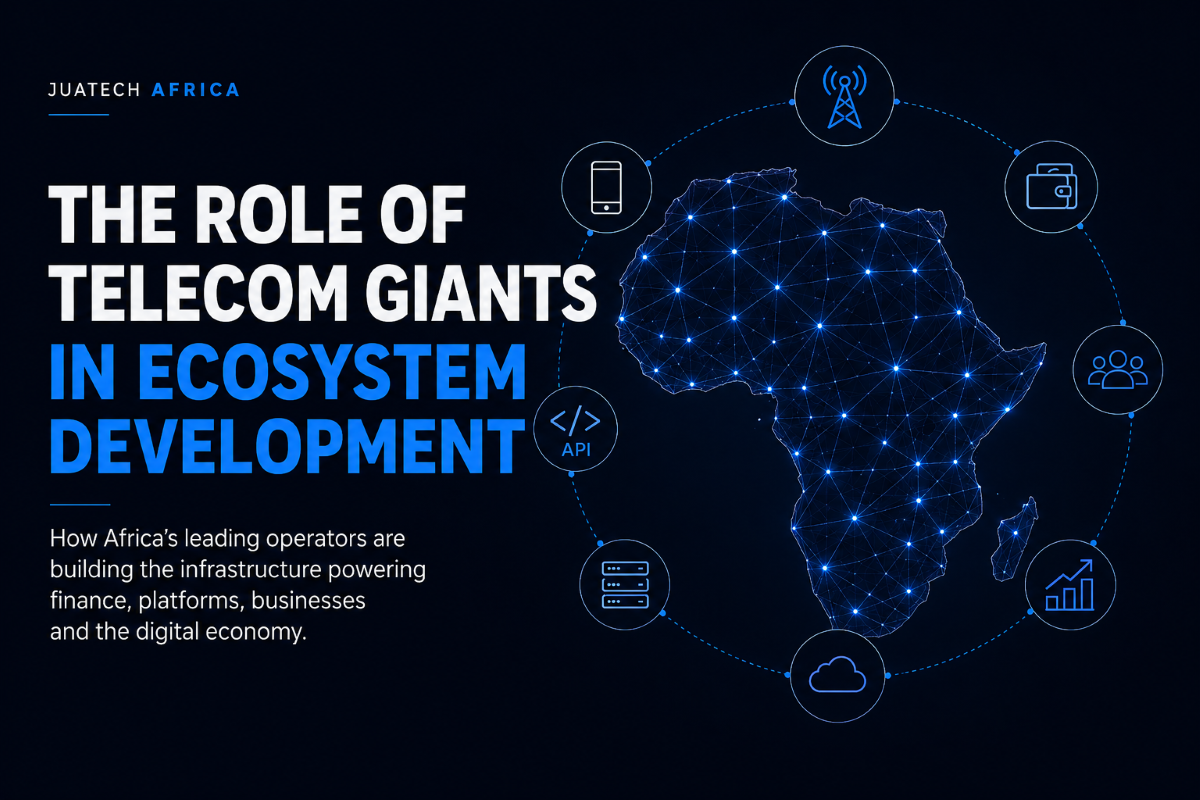
Africa’s telecom operators are evolving from connectivity providers into ecosystem builders, expanding into mobile money, digital platforms, enterprise technology, fiber, data infrastructure, and other services that increasingly shape how businesses and consumers participate in the digital economy.
The transformation matters because mobile connectivity is no longer simply an end product. According to the GSMA’s Mobile Economy Africa 2026, mobile technologies and services contributed approximately US$240 billion to Africa’s economy in 2025, equivalent to 7.8% of the continent’s GDP, while supporting about 13 million jobs and generating roughly US$45 billion in public-sector revenue. The organization expects the sector’s economic contribution to approach US$290 billion by 2030. These figures place telecom infrastructure within a much larger economic system encompassing financial services, commerce, enterprise technology, employment and digital inclusion.

The traditional telecommunications model was relatively linear: operators built networks, acquired subscribers, sold voice and data services, expanded coverage and invested in the next generation of infrastructure. Africa’s leading operators are now operating across a more complex value chain. Connectivity provides reach; reach creates customer relationships and distribution; those relationships can support mobile payments, financial services, enterprise solutions and digital platforms. Increasingly, operators are also investing in fiber, data centers, cloud capabilities, APIs and other infrastructure that enables third parties to build services on top of their networks. The operator consequently becomes not only a provider of connectivity, but a participant in the architecture of the digital economy.
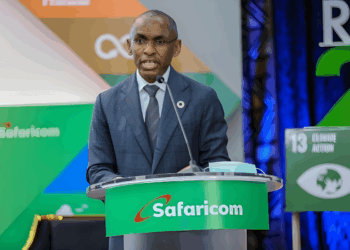
Safaricom’s evolution illustrates this transition particularly clearly. Since M-PESA launched in Kenya in 2007, the company has progressively expanded its network and customer base into payments, merchant services, financial products, enterprise solutions, and digital platforms. In FY2026, M-PESA generated KSh182.7 billion in revenue and had 40.99 million one-month-active customers, demonstrating how a service that began as a mobile money product can become a substantial economic layer within a telecommunications ecosystem. Across the continent, Airtel Africa, MTN, and Vodacom offer different expressions of the same broader movement, combining connectivity with financial services, enterprise technology, infrastructure, and digital platforms.
The more important question, therefore, is no longer simply how many people Africa’s telecom operators can connect. It is what becomes possible once those people, businesses and institutions are connected. When an operator combines network infrastructure with distribution, payments, customer relationships, enterprise services, and increasingly programmable digital infrastructure, its influence extends beyond telecommunications into the markets and ecosystems that develop around its network.
Africa’s telecom transformation is no longer simply about connecting more people. It is increasingly about determining what becomes possible once they are connected.
From Network Operator to Ecosystem Builder: The Historical Shift
Africa’s telecom ecosystem did not emerge fully formed. It was built incrementally as operators discovered that the same networks created to carry voice calls and text messages could support increasingly complex forms of economic activity. The first phase was about reach: building mobile networks, acquiring subscribers, and making communication accessible beyond fixed-line infrastructure. Safaricom’s commercial journey captures this early transition. The company was officially launched in Kenya in October 2000, initially operating as a mobile communications business. By 2004, it had reached two million subscribers and introduced mobile internet; by 2007, its subscriber base had reached six million, and the company had begun rolling out 3G. The trajectory from voice and SMS to mobile data was already turning the handset from a communications device into an access point to a broader digital economy.
The more consequential inflection point came on 6 March 2007, when Safaricom and Vodafone commercially launched M-PESA in Kenya. The service was initially conceived to facilitate microfinance loan repayments, but early users quickly demonstrated a different demand: they wanted to send money to one another. Safaricom records that M-PESA had 19,671 active users within its first month and crossed one million users by November 2007. What began as a mobile money service subsequently expanded into payments, merchant transactions, bill payments, financial services and digital platforms. The significance was not simply that a telecom operator had entered financial services. It was that connectivity had become the distribution layer for an entirely new economic relationship.
Other operators followed a similar broad trajectory, though through different markets and strategies. MTN began commercializing Mobile Money in 2009, extending the operator’s relationship with customers from communication into financial transactions. In 2010, Bharti Airtel acquired Zain’s African operations, laying the foundation for what became Airtel Africa’s multi-market footprint. The acquisition brought approximately 36 million subscribers across 15 African countries into the Bharti Airtel group and demonstrated another important dimension of telecom ecosystem development: scale itself could become an asset that enabled operators to replicate services, infrastructure and digital products across national markets.
Since then, the evolution has been cumulative rather than sequential. Voice created reach; mobile data expanded access; mobile money created transactions; smartphones created platforms; fintech extended financial relationships; enterprise services moved operators deeper into institutional technology; fiber and data infrastructure strengthened their role as digital infrastructure providers; and APIs increasingly allow third parties to build on network capabilities. Safaricom’s progression illustrates this layering, from M-PESA and merchant payments to fiber, enterprise solutions, digital platforms, and the M-PESA Super App. By 2022, M-PESA had grown across seven African markets to more than 51 million customers, 465,000 businesses, 600,000 agents and 42,000 developers, illustrating how a telecom-originated service can evolve into a multi-sided ecosystem involving consumers, merchants, financial institutions, developers and technology partners.
This is the central historical lesson. A single technological breakthrough has not driven telecom ecosystem development. It has emerged through layering. Each new capability gives the operator another relationship with the customer and another connection to the wider economy. The network creates reach; the customer base creates distribution; distribution creates opportunities for transactions and services; platforms bring in partners; and infrastructure allows those relationships to operate at scale. What began as a business of moving voice and data is therefore becoming a business of enabling, connecting, and increasingly orchestrating economic activity.
That shift from network operator to ecosystem builder is the foundation for understanding where Africa’s telecom industry is heading next.
The Scale of the Ecosystem: Africa in Numbers
Africa’s telecom industry has grown into an economic force whose significance extends well beyond connectivity. The GSMA estimates that mobile technologies and services contributed US$240 billion to Africa’s economy in 2025, equivalent to 7.8% of continental GDP, while supporting approximately 13 million jobs and generating US$45 billion in public-sector revenue. The contribution is projected to approach US$290 billion by 2030, reinforcing mobile technology’s position as a foundational layer of Africa’s digital economy.
A Connected Continent Still Faces a Usage Gap
The scale of infrastructure, however, should not be confused with universal participation. Approximately 63% of Africa’s population lives within mobile broadband coverage but does not use mobile internet, according to the GSMA. The coverage gap is only about 9%, making affordability, device access, digital skills, relevant services, and user confidence increasingly important barriers to adoption. For telecom operators, this creates the next strategic challenge: converting network availability into meaningful economic participation.
MTN Shows the Scale of the Multi-Market Ecosystem
MTN Group illustrates how far an African telecom operator can extend beyond traditional communications. At the end of 2025, MTN served more than 307 million customers across 16 markets, including approximately 70 million Mobile Money customers. Its fintech ecosystem processed more than 23 billion transactions worth over US$500 billion, supported by more than 1.4 million active Mobile Money agents and 2.1 million active merchants. MTN invested approximately R38 billion during the year in network and platform capacity, demonstrating the capital intensity required to sustain an increasingly diversified digital ecosystem.
Airtel Africa Extends the Model Across 14 Markets
Airtel Africa provides another measure of continental scale. By March 2026, the operator served approximately 183.5 million customers across 14 markets, while Airtel Money had 54.1 million customers and processed approximately US$196 billion in transaction value during FY2026, generating US$1.355 billion in revenue. Its wider operations now include enterprise services, fiber and data-center infrastructure alongside connectivity and financial services.
Kenya Demonstrates Ecosystem Depth
Safaricom provides perhaps the clearest illustration of how deeply telecom infrastructure can become embedded in economic activity. In FY2026, M-PESA had 40.99 million one-month-active customers and generated KSh182.7 billion in revenue. Its evolution from a 2007 mobile money service into a broader platform spanning payments, merchants, financial services, business solutions, and digital capabilities demonstrates how connectivity can become the foundation for multiple layers of economic activity.
The numbers point to a broader conclusion: Africa’s leading telecom operators are increasingly becoming economic infrastructure companies. Their strategic significance is no longer adequately captured by subscriber counts or network coverage alone. Increasingly, it lies in the transactions, businesses, services, and relationships their infrastructure enables. That is the ecosystem we need to examine next.
The Telecom Ecosystem Architecture
The scale outlined above explains why telecom operators in Africa matter. The more fundamental question is what turns a telecommunications network into an ecosystem. Subscriber numbers, transaction values and infrastructure investment demonstrate scale, but scale alone does not create ecosystem power. An ecosystem emerges when an operator’s assets begin reinforcing one another and when consumers, merchants, developers, banks, enterprises, governments and technology partners can create economic value around those assets. This is the shift from a traditional network business toward a telecom digital ecosystem.
The architecture can be understood through seven interconnected layers. These are not seven independent businesses. They are capabilities that compound as an operator moves from providing connectivity to enabling increasingly complex forms of participation in the digital economy.
Layer 1: Connectivity
Every telecom ecosystem begins with connectivity. Spectrum, mobile sites, fiber, broadband, and 4G and 5G networks provide the technical foundation through which people, devices, and organizations communicate. Without this layer, the others cannot operate at meaningful scale. Connectivity remains the operator’s foundational asset, but increasingly it is the beginning rather than the complete value proposition. The strategic question is no longer how much connectivity can be sold, but what economic activity can be built on the network.
Layer 2: Access
A network creates economic value only when people can access and use it. Devices, retail channels, agents, distribution networks, affordability, and customer support determine whether connectivity becomes participation. This layer is particularly important in Africa, where the usage gap remains substantially larger than the coverage gap. Operators that combine infrastructure with extensive distribution can influence not only whether people become connected, but how effectively they enter the digital economy.
Layer 3: Transactions
Mobile money transformed the architecture by turning the network into a transaction layer. Payments, remittances, merchant transactions, credit and insurance convert connectivity into recurring economic activity. M-PESA demonstrated this model’s potential in Kenya, while MTN MoMo and Airtel Money have extended comparable capabilities across multiple African markets. The operator’s relationship with the customer consequently evolves from communication toward economic participation.
Layer 4: Platforms
The platform layer changes the model again. Super Apps, business applications, APIs, and developer tools allow services to exist beyond the operator’s own interfaces. Developers and businesses can build on network capabilities, while merchants and financial institutions can integrate into the system. At this point, the operator is no longer simply delivering services to customers. It is increasingly creating an environment in which other organizations can deliver services to customers.
Layer 5: Enterprise Infrastructure
Cloud services, data centers, fiber, cybersecurity, IoT and enterprise connectivity extend the digital infrastructure ecosystem into institutional technology. The operator’s customer is no longer only an individual consumer. Banks, governments, corporations and startups can become dependent on the infrastructure itself. The telecom operator consequently moves closer to the core of how organizations conduct digital business.
Layer 6: Ecosystem Participation
An ecosystem becomes more powerful as more participants can create value within it. Developers build applications; fintechs create financial products; banks integrate services; merchants accept payments; startups gain distribution; governments use infrastructure; and technology partners contribute capabilities. The operator increasingly becomes an orchestrator of relationships, rather than simply a supplier at the end of a conventional value chain. This is central to understanding modern telecom ecosystem development.
Layer 7: Economic Activity and Ecosystem Value
The final layer is where the preceding capabilities translate into commerce, employment, entrepreneurship, productivity, financial inclusion, and digital services. A customer may enter through connectivity, gain access through a device and distribution network, transact through mobile money, use a digital platform, and ultimately participate in commerce enabled by the same underlying ecosystem. The layers therefore compound rather than operate independently. Connectivity creates reach; access creates participation; transactions create economic relationships; platforms bring third parties into the system; infrastructure deepens institutional engagement; and participation expands the network’s utility.
The layers therefore compound rather than operate independently. Connectivity creates reach; access creates participation; transactions create economic relationships; platforms bring third parties into the system; infrastructure deepens institutional engagement; and participation expands the network’s utility. The resulting ecosystem power comes not simply from owning the network, but from becoming increasingly embedded in the economic activity that develops around it. The clearest way to test this architecture is to examine what happens when these layers converge within a real market. Kenya provides one of the strongest examples.
Kenya: The Safaricom-M-PESA Case Study
Kenya offers one of Africa’s clearest demonstrations of how a telecom operator can evolve into an ecosystem builder. Safaricom’s significance is not simply that it became the country’s dominant mobile operator, or that M-PESA became one of the world’s most recognized mobile-money services. It is that a network originally designed to connect people progressively became a platform through which consumers, merchants, financial institutions, businesses, and developers could participate in the digital economy. Kenya therefore provides a practical test of the seven-layer ecosystem architecture established above: connectivity created reach, M-PESAcreated transactions, merchant services expanded participation, APIs enabled programmability, and financial services deepened the relationship between the operator and its customers.
From Mobile Network to Financial Platform
Safaricom was launched commercially in Kenya in October 2000, initially operating as a mobile communications company. The decisive inflection point came on 6 March 2007, when Safaricom and Vodafone launched M-PESA. The service was initially conceived around microfinance loan repayments, but customers quickly demonstrated a broader demand for convenient person-to-person money transfers. Within its first month, M-PESA had attracted 19,671 active users. What began as a mobile money service subsequently expanded into payments, merchant services and financial products, changing the economic role of Safaricom’s network.
The transformation accelerated as Safaricom converted the customer relationship into a commercial network. M-Shwari launched in 2012, followed by Lipa Na M-PESA in 2013, enabling consumers to pay participating businesses through their phones. M-PESA Global, merchant services, business applications, and other financial products subsequently broadened the platform. In 2017, the Daraja API opened M-PESA functionality to businesses and developers, allowing integrations into applications, websites, and other digital services. M-PESA consequently evolved from a mobile money product into a programmable platform connecting consumers, merchants, businesses, developers, and financial-service providers.
The Ecosystem Has Become Deep, Not Merely Large
The latest figures demonstrate the scale of that transformation. In FY2026, M-PESA reached 40.99 million one-month-active customers in Kenya and generated KSh182.7 billion in revenue. The platform processed 46.4 billion transactions worth KSh41.68 trillion, while its merchant ecosystem expanded to approximately 3.1 million businesses. Lipa Na M-PESA reached approximately 1 million merchants, and Pochi La Biashara reached approximately 2.1 million customers. M-PESA accounted for 45.6% of Safaricom Kenya’s service revenue in FY2026.
These figures demonstrate ecosystem depth rather than customer scale alone. A consumer can connect through Safaricom, transact through M-PESA, pay merchants through Lipa Na M-PESA, and access additional financial services. Merchants can receive payments and participate in financial products, while developers and businesses can integrate M-PESA capabilities through APIs. Each participant adds another relationship to the system, increasing the utility of the underlying platform.
The Ecosystem Continues to Expand
Safaricom is now extending the ecosystem beyond payments. In FY2026, wealth-management assets on M-PESA more than doubled to KSh21 billion, including KSh18.7 billion through Ziidi, while Ziidi Trader expanded access to securities trading through mobile devices. The company is also developing fiber, cloud, cybersecurity, enterprise connectivity and API capabilities, extending its reach into the wider digital infrastructure ecosystem.
The ownership structure has also become strategically significant. On 30 June 2026, Vodacom completed the acquisition of an additional 20% effective interest in Safaricom, taking its effective holding to approximately 55%. The approximately US$2.1 billion transaction strengthens Vodacom’s exposure to one of Africa’s most developed telecommunications and financial-services ecosystems.
Safaricom’s trajectory demonstrates the central proposition of this article: a telecom network becomes an ecosystem when connectivity evolves into infrastructure upon which other economic relationships depend. M-PESA did not replace Safaricom’s telecommunications business; it multiplied the relationships that could be built around the network. Kenya’s experience shows why the modern telecom operator must increasingly be assessed not only by the size of its network, but by the breadth, depth, and economic value of the ecosystem that network enables.
Airtel Africa: From Connectivity to Multi-Market Digital Infrastructure
Safaricom demonstrates how a telecom operator can develop exceptional ecosystem depth within one market. Airtel Africa provides a different perspective: how that model can be scaled across multiple national markets. Operating in 14 African countries, with a combined population of approximately 635 million people, Airtel Africa has built a business spanning mobile connectivity, Airtel Money, enterprise services, fiber and data-center infrastructure. By March 2026, the group served 183.5 million customers, demonstrating the scale of distribution on which its broader digital ecosystem can operate.
Mobile Money Becomes a Value Engine
Airtel Money is particularly important because it demonstrates how value created by telecom infrastructure can migrate into adjacent industries. As of March 2026, Airtel Money had 54.1 million customers, supported by 2.4 million active agents, and processed approximately US$196 billion in transaction value during FY2026. The business generated US$1.355 billion in revenue, with services extending beyond transfers into merchant payments, loans, savings, insurance and international money transfers.
The strategic significance became clearer in July 2026, when Airtel Africa announced plans to list its mobile-money business on the London Stock Exchange later in 2026. Reuters reported that the proposed transaction could value Airtel Money at around US$10 billion. If realized, such a valuation would send a striking market signal: a financial-services business that originated inside a telecommunications operator can develop sufficient scale, revenue, and strategic independence to be considered a separately valuable enterprise.
Extending the Ecosystem Into Infrastructure
Airtel Africa is simultaneously moving deeper into the infrastructure supporting Africa’s digital economy. Its enterprise business provides communications and digital solutions to businesses, governments and non-governmental organizations, while Telesonic uses terrestrial fiber and subsea cable systems to address growing wholesale-data demand. Nxtra by Airtel Africa operates data-centre infrastructure, while the group continues expanding 4G, 5G and home broadband capacity.
Airtel Africa therefore adds an important dimension to the ecosystem argument. The value created by telecom infrastructure does not have to remain inside telecommunications. Connectivity establishes reach; mobile money converts that reach into financial activity; enterprise services extend the relationship into institutional technology; and fiber and data centers position the operator deeper inside the infrastructure on which digital businesses depend. The multi-market model shows how telecom ecosystem development can become not only deeper but also geographically scalable.
MTN: The Telecom Operator as a Pan-African Platform
MTN demonstrates what happens when telecom ecosystem development is pursued at continental scale. Operating across 16 markets, the group had 307.2 million customers as of December 2025, alongside 172.6 million active data customers and 69.5 million monthly active Mobile Money users. The scale gives MTN an extensive distribution platform through which connectivity, financial services, commerce and digital infrastructure can reinforce one another.
Fintech Adds a Transaction Layer at Continental Scale
MTN’s MoMo platform illustrates the breadth of this model. At FY2025, it had 1.4 million active agents and 2.1 million active merchants, while fintech transaction value reached US$500.3 billion across 23.3 billion transactions. Merchant payments accounted for US$22.3 billion, while the platform facilitated US$3.5 billion in loans and enabled US$6.2 billion in cross-border remittances. MTN’s fintech portfolio now spans payments, commerce, lending, insurance and remittances, demonstrating how a telecommunications customer relationship can develop into a broader financial-services ecosystem.
Bayobab Extends the Platform Beneath the Network
MTN’s ecosystem also extends into the infrastructure supporting Africa’s digital economy. Through Bayobab, its digital-infrastructure business, MTN is expanding terrestrial fiber and international connectivity. Bayobab’s fiber network is being expanded toward 135,000 kilometers, while its participation in the 2Africa subsea cable, which spans approximately 45,000 kilometers and connects 33 countries, strengthens connectivity between Africa and global markets. Its East African Corridor has also linked Kampala to Kenya’s Mombasa subsea landing infrastructure through a 260-kilometer Kampala–Malaba fiber route.
MTN therefore adds a distinct dimension to the ecosystem framework. Safaricom demonstrates depth, Airtel Africa demonstrates multi-market replication, while MTN demonstrates breadth at continental scale. Its evolution shows how connectivity can become the foundation for financial services, commerce and digital infrastructure, creating an ecosystem whose value extends well beyond the traditional telecommunications business.
Beyond Mobile Money: The New Infrastructure Layer
The evolution of Africa’s telecom industry is no longer defined only by expanding mobile coverage or growing mobile-money transaction volumes. The next stage is being built deeper into the digital stack through fiber, data centers, cloud, APIs, artificial intelligence and the Internet of Things. These capabilities matter because they change what the network can do. The telecom operator increasingly becomes part of the infrastructure on which enterprises, governments, developers and technology companies build, rather than simply the provider that connects them.
Fiber, Data Centers and Cloud Build the Digital Backbone
Fiber is the physical backbone of this transition. As data consumption, cloud applications, enterprise connectivity, and AI workloads increase, operators need networks that can carry larger volumes of data with greater resilience and lower latency. Data centers extend this infrastructure into compute, storage, and interconnection, while cloud services turn underlying infrastructure into enterprise capabilities that organizations can consume without owning the physical systems themselves.
This creates a deeper commercial relationship with the enterprise. A bank, government agency, retailer, or technology company can increasingly procure connectivity, cloud, security, and managed digital services from the same ecosystem that operates its network. The operator consequently moves closer to the infrastructure supporting the customer’s core digital operations.
APIs Turn Networks into Programmable Infrastructure
The API layer creates another structural shift. Historically, operators used much of their network intelligence internally. Increasingly, capabilities such as identity verification, location, authentication, and fraud prevention are being exposed to developers, enterprises, and governments through standardized APIs. GSMA reports that 79% of African operators identify becoming a digital transformation partner as a primary enterprise objective, while Africa accounts for 11% of global GSMA Open Gateway operator commitments.
MTN’s Chenosis illustrates the model. Its developer ecosystem makes capabilities across telecommunications, payments, identity, authentication, location, IoT, fintech, and e-commerce available to developers and businesses. MTN’s current developer platform similarly exposes APIs for Mobile Money, payments, messaging, location, IoT, and identity. The implication is significant: network capabilities become building blocks that other businesses can incorporate into their own products and services.
AI and IoT Expand the Network’s Economic Reach
Artificial intelligence and IoT push the ecosystem beyond human communication. IoT connects vehicles, sensors, industrial equipment and other machines, creating new demand for reliable connectivity and data infrastructure. AI introduces another layer of demand for data, compute, connectivity, security and increasingly specialized infrastructure. GSMA’s 2026 research identifies AI, digital services and standardized network APIs among the forces driving this transition.
The significance is therefore larger than technological diversification. Fiber moves the data, data centers provide compute and storage, cloud turns infrastructure into enterprise services, APIs make network capabilities programmable, IoT expands the number of connected endpoints, and AI creates new workloads and services. Together, these layers move the telecom operator deeper into Africa’s digital infrastructure ecosystem.
The network is no longer simply the road on which the digital economy travels. It is increasingly becoming part of the infrastructure that makes the digital economy possible.
The Ecosystem Advantage: Why Telecom Companies Have an Unusual Position
Telecom operators occupy an unusually powerful position in digital ecosystems because they control several strategic assets simultaneously. They do not merely connect users to networks. They can combinemillions of customer relationships, trusted brands, extensive distribution networks, physical infrastructure, payment rails, enterprise relationships, and recurring revenue within a single corporate structure. They also operate under regulatory licenses that can create significant barriers to entry. At the same time, the capital intensity of networks, spectrum, and infrastructure makes their underlying assets difficult and expensive to replicate.
The advantage becomes more pronounced when these assets interact. A telecom operator can connect a consumer, authenticate that customer, facilitate a payment, distribute a financial product, provide the connectivity that supports a business application, and potentially expose network capabilities to developers through APIs. Transaction data and network intelligence can further inform how services are designed, distributed, and optimized, subject to privacy, data-protection, and regulatory requirements.
This creates what can be described as ecosystem leverage. A startup may have the product. A bank may have capital and financial expertise. A cloud provider may have computing infrastructure. A technology company may have software and artificial intelligence capabilities. The telecom operator can potentially provide the access, distribution, connectivity, and customer relationships through which those capabilities reach millions of people and businesses.
That does not automatically make every telecom operator an ecosystem orchestrator. Poor execution, regulatory constraints, weak platforms, or fragmented infrastructure can limit the advantage. But where these assets are integrated effectively, the operator possesses something difficult for a standalone competitor to reproduce: multiple strategic layers of the digital economy under one roof, connected to an existing customer base at national or continental scale.
The Other Side: Ecosystem Power Creates Dependencies
The same characteristics that give telecom operators ecosystem leverage can also create dependencies. As connectivity, payments, digital identity, enterprise services, and APIs become concentrated within a small number of large platforms, consumers and businesses may gain convenience while becoming increasingly dependent on those platforms’ infrastructure and commercial terms. For SMEs in particular, dependence on a dominant payment, distribution or connectivity channel can make changes in pricing, access conditions or platform rules economically consequential.
This raises questions that market share alone cannot answer. Who controls the data generated across the ecosystem? How easily can customers, merchants and developers move between competing platforms? Can APIs and payment systems interoperate effectively? When a telecom operator combines network infrastructure, financial services and digital platforms, does vertical integration produce efficiencies for users, or can it also create barriers for competitors? These questions place competition policy, interoperability, data governance, cybersecurity, consumer protection and financial regulation at the center of ecosystem development.
The regulatory challenge is particularly important as operators expose network capabilities through APIs and participate more deeply in financial and enterprise services. GSMA’s 2026 analysis of Open Gateway highlights the importance of regulatory and policy frameworks in enabling network APIs to scale across African markets. The objective is not necessarily to prevent operators from building integrated ecosystems, but to ensure that integration does not undermine competition, security, consumer choice, or market access.
The distinction is fundamental: ecosystem development is not automatically ecosystem openness. An ecosystem can generate enormous economic value while simultaneously creating dependencies that require thoughtful governance. For African markets, the policy challenge will be to capture the benefits of scale and integration without allowing infrastructure, data, or platform control to become unnecessary barriers to participation.
What This Means for Africa
The rise of telecom-led ecosystems has consequences well beyond the operators themselves. As connectivity, payments, digital infrastructure, and platforms converge, telecom companies increasingly sit between infrastructure providers and economic institutions. That changes how other participants in Africa’s digital economy must think about them.
For Governments
Governments should increasingly treat major telecom operators as strategic infrastructure partners, not simply licensed communications providers. Their networks support financial inclusion, public services, enterprise connectivity, and digital commerce. Policy should therefore encourage investment and innovation while preserving competition, interoperability, security, and consumer protection.
For Startups
Telecom platforms can provide startups with something that is otherwise expensive to build: distribution at scale. APIs, mobile payments, identity capabilities, and established customer relationships can reduce barriers to reaching users across markets. The opportunity is to build on telecom infrastructure without becoming excessively dependent on a single platform.
For Banks and Fintechs
Telecom operators are simultaneously partners, competitors, and infrastructure providers. Mobile money has brought telecom companies directly into financial services, while banks and fintechs increasingly depend on telecommunications infrastructure to reach customers and deliver digital products. Strategic positioning will therefore require understanding where collaboration creates more value than direct competition.
For SMEs
Mobile connectivity and payment platforms are increasingly becoming operating infrastructure. Businesses can depend on them to receive payments, communicate with customers, access financial services, and participate in digital commerce. Reliability, pricing, interoperability, and platform access therefore become commercial concerns, not merely technology considerations.
For Investors
Traditional metrics like subscribers and average revenue per user remain important, but they no longer tell the whole story. Transaction volumes, fintech revenues, enterprise services, fiber assets, data infrastructure, APIs and ecosystem participation increasingly provide insight into where future value may be created.
For Consumers
Connectivity is becoming the gateway through which people access financial, commercial, educational, and digital services. The benefit is greater convenience and inclusion, but concerns about affordability, privacy, security, competition, and consumer choice grow as dependence on digital platforms increases.
For Telecom Executives
The strategic question is ultimately more difficult than how to monetize more customers:
How do you monetize the ecosystem without weakening the trust, openness, and participation that make the ecosystem valuable in the first place?
Conclusion: From Pipes to Platforms to Ecosystems
Africa’s telecom revolution began by connecting people. The next phase connected money. The emerging phase connects businesses, platforms, infrastructure, data, and intelligence across an increasingly digital economy.
That progression changes the strategic significance of the telecom operator. Its value can no longer be assessed only through subscriber numbers, network coverage, or average revenue per user. The more consequential question is how many economic relationships its infrastructure enables, how deeply other participants can build upon it, and how much value those relationships generate across the wider ecosystem.
For governments, businesses, investors and technology leaders, this is the larger story unfolding across Africa. Telecom operators are becoming infrastructure owners, financial platforms, enterprise partners and ecosystem orchestrators at the same time.
The future of Africa’s telecom industry will therefore be shaped not simply by who connects the continent, but by who enables the most economic activity once it is connected.
Continue Exploring Ecosystems Intelligence
JuaTech Africa’s Ecosystems Intelligence examines the companies, infrastructure, platforms, policies, and relationships shaping Africa’s technology ecosystems. Explore the broader analysis to understand how individual developments connect to the larger transformation of the continent’s digital economy.
Read more Ecosystems Intelligence →
Subscribe to the JuaTech Africa Intelligence Brief for deeper analysis, research, and market intelligence delivered to your inbox.