

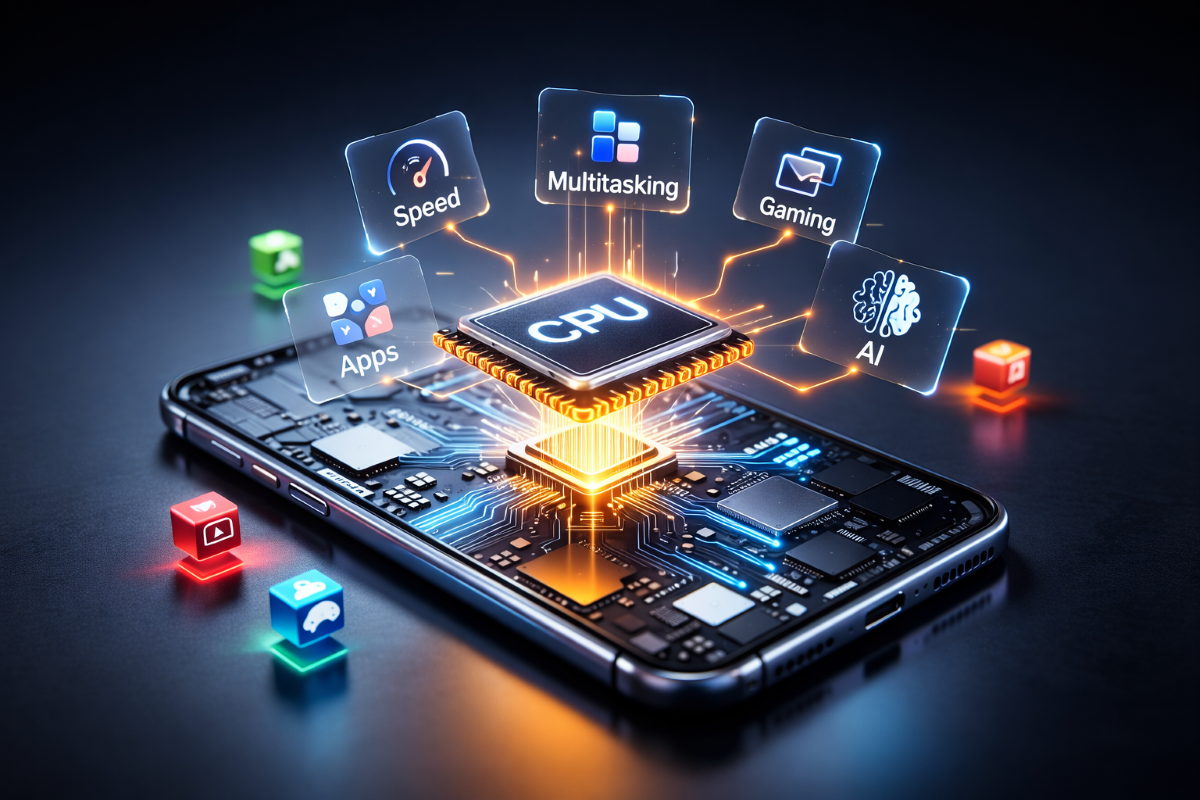
Every time you open an app, take a photo, browse the internet, or watch a video, your smartphone performs millions of calculations in seconds. These actions feel instant and effortless. But behind every tap and swipe is a single component responsible for making everything work: the processor.
The processor is the engine of your smartphone. It determines how fast your phone runs, how smoothly apps perform, how efficiently your device uses battery power, and how capable your device is overall.

Understanding the processor helps you move beyond marketing terms and specifications. It helps you understand why some phones feel fast and responsive, while others slow down, lag, or struggle with demanding tasks.
This guide explains what a processor is, how it works, and why it is the most important component powering your smartphone. Read in depth about RAM Explained.
What Is a Processor?
A processor, also called the CPU (Central Processing Unit), is the primary component responsible for executing instructions and controlling your smartphone’s operations.
In simple terms, the processor is the brain of your device.
Just as the human brain processes information and controls the body, the processor processes instructions and controls how your phone functions.
Every action you perform depends on the processor. When you open WhatsApp, scroll through Instagram, play a video on YouTube, or switch between apps, the processor executes those instructions quickly and accurately.
Without a processor, your smartphone cannot function.
It is the central system that connects software, hardware, and user interaction into a working device.
What Does a Processor Actually Do?
At its core, the processor receives instructions from software and executes them.
These instructions come from:
- The operating system (Android or iOS)
- Apps you install
- System services running in the background.
The processor reads these instructions, processes them, and produces results almost instantly.
For example:
When you open the camera app, the processor activates the camera hardware, processes the image data, and displays the preview on your screen in real time.
When you play a video, the processor decodes the video file, processes visual and audio data, and ensures smooth playback.
This process happens continuously, thousands of times per second.
The speed and efficiency of this process determine how smooth and responsive your device feels.
Understanding Processor Components: CPU, GPU, and AI Engine
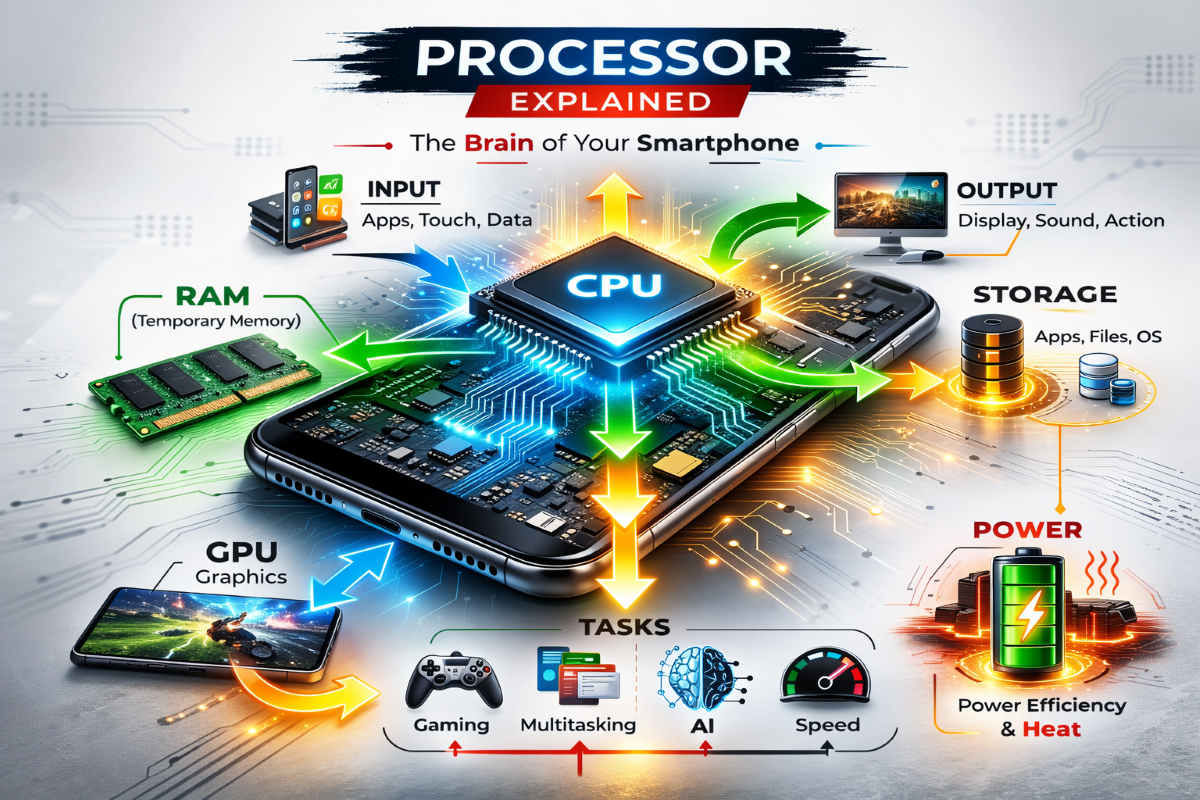
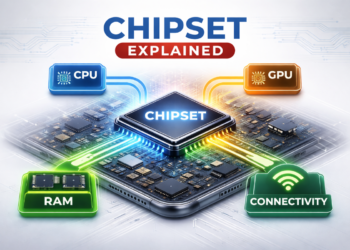
Modern smartphone processors are not a single unit. They are complex systems containing multiple specialized components.
The three most important components include the CPU, GPU, and AI engine.
CPU (Central Processing Unit)
The CPU handles general tasks and system operations.
It manages:
- Opening and running apps
- System processes
- Multitasking
- Background services
The CPU ensures your phone responds quickly and reliably.
A stronger CPU results in faster app loading, smoother multitasking, and better overall performance.
GPU (Graphics Processing Unit)
The GPU handles graphics and visual processing.
It is responsible for:
- Rendering images
- Processing videos
- Running games
- Display animations
If you play games, watch high-resolution videos, or use visually intensive apps, the GPU plays a critical role.
A powerful GPU delivers smoother graphics, better gaming performance, and improved visual quality.
AI Engine (Neural Processing Unit)
Modern processors include specialized components designed to handle artificial intelligence tasks.
These AI engines power features such as:
- Camera enhancements
- Face recognition
- Voice assistants
- Image processing
- Smart battery management
AI processing improves device efficiency and enables advanced features without slowing down performance.
This is especially important as smartphones become more intelligent and capable.
Processor Speed Explained: GHz and Cores
Processor performance is often described in terms of GHz (Gigahertz) and Cores.
Understanding these terms helps you interpret specifications more accurately.
Clock Speed (GHz)
Clock speed measures how many instructions a processor can execute per second.
A processor with higher GHz can process instructions faster.
However, higher clock speed alone does not guarantee better performance. Efficiency, architecture, and optimization also matter.
Modern processors are designed to balance speed and efficiency.
Processor Cores
A core is an individual processing unit within the processor.
Modern smartphone processors typically have multiple cores, such as:
- Quad-core (4 cores)
- Octa-core (8 cores)
Multiple cores allow the processor to handle multiple tasks simultaneously.
This improves multitasking, performance, and efficiency.
For example, one core may handle background tasks while another runs an app.
This ensures smooth and responsive performance.
Why the Processor Matters in Everyday Use
The processor directly affects your smartphone experience. It determines how fast, smooth, and capable your device feels.
Here is how the processor impacts real-world use.
App Performance
A strong processor opens apps faster and runs them smoothly. Weak processors cause delays, lag, and slower response times.
Multitasking
Modern smartphones run multiple apps simultaneously.
A powerful processor ensures smooth app switching without slowing down.
Camera Performance
Modern smartphone cameras rely heavily on processing power. The processor handles image processing, HDR, and AI enhancements. Better processors produce better photo quality.
Gaming Performance
Games require significant processing and graphics power. A powerful processor ensures smoother gameplay, higher frame rates, and better visual quality.
Battery Efficiency
Efficient processors use less power to perform tasks. This improves battery life and reduces overheating. Modern processors are designed to balance performance and efficiency.
Major Smartphone Processor Manufacturers
Several companies design and manufacture smartphone processors. Each produces processors for different performance levels.
Qualcomm Snapdragon
Snapdragon processors are widely used in Android smartphones. They offer strong performance, efficiency, and broad compatibility. Many premium and midrange smartphones use Snapdragon processors.
MediaTek
MediaTek processors power many affordable and midrange devices. Modern MediaTek processors offer excellent performance and efficiency. They are widely used across Africa due to their strong price-to-performance ratio.
Apple Silicon
Apple designs its own processors for iPhones. These processors offer industry-leading performance and efficiency. Apple’s tight integration between hardware and software enhances performance.
Samsung Exynos
Samsung develops Exynos processors for its smartphones. Exynos processors power selected Samsung Galaxy devices. Performance varies depending on generation and model.
Processor and Overall Device Performance
While the processor is the most important component, it works together with other systems.
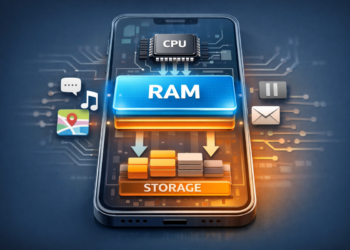
Performance depends on the combined efficiency of:
- Processor
- RAM
- Storage speed
- Software optimization
A powerful processor, along with sufficient RAM and fast storage, delivers the best experience. Understanding this relationship helps you evaluate devices more accurately.
How to Evaluate a Processor When Buying a Smartphone
When choosing a smartphone, understanding the processor helps you make better decisions.
Here are key factors to consider.
Processor Generation
Newer processors are generally faster and more efficient. They offer better performance and longer software support.
Performance Level
Processors are designed for different performance tiers:
- Entry-level processors handle basic tasks.
- Midrange processors offer balanced performance.
- Flagship processors deliver the highest performance.
Choose based on your usage needs.
Efficiency and Optimization
Efficient processors deliver strong performance without draining the battery. Efficiency is as important as speed. Modern processors are designed to balance performance and power consumption.
Why Understanding the Processor Matters
Understanding the processor gives you clarity and control when choosing and using technology.
It helps you:
- Understand device performance
- Interpret specifications accurately
- Avoid misleading marketing claims
- Make informed buying decisions
- Choose devices suited to your needs
This knowledge empowers you to engage with technology confidently.
The Processor & Performance Connection
The processor is the foundation of your smartphone’s performance.
It controls how fast your phone runs, how smoothly apps perform, how efficiently your battery is used, and how capable your device is overall.
Every feature you use depends on the processor. Understanding the processor helps you understand your device.
It helps you evaluate technology intelligently and make better decisions. Because when you understand what powers your device, you truly begin to know your tech.