


Why This Moment Matters
By the close of 2025, Kenya’s mobile story has moved decisively beyond adoption. The country is no longer defined by who has access to a phone or a network, but by how deeply mobile technology is embedded into everyday economic, social, and professional life.
The Kenya mobile market in 2025 reflects a phase of maturity shaped by scale, saturation, and consequence. Mobile connectivity now underpins how Kenyans earn, pay, commute, communicate, consume information, and participate in the digital economy. At this level, the numbers are no longer just impressive—they are structural.
With SIM penetration nearing saturation, smartphones firmly mainstream, and mobile money functioning as financial infrastructure, Kenya has entered a stage where mobile decisions carry system-wide implications. Pricing shifts, network reliability, platform governance, and device ecosystems now affect millions simultaneously.
This feature examines what the numbers really say, who is gaining and losing ground, and which signals matter most as the market transitions from 2025 into 2026. It is not a record of growth milestones, but an interpretation of power, behavior, and consequence in one of Africa’s most advanced mobile economies.
Executive Summary
-
Kenya’s mobile market in 2025 is no longer about penetration, but about platform dominance, monetisation depth, and governance tension.
-
Safaricom remains structurally dominant, not just by subscribers, but through embedded trust across payments, services, and state functions.
-
Airtel’s 5G and pricing strategies are reshaping competitive access, but are not yet redefining market power.
-
Mobile money volumes continue to grow, yet interoperability and openness remain unresolved structural constraints.
-
The next phase of Kenya’s mobile economy will be defined less by expansion and more by stewardship of power.
-
Policy, regulation, and execution in 2026 will determine whether Kenya’s mobile advantage compounds—or fragments.
The Kenya Mobile Market in 2025: Scale, Saturation, and Structure
By late 2025, Kenya records approximately 77–78 million active mobile SIM connections, placing mobile penetration well above 140%. This level of penetration is not excess; it is adaptation.
Multiple SIM ownership has become a rational response to:
- Network reliability considerations
- Data pricing arbitrage
- The separation of personal, professional, and financial identities
Mobile connectivity in Kenya has crossed a critical threshold. It is no longer a consumer service—it is national infrastructure.
Editorial insight:
In Kenya, mobile downtime is no longer an inconvenience. It is an economic risk.
Smartphones: The Device That Quietly Won
Smartphones now account for roughly 60–65% of active mobile devices nationally, with urban penetration exceeding 70%. This shift represents the most important structural change in Kenya’s tech landscape over the last decade.
The smartphone has become:
- Kenya’s primary internet device
- A business terminal for the informal and SME economy
- A gateway to finance, media, learning, and opportunity
Feature phones remain relevant, particularly for voice-centric users, but they are no longer the center of gravity. The economy is now optimized for screens, apps, and data.
What Kenyan buyers prioritize in 2025
- Battery reliability
- Camera dependability (real-world use, not specs)
- Software stability and updates
- Strong price-to-performance value
This explains why value-driven brands continue to grow—and why overpriced midrange devices struggle.
Mobile Money: From Innovation to Financial Infrastructure
Kenya closes 2025 with 48–50 million mobile money subscriptions, representing over 90% adult population penetration. At this scale, mobile money ceases to be a fintech category and becomes financial plumbing.
Mobile money now underpins:
- Retail payments
- Salary disbursement
- Credit and savings
- Merchant services
- Government collections
Kenya did not simply digitize money—it digitized trust, and anchored it to the mobile phone.
This depth remains one of Kenya’s strongest structural advantages, even as it raises questions around platform power, openness, and governance heading into 2026.
Devices Beyond the Phone: Where Growth Is Concentrated
While smartphones dominate volume and attention, adjacent device categories reveal how Kenyans are extending the mobile experience into daily routines.
Wireless Earbuds: A Street-Level Signal of a Deeper Shift
A short matatu commute from Nairobi’s residential estates into the CBD offers a revealing snapshot of Kenya’s mobile evolution. Across the rows, several passengers sit plugged into wireless earbuds—streaming music, scrolling short videos, taking calls, or retreating into their screens as the city moves around them.
This is not a lifestyle flourish. It is behavioral evidence.
The rise of affordable true wireless earbuds reflects a deeper shift in how Kenyans consume media, manage attention, and personalize shared public spaces. Mobile devices are no longer just functional tools—they are personal environments, carried from home to commute to work and back again.
This observation aligns with 2025 sales trends showing wireless earbuds as one of the fastest-growing mobile accessory categories, driven by affordability, improved battery life, and the disappearance of headphone jacks on modern smartphones.
Smartwatches and Fitness Bands
Wearables continue to grow, but the market remains highly price-sensitive. Most adoption sits below KES 6,000, focused on:
- Health and activity tracking
- Notifications
- Lifestyle signalling
Premium smartwatches remain niche, limited by cost and relatively modest localized utility.
Tablets: Quietly Relevant, Increasingly Embedded
Tablets remain a smaller category by volume in Kenya’s device market, but their strategic relevance continues to grow—often unnoticed. In many middle-income Kenyan households today, it is increasingly common to find both a laptop and a tablet serving distinct, complementary roles rather than competing with each other.
The laptop remains the primary workhorse for intensive tasks. The tablet, however, has evolved into the in-between device—always within reach, quicker to pick up, and easier to live with throughout the day.
For many Kenyans, the tablet has quietly become the device that:
- Lives on the coffee table or bedside
- Moves easily from the living room to the study desk
- Is shared between adults and children without friction
- Fills the gap between the phone’s small screen and the laptop’s formality
This shift has been driven not by hype, but by practical utility.
How Kenyans Are Actually Using Tablets Today
Real-life routines, not spec sheets are shaping tablet adoption in Kenya.
Education and e-learning:
Tablets are increasingly used by students for online classes, homework research, reading PDFs, and watching recorded lessons. For parents, a tablet offers a larger, more controlled learning screen than a smartphone, without the cost and complexity of a full laptop.
Content consumption:
From YouTube and Netflix to news articles, ebooks, and long-form reading, tablets have become the preferred screen for relaxed, extended viewing. The larger display reduces eye strain, while portability makes them ideal for evening use or weekend downtime.
Entry-level productivity:
Many users rely on tablets for note-taking, document review, email, presentations, and light writing. Paired with a Bluetooth keyboard or stylus, tablets increasingly handle tasks that once required a laptop—especially for users who value mobility and simplicity.
Household and personal organization:
Tablets often double as shared family devices—for planning, video calls, browsing, and even managing small home-based businesses. Their accessibility encourages use without the “setup cost” of opening a laptop.
Why Tablets Are Gaining Ground Now
Several market dynamics are converging:
- Tablets are more affordable than before, with capable Android models available at accessible price points
- Battery life consistently outperforms laptops for casual use
- Larger screens make them more comfortable than phones for extended sessions
- Android familiarity reduces the learning curve
As a result, tablets are no longer seen as luxury or afterthought devices. They are being adopted as intentional secondary screens—devices that complement, rather than replace, smartphones and laptops.
Market Reality
Affordable Android tablets dominate the Kenyan market due to:
- Familiar operating systems
- Strong battery endurance
- Competitive pricing
- Adequate performance for everyday tasks
- Portable, enabling working away from the main desk or even from laptops and desktops.
Premium tablets exist, but volume growth remains concentrated in practical, value-oriented models that fit into daily life without demanding behavioral change.
Editorial Insight
The tablet’s strength in Kenya is not performance—it is presence.
It is the device people reach for when they want a bigger screen without the mental commitment of a laptop.
Telcos, Platforms, and Power Dynamics: How Kenya’s Mobile Power Map Took Shape
Kenya’s telecom market did not arrive at its current structure by accident. The balance of power in 2025 is the result of deliberate strategy, regulatory pressure, pricing battles, infrastructure bets, and shifting user expectations. What now looks like a settled, scale-driven market was actively contested over the past year.
At the center of this dynamic sit two dominant players — Safaricom and Airtel Kenya — alongside a group of smaller operators navigating survival through niche relevance rather than brute scale.
Safaricom: Dominance Under Pressure, Not Decline

Safaricom closes 2025 as the clear market leader, with approximately 65% share of mobile subscriptions. Its position remains anchored in three structural advantages:
- Network depth and reliability
- The scale of M-Pesa as financial infrastructure
- Ecosystem reach across consumers, enterprises, and government
Yet 2025 has not been a year of effortless dominance.
Under CEO Peter Ndegwa, Safaricom has had to contend with:
- Heightened regulatory scrutiny, particularly around pricing power and platform dominance
- Slower subscriber growth, reflecting market saturation rather than failure
- Increased consumer price sensitivity, especially around data bundles
- Rising infrastructure and operational costs, including energy and network expansion
For everyday users, this has translated into a more complicated relationship with the market leader. Safaricom is still trusted — especially for network stability and mobile money — but no longer taken for granted on price.
Safaricom’s challenge in 2025 has not been relevance, but defending premium positioning in a price-aware market.
The result is a company still firmly on top, but increasingly aware that scale alone no longer guarantees unquestioned loyalty.
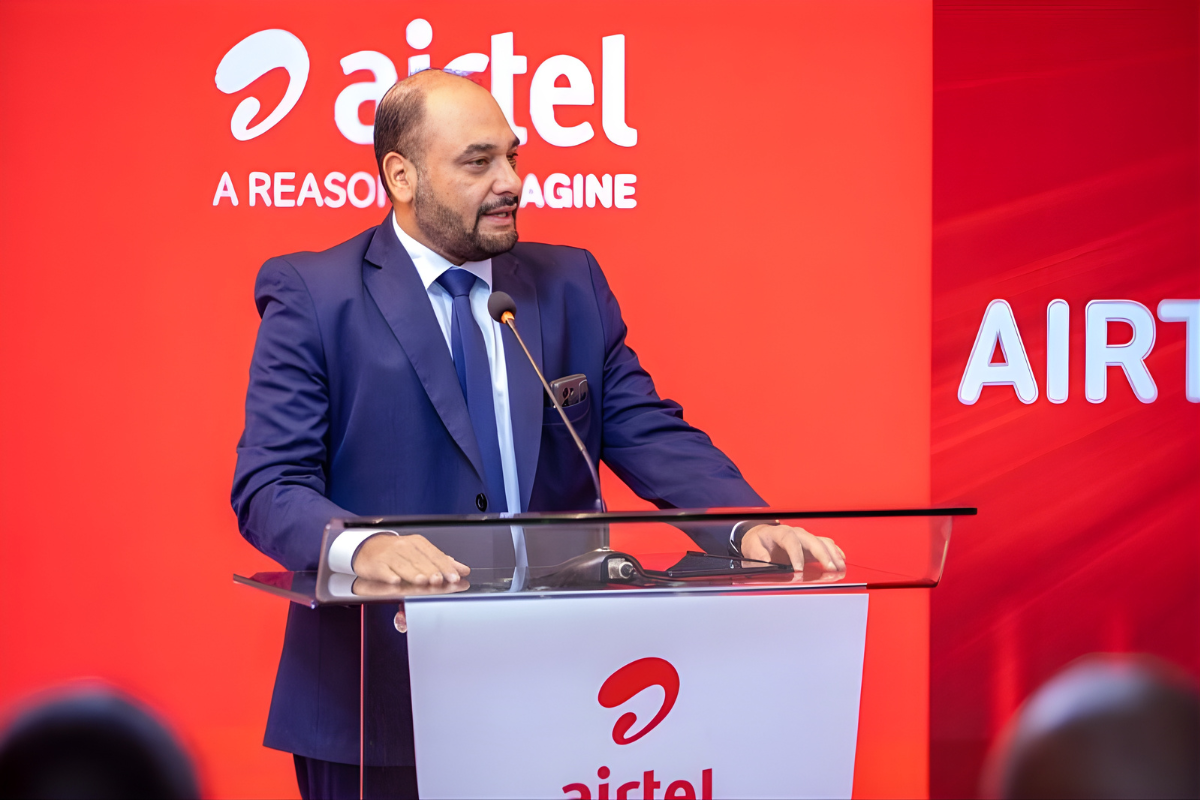
Airtel Kenya: The Relentless Challenger That Changed the Conversation
Airtel Kenya’s story in 2025 is one of discipline and persistence finally paying off.
With roughly 30% market share, Airtel has not displaced Safaricom — but it has redefined competition.
Under CEO Ashish Malhotra, Airtel’s strategy has been clear and consistent:
- Aggressive, transparent data pricing
- Simpler bundles that users can understand
- Steady improvements in network perception, particularly in urban and peri-urban areas
- A focus on value rather than ecosystem lock-in
For many Kenyans, Airtel has become the “second SIM that quietly became essential”—the line people rely on for data-heavy use, streaming, and price-sensitive tasks.
What makes Airtel’s gains significant is not just the numbers, but the behavioral shift:
- Users now actively compare bundles
- SIM-swapping is normalized
- Loyalty is conditional, not automatic
Airtel did not beat Safaricom on infrastructure. It challenged Safaricom on psychology and pricing expectations.
The current Premium and Smarta Packages are value-driven, and great for intensive smartphone call and internet users.
That shift has permanently altered the market.
Smaller Operators: Surviving Through Niche, Not Scale
Below the top two players, Kenya’s smaller telecom operators operate in a far less forgiving environment. Scale is no longer optional, and ambition without capital is quickly exposed.
Telkom Kenya remains active but structurally constrained by:
- Limited capital for aggressive network expansion
- Reduced brand recall, particularly among younger users
- Difficulty competing head-to-head on pricing, coverage, or bundle simplicity
Meanwhile, MVNOs such as Equitel, leveraging Equity Bank’s financial ecosystem, continue to play targeted roles—particularly where financial services integration matters more than raw network performance.
These players are not failing.
They are simply no longer competing on the same battlefield.
Their relevance increasingly lies in:
- Clearly defined customer segments
- Bundled financial or enterprise-focused solutions
- Institutional and niche partnerships
Kenya’s telecom market no longer rewards ambition without scale.
It rewards focus, partnerships, and strategic restraint.
What Actually Shifted the Power Dynamics in 2025
Kenya’s current telecom structure is the result of several forces converging over the past year—none dramatic on their own, but decisive in combination.
- Market saturation: Subscriber growth slowed across the board
- Data-first behavior: Pricing clarity now outweighs brand sentiment
- Multi-SIM normalization: Users actively manage loyalty and cost
- Regulatory pressure: Dominance now comes with scrutiny and limits
- Cost realities: Network investment remains expensive and unavoidable
Together, these forces hardened the market into what it is today: a two-player scale contest with niche survivors orbiting the edges.
Where This Leaves Kenya’s Telco Market
Kenya is no longer a forgiving telecom market. It is now a mature, disciplined, and user-aware ecosystem.
- Safaricom remains dominant, but must constantly justify its premium
- Airtel has secured its place as a credible, permanent challenger
- Smaller players survive by serving needs the giants overlook
In 2025, telco success in Kenya is no longer about adding users.
It is about earning relevance every single day.
Why This Matters Beyond Telcos
These power dynamics ripple far beyond the telecom sector itself.
They:
- Shape data affordability
- Influence device buying decisions
- Affect digital inclusion
- Determine how platforms, fintechs, and creators operate.
Telecoms are no longer just connectivity providers.
They are gatekeepers of Kenya’s digital economy.
Beyond SIM Cards: How Jamii Telecom Shapes Kenya’s Connectivity Ecosystem
Beyond mobile, players such as Jamii Telecom (Faiba) continue to shape Kenya’s connectivity landscape through fibre and enterprise services, particularly in urban centres.
While not a mass-market mobile competitor, Jamii’s footprint in fixed broadband influences:
- Household data behaviour
- Device usage patterns
- The growing preference for multi-network connectivity
Jamii does not compete for SIM dominance. It competes for where mobile data is no longer the default.
Biggest Gainers and Pressure Points in 2025
Clear Gainers
- Samsung (portfolio breadth and trust)
- Tecno and Infinix (value leadership)
- Xiaomi (spec-to-price efficiency)
- Airtel Kenya (pricing discipline and momentum)
- Budget wearables and TWS accessory brands
Under Pressure
- Brands with weak after-sales support
- Overpriced midrange smartphones
- Closed or rigid platforms that limit ecosystem value
Kenyan consumers are no longer brand-loyal by default—they are value-loyal by experience.
Data Has Won. Voice Has Stabilized.
Mobile data usage now dwarfs traditional voice traffic. Video streaming, social media, fintech applications, and cloud services dominate usage patterns.
- 4G remains the backbone of the market
- 5G plays a targeted role in urban and enterprise contexts
This shift is reshaping:
- Network investment priorities
- Device design decisions
- Pricing strategies
Data Has Won. Voice Has Stabilized.
By late 2025 the shift is unmistakable: mobile data now drives network demand, revenues and investment priorities in Kenya. Voice traffic has plateaued; video, social apps, fintech and cloud services account for the largest share of traffic and customer value.
Kenya remains overwhelmingly a 4G nation — 4G carries the bulk of everyday data use while 5G is being deployed tactically in urban and enterprise pockets. Safaricom doubled its 5G footprint in FY2025 — expanding from roughly 803 to 1,700 5G sites — and guided group capex at around KShs 91.3bn (with Kenya-specific capex of ~KShs 52.1bn), reflecting continued network investment.
Airtel Africa has likewise stepped up investment: group capex guidance moved toward $875–900m, underpinning broader network expansion and targeted 5G rollouts.
Despite this progress, 5G remains limited across the continent — only a small fraction of Africans have 5G access, even as more operators launch commercial services; markets such as South Africa and parts of West Africa (MTN/Vodacom) show noticeably higher 5G population coverage and site counts than Kenya today.
Year-on-year, Kenya’s SIM and data numbers rose—SIM penetration hit ~149%—but the competitive reality shifted from acquisition to capacity and monetisation per user. The practical consequence: operators prioritise backhaul, spectrum efficiency and urban capacity over blanket 5G rollouts; device makers optimise modems and battery life for sustained data use; and pricing strategies centre on simple, high-value data bundles.
Kenya’s near term is 4G-first and data-centric. The 5G race is real, but it’s now a question of where (cities, enterprises) and how (value, use cases), not simply who switches on the most towers.
Key Data Points & Sources (2024–2025)
Data references are drawn from Communications Authority of Kenya reports, operator disclosures, and GSMA Mobile Economy insights.
Network & Coverage
- 4G: Kenya’s primary data layer nationwide, carrying the vast majority of mobile internet traffic
- 5G (Kenya): at around 15–20% population coverage, concentrated in Nairobi, Mombasa, Kisumu, Eldoret, and key enterprise corridors
- Safaricom 5G Sites: Expanded from ~800+ to ~1,700+ sites between FY2024 and FY2025
Investment
- Safaricom Group CAPEX (FY2025): Approx. KES 91.3 billion
- Kenya-specific CAPEX: Approx KES 52.1 billion, directed toward network expansion, capacity upgrades, 5G rollout, fibre, and IT systems
- Airtel Africa CAPEX (FY2025 guidance): approx. USD 875–900 million, supporting data capacity expansion and selective 5G deployment
Market Structure
- SIM penetration (Kenya): about 149%, reinforcing multi-SIM normalization
- Voice traffic: Largely stabilized year-on-year
- Data traffic: Sustained double-digit growth, driven by video streaming, social platforms, fintech applications, and cloud services
Regional Comparison
- Kenya: Deep 4G penetration with targeted, demand-led 5G deployment
- South Africa: Significantly higher 5G population coverage and site density
- Nigeria & Ghana (select metros): Faster 5G expansion in dense urban centres
- Regional reality: Sub-Saharan Africa remains predominantly 4G-led, with 5G adoption still largely urban-centric
Primary Reference Sources
- Communications Authority of Kenya (CA) — sector statistics
- Safaricom FY2024–FY2025 annual and integrated reports
- Airtel Africa investor disclosures
- GSMA Mobile Economy and regional outlook reports
What the Numbers Really Say
By the close of 2025, Kenya’s mobile market data points to a structural shift that goes far beyond headline growth. With SIM penetration nearing 150%, smartphone adoption exceeding 60% nationally, and mobile money usage covering over 90% of the adult population, mobile connectivity has moved from access to systemic dependence. These are no longer adoption metrics; they are indicators of how deeply mobile infrastructure is embedded in daily economic and social life.
At this stage, growth has given way to optimization. Subscriber additions have slowed across operators, while data consumption continues to expand at double-digit rates, redirecting investment toward network quality, capacity, and efficiency rather than scale alone. Capital expenditure patterns—focused on backhaul, spectrum efficiency, fibre, and targeted 5G—reinforce this transition from expansion to refinement.
More critically, Kenya’s mobile ecosystem has entered a consequential era. At this level of penetration, pricing decisions affect millions, outages disrupt commerce, and platform dominance attracts regulatory scrutiny. Mobile infrastructure is no longer peripheral to the economy; it is foundational to payments, communication, work, media consumption, and digital participation.
Taken together, the numbers confirm three decisive thresholds:
- From access to dependence
- From growth to optimization
- From experimentation to consequence
Mobile in Kenya is no longer a sector to be managed tactically.
It is a system, and how it is governed, priced, and evolved will shape the country’s digital trajectory over the next decade.
Mobile in Kenya is no longer a high-growth sector to be managed tactically. It is a critical system.
What This Means for Kenya’s Tech Stakeholders
As Kenya’s mobile market matures, the implications are no longer uniform across the ecosystem. They diverge by role—but the direction is clear: value, accountability, and execution now matter more than expansion alone.
For consumers, reliability, value, and software quality increasingly outweigh brand prestige. With smartphones and connectivity embedded in daily life, tolerance for poor updates, unstable networks, or weak after-sales support continues to shrink.
For device brands, long-term relevance will depend less on headline specifications and more on sustained support, software updates, ecosystem integration, and trust. In a saturated market, retention is earned through experience—not launches.
For telcos, growth will come from deeper engagement per user rather than simply adding connections. Data quality, network consistency, and service differentiation now define competitiveness in a market where nearly everyone is already connected.
For fintechs and digital platforms, scale brings scrutiny. As mobile money and platform services reach systemic importance, openness, governance, and resilience will matter as much as innovation heading into 2026.
For policymakers, the message is unequivocal: the mobile ecosystem now qualifies as critical national infrastructure. Regulation must evolve from reactive intervention to long-term foresight—balancing innovation, competition, and public interest.
This is not a market slowing down.
It is a market settling into responsibility.
Looking Ahead: The 2026 Outlook— Where the Numbers Are Pointing
By 2026, Kenya’s mobile market will be operating firmly in a post-saturation reality. With SIM penetration already near 150%, headline subscriber growth is expected to slow further into the low single digits (1–3%), making volume expansion an increasingly marginal growth lever.
The centre of gravity will shift decisively toward value per connection. Data traffic is projected to continue growing at double-digit rates (15–25% year-on-year), driven by video consumption, fintech usage, cloud services, and multi-device behaviour. This growth will place sustained pressure on network capacity, pushing telcos to prioritise quality, latency, and consistency over geographic expansion.
4G will remain the dominant access layer through 2026, expected to carry well over 85% of mobile data traffic, while 5G coverage is likely to expand gradually toward the 25–30% population range, concentrated in major urban centres, industrial zones, and enterprise corridors. The pace of 5G adoption will depend less on rollout announcements and more on device affordability, enterprise demand, and practical use cases.
On devices, smartphone penetration is expected to edge toward 65–70% nationally, with replacement cycles—not first-time adoption—driving sales. Growth will increasingly come from ecosystems: phones paired with wearables, tablets, services, and software experiences that extend user lifetime value rather than one-off purchases.
Platform power will also become more visible. As mobile money, super-apps, and connectivity platforms continue to intermediate daily economic activity, regulatory and public scrutiny will intensify, particularly around pricing transparency, interoperability, and resilience.
Kenya’s next phase of mobile growth will not be measured by how many new users come online,
but by how much economic and social value is generated per existing connection.
By 2026, the winners will not be those who expand fastest, but those who execute best at scale.
Final Editorial Note
As 2025 closes, Kenya’s mobile story is no longer a narrative of possibility. It is a narrative of stewardship, power, and consequence.
The numbers make this clear. With SIM penetration near 150%, smartphone adoption above 60%, mobile money embedded in over 90% of adult lives, and data traffic growing faster than infrastructure can be taken for granted, mobile technology has moved beyond disruption. It now functions as critical national infrastructure.
The mobile phone remains Kenya’s most important piece of technology—not because of novelty, but because of centrality. It anchors communication, payments, work, commerce, media, and access to opportunity. When it performs well, the economy flows. When it fails, the impact is immediate and systemic.
What comes next will not be defined by who launches the fastest network, the loudest device, or the boldest platform. It will be defined by execution at scale—by how responsibly connectivity is priced, how resilient networks are built, how platforms are governed, and how value is created per connection.
This is why market intelligence matters now more than ever. Not to predict headlines, but to interpret direction.
At JuaTech Africa, our mission is to move beyond reporting what happened and toward explaining what it means, who it affects, and what comes next. This feature is part of a broader commitment to delivering grounded, data-driven insight on Africa’s technology markets—insight that informs decision-makers, builders, policymakers, and everyday users alike.
If you found this analysis valuable, explore more in our Market Intelligence, Tech Decoded, and Tech Insights sections, where we continue to unpack the forces shaping Africa’s digital future.
The numbers have spoken.
The system is in place.
The decade ahead will be defined by how wisely it is managed.