
There are moments when a product launch is loud, dramatic, and unmistakably about attention.
And there are moments when a product arrives quietly, confirming something more profound: that the game has already changed, and the real work now lies in the consolidation of power.
The iPhone 17 Series strategy belongs firmly in the second category.
In the weeks following its release, much of the global conversation has followed a familiar script. Comparisons with the iPhone 16 Series. Debates about design boldness. Enthusiasm around performance gains. Curiosity about newer variants like the iPhone 17 Air. Praise for the Pro Max as a performance heavyweight.
All of it understandable.
And all of it incomplete.
Because none of these conversations confront the question that actually matters: why Apple continues to design the iPhone this way — and why this strategy consistently resonates with those who value continuity, reliability, and control over outcomes rather than novelty.
This article does not attempt to review the iPhone 17 Series. It examines what the series reveals about Apple’s thinking: how price, design, and ecosystem coherence operate together as strategic tools, and why that approach continues to appeal to leaders, institutions, and professionals operating in environments where failure is expensive and predictability is power.
Also, read our exclusive feature on the the Indomitable Apple Ecosystem, and why it is different, as we dwell on one of the most iconic brands in our generation.
Apple Is No Longer Selling Devices — It Is Selling Stability
Apple’s most misunderstood evolution is the quiet shift away from devices as the centre of value.
The company’s real product today is not the iPhone, the Mac, or the Watch. It is continuity — the uninterrupted flow of information, identity, and work across time, devices, and contexts. Everything else serves that goal.
This is why Apple no longer chases spectacle. It avoids radical interface resets, resists excessive customisation, and rarely responds directly to competitors’ feature checklists. What appears conservative on the surface is, in reality, an aggressive bet on behavioural consistency.
The iPhone 17 Series does not exist to surprise users. It exists to reassure them.
Apple reassures users that what worked yesterday will still work tomorrow. Muscle memory remains valid, habits stay intact, and learning costs do not resurface.
For users whose days are filled with decisions that matter — financial, organisational, reputational — that reassurance is not emotional comfort. It delivers operational efficiency.
The Redesign That Matters Is the One You Don’t Have to Notice
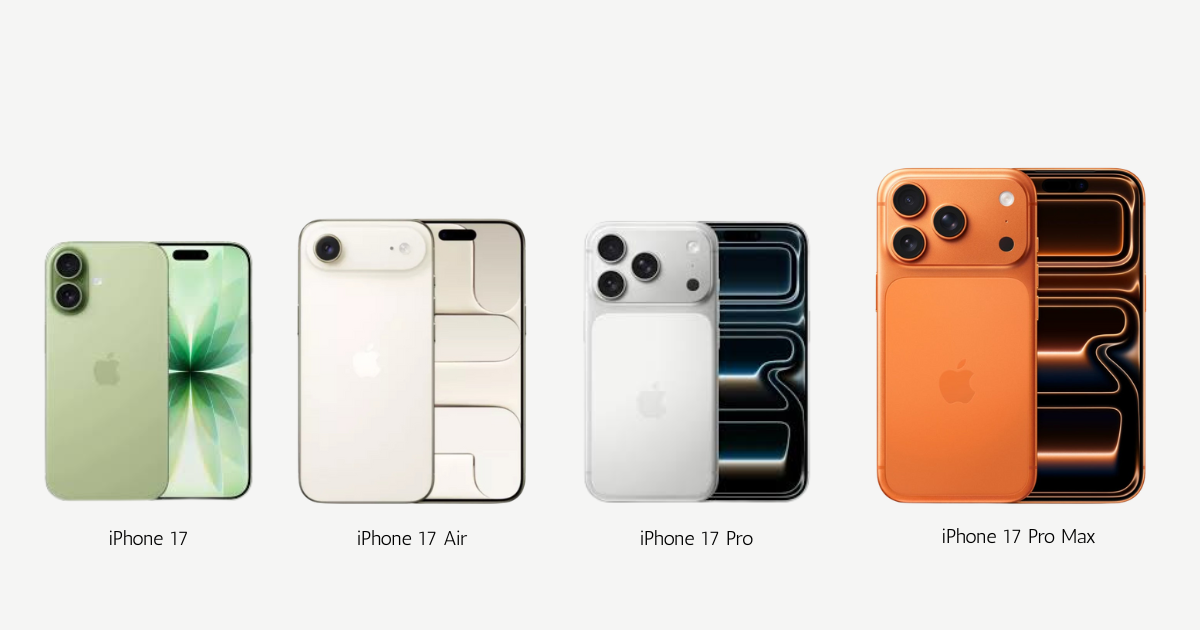
Yes,the iPhone 17 Series marks a bolder visual and structural departure from the iPhone 16 generation. The lineup is more visibly differentiated, introducing models like the iPhone 17 Air in a form Apple would not have attempted years ago, while the Pro Max emerges as a statement of sustained performance.
But Apple’s most crucial redesign is not physical. It is philosophical.
The company has reached a level of ecosystem confidence where it can afford to make devices more distinct without fragmenting behaviour. Each model looks and feels different in the hand, yet behaves identically in use. That is not accidental. It is discipline.
Apple is testing how far it can stretch form while keeping the function psychologically stable. The iPhone 17 Air, stripped down and unusually minimal, is less about thinness than about proof: proof that Apple can remove elements and still retain users because the ecosystem does the heavy lifting. The Pro Max, by contrast, is not about bragging rights. It is about margin — margin for error, margin for endurance, margin for days that do not go as planned.
Together, they tell a single story: Apple designs around tolerance for compromise, not around feature envy.
Price as Strategy, Not Arrogance
Few aspects of Apple’s strategy provoke as much criticism as pricing. Yet few are as poorly understood. The assumption is often simple: Apple charges more because it can. The reality is more deliberate — and far more strategic.
Apple does not price the iPhone 17 Series to justify its bill of materials. It prices it to shape its user base.
Pricing as a Filter, Not a Markup
High pricing performs a filtering function. It attracts users who are prepared to commit, not experiment. These are users who intend to stay, not sample; who integrate tools into their lives rather than rotate through them. The result is lower churn, longer ownership cycles, and a more stable ecosystem.
This stability is not accidental. It allows Apple to design for continuity rather than constant re-acquisition. Software updates, ecosystem services, and long-term support all benefit from a user base that behaves predictably. In effect, price becomes a behavioural gatekeeper—not just a revenue lever.
The Hidden Cost Leaders Actually Care About
For senior professionals, the real cost of technology is not the purchase price. It is an interruption. It is a failure at critical moments. There is an inconsistency across devices. It is the cognitive tax of relearning systems mid-flight.
Apple prices the iPhone as an insurance premium against those costs.
This is why Apple’s prices persist even as competitors offer faster charging, higher refresh rates, and increasingly aggressive specifications. Apple is not selling superiority in isolation. It is selling predictability across time.
And predictability, at scale, is power.
Design as Leadership Infrastructure
Apple’s design philosophy is often discussed in terms of aesthetics. Clean lines. Minimal interfaces. Visual restraint. But at scale — and especially in leadership contexts — Apple’s design choices function less like art and more like infrastructure.
They are designed not to impress, but to govern behaviour.
Design as Decision Reduction
Every serious leader understands that decision fatigue is real. Not all decisions carry equal weight, but they all draw from the same cognitive reservoir. Apple designs its products to remove unnecessary micro-decisions from daily use.
The iPhone 17 Series continues this philosophy. Interface consistency, predictable gestures, and restrained customisation are not oversights. They are deliberate attempts to ensure that users do not have to think about how to do things, only what needs to be done.
In leadership roles, where judgment quality matters more than speed, reducing background decisions is a competitive advantage.
Familiarity as a Strategic Asset
In many technology ecosystems, change is celebrated for its own sake. Apple takes a different view. Familiarity is not stagnation; it is compounded efficiency.
By preserving behavioural patterns across generations of devices, Apple allows users to carry habits forward. Workflows survive upgrades. Muscle memory remains valid. Learning costs approach zero over time.
For senior professionals, this continuity translates directly into execution stability — especially during travel, high-pressure periods, or crisis response.
Reliability Under Pressure
Design choices matter most when conditions deteriorate. Long days, unstable networks, and compressed timelines test leadership technology.
Apple engineers the iPhone 17 Series to behave consistently under sustained load, not just at peak performance. Battery endurance, thermal stability, and predictable system behaviour may not grab headlines, but they remain leadership essentials.
In moments where failure carries consequence, reliability is not convenience.
It is an authority.
Why Senior Leaders Keep Choosing Apple — Quietly
Senior leaders rarely debate platforms publicly. Their choices are pragmatic, private, and often unarticulated.
What matters at that level is not novelty, but reliability under pressure. The confidence that messages will deliver. That data will sync. That the device will behave the same way during a crisis as it does on a calm day.
The iPhone 17 Series is optimised for that reality not because it is flawless, but because it is intentionally boring in the right ways. It fails less often, surprises less frequently, and asks less of its user.
This is why many executives gravitate toward the Pro Max variant without analysis. It is not a status choice. It is a risk-management decision. When the phone is a primary interface to people, information, and decisions, the least-compromised option becomes the rational one.
Apple does not explicitly design “for CEOs.” It is designed for people with low tolerance for disruption. Leadership happens to sit squarely in that category.
Competitive Ecosystems, Different Philosophies
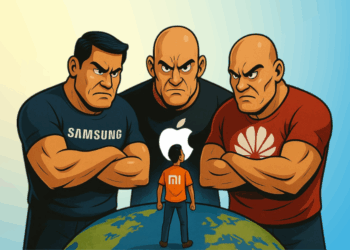
Samsung, Huawei, Honor, and OnePlus have built formidable ecosystems. In many respects, they are more flexible, more open, and more technically adventurous than Apple’s. They move faster on hardware innovation, offer broader customisation, and respond aggressively to market shifts. For users who value experimentation and control, these ecosystems are not inferior alternatives — they are often compelling choices.
But capability is not coherence.
Optionality Versus Alignment
Most competing ecosystems are designed around optionality. They maximise choice, configurability, and feature breadth, trusting users to assemble their own optimal experience. This philosophy rewards exploration, technical curiosity, and personal control.
Apple takes a different path. It prioritises alignment — between hardware, software, services, and user behaviour. Instead of offering many ways to achieve the same outcome, Apple narrows the path and optimises it deeply.
This is not about limiting users. It is about standardising outcomes.
Critics often describe this approach as control, or even lock-in. The observation is not entirely wrong — but it is incomplete. Control alone does not sustain loyalty at scale. What endures is trust earned through consistency. Poor systems with high switching costs still lose users over time; Apple’s ecosystem persists because it works predictably, year after year.
In leadership environments, where consistency matters more than experimentation, alignment often outperforms optionality.
Scale Is Where Ecosystems Break — or Hold
Many ecosystems perform exceptionally well in isolated use cases. Far fewer remain internally consistent as they scale across millions of users, multiple devices, and long time horizons.
Apple’s advantage is not that its ecosystem is closed. It is internally disciplined at scale. Devices behave the same way. Services integrate predictably. Updates reinforce existing patterns rather than disrupt them.
That discipline allows Apple to preserve user trust across generations of products—a feat structurally difficult to replicate.
Compounding Trust as Strategic Moat
Consistency compounds. Habits persist across upgrades. Workflows survive device changes. Cognitive load decreases as familiarity deepens.
Over time, trust shifts from being rational to being default. Users stop actively evaluating alternatives not because competitors are incapable, but because switching introduces unnecessary uncertainty into a system that already works.
This is Apple’s real moat.
Not feature dominance.
Not technical supremacy.
But a system so coherent that leaving it feels like introducing friction into a life — or an organisation — that already runs smoothly.
Why This Matters in the African Context
In African markets, technology operates under far from ideal conditions. Infrastructure reliability fluctuates, upgrade cycles stretch longer, and professionals rely on devices across unstable networks, extended travel, and mixed work environments where failure carries real cost.
In this context, predictability carries disproportionate value.
Professionals are not optimising for novelty. They are optimising for endurance—support matters. Familiarity reduces friction. Stability lowers the actual cost of ownership in ways that spreadsheets and spec sheets fail to capture.
The iPhone 17 Series fits this reality not because it is the most aggressive device on paper, but because it is structurally dependable. Apple’s long-term software support, consistent security posture, and ecosystem continuity allow users to plan years ahead, not months. In environments where replacement is not trivial and downtime is expensive, that planning horizon matters.
Recent economic pressures have only reinforced this dynamic. Currency volatility, tightening corporate budgets, and heightened scrutiny around data and operational risk are pushing professionals to favour tools that age predictably rather than impress temporarily. Devices are no longer upgraded for excitement; they are selected for resilience.
For African executives, founders, and senior professionals navigating high-stakes environments, stability is not indulgence. It is not even a preference.
It is a strategy.
Apple delivers continuity at scale across devices, regions, and years, and its ecosystem resonates in markets where reliability is earned, not assumed.
The Verdict
The iPhone 17 Series matters not because it is radical, but because it is revealing.
Apple has stopped chasing users who want more control and has doubled down on serving those who want to make fewer decisions. Price, restraint, and consistency are not weaknesses to be apologised for; Apple uses them as deliberate tools to shape behaviour, reduce friction, and compound trust over time.
Most importantly, it reveals that Apple understands something many competitors still underestimate.
At the highest levels of responsibility, the best technology is not the one that excites you.
It is the one you stop thinking about.
Apple does not design for preference.
It designs for power — the quiet power of continuity, reliability, and behavioural alignment at scale.
The iPhone 17 Series is not a departure from that philosophy.
It is confirmation that Apple believes this is the game that matters — and that it intends to keep playing it, patiently, and from a position of strength.