


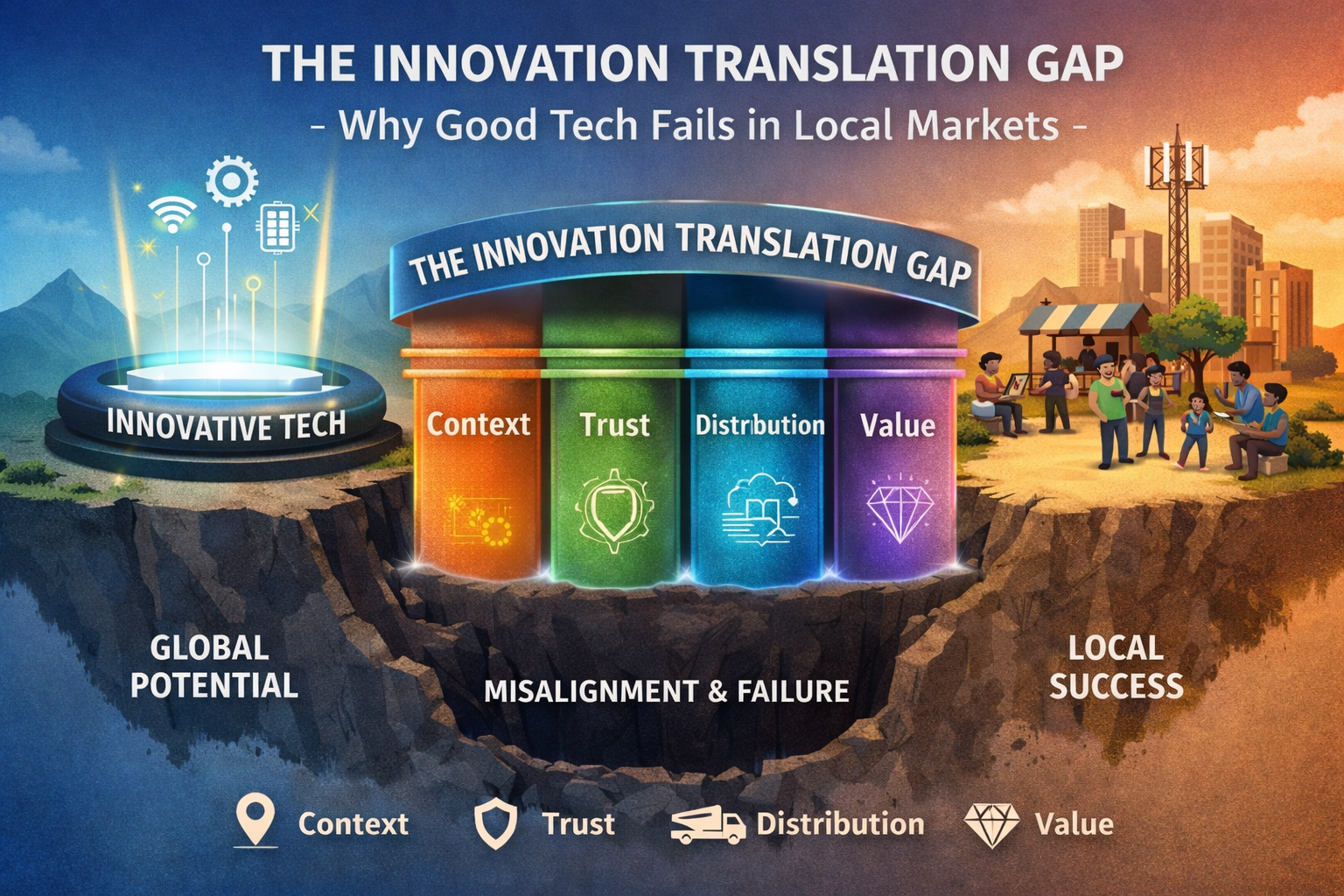
Technology innovation alone does not guarantee market success. Across Africa, many globally successful products struggle to achieve meaningful adoption despite strong technical capability. This disconnect reflects a critical gap between innovation and market translation.
Local markets operate within distinct economic realities, infrastructure limitations, consumer priorities, and distribution systems. Technologies designed for global markets often fail to align with these conditions, limiting adoption regardless of technical merit.

Understanding this innovation translation gap is essential for companies seeking sustainable growth in Africa. Market success depends not only on technological capability, but on alignment with local market conditions, pricing structures, and user realities.
This analysis examines why innovation translation fails and what it reveals about technology adoption in African markets.
Defining the Innovation Translation Gap
The Innovation Translation Gap describes the distance between a product’s technical value and its ability to be understood, trusted, adopted, and sustained within a local market.
Translation here does not mean localisation of language or features. It refers to the process by which innovation becomes usable, credible, and durable within a specific social, economic, and infrastructural context.
Innovation, by itself, is not enough. Technology must be translated into the realities of the people expected to rely on it. When this translation fails, even well-designed products struggle to survive.
In local markets, particularly across Africa, innovation rarely fails at the point of creation. It fails at the point of integration into everyday life.
The Four Layers of Translation
The Innovation Translation Gap can be understood through four interdependent layers. Failure at any one layer weakens adoption. Failure across several makes is almost inevitable.
1. Context Translation
Technology is often designed around assumptions: stable power, reliable connectivity, predictable usage patterns, and short upgrade cycles. Local markets rarely conform to these assumptions.
When products fail to account for infrastructural inconsistency, cost sensitivity, or extended device lifespans, they struggle to embed themselves meaningfully. Technical excellence that ignores context becomes fragile in practice.
2. Trust Translation
In many local markets, trust is not granted upfront. It is accumulated through visibility, continuity, and accountability.
Users look for signals of commitment: consistent updates, accessible support, repairability, and long-term presence. A product may perform well initially, but without signs of permanence, confidence erodes. Trust, once lost, is difficult to rebuild.
3. Distribution Translation
Distribution is often misunderstood as logistics. In reality, it is about lifecycle assurance.
Can users access accessories easily? Are repairs affordable and timely? Is resale possible? Does ownership remain viable beyond the first year? When these questions lack clear answers, adoption slows — not because users dislike the product, but because they cannot plan around it.
4. Value Translation
Specifications promise future value. Users experience present value.
If performance degrades over time, batteries age poorly, storage fills unpredictably, or updates introduce friction, perceived value collapses. In local markets, where purchasing decisions carry long-term weight, immediate and sustained utility matters more than theoretical capability.
Mobile Technology as a Living Illustration
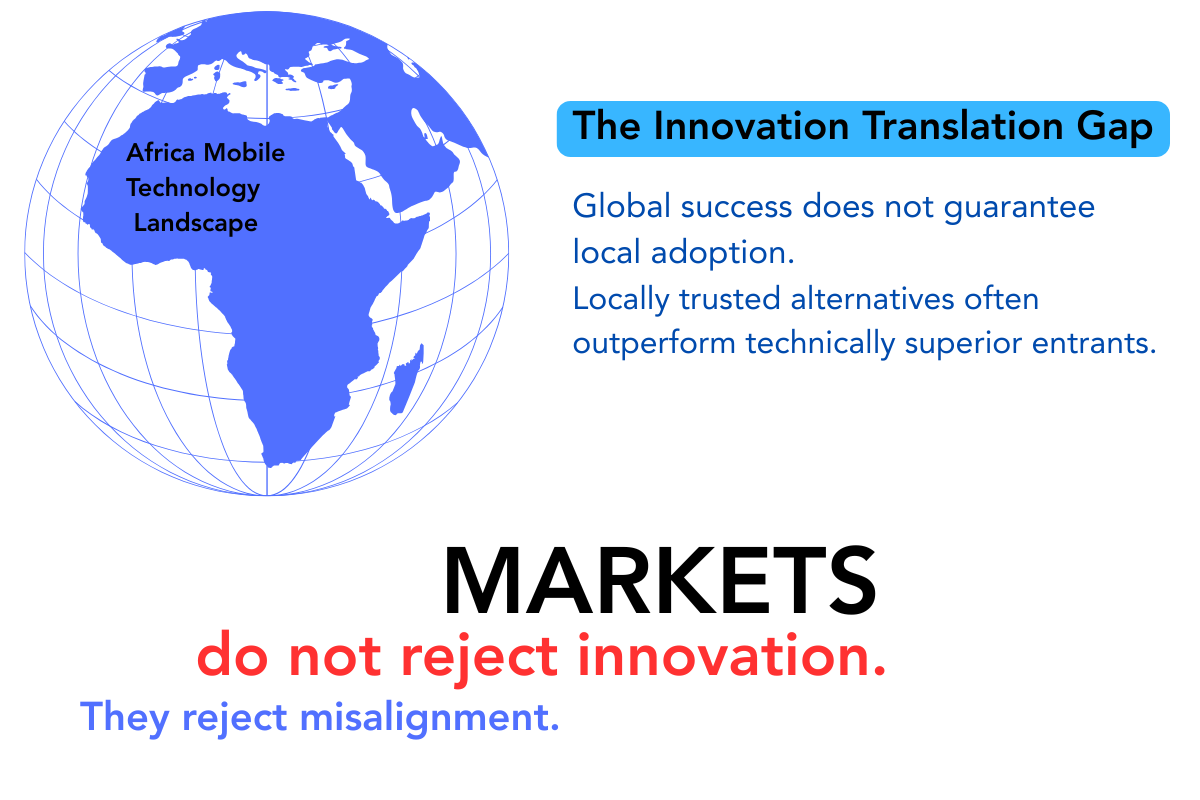
Mobile technology offers one of the clearest illustrations of the Innovation Translation Gap. Across African markets, users have repeatedly encountered devices that impressed on paper but disappointed over time — not because they were defective, but because they failed to translate into dependable, long-term companions.
At the same time, less celebrated alternatives often succeed by aligning with local realities: predictable performance, visible support structures, accessible servicing, and strong community validation.
This divergence reveals a critical insight: markets do not reject innovation. They reject misalignment.
Why This Model Matters
The Innovation Translation Gap helps explain why global success does not guarantee local adoption, and why locally trusted alternatives often outperform technically superior entrants.
For builders, it offers a diagnostic lens for identifying where adoption friction truly lies.
To the analysts, it provides a framework for interpreting market behaviour beyond surface metrics.
For users, it names a long-felt but rarely articulated frustration.
Most importantly, it shifts the conversation from what technology can do to how technology actually lives in people’s hands.
Intelligence Verdict: Market Translation Determines Technology Success
This model does not challenge the value of innovation or the importance of global technology platforms. Instead, it highlights a critical reality: innovation reaches its full potential only when it aligns with local market conditions, user expectations, and infrastructure realities.
Across African markets, the Innovation Translation Gap will continue to appear in different forms. From smartphone ecosystems and mobile financial services to artificial intelligence tools and digital infrastructure, technologies succeed not solely because they are advanced, but because they are understood, trusted, and practically usable within local contexts.
Closing this gap requires more than technological capability. It requires strategic adaptation, localized execution, and sustained alignment with real-world market conditions.
This framework provides a strategic lens for evaluating technology adoption across Africa. Future Intelligence analyses will apply this model to mobile ecosystems, digital platforms, and emerging infrastructure to identify where global innovation translates effectively into local success — and where structural gaps continue to limit adoption.
————————–
Read the Tech Mobile Numbers and Data signals 2025 article and Mobile Ecosystems Battle 2026 as we get deep into strategy and understanding dynamics in play on the Kenyan and African scene. Sign-up to our Newsletter for timely updates on high value tech information affecting Kenya and Africa.