

A New Engineering Moment, and a New Question for Africa
We are a fortunate generation to witness yet another engineering era unfold in the 21st century – marked by the arrival of the Samsung Galaxy Z Trifold. In Kenya, conversations have already begun around what the Samsung Galaxy Z Trifold Kenya could represent, even before it becomes an everyday reality. But the deeper question remains: is this technology simply impressive – or truly ahead of its time?
For over a decade, the smartphone has evolved in visible but predictable ways – faster processors, sharper cameras, brighter displays. Yet beneath all that progress, one truth has quietly remained unchanged: how we use our devices has not fundamentally shifted. We still move between phones, tablets, and laptops to work, create, trade, edit, and communicate.

But Africa’s digital economy is forcing a new question.
In Kenya today, full businesses are run from phones. Traders monitor markets in real time from handheld devices. Creators shoot, edit, and publish entirely on mobile. Work is no longer desk-bound or device-segmented.
This is the deeper context into which the Samsung Galaxy Z Trifold arrives. Not as a luxury curiosity. Not as a gimmick. But as a signal – quiet yet profound – of where mobile computing itself is heading.
Yet the first reality check is telling: the Galaxy Z Trifold is expected to debut in China, Europe, and the United States – with Africa notably absent from the early rollout. And that single detail reframes the entire conversation.
What Exactly Is a Triple-Fold Smartphone?
To understand the significance of a trifold phone, it helps to think in physical logic rather than marketing language.
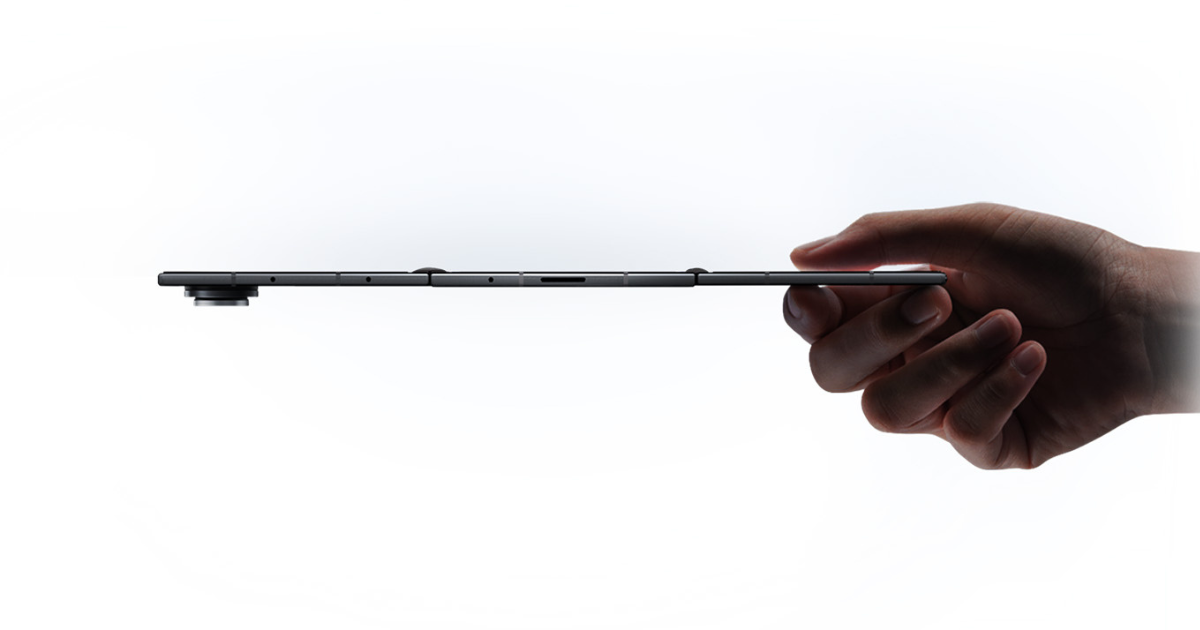
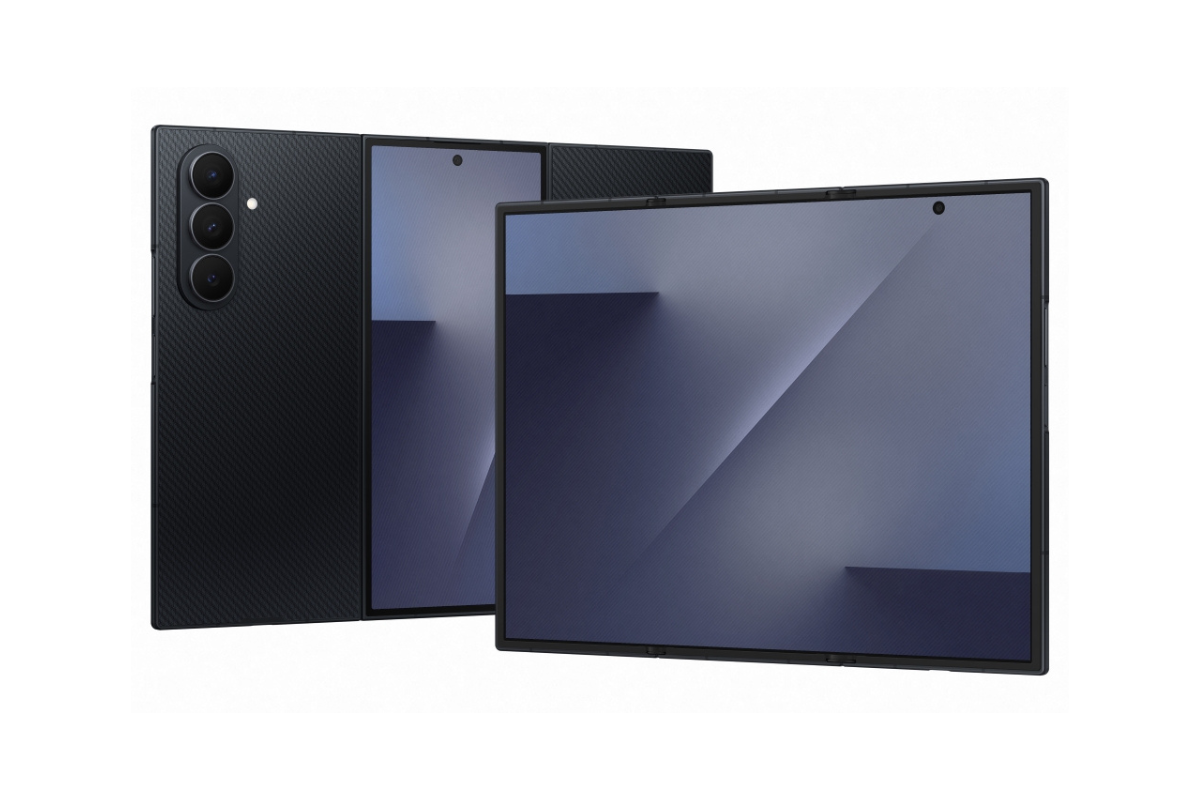
A conventional smartphone is one rigid slab of glass. A foldable phone bends once, transforming from phone to tablet. A trifold takes that concept further, introducing two hinges and three display segments. This allows one device to operate in three physical states: compact phone mode, expanded tablet mode, and an extended workstation-like display.
In a real-life use case, this enables a form of mobile computing that no current smartphone fully achieves. Communication in pocket mode. Browsing and document editing in tablet mode. Full multi-window workflows – dashboards, timelines, financial tools, creative canvases – when fully extended.
This is not about having a bigger screen for entertainment. It is about collapsing multiple work devices into a single adaptive surface. That structural change – more than any processor or camera sensor – is what makes the trifold category fundamentally different.
Why This Isn’t “Just Another Phone.”
Smartphone innovation has reached a mature phase. Annual upgrades still matter, but most no longer redefine how the device fits into daily life. The slab phone has become a stable, perfected form.
Triple-fold design challenges the stability.
It reframes the smartphone as a flexible computing platform rather than a fixed screen. It questions the assumption that serious work must live on laptops and tablets. It proposes a future in which the phone becomes the primary digital workstation, not a secondary tool.
For Africa, this shift carries special weight. The continent did not transition into mobile computing as an alternative – it adopted it as a foundation. For millions, the smartphone is their first and primary computer.
A trifold device, in this context, is not merely a display innovation. It is an attempt – still experimental, still elite – to meet the way Africa already works: continuously mobile, multitasking by default, and compressed into a single always-on device.
The Engineering Behind the Breakthrough
And yet, even with all that hard-earned engineering confidence, the trifold’s true test does not begin in a laboratory — it begins in the real-world conditions of the markets it hopes to serve.
From the First Fold to the Trifold: Why This Moment Is Earned
When the first modern foldable smartphone entered the global spotlight in 2019 through the Samsung Galaxy Fold series, it was met with a mixture of awe, doubt, and public scrutiny. Early durability failures made headlines. Critics questioned whether folding phones were a meaningful technological direction or an expensive dead end.
What followed was not retreat – but repetition.
Across subsequent Fold generations, hinge mechanisms were re-engineered, ultra-thin glass formulations were strengthened, water resistance was introduced, and software was reimagined to behave intelligently across changing screen states. With each cycle, failure points became data, and data became refinement. Public criticism became part of the engineering process.
This quiet, disciplined iteration is what gives the trifold concept its credibility today. The leap from one fold to two is not driven by spectacle. It is driven by Samsung’s accumulated mechanical learning, material science progress, and software maturity.
In that sense, the trifold is not an act of bravado. It is the logical continuation of a long, high-risk engineering journey that began well before the market was certain it wanted foldable screens at all.
When Frontier Engineering Meets African Reality
To fold glass once is already difficult. To fold it twice – thousands of times, reliably, without structural collapse – is a different class of engineering problem altogether.
A trifold design must synchronize multiple hinge systems, layered ultra-flexible display substrates, adaptive brightness control, precise touch response, and thermal management inside an ultra-thin enclosure. Each fold introduces stress points. Each stress point becomes a durability equation that must be solved not just in theory, but at a manufacturing scale.
This is where Samsung deserves measured, earned credit. From the first Galaxy Fold, back in 2019 – fragile, controversial, but historically necessary – to today’s far more refined folding systems (Fold6,7), this progression has taken years of mechanical learning and software reinvention.
Samsung did not stumble into the trifold era. It was engineered toward it. The Galaxy Z Trifold represents the visible outcome of long-range mechanical ambition, not a rushed experiment for headlines.
The Africa Reality Check: Innovation Meets Infrastructure
Engineering excellence alone does not guarantee real-world success – particularly in African markets.
Ultra-premium devices enter ecosystems shaped by factors that rarely appear on spec sheets: power stability, data affordability, repair capacity, import duties, insurance culture, resale dynamics, and service turnaround time. These forces determine whether innovation becomes a daily tool – or remains a fragile luxury.
In Kenya, smartphones endure extended daily use, dust, heat, power fluctuations, and constant movement. Foldable devices already stretch existing repair ecosystems. A trifold adds another layer of mechanical and financial complexity when anything goes wrong. Internal displays are expensive and scarce. Certified parts channels remain limited. Repair timelines can stretch into weeks.
Insurance, still optional for most smartphone buyers, becomes structurally non-optional at this tier. Downtime now carries direct opportunity cost: lost deals, delayed payments, and interrupted operations.
Africa may be emotionally ready for the future of mobile computing. But the systems that support that future — service, protection, logistics, and affordability – are still in active transition.
And it is precisely this gap between ambition and infrastructure that begins to explain why Africa often watches frontier technology arrive elsewhere first.
Africa Outside the First Launch: What That Really Means
The absence of Africa from the first Galaxy Z Trifold launch markets is neither accidental nor personal. It is strategic.
First-generation frontier devices always debut where:
- Insurance ecosystems are mature
- Certified repair logistics are dense
- High-margin buyers are concentrated
- Replacement parts pipelines are the fastest
China, Europe, and the U.S. meet those conditions. Most African markets do not at present.
For Kenya, this means the device will arrive first through parallel imports, early adopters, top executives, and tech elites importing privately. Official distribution typically follows only after the first durability and failure data stabilizes.
This also confirms a critical truth: the Galaxy Z Trifold is not yet designed with African conditions as its primary reference environment. That does not mean Africans will not use it. It means Africa is being observed before being entered.
This single fact reshapes how we should think about ownership, risk, and timing.
Pricing Logic Without Guesswork
Rather than chase speculative figures, it is more useful to understand why the Samsung Galaxy Z Trifold price in Kenya is structurally bound to the ultra-premium end.
Early international pricing expectations place it firmly in the ultra-premium bracket, well above mainstream foldables. Currently, the Galaxy Fold7 retail in Kenya at around KES 250,000, depending on specs. The Trifold will definitely featch a higher price, once retail prices are officially released globally.
Flexible OLED displays have low manufacturing yields and high rejection rates. Multi-hinge systems multiply mechanical complexity. R&D spans multiple product cycles. Software must adapt to three physical display states. Add global logistics, currency volatility, import duties, distributor margins, and limited supply, and pricing pressure intensifies.
Kenyan retail pricing traditionally diverges from U.S. and Asian launch pricing due to tax structures and supply-layering.
The fundamental insight is not the final number. It is what that number represents: engineering difficulty, production risk, and the economic cost of being first.
Who This Device Is Truly For, and Who It Is Not
Every ultra-premium device demands an honest identity test.
The Galaxy Z Trifold makes sense for:
- Executives running mobile-first operations
- Financial traders tracking multiple real-time streams
- Elite digital creators managing complete production workflows on mobile
- Entrepreneurs whose phone is their primary office
- Professionals who value screen real estate without carrying multiple devices
For these users, a trifold device can become an efficiency multiplier. It compresses workflows, reduces device switching, and centralizes control.
Users it will frustrate:
- Budget-conscious buyers
- First-time foldable users exploring casually
- Heavy outdoor users with low tolerance for fragility
- Anyone prioritizing low-maintenance ownership over experimental power
This is not a mass-market phone. It is not meant to be accessible. It is intended to redefine the upper boundary of what mobile capability looks like.
Durability, Repairs & the Psychology of Risk
Loss aversion is the most potent force in buyer behavior. We fear losing money more than we enjoy gaining features.
With a first-generation trifold device, that fear is rational.
Internal displays remain the most expensive components to replace on smartphones. Multi-hinge systems multiply potential failure points. Dust intrusion, hinge fatigue, and accidental impact remain real-world risks. In Kenya, foldable repair costs already exceed those of conventional smartphones. A trifold will raise that ceiling.
Insurance stops being a safety net and becomes a baseline requirement—ownership shifts from excitement to calculated exposure.
This does not invalidate the product. It simply reframes it as a strategic commitment rather than an impulse purchase.
Should You Buy Early, Or Wait?
Early adoption has always been a double-edged privilege. You access the future before others, but you also absorb the turbulence of its refinement.
Buying the Trifold early makes sense only if increased screen density directly improves your income, output, or operational speed. For such users, the device can justify itself through productivity.
For most buyers, patience remains the smarter form of power. Historically, foldable technology stabilizes significantly after 6–12 months of real-world feedback. Software maturity improves. Parts availability widens. Pricing calibrates. Market understanding deepens.
The intelligent question, therefore, is not whether the Galaxy Z Trifold is impressive. It clearly is. The real question is whether this exact moment aligns with your risk tolerance and your dependency on uninterrupted uptime.
When the Future Arrives Before the Systems Are Ready
The Samsung Galaxy Z Trifold Africa conversation is not ultimately about one device. It is about what happens when engineering ambition outpaces ecosystem readiness.
This device challenges the inherited hierarchy between phones, tablets, and laptops. It compresses power into new shapes. It invites African professionals to imagine a future in which creation, calculation, coordination, and commerce live within a single adaptive surface.
Yet technology does not transform societies by existing. It transforms them by becoming reliable, serviceable, affordable, and trusted.
At JuaTech Africa, that is the line we will continue to walk: celebrating what engineering makes possible, while interrogating what African systems can truly sustain.
The future will not be shaped by what dazzles us.
It will be shaped by what survives contact with reality.